Everyday Safety & Design Standards

Why Pen Caps Have Holes: Safety Standards, Airflow, and Choking Prevention

That tiny hole is not just a manufacturing quirk. It is mainly a safety feature designed to allow limited airflow if a cap blocks someone's airway.

Quick answer

The small hole at the tip of writing pen caps (most famously BIC Cristal ballpoints) is an international safety feature designed to prevent asphyxiation if the cap is accidentally swallowed. Governed by international standards ISO 11540 and British Standard BS 7272, ventilated pen caps must permit a minimum airflow passage of 6.8 liters per minute under a pressure differential of 1.33 kPa, buying critical time for emergency medical response if a cap becomes lodged in a person's trachea.

A vented cap is an emergency backup safety feature. It does not make chewing or swallowing pen caps safe.
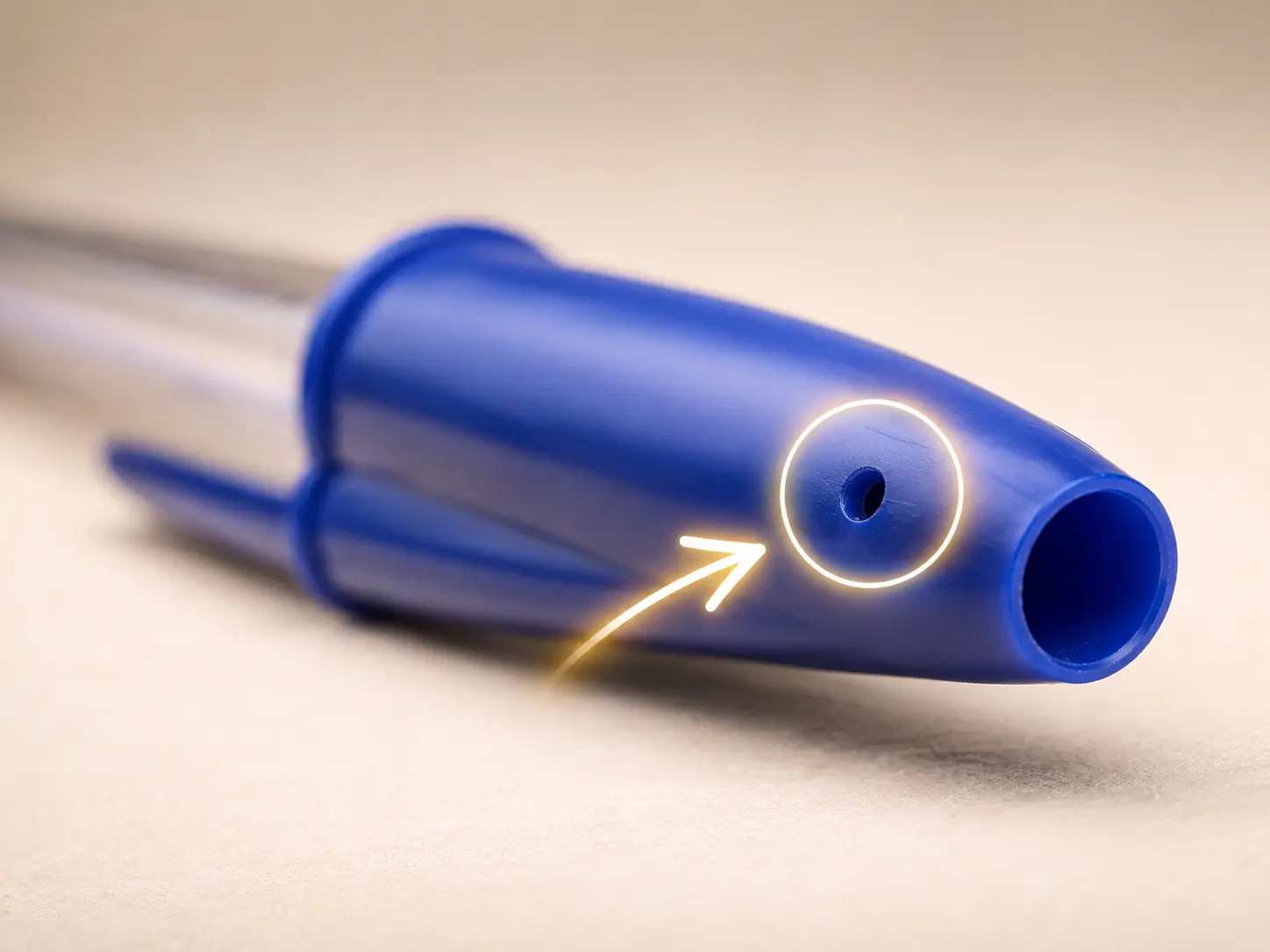
Close-up of a blue ballpoint pen cap highlighting the top airflow ventilation hole

International Standard

ISO 11540 / BS 7272-1

Min Airflow Metric

6.8 Liters / minute @ 1.33 kPa

Primary Risk Addressed

Tracheal Occlusion / Inhalation

BIC Adoption

Introduced early 1990s worldwide

1. The Physics of ISO 11540 and BS 7272 Standards

In the late 1980s and early 1990s, safety organizations in Europe and North America evaluated pediatric choking risks associated with stationery. Because children and adults frequently chew on pen caps while concentrating, unvented caps posed a serious risk of complete tracheal blockages.

To mitigate this, the International Organization for Standardization issued **ISO 11540** ('Caps for writing and marking instruments intended for use by children'). Under ISO 11540, any pen cap for writing instruments used by children up to 14 years old must either:

1. Be large enough that it cannot enter a 16 mm diameter test cylinder, OR

2. Feature a continuous air passage providing a minimum airflow rate of **6.8 liters per minute** measured at a differential pressure of 1.33 kPa.

2. Cap Ventilation vs Pen Barrel Equalization Holes

It is common to confuse the hole at the top of a pen cap with the tiny pinhole on the side of the clear pen body (barrel):

• **Cap Top Hole**: A safety vent designed solely for human airway breathing passage.

• **Pen Barrel Side Hole**: An atmospheric equalization vent. As ink is drawn out of the reservoir tube onto paper, air must enter the plastic barrel to equalize internal pressure. Without this side pinhole, a vacuum would form inside the barrel, causing the ink to stop flowing.

3. The BIC Cristal Case Study

The BIC Cristal ballpoint pen is the best-selling pen in human history, with over 100 billion units sold since 1950. In 1991, BIC updated the cap design across all standard Cristal models to add the distinctive hole at the tip.

While some users mistakenly believed the hole was introduced to prevent ink drying, ballpoint ink relies on oil-based solvents that do not evaporate under normal atmospheric exposure inside the cap.

Safety note

Important Medical Disclaimer

An ISO-compliant ventilated pen cap reduces the risk of total instantaneous suffocation, but an inhaled cap is still a life-threatening medical emergency requiring immediate first aid (Heimlich maneuver / back blows) and emergency medical services.

Quick answers

Common questions

Why do fountain pens not always have vented caps?

Fountain pens use water-based inks that dry out rapidly if exposed to continuous airflow. Fountain pen caps use alternative safety compliance paths, such as oversized cap diameters or clip attachments that fail the small-parts test cylinder.

What is ISO 11540?

ISO 11540 is the international safety standard specifying cap size and ventilation requirements for writing and marking instruments to reduce asphyxiation hazards.

Everyday Safety & Design Standards

Important Medical Disclaimer

An ISO-compliant ventilated pen cap reduces the risk of total instantaneous suffocation, but an inhaled cap is still a life-threatening medical emergency requiring immediate first aid (Heimlich maneuver / back blows) and emergency medical services.