Everyday Science

Why Do Mirrors Reverse Left and Right?

A question so deceptively simple that it has occupied philosophers for centuries. Look in a mirror and your left hand appears on the right side of your reflection. If you raise your right hand, the reflection raises its left. The mirror seems to reverse left and right - but bizarrely, it does not reverse up and down. Why does a flat mirror flip one axis and not the other? The answer requires thinking carefully about what a mirror actually does, which turns out to be rather different from what it seems to do. The answer involves depth, not left-right orientation, and a specific confusion between how mirrors work physically versus how we interpret what we see.

Quick answer

Mirrors do not actually reverse left and right at all - they reverse front and back, reflecting the depth axis. The left-right reversal is a perceptual interpretation that humans make when mentally rotating the image to compare it to themselves, not something the mirror physically does. A mirror treats all three axes identically - it never reverses left-right more than it reverses up-down. Both appear unchanged because of how humans interpret the image.
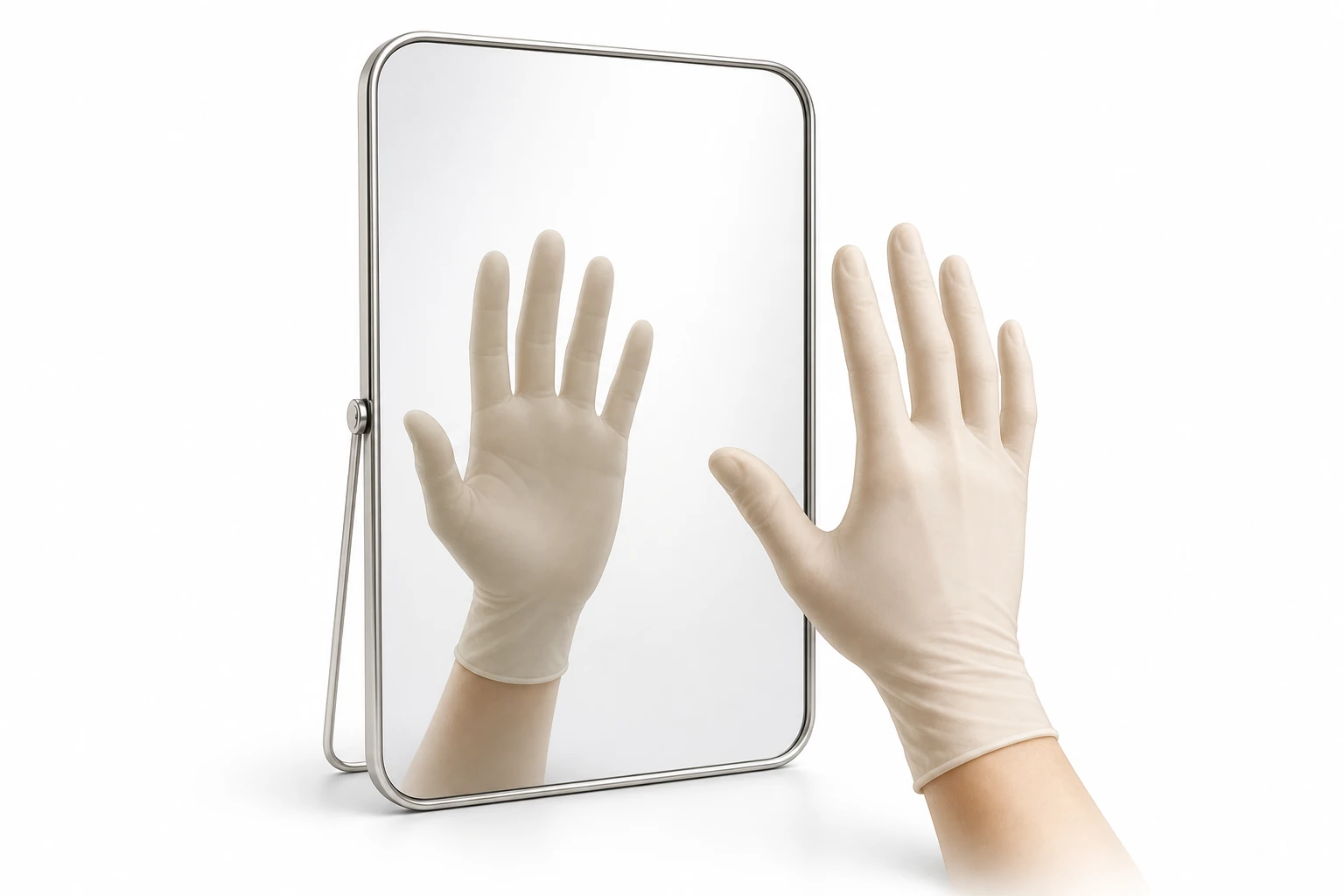
Why Do Mirrors Reverse Left and Right? hero image

The mystery

The answer involves depth, not left-right orientation, and a specific confusion between how mirrors work physically versus how we interpret what we see.

The short answer

Mirrors do not actually reverse left and right at all - they reverse front and back, reflecting the depth axis. The left-right reversal is a perceptual interpretation that humans make when mentally rotating the image to compare it to themselves, not something the mirror physically does.

The twist

A mirror treats all three axes identically - it never reverses left-right more than it reverses up-down. Both appear unchanged because of how humans interpret the image.

Common mistake

The universal experience of mirror reversal makes it feel like a physical fact about mirrors.

Mirrors reverse depth, not sides

The mirror's apparent left-right reversal is a product of how the human mind interprets reflection, not what the mirror physically does.

A mirror reflects depth, not orientation

A flat mirror reflects each point of an object directly back along the depth axis perpendicular to its surface. Your nose, the closest point to the mirror, appears closest in the reflection; your ears appear at the sides; and this is all geometrically accurate.

The mirror has not rearranged any left-right information; it has simply reversed the front-back direction.

A mirror does one thing: it pushes depth inward. Everything else we see in it is our own interpretation.

Humans interpret the reflection by mentally rotating it

When looking at a reflection of ourselves, we instinctively compare it to how another person would appear if they turned to face us, which involves imagining a rotation around the vertical axis.

That mental rotation is what produces the left-right swap - not the mirror. The mirror itself treats left-right and up-down completely identically.

The left-right confusion in mirrors is something the human brain generates all by itself, in the process of trying to be helpful.

Up-down is not reversed because we do not rotate around the horizontal axis

If we imagined a person lying down and then standing up to face us, we would see a vertical reversal instead. We see left-right reversal only because we habitually imagine a lateral rotation to orient the reflection.

A mirror that is rotated 90 degrees to lie flat on the floor would appear to reverse up and down instead of left and right.

The mirror flips whatever axis you choose to interpret as the axis of rotation - it has no preference of its own.

What mirrors actually do

A short sequence separates what the mirror does physically from what the brain adds perceptually.

1

01. Mirror reverses the depth axis only

Each point is reflected straight back perpendicular to the mirror surface.

2

02. The image is geometrically accurate for all other axes

Left, right, up, and down are preserved exactly.

3

03. The viewer mentally rotates the image to face them

Imagining the reflection as a person who has turned around introduces a virtual lateral rotation.

4

04. This mental rotation produces an apparent left-right reversal

The swap is generated by the interpretation, not the mirror.

Why this question occupied philosophers for centuries

The mirror reversal paradox has been discussed since at least ancient Greece, and the confusion is genuine - the question contains a hidden assumption about which axis is being reversed that turns out to be wrong.

Philosophers from Plato to Ernst Mach have written about it, and the fully satisfying explanation requires distinguishing carefully between physical reflection and perceptual interpretation.

Surprising mirror reflection facts

Text in a mirror is reversed because text has a designated reading direction
When you hold up writing to a mirror, the left-right reversal occurs because you physically rotated the paper around the vertical axis to show it, not because the mirror reversed it.
Two mirrors at 90 degrees produce a non-reversed image
A corner of two perpendicular mirrors reverses the depth axis twice, showing you what you look like to others rather than the familiar mirror-image.

Doesn't the mirror literally flip left and right?

Myth

The universal experience of mirror reversal makes it feel like a physical fact about mirrors.

The experience is completely consistent and feels external, making it natural to attribute it to the mirror rather than to one's own interpretation.

Reality

Mirrors reverse depth only; the left-right reversal is a perceptual construction added by the viewer.

Mirrors reverse depth only; the left-right reversal is a perceptual construction added by the viewer.

Where mirror reflection creates practical effects

Ambulance lettering
AMBULANCE is written mirror-reversed on ambulance fronts so it reads correctly when seen in a rearview mirror.
Dental mirrors
Dentists work with reversed mirror images of teeth and are trained to perform fine motor tasks using mirror-image feedback.

Why this matters beyond the bathroom

Distinguishing between what a physical process does and how the human mind interprets it is one of the most broadly applicable lessons in perception science.

The mirror paradox teaches that not all apparent physical effects are actually physical - some are imposed by the observer's perceptual framework.

Worth noting

The mirror did nothing - you did it

Mirrors reverse depth and leave everything else alone. The left-right switch is a story the human brain tells about what it is seeing, and it tells it every single time without ever questioning it. For centuries, philosophers blamed the mirror. The mirror was innocent the entire time.

Quick answers

Common questions

Is there any mirror that shows you what you actually look like to others?

Yes - two perpendicular mirrors at a corner, or a third-surface mirror, can show a non-reversed image.

Everyday Science

Related questions

Because turning a page to face the mirror rotates it around the vertical axis, which the mirror then reflects straight back.

The physicist who finally solved the mirror paradox

Ernst Mach

The 19th-century Austrian physicist whose analysis of sensory perception provided one of the clearest early explanations of why the mirror reversal is perceptual rather than physical.

Where mirror reflection creates practical effects

Ambulance lettering

AMBULANCE is written mirror-reversed on ambulance fronts so it reads correctly when seen in a rearview mirror.

Where mirror reflection creates practical effects

Dental mirrors

Dentists work with reversed mirror images of teeth and are trained to perform fine motor tasks using mirror-image feedback.

Doesn't the mirror literally flip left and right?

Mirrors reverse depth only; the left-right reversal is a perceptual construction added by the viewer.

Mirrors reverse depth only; the left-right reversal is a perceptual construction added by the viewer.