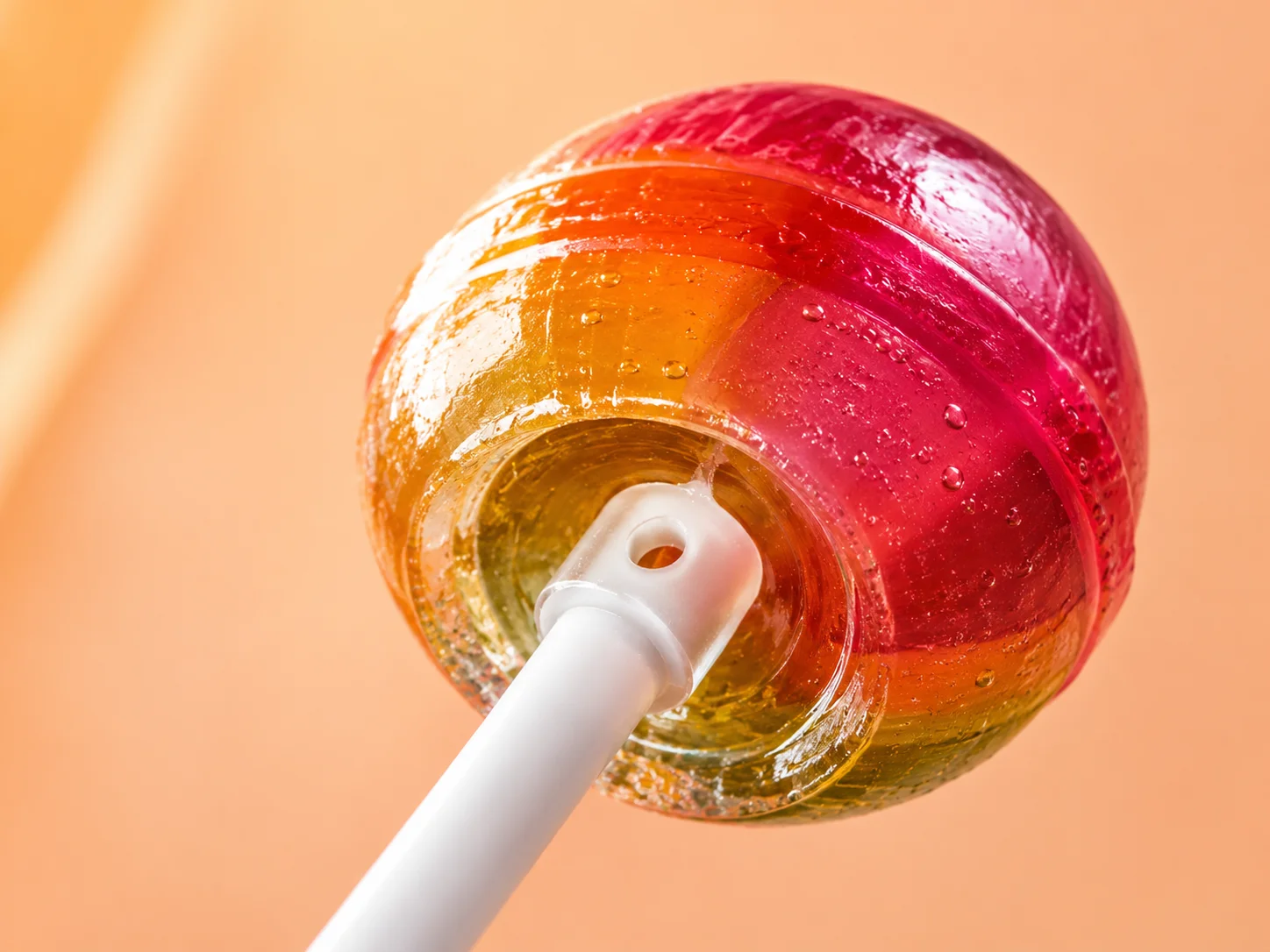
That hole in your candy stick

Why Do Lollipop Sticks Have Holes?

That hole in a lollipop stick is not there for a whistle. It lets hot candy harden through the stick so the candy head stays anchored.

Quick answer

Three reasons. First — and most important — the candy anchor. When lollipops are made, hot liquid candy is poured around the stick. It flows through the hole and hardens inside it, locking the candy head to the stick so it can't slide off. Second, safety: if a child swallows the stick, the hollow center lets air pass through, reducing choking risk. Third, manufacturing — a thin rod is inserted through the holes of many sticks at once to hold them in alignment while the candy sets.

Close-up of a lollipop stick near the candy end, showing the hole that anchors the candy

Primary job

Anchor the candy head

Safety function

Airway if swallowed

Manufacturing use

Alignment rod during production

A whistle?

Not the real reason

The candy doesn't stick to the stick — it locks through it

Hot candy mixture doesn't bond strongly to a smooth plastic surface. If the stick were solid, the hardened candy head would just slide off — especially after you've been sucking on it for a while.

The hole solves this mechanically. When the liquid candy is poured, it flows through the hole and fills it. As it cools and hardens, the candy inside the hole creates a rivet-like anchor. The candy head is physically interlocked with the stick, not just resting against it.

Without this, lollipops would fall apart constantly. The hole is the primary reason lollipops work as a product.

Myth vs Reality

Myth

The hole is there so kids can use the stick as a whistle.

This shows up on social media regularly. The hollow stick can technically make a sound, so people assume that was the intent.

Reality

That's a coincidence, not a design goal.

The hollow center exists to create an airway safety feature and to enable the candy-anchoring manufacturing process. The whistle thing is an accidental side effect. No candy manufacturer designed a lollipop stick as a musical instrument.
What each function of the lollipop hole does

Candy anchor
Liquid candy flows through the hole and hardens inside, creating a mechanical lock between the candy and stick. This is why lollipops don't fall apart.
Safety airway
If the stick is accidentally swallowed whole, the hollow channel allows air to pass through, reducing the risk of complete airway blockage.
Manufacturing alignment
A thin rod is threaded through the holes in a row of sticks during production to hold them perfectly in place while candy is applied and sets.

Quick answers

Common questions

Why do lollipop sticks have holes?

Primarily to anchor the candy. Hot liquid candy flows through the hole and hardens inside it, creating a mechanical lock so the candy can't slide off the stick.

Is the hole in a lollipop stick a safety feature?

Yes — secondarily. The hollow stick allows air to pass through if accidentally swallowed, reducing choking risk. It's an important safety backup.

Can you use a lollipop stick as a whistle?

You can produce a sound, but that's an accidental side effect of the hollow design. It wasn't designed as a whistle — the hollow center exists for candy anchoring and safety.

Why doesn't the candy just bond to the plastic?

Hot candy doesn't form a strong chemical bond with smooth plastic. The hole creates a mechanical lock — the candy hardens inside and around the hole, interlocking with the stick physically.

Do all lollipop sticks have holes?

Plastic hollow sticks mostly do. Paper and wooden sticks often use a different design where the candy is molded around a grooved or notched stick end to create the anchor.

Is the hole at the top or bottom of the stick?

Near the top — the end that goes into the candy. That's where the anchor function and manufacturing alignment both need it.