1
01. Friction transfers electrons from hair to balloon
The balloon becomes negatively charged.
Everyday Science
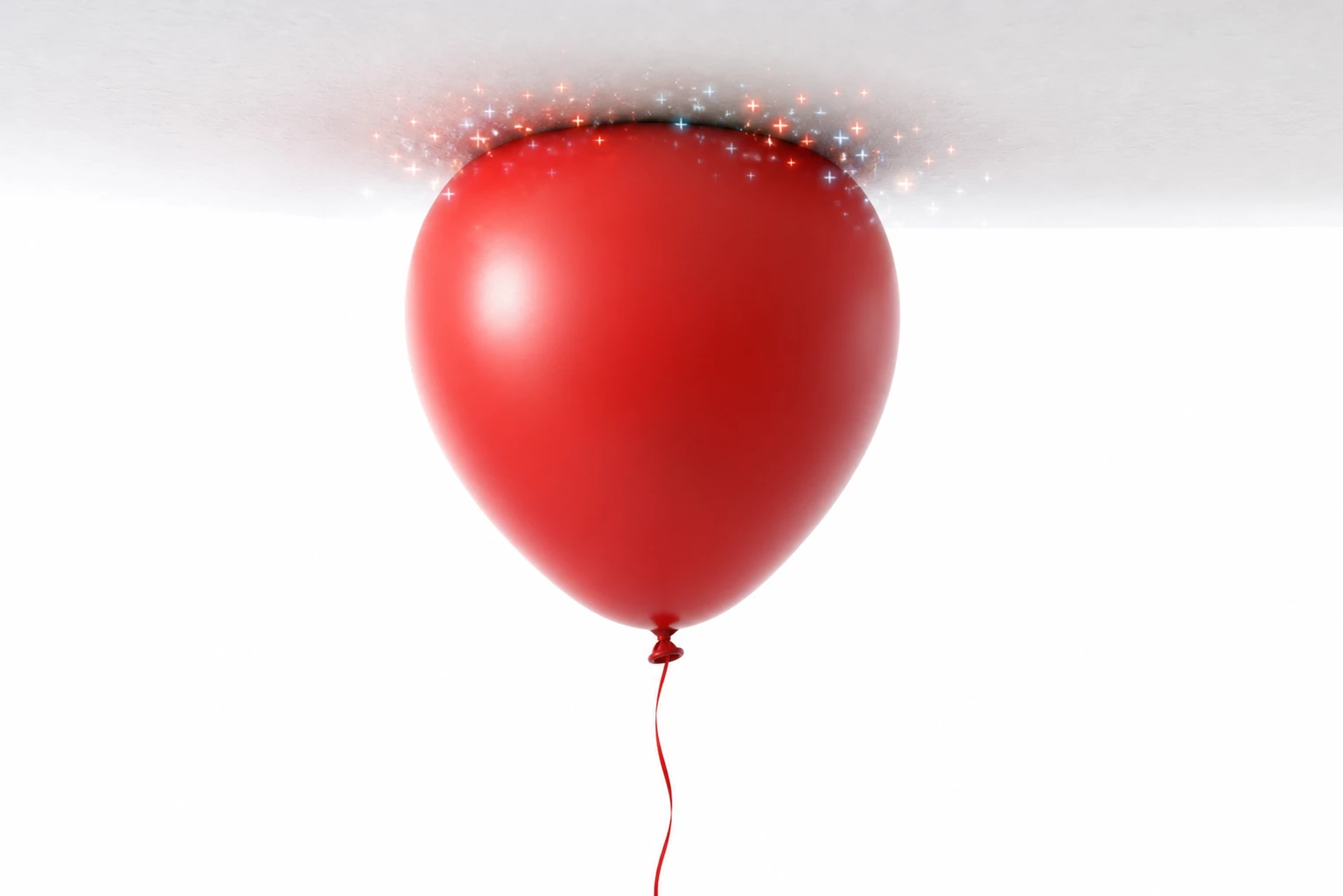
A party trick that works because you just gave the balloon 10 billion extra electrons. Rub a balloon on your hair, hold it near the ceiling, let go, and it stays. Every child finds this delightful. Most adults forget to wonder why. The answer involves a charge imbalance, invisible electrical fields, and the fact that a simple balloon can demonstrate the same force that makes lightning. The answer involves static electricity, electron transfer through friction, and the moment a balloon becomes electrically interesting enough to defy gravity.
Quick answer
Rubbing a balloon on hair transfers electrons from the hair to the balloon, giving it a net negative charge. This charge induces a slight positive charge on the ceiling surface nearest the balloon, and the resulting attraction between opposite charges is strong enough to overcome gravity and hold the balloon in place. The ceiling does not become permanently charged - it only appears to have a positive charge because the balloon's negative charge pushes nearby electrons in the ceiling material slightly away, leaving the surface facing the balloon momentarily more positive.
The mystery
The answer involves static electricity, electron transfer through friction, and the moment a balloon becomes electrically interesting enough to defy gravity.
The short answer
Rubbing a balloon on hair transfers electrons from the hair to the balloon, giving it a net negative charge. This charge induces a slight positive charge on the ceiling surface nearest the balloon, and the resulting attraction between opposite charges is strong enough to overcome gravity and hold the balloon in place.
The twist
The ceiling does not become permanently charged - it only appears to have a positive charge because the balloon's negative charge pushes nearby electrons in the ceiling material slightly away, leaving the surface facing the balloon momentarily more positive.
Common mistake
Some assume balloons need to be helium-filled to stick to ceilings.
Everyday Science
The same electron transfer friction causes your hair and sweater to carry opposite charges, producing repulsion and attraction.
The scientist who named static electricity
The 16th-century English physician who first systematically studied static electricity and coined the word 'electric.'
Where electrostatic attraction matters
These use precisely controlled static charge to attract toner particles onto paper in the pattern of the image.
Where electrostatic attraction matters
Electrostatic air filters charge particles so they are attracted to and captured on oppositely charged filter surfaces.
Is it the helium that keeps a charged balloon on the ceiling?
Air-filled balloons stick just as readily, since the static charge, not buoyancy, provides the adhesion.
Continue learning
Everyday Science
Another familiar question explained by simple physics.
Everyday Science
Another familiar question explained by simple physics.
Everyday Science
Another familiar question explained by simple physics.