1
01. Warm water fuels new rain clouds
Warm ocean water evaporates more readily, feeding towering rain clouds that used to form over Indonesia but now form much farther east, over the middle of the Pacific.
Nature Mysteries
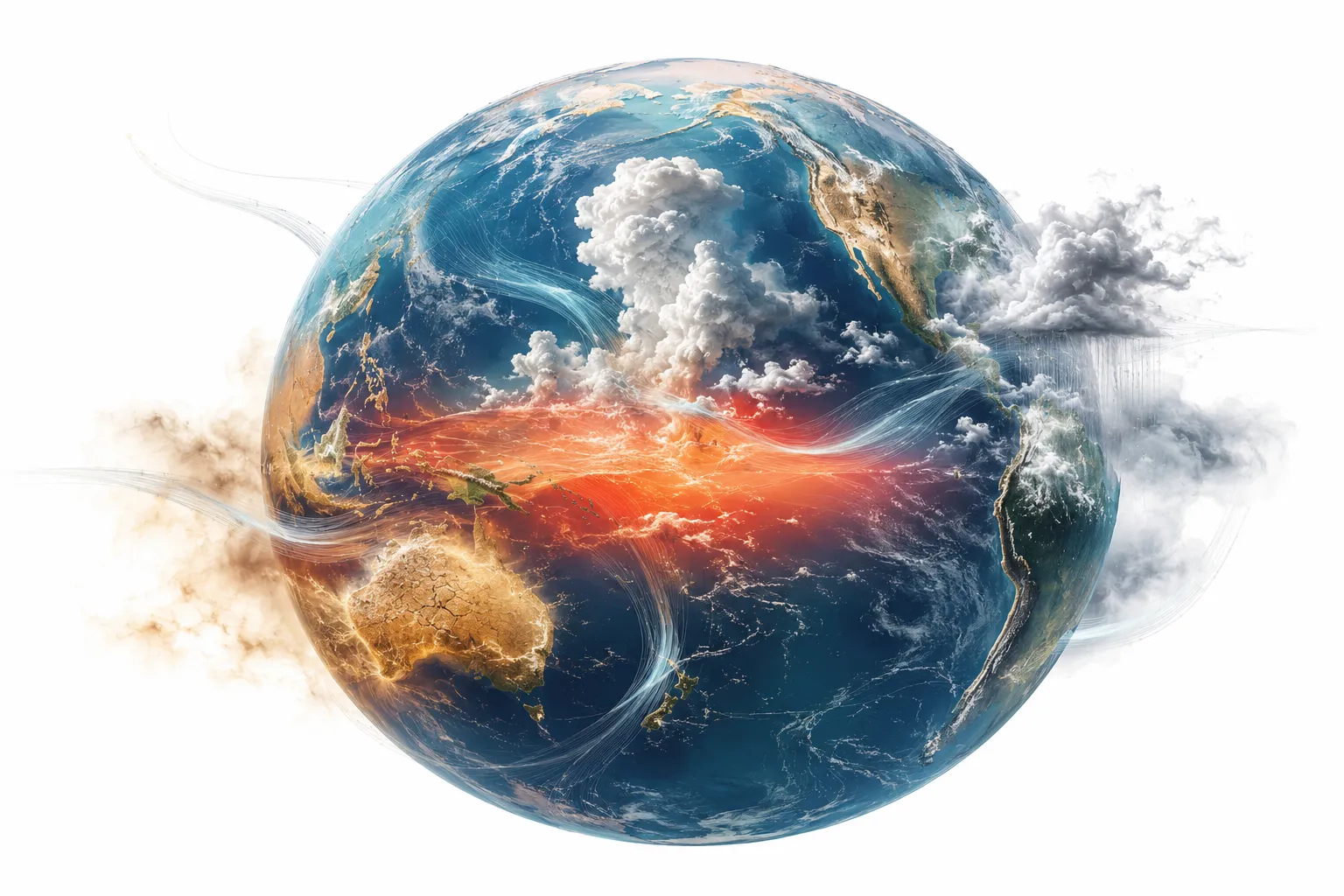
A patch of warm water in the Pacific that somehow decides whether your winter will be a disaster. Somewhere off the coast of Peru, a stretch of ocean occasionally decides to run a fever. Nobody declares this officially. There is no ceremony. The water simply gets warmer than usual, and within months, farmers in Australia are watching their crops fail, fishermen in California are hauling in strange tropical fish, and meteorologists everywhere are saying the same two words with a mixture of dread and relief. El Niño. The boy. Named, four hundred years ago, by fishermen who noticed the warm water tended to show up around Christmas. The story involves Peruvian fishermen, a lazy wind, and an ocean current that quietly rearranges the entire planet's weather.
Quick answer
El Niño is a periodic warming of surface waters in the central and eastern Pacific Ocean, part of a natural cycle that shifts rainfall and temperature patterns across the globe. It isn't a storm or a single event. It's closer to the ocean and atmosphere getting into an argument that takes months to resolve, and the rest of us just live with the consequences.
The mystery
The story involves Peruvian fishermen, a lazy wind, and an ocean current that quietly rearranges the entire planet's weather.
The short answer
El Niño is a periodic warming of surface waters in the central and eastern Pacific Ocean, part of a natural cycle that shifts rainfall and temperature patterns across the globe.
The twist
It isn't a storm or a single event. It's closer to the ocean and atmosphere getting into an argument that takes months to resolve, and the rest of us just live with the consequences.
Common mistake
Every unusual storm, drought, or heat wave gets blamed on El Niño in casual conversation.
Nature Mysteries
La Niña is the cool-phase counterpart to El Niño, marked by below-average sea surface temperatures in the central Pacific and roughly opposite global weather effects.
The scientist who connected the dots
A British mathematician working in colonial India in the early 1900s, tasked with predicting monsoon failures, who discovered the broader atmospheric seesaw now called the Southern Oscillation.
Where El Niño's fingerprints show up
Shifted rainfall patterns during El Niño years often leave these regions significantly drier than usual, straining agriculture and water supplies.
Where El Niño's fingerprints show up
A stronger, more southerly jet stream during El Niño years frequently brings increased rain and storms to states like California and Texas.
Does El Niño cause all extreme weather?
El Niño shifts the odds of certain weather patterns in certain regions; it doesn't single-handedly cause every extreme event, many of which have separate or compounding causes.
Continue learning