Geography

Why Is the Sahara Desert So Dry?

It wasn't always like this — six thousand years ago, it was green, and Earth's own wobble is why that changed. It's easy to assume deserts have always been deserts, dry by some permanent decree of geography. The Sahara makes a strong case against that assumption: as recently as six thousand years ago, it was covered in lakes, grasslands, and rivers deep enough for hippos. Something changed, and that something was less about rainfall running out and more about the planet itself quietly tilting. The story spans a sinking band of dry air, a slow wobble in Earth's orbit, and a green Sahara that vanished within a few thousand years.

Quick answer

The Sahara is dry mainly because it sits under a band of high pressure where dry air sinks and suppresses rainfall, a pattern reinforced by shifts in Earth's orbit that ended a wetter era roughly 5,000 years ago. The transition from lush grassland to desert happened surprisingly fast in geological terms — likely within a few centuries, not gradually over millennia.
Why Is the Sahara Desert So Dry? hero image

The mystery

The story spans a sinking band of dry air, a slow wobble in Earth's orbit, and a green Sahara that vanished within a few thousand years.

The short answer

The Sahara is dry mainly because it sits under a band of high pressure where dry air sinks and suppresses rainfall, a pattern reinforced by shifts in Earth's orbit that ended a wetter era roughly 5,000 years ago.

The twist

The transition from lush grassland to desert happened surprisingly fast in geological terms — likely within a few centuries, not gradually over millennia.

Common mistake

Popular imagery often portrays the entire Sahara as an endless sea of sand dunes.

A desert built by sinking air, and undone by an ancient tilt

Two separate forces explain the Sahara: one is a permanent feature of global air circulation, and the other is a slow astronomical cycle that occasionally overrides it.

The permanent dry zone

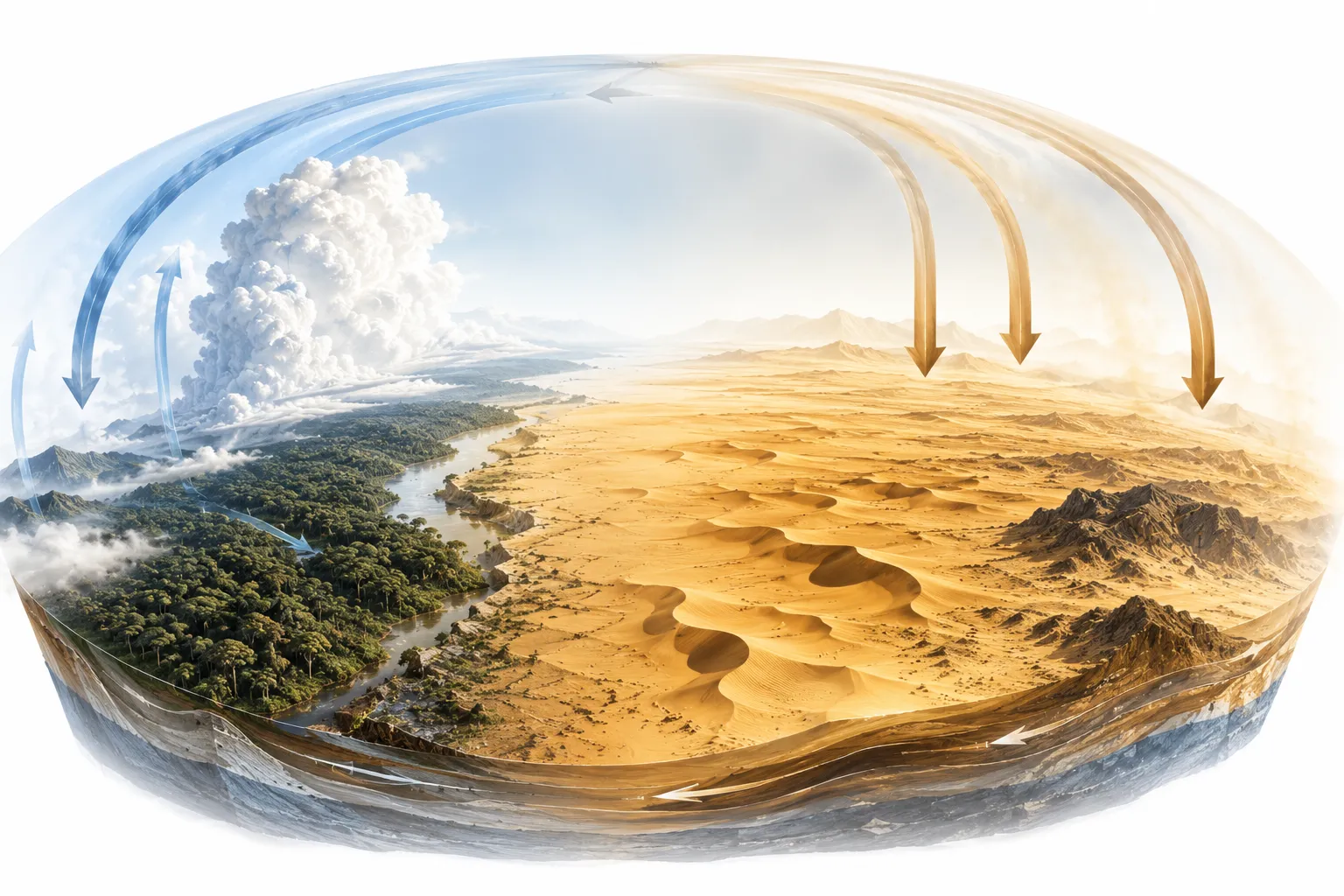
Around 30 degrees latitude north and south of the equator, global air circulation patterns called Hadley cells cause warm, moist air that rose near the equator to descend again, having already lost its moisture as rain along the way.

This descending air is dry and warm, suppressing cloud formation and rainfall — which is why a band of major deserts, including the Sahara, sits at almost exactly this latitude worldwide.

The Sahara isn't dry by accident. It sits exactly where global air circulation dumps its driest, most exhausted air.

The Sahara wasn't always like this

Roughly 11,000 to 5,000 years ago, during a period scientists call the African Humid Period, the region now occupied by the Sahara supported lakes, rivers, grasslands, and abundant wildlife, evidenced by ancient rock art depicting giraffes and swimming figures.

This greening happened because Earth's axial tilt was different at the time, strengthening the West African monsoon enough to push moisture deep into what is now desert.

There's rock art in the middle of the Sahara depicting people swimming — proof the desert wasn't always winning.

Why it dried out again

Earth's axial tilt and orbital wobble shift slowly over thousands of years in a cycle called precession, gradually changing how strongly the sun heats different latitudes across the seasons.

As the tilt shifted back around 5,000 years ago, the monsoon weakened, vegetation declined, and a feedback loop took hold: less plant cover meant less local moisture, which meant even less vegetation, accelerating the shift toward the desert we see today.

Earth's tilt wobbled just slightly, and an entire green landscape quietly gave up and turned to sand.

How the Sahara's dryness is maintained today

The current dry state isn't just leftover history — active atmospheric processes keep it that way.

1

01. Descending air suppresses cloud formation

Sinking air in the Hadley cell warms as it descends, which lowers relative humidity and actively discourages the cloud formation needed for rain.

2

02. Sparse vegetation reduces local moisture recycling

With little plant cover to release moisture back into the air through transpiration, the region has less opportunity to generate its own local rainfall.

3

03. Reflective sand reinforces the dry pattern

Pale desert sand reflects more sunlight than vegetation would, altering local heating patterns in ways that further discourage the rainfall that might otherwise soften the desert's edges.

The feedback loop that locked the desert in place

Once vegetation loss began during the drying period, it triggered a self-reinforcing cycle: less plant cover meant less moisture recycled into the local atmosphere, which meant even less rain to support remaining plants.

Researchers believe this feedback loop is part of why the transition from green to desert happened in what geologists consider a strikingly short window, rather than a slow, even decline.

Surprising Sahara facts

The Sahara is the source of nutrients for the Amazon
Massive dust storms carry mineral-rich Saharan sand across the Atlantic, depositing nutrients that help fertilize soil in the Amazon rainforest thousands of miles away.
It contains areas that haven't seen rain in years
Some extremely arid pockets within the Sahara can go multiple consecutive years without any recorded rainfall at all.

Is the Sahara mostly sand dunes?

Myth

Popular imagery often portrays the entire Sahara as an endless sea of sand dunes.

Dramatic dune imagery dominates films and photography of the Sahara, since it's the most visually striking terrain, even though it isn't the most common.

Reality

Sand dunes, called ergs, actually cover only about a quarter of the Sahara's total area — much of the rest is rocky plateaus, gravel plains, and mountains.

Sand dunes, called ergs, actually cover only about a quarter of the Sahara's total area — much of the rest is rocky plateaus, gravel plains, and mountains.

Where the Sahara's dryness shapes life around it

The Sahel region to the south
This transitional zone between the Sahara and wetter African savannas experiences frequent droughts influenced by the same shifting rainfall patterns that shaped the desert itself.
Ancient trade routes across the desert
Historic trans-Saharan trade routes developed specifically around scarce oases and known water sources, shaped entirely by the desert's extreme aridity.

Why understanding the Sahara's history matters today

Studying how the Sahara flipped from green to arid helps climate scientists understand how sensitive large-scale ecosystems can be to relatively subtle shifts in Earth's orbital patterns and monsoon strength.

This research informs current models of how modern climate change might trigger similarly abrupt ecological transitions in vulnerable regions today.

Worth noting

A desert with a green memory

The Sahara's dryness isn't a fixed, ancient fact of geography — it's the current chapter of a story that has swung between lush and arid before, driven by the quiet astronomical rhythms of Earth's tilt. Somewhere under all that sand, the Sahara remembers what it felt like to be green.

Quick answers

Common questions

How large is the Sahara Desert?

The Sahara spans roughly 3.6 million square miles, making it the largest hot desert in the world, comparable in size to the entire United States.

Geography

Related questions

Some climate models suggest orbital cycles could eventually shift monsoon patterns again over thousands of years, though this is a far longer timescale than modern climate change concerns.

The researchers who uncovered the green Sahara

Rock art discoveries at Tassili n'Ajjer

A mountain range in the Algerian Sahara containing thousands of ancient rock paintings depicting swimming figures, hippos, and grazing animals, offering direct evidence of the region's once-lush past.

Where the Sahara's dryness shapes life around it

The Sahel region to the south

This transitional zone between the Sahara and wetter African savannas experiences frequent droughts influenced by the same shifting rainfall patterns that shaped the desert itself.

Where the Sahara's dryness shapes life around it

Ancient trade routes across the desert

Historic trans-Saharan trade routes developed specifically around scarce oases and known water sources, shaped entirely by the desert's extreme aridity.

Is the Sahara mostly sand dunes?

Sand dunes, called ergs, actually cover only about a quarter of the Sahara's total area — much of the rest is rocky plateaus, gravel plains, and mountains.

Sand dunes, called ergs, actually cover only about a quarter of the Sahara's total area — much of the rest is rocky plateaus, gravel plains, and mountains.