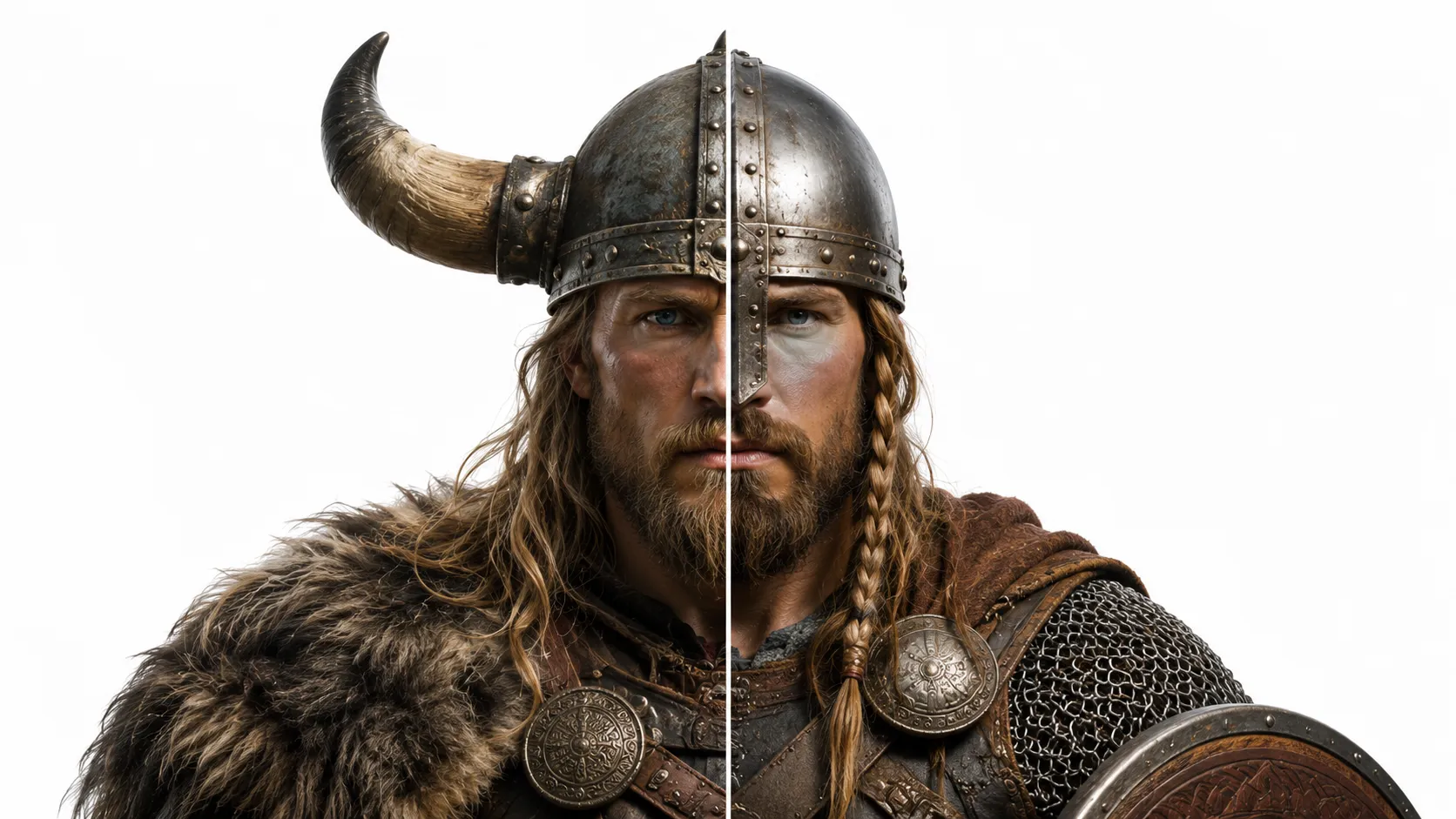
Visual answer
Real Viking Helmet vs the Popular Image
A comparison of what Viking helmets looked like based on archaeological evidence, versus the version that became famous in art and popular culture.
Rounded iron crown
Real Viking helmets had a hemispherical iron cap that deflected blows rather than catching them. No protrusions of any kind.
Nose guard
A vertical iron strip protected the face without obscuring vision. Simple, effective, and practical for both attack and defence.
Spectacle guard (on some helmets)
Some helmets included iron rings around the eye sockets, offering additional facial protection. The Gjermundbu helmet has this feature.
Where the horns came from
Costume designer Carl Emil Doepler added horns to Viking costumes for Richard Wagner's opera Der Ring des Nibelungen in 1876. The image spread from there into painting, illustration, and eventually film.
The helmet everyone imagines
The Viking Helmet Everyone Imagines
Close your eyes and picture a Viking. What do you see? Almost certainly: a large, bearded warrior wearing a helmet with two horns curving outward from the sides. The image is everywhere. Sports team mascots, Halloween costumes, cartoon characters, film posters, and beer labels all use the same shorthand. Two horns on an iron helmet and the message is instantly clear: this is a Viking.
The image is so universal that most people have never stopped to question it. It feels ancient. It feels authentic. It feels like something passed down from real history through centuries of accurate retelling.
It is not. The horned Viking helmet is one of the most successful historical fabrications ever made, and tracing how it was invented and spread is, if anything, more fascinating than the real story of what Vikings actually wore.
What real helmets looked like
What Did Real Viking Helmets Look Like?
Here is the strange reality of Viking helmet archaeology: after more than a century of excavations across Scandinavia and beyond, researchers have found almost nothing.
Viking Age burials have yielded swords, axes, shield bosses, jewellery, tools, and household items in abundance. Helmets are almost entirely absent. Of all the Viking Age sites ever excavated, only one nearly complete helmet has been recovered.
That helmet is the Gjermundbu helmet, found in 1943 in a burial mound in Ringerike, Norway. It dates to around the 10th century AD, placing it squarely in the Viking Age. The helmet is a rounded iron cap, constructed from several iron bands riveted together, with a curved spectacle guard that protected the eyes and nose. It sits low over the face. It is clearly designed to protect the wearer from sword cuts and axe blows.
There are no horns. There is no decoration beyond the functional iron framework. There is nothing theatrical about it at all. It is a tool built by people who needed to survive close-quarters combat, and it looks exactly like that.
Fragments of other helmets have been found at a handful of sites, all consistent with the same basic design: rounded, practical, with a face guard of some kind. Not a single confirmed Viking Age helmet with horns has ever been discovered.
Why horns made no sense
Why Horns Would Have Been a Terrible Idea in Battle
Even without the archaeological evidence, basic military logic argues strongly against horned battle helmets.
In close combat, anything that sticks out from a warrior's head becomes a liability. Horns give an opponent something to grab, allowing them to control your head and neck with a single hand. A fighter who can steer your head has a significant advantage.
Horns also add weight at the worst possible point, the top and sides of the helmet, shifting the centre of gravity upward and making the head harder to hold steady under the fatigue of prolonged fighting. Every unnecessary gram on a helmet is energy a warrior cannot spend on the fight itself.
Longer horns create leverage. A blow that strikes a horn transfers rotational force to the neck rather than distributing it across the skull. What was designed as armour becomes a mechanism for neck injuries.
Then there is the practical problem of moving through confined spaces: narrow ship passages, doorways, dense forest undergrowth, and the tight press of a shield wall. Horns project outward. They snag, they clatter, they announce your position.
Real combat equipment converges on the same design principles across every culture and era: keep the profile tight, protect the face, deflect blows away from the skull. Viking helmets, as the Gjermundbu helmet shows, followed exactly this logic. They look boring because boring kept people alive.
Did any Vikings wear horns?
Did Any Vikings Ever Wear Horns?
This is an important nuance. The question is not whether horn-shaped headgear ever appeared in Norse culture. It is whether Viking warriors wore horns into battle.
Norse mythology and ceremonial culture are full of rich symbolic imagery, and horns appear in various religious and ritual contexts. Some scholars have suggested that horn-decorated headgear might have been worn in religious ceremonies or by figures performing ritual roles, distinct from battlefield equipment. A warrior dressed for a ceremony and a warrior dressed for combat are not the same person wearing the same things.
There is also a single piece of visual evidence that gets cited regularly in this debate: a small tapestry fragment from the Oseberg ship burial, dated to around 834 AD, which appears to show a figure wearing a helmet with what might be horns or bird-like decorations. Scholars continue to debate what the image actually depicts, and a single ambiguous textile fragment is a thin foundation for an entire costume tradition.
The honest summary is this: there is no strong evidence that Viking warriors regularly fought wearing horned helmets. There may have been ceremonial uses of horn imagery in ritual contexts. But the battlefield image that defines Vikings in popular culture has no solid archaeological support.
Who actually wore horns
Who Actually Wore Horned Helmets?
Here is the twist that makes the whole story stranger: horned helmets are real. They just have nothing to do with Vikings.
In 1942, a peat bog near Veksø in Denmark yielded two extraordinary bronze helmets, each fitted with large curved horns and decorated with bird figures. They are beautifully crafted and clearly significant objects. Radiocarbon dating places them at around 900 BC.
That is approximately 1,800 years before the Viking Age began.
These are Bronze Age ceremonial helmets, almost certainly used in religious rituals rather than warfare. Their elaborate decoration and the circumstances of their discovery, buried together in a bog, a common site for ritual deposits in prehistoric Northern Europe, suggest they were votive offerings rather than practical equipment.
Similar horned helmets appear in Bronze Age rock carvings across Scandinavia, shown being worn by figures in what appear to be ceremonial scenes. The evidence points consistently toward religious or ritual use in a culture that disappeared long before the first Norse longship set sail.
The irony is rich. The horned helmet does exist in Scandinavian history. It is just from the wrong culture, the wrong era, and the wrong context by more than a millennium.
Where the myth came from
Where Did the Viking Horn Myth Come From?
The origin of the horned Viking is surprisingly recent and surprisingly well-documented.
In the early 19th century, a wave of Romantic nationalism swept through Europe. Intellectuals, artists, and writers became fascinated with the distant past of their own peoples, searching for heroic ancestors who embodied strength, freedom, and national identity. For Scandinavian and German Romantics, the Vikings and the ancient Norse fitted perfectly. They were powerful, mysterious, and conveniently distant enough to be reimagined freely.
Artists began depicting Norse warriors with an increasingly dramatic visual vocabulary. The Swedish painter Carl Larsson and the Danish artist Lorenz Frølich both produced images of Norsemen wearing helmet designs with horns or wings in the mid-19th century. These were aesthetic choices, not historical reconstructions. But the images were compelling and widely reproduced.
The single most influential moment came in 1876, when the German composer Richard Wagner premiered his epic opera cycle Der Ring des Nibelungen. The costume designer Carl Emil Doepler created the production's visual language, dressing the Norse and Germanic characters in horned and winged helmets. The Ring Cycle became one of the most famous artistic works of the century. Its imagery of horned warriors, reproduced in programmes, posters, and reviews across Europe, burned the image into the cultural imagination of an entire generation.
Painters, book illustrators, and advertisers picked up the visual shorthand. By the time cinema arrived in the early 20th century, the horned Viking was already a cliche. Hollywood simply repeated what it had inherited.
The process by which a costume designer's theatrical invention became accepted as historical fact took less than a century.
Why the myth survived
Why Do We Still Believe Vikings Wore Horns?
The persistence of the horned helmet myth illustrates something important about how cultural images work.
The horned helmet is a perfect visual symbol. It communicates instantly. Two horns on a metal cap and any viewer, anywhere in the world, understands they are looking at a Viking. The image requires no context, no caption, no explanation. It is the visual equivalent of a single word.
Symbols that communicate this efficiently are almost impossible to replace, even when evidence contradicts them. Correcting the record requires people to hold two ideas in their heads simultaneously: the vivid, memorable wrong image and the accurate but less dramatic replacement. The brain reliably prefers the more memorable version.
The same dynamic preserves other historical myths. Napoleon was not especially short by the standards of his era. Einstein did not fail mathematics at school. Neither of these corrections has dislodged the popular belief, because the myth is simply easier to carry.
The horned helmet has the additional advantage of appearing in children's books, cartoons, and sports logos from an early age, encoding it before critical thinking has a chance to intervene. By the time most people encounter the historical evidence, the image has been reinforced hundreds of times.
Why Viking helmets are rare
Why Are Viking Helmets So Rare?
The scarcity of Viking helmets puzzles many people. If the Vikings were such prolific warriors, why have archaeologists found almost none of their helmets?
Iron was extraordinarily valuable in the Viking Age. Smelting required significant fuel, skilled labour, and time. A well-made iron helmet represented weeks of work and a substantial material investment. When a helmet was no longer needed, whether through damage, death, or the end of a campaign, the iron would typically be recycled rather than discarded. It would be melted down and reforged into something else.
Viking Age burial practices also varied considerably. While some warriors were buried with their weapons and tools, this was not universal. Many burials were simple, cremations were common, and the specific items chosen for burial reflected individual, family, or community choices rather than any systematic preservation of military equipment.
Organic materials including leather linings, textile padding, and wooden elements that would have formed part of a complete helmet have almost always rotted away entirely, leaving even partial iron survivals hard to identify and reconstruct.
The result is a nearly empty archaeological record for one of the most iconic pieces of equipment in the popular imagination. The Gjermundbu helmet survives because it was buried in conditions that slowed corrosion. Every other Viking helmet we know about is fragments.
Vikings were clean
Surprisingly, Vikings Were Quite Clean
The horned helmet is not the only Viking myth worth dismantling. The popular image of Vikings as unwashed, matted, rough-sleeping raiders is equally misleading.
Archaeological finds from Viking Age sites consistently include grooming tools. Combs carved from antler and bone. Tweezers for removing unwanted hair. Ear-cleaning spoons. Razors. These were not luxury items found only in wealthy graves. They appear across a wide social range, suggesting that personal grooming was a routine part of Viking life rather than an elite affectation.
Historical sources support this. The 10th-century Arab diplomat Ibn Fadlan, who encountered a group of Norse traders on the Volga River in Russia, wrote a detailed account of their appearance. He had plenty of unflattering things to say about their customs, but he also noted that they washed their faces and hands every morning.
An English chronicler from the same era complained that Danish Vikings living in England were stealing local women's affections, partly because they combed their hair and changed their clothes more often than English men did.
This does not mean Vikings were hygiene-conscious by modern standards. But the image of the filthy, unkempt barbarian is largely a product of the same 19th-century Romantic mythology that gave us the horned helmet.
What Vikings actually wore
What Did Vikings Actually Wear?
Strip away the Hollywood additions and the real Viking warrior's appearance is both more practical and more interesting than the popular version.
Helmets, where worn, were rounded iron caps with nose guards, sometimes with spectacle-style eye protection as on the Gjermundbu helmet. Not everyone wore one. Helmets were expensive and not every fighter could afford one. Many warriors went into battle with a leather cap or no head protection at all.
Shields were round, made of planks of wood, typically painted, with an iron boss at the centre to protect the hand. They were the primary defensive item for most Viking fighters and appear in abundance in the archaeological record.
Chainmail was worn by those who could afford it. A chainmail shirt, called a byrnie, required thousands of individually linked iron rings and represented significant wealth. Wealthy or experienced warriors wore it. Many did not.
Everyday clothing was wool: tunics, trousers, and cloaks. Wool was warm, durable, and water-resistant when not fully saturated. Leather was used for boots, belts, and some armour reinforcement.
Weapons varied by wealth and role. Axes were common and cheap to produce. Swords were expensive, high-status weapons. Spears were widely used. The Viking weapon of choice was not the massive axe of popular imagination but the spear, the most common battlefield weapon of the era.
This is the reality: practical, effective, relatively unglamorous equipment worn by people who needed it to work. Not a horn in sight.
Myth: horned helmets
Myth vs Reality: Vikings Wore Horned Helmets
What people think
Viking warriors wore helmets with large curved horns
The image appears in virtually every popular depiction of Vikings, from cartoons to sports logos, suggesting it has historical authenticity.
What actually happens
No confirmed Viking Age battle helmet with horns has ever been found
The only nearly complete Viking helmet ever discovered, the Gjermundbu helmet from Norway, has a rounded iron cap with a nose guard and no horns. The horned helmet image was invented in the 19th century by Romantic artists and popularised by Wagner's opera costume designs in 1876.
Myth: dirty barbarians
Myth vs Reality: Vikings Were Filthy Barbarians
What people think
Vikings were unwashed, unkempt raiders with no regard for personal cleanliness
The popular image of Vikings as primitive savages includes assumptions about hygiene that reinforce their status as the opposite of civilised society.
What actually happens
Archaeological evidence shows Vikings regularly groomed themselves
Viking Age sites consistently yield combs, tweezers, razors, and ear-cleaning tools. Historical accounts describe Norse traders bathing regularly and changing clothes more often than many Europeans of the time. The filthy barbarian image owes more to Romantic-era mythology than to historical evidence.
Myth: only raiders
Myth vs Reality: Vikings Only Raided Villages
What people think
Vikings were primarily violent raiders who existed to terrorise coastal communities
The word Viking is often used as a synonym for marauder, implying that raiding was the defining activity of Norse people.
What actually happens
Most Norse people were farmers, traders, and craftspeople
Raiding was a real and significant part of Norse activity, particularly from the late 8th to 11th centuries. But the majority of Norse people farmed, fished, crafted, and traded. Norse merchants established extensive trade networks from Greenland to Constantinople. The word 'Viking' technically referred to people who went on raiding voyages, not to all Norse people.
Myth: giant warriors
Myth vs Reality: All Vikings Were Giant Warriors
What people think
Vikings were enormous, physically overwhelming fighters who towered over their opponents
Hollywood Vikings are invariably cast as huge, muscular figures whose physical size is itself a weapon.
What actually happens
Average Viking Age Norse men were similar in height to other Europeans of the era
Skeletal analysis from Viking Age burials places average male height at around 5 feet 7 to 5 feet 9 inches, comparable to other Northern Europeans of the period. Some individuals were certainly tall and powerfully built. Most were not exceptional by modern standards. The towering Viking warrior is another Romantic-era embellishment.
Popular vs real Vikings
Popular Image vs Archaeological Reality
Helmet
Popular: horned iron helmet. Reality: rounded iron cap with nose guard, no horns. Only one nearly complete example has ever been found.
Primary weapon
Popular: enormous double-headed axe. Reality: the spear was the most common Viking Age weapon. Swords were expensive and high-status. Single-headed axes were common and practical.
Body armour
Popular: full chainmail suit. Reality: chainmail was expensive and worn mainly by wealthier warriors. Many fighters had leather reinforcement or no body armour at all.
Hygiene
Popular: filthy, matted, unwashed. Reality: combs, tweezers, and razors found routinely in burials. Historical accounts note regular bathing and clean clothing.
Occupation
Popular: full-time raider. Reality: most Norse people were farmers, traders, and craftspeople. Raiding was seasonal and undertaken by a subset of the population.
Physical size
Popular: enormous, physically dominating. Reality: average height similar to other Northern Europeans of the period, around 5 feet 7 to 9 inches.
Final verdict
The Final Verdict
Did Vikings wear horned helmets? The archaeological record is about as clear as it ever gets: no confirmed Viking Age battle helmet with horns exists. The only nearly complete Viking helmet ever found has none. The fragments discovered at other sites are consistent with the same practical, horn-free design.
Horned helmets do appear in Scandinavian history, but they belong to Bronze Age ceremonial culture, more than a thousand years before the first Viking longship was built. They were ritual objects, not warrior equipment, and the people who made them had been gone for centuries before the Viking Age began.
The horned Viking image was built by 19th-century artists seeking dramatic symbols for Romantic nationalism, crystallised by an opera costume designer in 1876, and repeated so many thousands of times across paintings, books, films, cartoons, and sports logos that it became indistinguishable from historical memory.
Ironically, one of the most famous symbols of Viking culture is probably something most Vikings never wore at all. The real helmet, a modest iron cap in a Norwegian museum, sits quietly correcting the record for anyone who goes to look.
Quick answers
Common questions
Did Vikings wear horned helmets? +
Almost certainly not in battle. No confirmed Viking Age battle helmet with horns has ever been found. The only nearly complete Viking helmet discovered, the Gjermundbu helmet from Norway, has a rounded iron cap and nose guard but no horns. The horned image was largely created by 19th-century artists.
Did any Vikings have horns on their helmets? +
There is no strong archaeological evidence for this. Some scholars suggest horn imagery may have appeared in ceremonial or ritual contexts, but there is no confirmed example of a Viking warrior wearing horned headgear in battle. The battlefield image has no solid historical foundation.
What did actual Viking helmets look like? +
Based on the Gjermundbu helmet, the only nearly complete example, real Viking helmets were rounded iron caps with spectacle-style eye protection and a nose guard. No horns, no dramatic decoration. Practical construction designed to deflect blows and protect the face.
Why are Viking helmets so rare? +
Iron was extremely valuable and was typically recycled rather than buried or discarded. Viking Age burial practices were inconsistent, and many graves did not include weapons or armour. Organic components like leather and padding rotted away. The result is an almost empty archaeological record for helmets specifically.
Who wore horned helmets in history? +
Bronze Age peoples in Scandinavia and Northern Europe, at least 1,000 years before the Viking Age. The Veksø helmets from Denmark date to around 900 BC and were almost certainly ceremonial objects. Horned helmets also appear in Bronze Age rock carvings, consistently in ritual rather than battle contexts.
Were Viking helmets historically accurate? +
The popular image of Viking helmets is not historically accurate. Real Viking helmets were simple rounded iron caps with nose guards. The horned helmet image has no confirmed basis in Viking Age archaeology and was largely invented in the 19th century.
Did Vikings wear helmets at all? +
Some did, but helmets were expensive and not every fighter could afford one. The archaeological record for Viking Age helmets is remarkably thin, with only one nearly complete example ever found. Many warriors likely went into battle with leather caps, simple iron reinforcement, or no head protection.
How good was Viking hygiene? +
Better than popular mythology suggests. Archaeological sites regularly yield combs, tweezers, razors, and ear-cleaning tools. Historical accounts, including those by Arab diplomat Ibn Fadlan, describe Norse people bathing regularly. A medieval English writer complained that Vikings in England attracted women by grooming themselves more carefully than local men.
Why do people think Vikings wore horns? +
The image was created by Romantic-era artists in the early 19th century and crystallised by Carl Emil Doepler's costume designs for Wagner's Ring Cycle opera in 1876. The production was enormously influential, and its imagery spread through posters, illustrations, and reviews until the theatrical invention became accepted as historical fact.
What is the Gjermundbu helmet? +
The Gjermundbu helmet is the only nearly complete Viking Age helmet ever found. Discovered in a burial mound in Ringerike, Norway, in 1943, it dates to around the 10th century AD. It is a rounded iron cap with a spectacle guard and nose guard. It has no horns and is now held at the Museum of Cultural History in Oslo.