Visual answer
Who Reached the Americas and When
A timeline of the major arrivals in the Americas, from the first migrations out of Asia to Columbus's 1492 voyage and beyond.
~15,000 BC: First peoples cross into the Americas
During the last Ice Age, lower sea levels created a land bridge between Asia and North America. Groups migrated across and spread throughout the continents over thousands of years.
~1000 AD: Vikings reach North America
Norse explorer Leif Erikson establishes a settlement at L'Anse aux Meadows in Newfoundland, Canada. The settlement is later abandoned without lasting European contact.
1492 AD: Columbus lands in the Bahamas
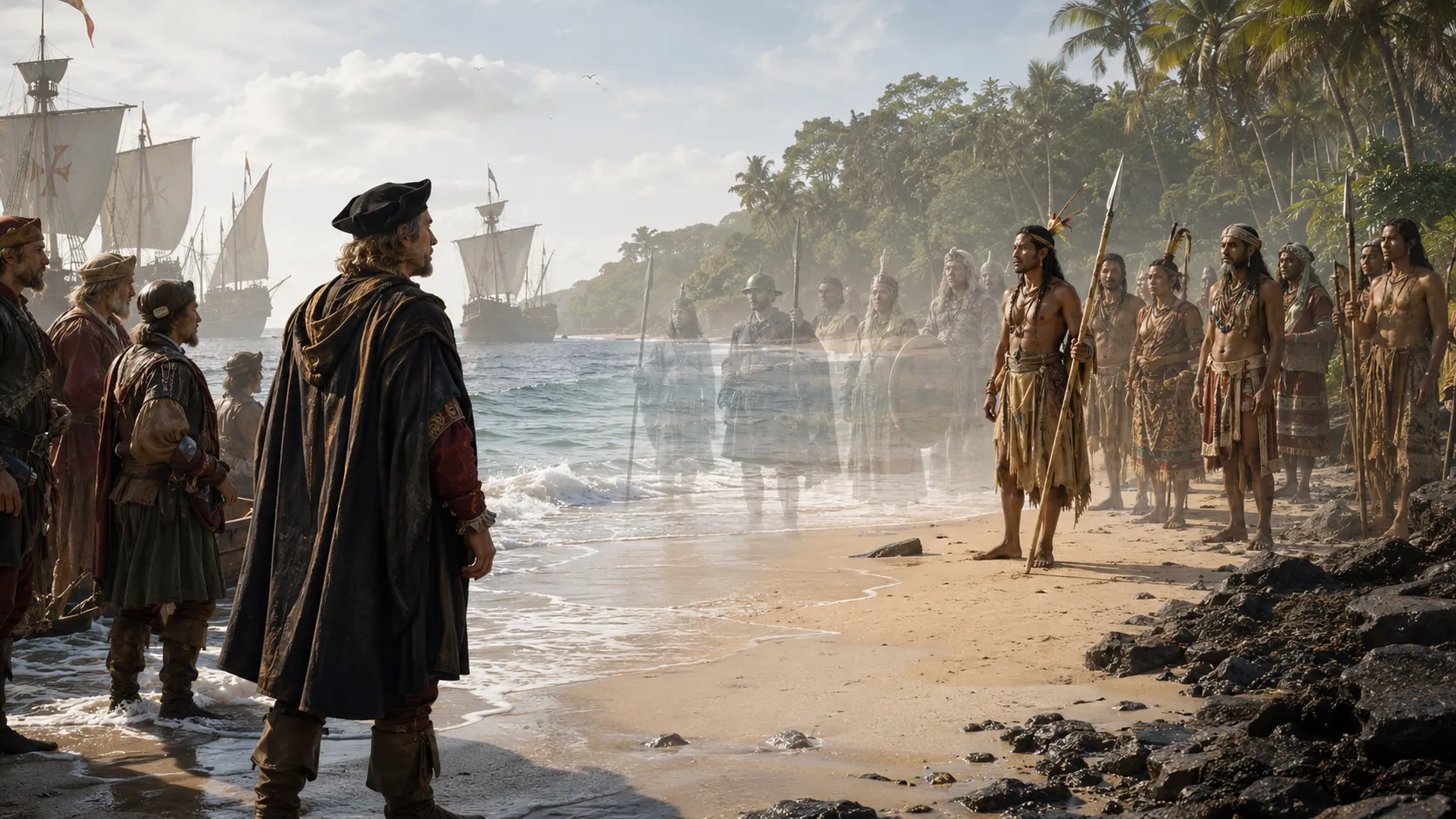
Columbus makes landfall on an island he calls San Salvador, believing he has reached islands near the coast of Asia. He never realises a previously unknown continent lies before him.
Post-1492: Permanent contact begins
Columbus's voyages trigger sustained European exploration, colonisation, and global exchange. This marks the beginning of what historians call the Columbian Exchange.
Before Columbus
What Was America Like Before Columbus?
When European ships appeared on the horizon in 1492, the Americas were anything but empty. Scholars estimate that between 50 and 100 million people lived across North and South America at that time. That is a population comparable to Europe's.
These were not scattered hunter-gatherer bands living in isolated forests. The Americas contained some of the most sophisticated civilisations on Earth. The Aztec capital of Tenochtitlan, built on an island in a lake where Mexico City now stands, had a population of around 200,000 to 300,000 people. That made it one of the largest cities in the world. London at the same time had perhaps 50,000 inhabitants.
Further south, the Inca Empire stretched 4,000 kilometres along the Andes, connected by an extraordinary road network of over 40,000 kilometres. The Maya had developed a complex writing system, an accurate astronomical calendar, and monumental architecture centuries before Columbus was born. In North America, the Mississippian city of Cahokia, near present-day St. Louis, had reached a population of around 20,000 people at its peak in the 12th century.
Trade networks crossed entire continents. Farmers in the Americas had independently domesticated maize, potatoes, tomatoes, cacao, and hundreds of other crops that would later transform the global food supply. None of this was a wilderness waiting to be found. It was a world as rich, complex, and inhabited as the one Columbus left behind.
The first Americans
The First People in the Americas
To understand how long humans had been in the Americas before Columbus, you need to think in a different timescale entirely.
Around 15,000 to 20,000 years ago, during the last Ice Age, sea levels were dramatically lower than today because so much water was locked in glaciers. This exposed a wide land bridge between what is now Siberia and Alaska, connecting Asia and North America across what we now call the Bering Strait. Groups of people migrated across it.
Over thousands of years, their descendants spread across both continents, reaching the tip of South America by at least 12,000 years ago. Some archaeological sites suggest humans may have arrived even earlier, though the exact dates remain debated.
By the time Columbus sailed, these populations had been building civilisations in the Americas for longer than the entire recorded history of ancient Egypt. Saying Columbus discovered a continent that had been inhabited for 15,000 years is a bit like saying someone discovered a house by knocking on the front door while the family was home.
The Vikings
The Vikings Got There First
Nearly 500 years before Columbus was born, a Norse explorer named Leif Erikson sailed west from Greenland and reached the coast of North America. He called the place Vinland, probably because of the wild grapes or berries he found there.
For a long time, this was treated as legend. Then, in 1960, archaeologists discovered the remains of a Norse settlement at L'Anse aux Meadows in Newfoundland, Canada. Eight turf buildings. Norse-style construction. Iron nails made using a process unknown to Indigenous peoples at the time. Radiocarbon dating placed the settlement firmly around the year 1000 AD. The legend turned out to be history.
So why do we not celebrate Leif Erikson Day the way we celebrate Columbus Day? The answer lies in impact. The Norse settlement at L'Anse aux Meadows was small, short-lived, and largely forgotten outside Scandinavia. It did not trigger a wave of exploration. It did not connect two civilisations. It left no lasting trace in European consciousness and no sustained contact with the peoples already living there.
History is not just about who arrives first. It is about what happens next.
Why Columbus sailed west
Why Was Columbus Sailing West?
To understand Columbus, you need to understand what European merchants desperately wanted in the 1400s: spices.
Spices like pepper, cinnamon, cloves, and nutmeg were extraordinarily valuable. They preserved food, masked the flavour of meat that had begun to turn, and were used in medicines. A small sack of pepper was worth more than a skilled worker could earn in months. All of it came from Asia, carried overland along the Silk Road through Arab middlemen who took substantial cuts along the way.
When the Ottoman Empire took control of Constantinople in 1453, those overland routes became even more expensive and difficult. European kingdoms began searching urgently for a sea route to Asia that cut out the middlemen. Portugal was making progress sailing south around Africa. Spain wanted its own route.
Columbus had a different idea: sail west. The Earth was round, he argued. Asia must therefore be reachable by heading in the opposite direction. His proposal was not as radical as popular myth suggests, educated people already knew the Earth was spherical. The problem was that Columbus had badly miscalculated Earth's circumference. He believed the planet was roughly 25 percent smaller than it actually is, which made Asia seem reachably close.
He spent years pitching the idea to the Portuguese court, who rejected it. Their own astronomers correctly calculated that the ocean crossing would be far too long to survive. Columbus eventually found support from the Spanish monarchs Ferdinand and Isabella, who agreed to fund the voyage in 1492. He was not trying to find America. He was trying to find Japan.
Did he think he was in India?
Did Columbus Think He Was In India?
When Columbus landed on an island in the Caribbean in October 1492, he was convinced he had reached the outer islands of Asia. He called the people he encountered 'Indians' because he believed he was near the Indies, the European name for the lands of South and Southeast Asia.
The name stuck. Five centuries later, the descendants of those peoples are still referred to as 'Indians' or 'Native Americans' in everyday English, a linguistic fossil of one explorer's geographical mistake.
Columbus made four voyages across the Atlantic between 1492 and 1504. He explored the Caribbean extensively, touched the coast of Central America, and reached the northern coast of South America. At various points he described what he was seeing as islands off the coast of China or the outskirts of the Asian mainland.
He never updated his model. He never concluded he had found something entirely unknown to European maps. He never realised that between him and Asia lay an entire continent, the Pacific Ocean, and then another continent beyond that. Columbus died in 1506 believing he had pioneered a western route to Asia. He had found something far more significant, and he never knew it.
Where Columbus landed
Where Did Columbus Actually Land?
Columbus's first landfall in 1492 was on an island he named San Salvador, now believed to be in the Bahamas. He was greeted by the Taino people, whom he described in his journal as gentle, generous, and intelligent, and immediately began calculating how easily they could be enslaved.
From there he sailed to Cuba, which he initially suspected might be Japan, and then to the island he called Hispaniola, now divided between Haiti and the Dominican Republic. He established a small settlement there before returning to Spain with gold, parrots, and several Taino people taken against their will.
On his subsequent voyages he explored Puerto Rico, Jamaica, Trinidad, the coast of Venezuela, and the shores of Central America. On his third voyage he became the first European to reach the South American mainland.
He never came close to what is now the continental United States. The American history taught in many schools gives the impression that Columbus arrived on American shores and planted a flag. He did not. The closest he ever got to the present-day United States was the Bahamas, which are not part of the continental landmass at all.
Myth: empty continent
Myth vs Reality: Columbus Found an Empty Continent
What people think
Columbus discovered an uninhabited wilderness
The popular image of Columbus arriving on empty shores, planting a flag, and claiming land for Spain implies the Americas were vacant and unclaimed before Europeans arrived.
What actually happens
Between 50 and 100 million people were already living there
The Americas were densely populated by hundreds of distinct peoples with complex societies, large cities, trade networks, and sophisticated agriculture. Tenochtitlan, the Aztec capital, was larger than any city in Europe at the time Columbus sailed.
Myth: first to arrive
Myth vs Reality: Columbus Was the First Person to Reach America
What people think
Columbus was the first human being to set foot in the Americas
The phrase 'Columbus discovered America' implies no human had ever been there before he arrived.
What actually happens
Humans had lived in the Americas for at least 15,000 years
Indigenous peoples descended from Asian migrants had populated both continents for millennia. Viking explorer Leif Erikson established a confirmed settlement in Canada around 1000 AD, nearly 500 years before Columbus. Columbus was, at best, the third wave of arrivals.
Myth: proved Earth is round
Myth vs Reality: Columbus Proved the Earth Was Round
What people think
Columbus bravely sailed west to prove the Earth was not flat
A popular story frames Columbus as a visionary challenging the medieval belief that the Earth was flat and ships would fall off the edge.
What actually happens
Educated Europeans had known the Earth was spherical for nearly 2,000 years
Ancient Greek scholars had calculated Earth's circumference with impressive accuracy. Medieval European scholars, including those who rejected Columbus's proposal, knew perfectly well the planet was round. The dispute was about distance, not shape. Columbus's critics argued, correctly, that Asia was far too distant to reach by sailing west. They were right. Columbus simply got lucky that unknown continents stood in the way.
Myth: landed in the USA
Myth vs Reality: Columbus Landed in the United States
What people think
Columbus landed on the shores of what is now the United States of America
Columbus Day is a US national holiday, creating a strong cultural association between Columbus and the American mainland.
What actually happens
Columbus never reached the continental United States
All four of Columbus's voyages took him through the Caribbean, Central America, and the northern coast of South America. His first landfall was in the Bahamas. He never landed on the continental United States. The European explorer credited with the first confirmed landing on the North American mainland was John Cabot, sailing in 1497.
What he actually discovered
What Columbus Actually Discovered
It would be wrong to dismiss Columbus's achievement simply because other people arrived before him. What he discovered was not a continent. It was a connection.
For roughly 12,000 years, since the land bridge between Asia and North America had been swallowed by rising seas, the peoples of the Old World and the New World had developed in complete isolation from each other. Different crops, different animals, different diseases, different technologies, different languages. Two branches of humanity that had diverged and had no knowledge of each other's existence.
Columbus's 1492 voyage opened a sustained two-way exchange that had never existed before and has not stopped since. Within decades, Spanish, Portuguese, English, French, and Dutch expeditions were crossing the Atlantic regularly. Crops from the Americas, including maize, potatoes, tomatoes, and chocolate, transformed European diets and helped fuel a population explosion. European livestock, wheat, and diseases crossed the other way, with catastrophic consequences for Indigenous populations who had no immunity to illnesses like smallpox.
This transfer of goods, people, animals, plants, and microbes is called the Columbian Exchange by historians, and it reshaped the biology of both hemispheres within decades. The Viking settlement at L'Anse aux Meadows produced none of this. Columbus's voyages produced all of it.
That is the genuine historical significance of 1492. Not a discovery, in the sense of finding something no person had ever seen. But an opening, in the sense of connecting two worlds that had no knowledge each other existed.
Was it accidental?
Was Columbus's Discovery Accidental?
Columbus did not stumble onto a ship and drift westward by mistake. He spent years planning the voyage, lobbying monarchs for funding, and calculating (incorrectly, as it turned out) the distance to Asia. The voyage west was entirely intentional.
What was accidental was what he found. Columbus was searching for Asia. He found the Caribbean. He was looking for the court of the Great Khan. He found the Taino people. He spent the rest of his life insisting he had found what he was looking for, even as evidence accumulated that the lands he had reached bore no resemblance to any part of Asia that Europeans knew about.
In this sense, historians sometimes describe 1492 as an accidental discovery: a deliberate voyage that found something completely different from its intended destination, and whose discoverer never understood the true nature of what he had encountered.
It was left to Amerigo Vespucci, an Italian explorer who followed Columbus across the Atlantic in the early 1500s, to argue clearly in print that these lands were not Asia at all but a previously unknown part of the world. When German cartographers printed a world map in 1507, they labelled the new continent after Vespucci. They called it America.
Why Columbus gets the credit
Why Does Columbus Get So Much Credit?
If Columbus was not the first human in the Americas, not the first European, and did not even know what he had found, why does his name dominate the history of the continent?
The answer is documentation, consequence, and timing.
Columbus returned to Spain and published accounts of his voyage. Those accounts spread through Europe's printing presses, which had been invented only decades earlier. His voyage was a documented, witnessed, officially sanctioned event that European courts, merchants, and mapmakers could act upon immediately. The Viking voyages, by contrast, were recorded only in Norse sagas written down centuries after the fact, and were completely unknown to the Spanish, Portuguese, or English explorers who followed Columbus.
Consequence matters most of all. Columbus's voyages triggered an immediate and permanent cascade of exploration, colonisation, and exchange. Within a generation, Spanish conquistadors had reached the Aztec and Inca empires. Within a century, European powers had established colonies across both American continents. The world was permanently altered.
History tends to credit the person whose actions changed everything, not the person who merely arrived first. By that measure, Columbus's claim on 1492 is genuine, even if the word 'discover' does not quite fit.
Who arrived first
Who Reached the Americas and What It Meant
First Indigenous peoples (~15,000 BC)
Migrated from Asia during the Ice Age. Built the entire human history of the Americas across thousands of years. Their descendants numbered tens of millions by 1492.
Leif Erikson (~1000 AD)
Established a confirmed Norse settlement in Newfoundland, Canada. Settlement was short-lived and abandoned. Had no lasting impact on European knowledge or global history.
Christopher Columbus (1492 AD)
Opened permanent, sustained contact between Europe and the Americas. Triggered the Columbian Exchange and five centuries of global transformation. Never realised he had found a new continent.
Who gets historical credit
Columbus, because his voyages changed everything that followed. History rewards consequence over chronology.
Final verdict
The Final Verdict
Did Columbus discover America? The honest answer is: it depends entirely on what you mean by the word 'discover.'
If you mean 'was the first human to set foot there,' the answer is clearly no. Indigenous peoples had built entire civilisations there for thousands of years. If you mean 'was the first European,' the answer is still no. Leif Erikson beat him by half a millennium. If you mean 'realised he had found an unknown continent,' the answer is emphatically no. Columbus went to his grave believing he had found Asia.
But if you mean 'made the connection that permanently joined two halves of humanity and reshaped the world,' then Columbus's voyage of 1492 is genuinely one of the most consequential events in recorded history. No earlier voyage had done that.
The reason this question still sparks debate is that the word 'discover' carries assumptions about emptiness, priority, and importance that the messy reality of history refuses to satisfy. The Americas were not waiting to be discovered. They were home.
History is often recorded by the people whose actions had the biggest consequences, not by the people who arrived first. Columbus got credit for a discovery he did not fully make, in lands he never properly identified, that were populated by people he never truly saw. And yet the world that emerged from his voyages is, for better and worse, the world we still live in.
Quick answers
Common questions
Did Columbus discover America? +
Not in any straightforward sense. Indigenous peoples had lived in the Americas for at least 15,000 years before Columbus arrived, and Vikings had reached North America around 1000 AD. What Columbus did was open permanent, sustained contact between Europe and the Americas, an event with enormous global consequences.
Who discovered America before Columbus? +
Indigenous peoples discovered and populated the Americas thousands of years before any European. Among Europeans, Norse explorer Leif Erikson established a settlement in Newfoundland, Canada, around 1000 AD, confirmed by archaeology at L'Anse aux Meadows in 1960.
Who landed in America first? +
The ancestors of today's Indigenous peoples, who migrated from Asia during the last Ice Age roughly 15,000 years ago or earlier. Among Europeans, Leif Erikson arrived around 1000 AD. Columbus arrived in 1492.
Did Columbus discover America by accident? +
His voyage was intentional: he was deliberately sailing west in search of Asia. What was accidental was what he found. Columbus never intended to discover unknown continents and never understood that he had. He was looking for Japan and found the Caribbean.
Did Columbus think he was in India? +
He believed he had reached islands near the coast of Asia, which Europeans called the Indies. That is why he called the people he encountered Indians. He maintained this belief on all four voyages and died without accepting that he had found an entirely new continent.
Did Columbus land in North America? +
No. Columbus never landed on the continental United States or mainland North America. His voyages took him through the Caribbean, Central America, and the northern coast of South America.
Why did Columbus sail west? +
He wanted to find a sea route to Asia by heading west rather than east around Africa, which Portugal was pursuing. He believed, based on a calculation that turned out to be badly wrong, that Asia was close enough to reach across the Atlantic.
What was Columbus trying to find? +
A western sea route to Asia, specifically to the spice-producing regions of the Indies. He was funded by the Spanish monarchs Ferdinand and Isabella to find a route that would compete with Portugal's African route.
Who came first, Vikings or Columbus? +
Vikings. Leif Erikson established a settlement in Newfoundland, Canada, around 1000 AD, confirmed by the archaeological site at L'Anse aux Meadows. Columbus arrived in 1492, approximately 492 years later.
Did Columbus know he had found a new continent? +
No. Columbus believed until his death in 1506 that he had found islands off the coast of Asia. It was Amerigo Vespucci who first argued in print that these were an entirely new part of the world, and a German cartographer named the continents after him in 1507.