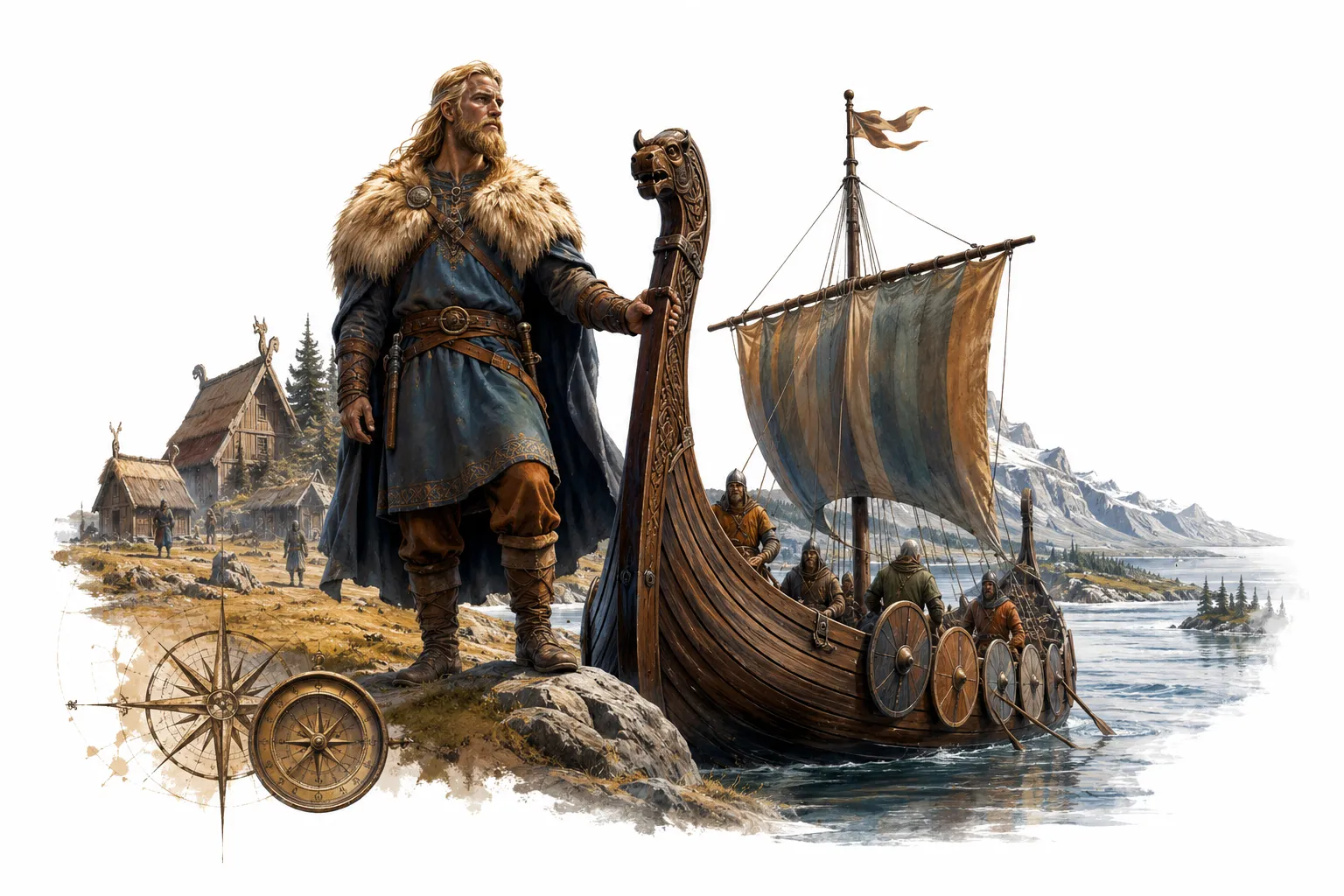
Quick Facts
Quick Facts
Leif Erikson was the son of Erik the Red, the founder of the Norse settlement in Greenland.
According to the sagas, Leif had heard about a land to the west from a previous explorer, Bjarni Herjólfsson.
Leif called the land 'Vinland' because of the wild grapes (or perhaps berries) he found there.
The settlement at L'Anse aux Meadows had several buildings, including a forge and a carpentry workshop.
The Norse stayed for only a few years before abandoning the settlement.
Visual answer
The Norse Route to America
How the Vikings reached North America.
Norway
The Norse homeland.
Iceland
Settled by the Norse in the 9th century.
Greenland
Settled by Erik the Red in 985 AD.
Vinland (Newfoundland)
Leif Erikson reaches North America around 1000 AD.
Story in brief
Story in Brief
985 AD
Bjarni Herjólfsson sights land west of Greenland but does not land.
His sighting inspired later voyages.
~1000 AD
Leif Erikson sails to Vinland (North America). He builds houses and spends the winter.
He is the first European known to have reached North America.
~1000-1020 AD
Subsequent Norse voyages attempt to settle Vinland. They encounter indigenous people, whom they call 'Skraelings.' Conflict leads to abandonment.
1960
Archaeologists Helge Ingstad and Anne Stine Ingstad discover a Norse settlement at L'Anse aux Meadows, Newfoundland.
The discovery proves the sagas were correct. The Vikings did reach America before Columbus.
The Story
Why Leif Is Not a Household Name
In the year 1000 AD, a Norse explorer named Leif Erikson sailed from Greenland to a mysterious land to the west. He found forests, wild grapes, and a climate milder than Greenland. He called it Vinland. He built a settlement and spent the winter. Then he returned to Greenland.
Other Norse explorers tried to settle Vinland. They brought livestock. They built more buildings. They encountered indigenous people, whom they called Skraelings. The relationship started with trade and ended with violence. The Norse were outnumbered. They abandoned Vinland after a few years.
The knowledge of Vinland was preserved in Icelandic sagas, but it was treated as a curiosity, not a world changing discovery. The Norse settlement was forgotten. When Columbus sailed in 1492, he had no idea that Vikings had been there first. The discovery was lost to history until archaeologists found the remains in 1960.
From the Sagas
"They remained there during the winter, and no snow came, and all their livestock fed themselves on the grass."
, Saga of Erik the Red
The sagas describe Vinland as a mild, fertile land. The description is probably accurate for Newfoundland, which is milder than Greenland.
Evidence
Proof That the Vikings Were First
The Icelandic sagas describe voyages to Vinland in detail.
ModerateArchaeological remains at L'Anse aux Meadows include Norse style buildings.
StrongRadiocarbon dating places the settlement at around 1000 AD.
StrongNo European contact after the Norse left until Columbus.
StrongKey Points
Key Points So Far
Leif Erikson reached North America around 1000 AD, nearly 500 years before Columbus.
The Norse settlement at L'Anse aux Meadows, Newfoundland, has been confirmed by archaeologists.
The settlement was short lived, probably due to conflict with indigenous peoples.
The knowledge of Vinland was preserved in sagas but was largely forgotten until the 1960s.
Analogy
Like Showing Up Early to a Party
The familiar part
Imagine you show up to a party at 7 PM. The host is not ready. No one else is there. You leave. The real party starts at 9 PM. Everyone remembers the 9 PM crowd.
How it applies
Leif Erikson was the 7 PM guest. He showed up early. No one was there. He left. Columbus was the 9 PM guest. He arrived when Europe was ready to stay. He gets the credit.
Where the analogy breaks
Parties do not involve genocide and disease. The European arrival in the Americas did.
Curiosity Notes
Details Most People Miss
Why this still matters
Why This Still Matters
The story of Leif Erikson matters because it challenges the Columbus myth. Columbus was not the first. He was not even particularly brave. He was a lucky sailor who benefited from centuries of technological advancement. The Vikings crossed the Atlantic in open boats with no maps, no compasses, and no backup. They did it 500 years earlier. They deserve recognition. Columbus can share the spotlight.
Key Findings
- ✓Core findingLeif Erikson reached North America around 1000 AD, nearly 500 years before Columbus.
- ✓Strong evidenceArchaeological evidence at L'Anse aux Meadows, Newfoundland, confirms the Norse settlement.
- ⚠Main consequenceThe Norse settlement was short lived, probably due to conflict with indigenous peoples.
- ✓Wider legacyThe knowledge of Vinland was preserved in Icelandic sagas but largely forgotten.
- ★Bottom lineColumbus is remembered because his voyage led to permanent European settlement.
Final insight
A Last Thought
Leif Erikson reached America first. He built houses. He explored. He left. Then he was forgotten. Columbus came 500 years later. He was not first. But he was remembered. History is not a race. It is a story. And the story we tell depends on who stays, not who visits. The Vikings visited. Columbus's people stayed. That is why Columbus gets the credit. Being first is not enough. You have to make it stick.
Quick answers
Common questions
Why is Columbus famous if Leif Erikson came first? +
Because Columbus's voyages led to permanent European colonization. Leif Erikson's voyages did not. History remembers the people who change the world, not necessarily the people who arrive first.
Could the Norse have colonized America? +
Probably not. The distance from Greenland to Newfoundland is long. The Norse population was small. They were outnumbered by indigenous people. A permanent Norse America was never realistic.