What is the Pareto Principle?
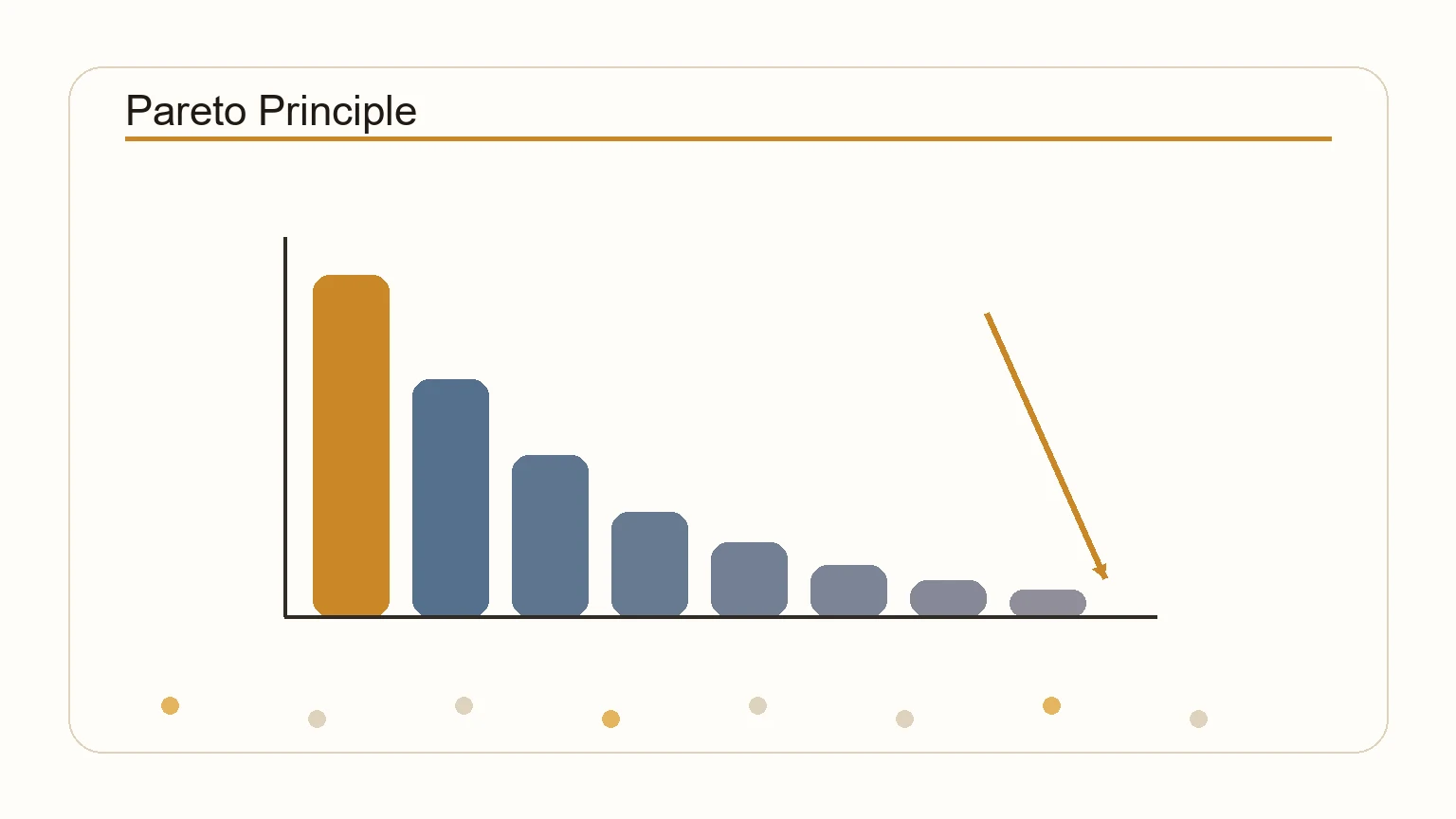
The Pareto Principle, also called the 80/20 rule, states that roughly 80% of effects come from 20% of causes. It is a mental model for understanding uneven distribution.
What is the 80/20 rule in simple terms?
80% of results come from 20% of effort. 80% of revenue comes from 20% of customers. 80% of traffic comes from 20% of content. The numbers are approximate, but the pattern is real.
Who invented the Pareto Principle?
Vilfredo Pareto observed the pattern in 1896. Joseph Juran popularized it in the 1940s. Juran coined the phrase 'the vital few and the trivial many.'
What is a real-life example of the Pareto Principle?
Wealth distribution: 80% of global wealth is held by 20% of people. Customers: 80% of revenue comes from 20% of customers. Tasks: 80% of results come from 20% of effort.
How do you apply the 80/20 rule?
Identify the 20% of activities, customers, or inputs that generate 80% of your results. Focus on those. Reduce energy on the remaining 80%. Re-evaluate regularly.
Does the Pareto Principle apply to everything?
No. The principle applies to many systems, but not all. Some systems are evenly distributed. The principle is a useful lens, not a universal law.
What are common mistakes with the Pareto Principle?
Assuming the ratio is always 80/20. Applying it to everything. Using it to ignore the remaining 80%. Treating it as a scientific law rather than a heuristic.
What are the disadvantages of the Pareto Principle?
Oversimplification. Arbitrary ratios. Misuse in management. Ignoring long-tail effects. The principle is a tool, not a strategy.
What is Pareto Analysis?
A decision-making tool that ranks problems by impact and focuses on the top contributors. It is often visualized as a Pareto Chart.
What is the opposite of the Pareto Principle?
There is no true opposite. The closest is equal distribution, where all inputs produce equal outputs. This is rare in complex systems.