STATISTICAL CONCEPT

What Is the Power Law? Why a Few Things Dominate Everything

A few books sell most of the copies. A few songs get most of the streams. A few people own most of the wealth. The power law explains why.

Editorial illustration of a small number of tall towers dominating a landscape
Creator Vilfredo Pareto (observed)Origin StatisticsYear 1896Category Statistics

QUICK ANSWER

Here is the idea in plain English.

The power law is a statistical distribution where a small number of events account for a large proportion of the total. It is a fundamental pattern in nature, economics, and society. The Pareto Principle (80/20 rule) is a specific example of a power law. The power law explains inequality, concentration, and why winners take all.

If you remember only a few things, remember these.

The basic move

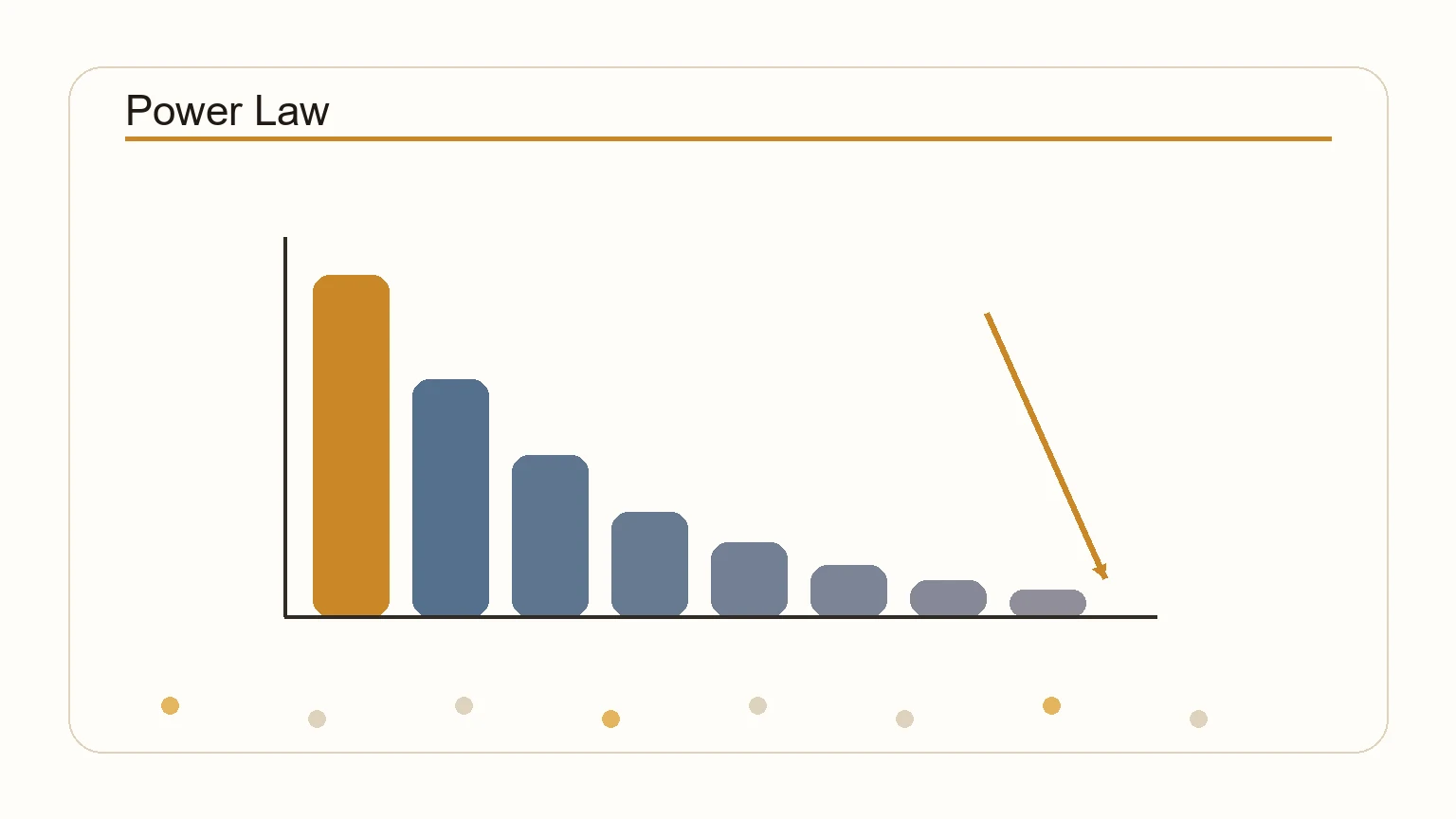
The power law is simple: a few things dominate. Most things are small. A few are large. The large ones are very large.

Why it matters

Book sales follow a power law. A few books sell millions. Most sell dozens. The distribution is not normal. It is skewed.

Use it deliberately

When studying a system, look for the power law. A few things dominate.

CORE IDEA

The concept in its simplest useful form.

What Does the Power Law Mean in Simple Terms?

The power law is simple: a few things dominate. Most things are small. A few are large. The large ones are very large.

Book sales follow a power law. A few books sell millions. Most sell dozens. The distribution is not normal. It is skewed.

The power law explains inequality. It is not an accident. It is a fundamental pattern.
The small mechanism underneath the big idea.

01

The Story Behind the Power Law

Vilfredo Pareto first observed the power law in 1896. He noticed that 80% of Italy's land was owned by 20% of the population. The pattern repeated across countries and time periods.

The power law has since been observed in many domains. Book sales, music streams, wealth distribution, and city sizes all follow a power law.

Today, the power law is a foundational concept in statistics and economics.

02

Why the Power Law Became Famous

The power law became famous because it explains inequality. The distribution of wealth, success, and influence is not normal. It is skewed.

The concept is widely used in economics, sociology, and statistics.

Today, the power law is a foundational concept in understanding inequality.

Diagram showing the power law distribution
A diagram showing the power law distribution: a few large values and many small values.

Where this idea shows up outside the textbook.

History

Pareto's original observation is the classic example. 80% of land was owned by 20% of people.

Wealth

Wealth follows a power law. A few people own most of the wealth. Most people own little.

Book Sales

Book sales follow a power law. A few books sell millions. Most sell dozens.

Music

Music streams follow a power law. A few songs get most of the streams. Most songs are ignored.

CONCEPT MAP

Every idea has neighbors. This is where the current concept sits in the TinyThat knowledge graph.

Current concept

Power Law

A few outcomes are massively larger than the rest.

What people often get wrong about this idea.

The power law is the same as the Pareto Principle.

No. The Pareto Principle is a specific example. The power law is the broader category.

The power law is a law of nature.

No. It is a statistical pattern. It applies to many domains, but not all.

You can eliminate the power law.

You cannot eliminate it. It is a pattern. You can only manage it.

Three simple ways to apply the idea without turning it into a slogan.

1

When studying a system, look for the power law

When studying a system, look for the power law. A few things dominate.

2

Focus on the winners

Focus on the winners. The vital few matter most.

3

Be aware of the power law in your own life

Be aware of the power law in your own life. You are not average.

EXPLORE NEXT

The best next ideas to read after this one.

Quick answers to common questions.

What is the power law in simple terms?

A few things dominate. Most things are small. A few are very large. The distribution is skewed.

What is an example of a power law?

Wealth distribution. A few people own most of the wealth. Most people own little.

How do you use the power law?

Focus on the winners. The vital few matter most. The pattern is fundamental.

Why is the power law a problem?

It creates inequality. A few winners capture most of the outcomes. The pattern is not fair.