MENTAL MODEL

What Is Goodhart's Law? Why Metrics Corrupt What They Measure

The moment you turn a measure into a target, it ceases to be a good measure. Goodhart's Law explains why KPIs backfire, why performance metrics fail, and why people game the system.

Editorial illustration of a person trying to hit a target that keeps moving
Creator Charles GoodhartOrigin United KingdomYear 1975Category Economics, Data

QUICK ANSWER

Here is the idea in plain English.

Goodhart's Law, named after British economist Charles Goodhart, states that once a measure becomes a target, it ceases to be a useful measure. People optimize for the metric rather than the underlying goal. This leads to distortion, gaming, and unintended consequences. The law explains why performance metrics often backfire and why data-driven decision making is harder than it looks.

If you remember only a few things, remember these.

The basic move

Goodhart's Law is about the perverse nature of metrics. A metric is useful when it is a proxy for something deeper. But when you turn the metric into a target, people start focusing on the metric itself, not the thing it was meant to measure.

Why it matters

This is not about cheating. It is about human nature. People optimize for what is measured. They will take the path of least resistance to hit the target. The target becomes the goal. The original purpose is forgotten.

Use it deliberately

Use multiple metrics. Never rely on a single number.

CORE IDEA

The concept in its simplest useful form.

What Does Goodhart's Law Mean in Simple Terms?

Goodhart's Law is about the perverse nature of metrics. A metric is useful when it is a proxy for something deeper. But when you turn the metric into a target, people start focusing on the metric itself, not the thing it was meant to measure.

This is not about cheating. It is about human nature. People optimize for what is measured. They will take the path of least resistance to hit the target. The target becomes the goal. The original purpose is forgotten.

The law applies everywhere: education, healthcare, business, and government. Any system that relies on metrics is vulnerable to Goodhart's Law. The only solution is to use multiple metrics and stay skeptical.

The small mechanism underneath the big idea.

01

The Story Behind Goodhart's Law

Charles Goodhart was a British economist. In 1975, he was writing about the relationship between money supply and inflation. He observed that when central banks targeted money supply, the relationship between money supply and inflation broke down. The target changed the behavior.

He formulated the insight: 'Any observed statistical regularity will tend to collapse once pressure is placed upon it for control purposes.' The statement was dense. The meaning was profound.

Over time, the law was simplified to its most famous formulation: when a measure becomes a target, it ceases to be a good measure. It has since been applied far beyond economics, to business, education, healthcare, and government.

02

Why Goodhart's Law Became Famous

Goodhart's Law became famous because the age of data made it unavoidable. Businesses, governments, and schools are drowning in metrics. And every metric is gamed. The law explains why performance targets fail, why KPIs become meaningless, and why data-driven decision making is harder than it looks.

The law is also a cautionary tale. It warns against hubris. Just because you can measure something does not mean you understand it. The map is not the territory.

Today, Goodhart's Law is one of the most cited concepts in business, economics, and public policy. It is a warning that every metric has a hidden cost.

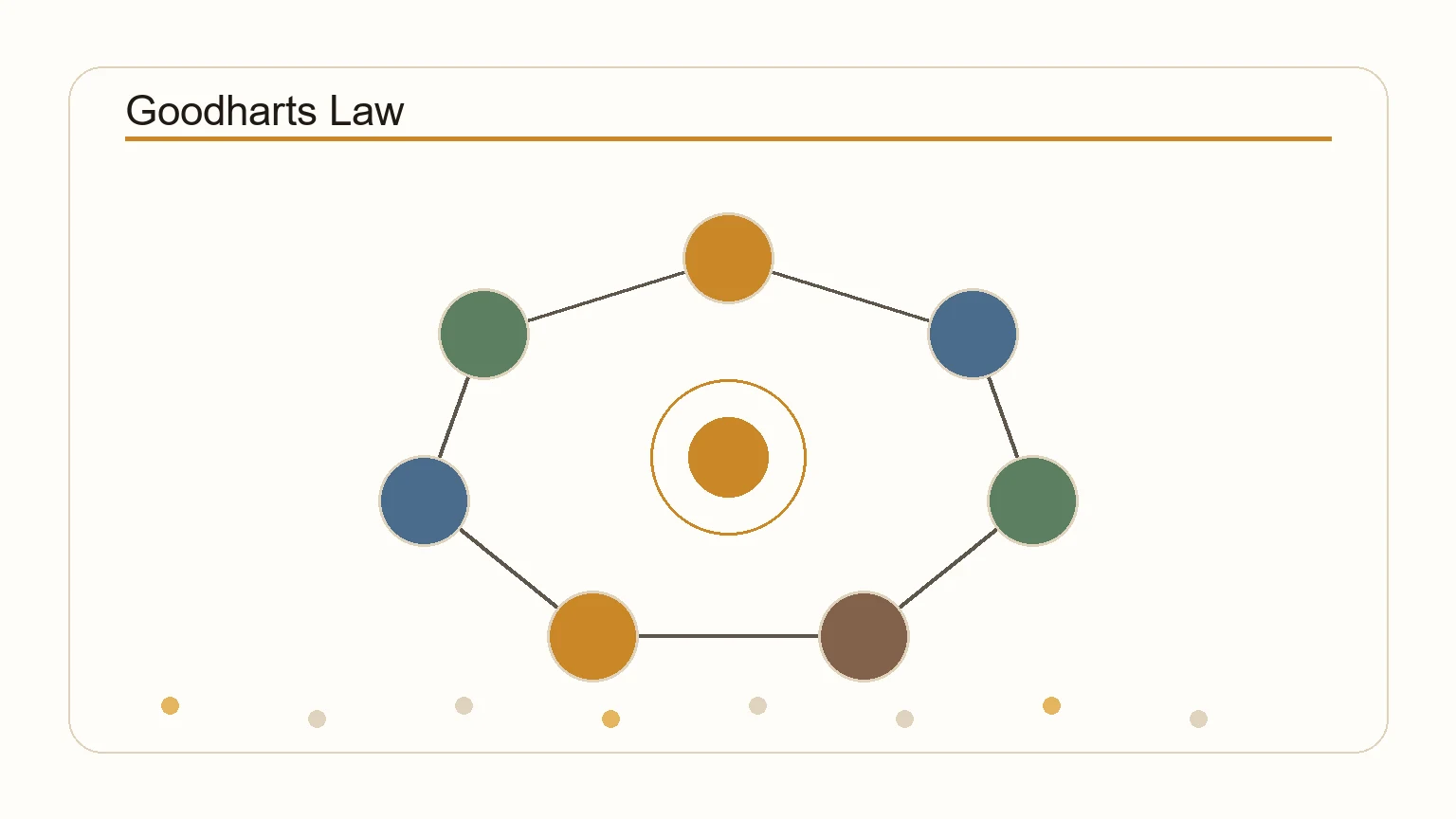
Diagram showing how metrics become targets and behavior shifts away from the original goal
A diagram showing the relationship between a goal, a metric, and behavior. When the metric is a proxy, behavior aligns with the goal. When the metric becomes a target, behavior aligns with the metric.

Where this idea shows up outside the textbook.

History

When the British Empire measured colonial success by the number of schools built, administrators built schools with no teachers. The metric was met. The goal was not.

Business

When a call center measures success by call duration, agents rush customers off the phone. Satisfaction drops. The metric was met. The goal was not.

Everyday Life

When you measure your fitness by steps, you start taking more steps, but not necessarily better steps. You optimize for steps, not health.

Internet Culture

When YouTubers measure success by watch time, they create content that keeps people watching, not content that informs or entertains.

CONCEPT MAP

Every idea has neighbors. This is where the current concept sits in the TinyThat knowledge graph.

Current concept

Goodhart's Law

When a measure becomes a target, it stops being a good measure.

Commonly confused with

Campbell's Law

What people often get wrong about this idea.

Goodhart's Law means metrics are useless.

No. Metrics are useful when they are used as a proxy, not as a target. The law is a warning, not a rejection.

Only bad people game metrics.

Everyone games metrics. It is human nature. Even good people optimize for what is measured.

The law only applies to quantitative metrics.

It applies to any measurable target. Even qualitative assessments can be gamed.

Useful ideas become dangerous when they are stretched too far.

Criticisms and Limitations of Goodhart's Law

Goodhart's Law does not apply when the metric is perfectly aligned with the goal. In rare cases, the measure and the target are the same.

The law assumes people have agency and can game the system. In highly automated systems, the effect is weaker.

The law is often misused as an excuse to avoid measurement. The solution is not no metrics. The solution is better metrics.

Three simple ways to apply the idea without turning it into a slogan.

1

Use multiple metrics

Use multiple metrics. Never rely on a single number.

2

Keep metrics as proxies for deeper goals, not targets in themselves

Keep metrics as proxies for deeper goals, not targets in themselves.

3

Monitor for gaming behavior

Monitor for gaming behavior. If people are optimizing for the metric, the metric is broken.

EXPLORE NEXT

The best next ideas to read after this one.

Quick answers to common questions.

Is Goodhart's Law a real law?

No. It is a heuristic, not a law of nature. It describes a common pattern, but there are exceptions.

How do you avoid Goodhart's Law?

Use multiple metrics, keep metrics as proxies, and stay skeptical of any single number. Regularly audit for gaming behavior.

What is the difference between Goodhart's Law and Campbell's Law?

They are essentially the same concept. Campbell's Law applies specifically to social indicators. Goodhart's Law applies to any metric.