
PHILOSOPHICAL PRINCIPLE

What Is Occam's Razor? The Simplest Explanation Is Often Best

Entities should not be multiplied without necessity. That is the formal version. The simple version is: the simplest explanation is often the best one.

Editorial illustration of a razor cutting away unnecessary assumptions
Creator William of OckhamOrigin EnglandYear c. 1320Category Philosophy, Logic

QUICK ANSWER

Here is the idea in plain English.

Occam's Razor is a principle that states that the simplest explanation is usually the correct one. It was formulated by William of Ockham in the 14th century. The principle is not a law of nature. It is a heuristic for decision making. It says that when you have competing explanations, choose the one that makes the fewest assumptions. The simplest explanation is often the best.

If you remember only a few things, remember these.

The basic move

Occam's Razor is simple: the simplest explanation is often the best. When you have two explanations that explain the same thing, choose the simpler one. It is likely to be correct.

Why it matters

This is not a guarantee. Sometimes the complex explanation is correct. But simplicity is a clue. It is a sign that you are on the right track.

Use it deliberately

When you have competing explanations, choose the simplest one. It is usually correct.

CORE IDEA

The concept in its simplest useful form.

What Does Occam's Razor Mean in Simple Terms?

Occam's Razor is simple: the simplest explanation is often the best. When you have two explanations that explain the same thing, choose the simpler one. It is likely to be correct.

This is not a guarantee. Sometimes the complex explanation is correct. But simplicity is a clue. It is a sign that you are on the right track.

The principle is about parsimony. It is about economy. It is about not overcomplicating things. The world is often simpler than it seems.

The small mechanism underneath the big idea.

01

The Story Behind Occam's Razor

William of Ockham was a Franciscan friar and philosopher in the 14th century. He lived in England and studied logic. He was interested in how to know what is true.

Ockham argued that we should not multiply entities without necessity. He meant that we should not add complexity to explanations unless we have to. Simpler explanations are better.

The principle became known as Occam's Razor. It was a tool for cutting away unnecessary assumptions. It is not a law of nature. It is a heuristic. It says: prefer simplicity.

02

Why Occam's Razor Became Famous

Occam's Razor became famous because it is a powerful tool for thinking. It is simple. It is memorable. It is useful.

The principle has been used in science, philosophy, and everyday life. It is a reminder that complexity is often unnecessary. Simplicity is a virtue.

Today, Occam's Razor is one of the most widely cited principles in decision making. It is a foundation of critical thinking. It is a tool for cutting through noise.

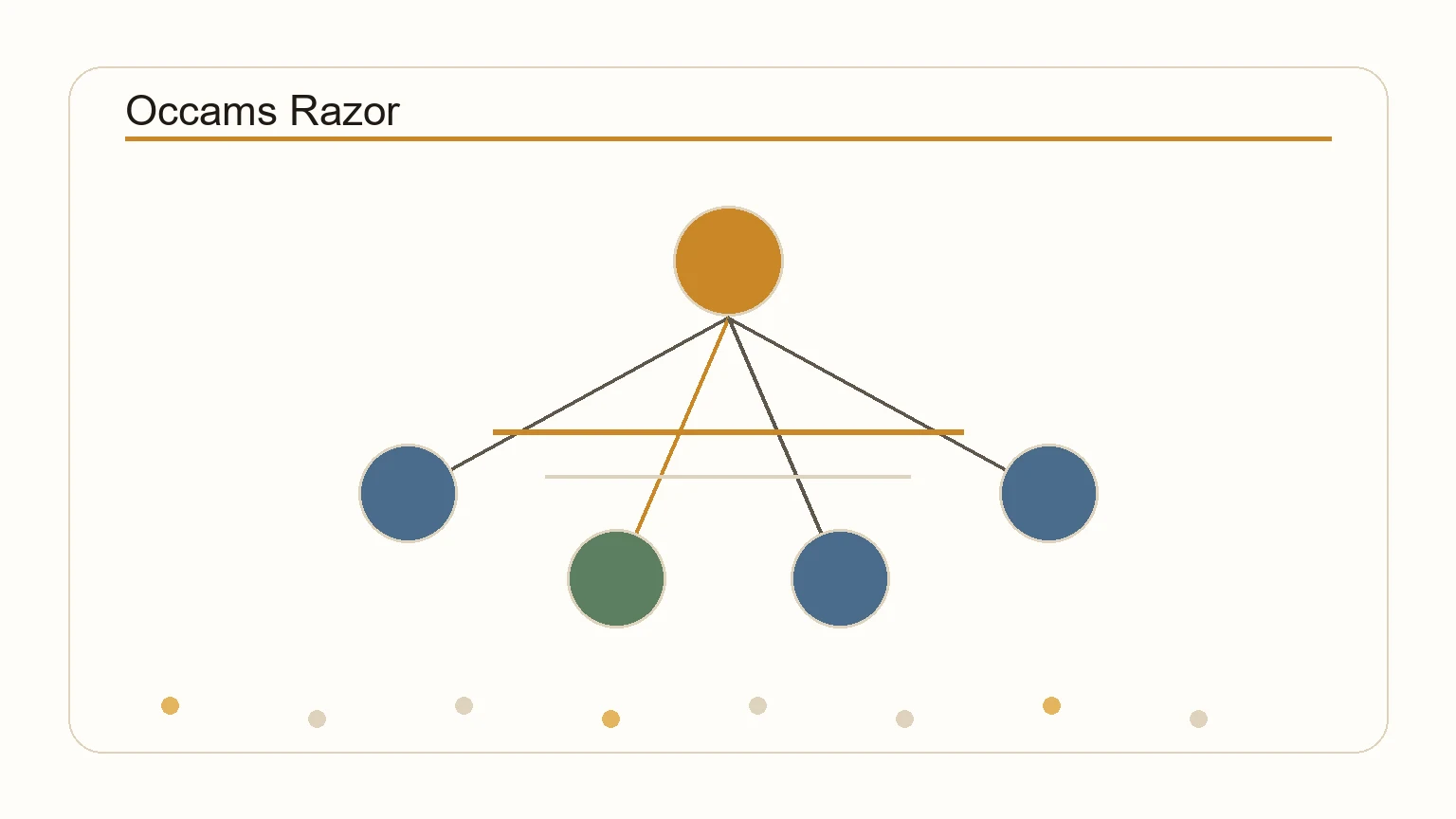
Diagram showing Occam's Razor: choosing the simpler explanation over a complex one
A diagram showing two explanations for the same phenomenon. The simpler explanation is preferred.

Where this idea shows up outside the textbook.

Science

When two theories explain the same data, scientists prefer the simpler one. This is how we avoid adding unnecessary complexity.

Medicine

When a patient has symptoms, doctors look for the simplest explanation first. Occam's Razor is a diagnostic tool.

Everyday Life

You hear a strange noise at night. The simplest explanation is a branch tapping the window. Not a ghost. Occam's Razor applies.

Internet Culture

A viral video has a simple explanation. People invent complex conspiracies. Occam's Razor says: go with the simple explanation.

CONCEPT MAP

Every idea has neighbors. This is where the current concept sits in the TinyThat knowledge graph.

Current concept

Occam's Razor

Prefer the simpler explanation when it fits the evidence.

What people often get wrong about this idea.

Occam's Razor says the simplest explanation is always correct.

No. It says it is usually correct. Sometimes the complex explanation is right. The principle is a heuristic, not a law.

Occam's Razor is a scientific law.

No. It is a philosophical principle. It is a tool for thinking, not a proven fact.

Occam's Razor means you should never think deeply.

No. It means you should not overcomplicate. Simplicity is a tool for clarity, not a substitute for thinking.

Useful ideas become dangerous when they are stretched too far.

Criticisms and Limitations of Occam's Razor

Occam's Razor is a useful principle, but it has limitations. Sometimes the complex explanation is correct. The principle is a heuristic, not a guarantee.

The principle can be misused. Some people use it to dismiss legitimate complexity. Not every complex explanation is unnecessary.

The principle is subjective. What counts as 'simple' is not always clear. One person's simplicity is another person's oversimplification.

Three simple ways to apply the idea without turning it into a slogan.

1

When you have competing explanations, choose the simplest one

When you have competing explanations, choose the simplest one. It is usually correct.

2

When you are overcomplicating a problem, stop

When you are overcomplicating a problem, stop. Ask: what is the simplest solution?

3

When you are adding assumptions, ask: are they necessary? If not, cut them

When you are adding assumptions, ask: are they necessary? If not, cut them.

EXPLORE NEXT

The best next ideas to read after this one.

Quick answers to common questions.

What is Occam's Razor in simple terms?

The simplest explanation is often the best one. When you have two explanations, choose the simpler one.

What is an example of Occam's Razor?

Your car does not start. The simplest explanation is a dead battery. Occam's Razor says: check the battery first.

How do you use Occam's Razor?

When you have competing explanations, choose the simplest one. When you are overcomplicating, stop and simplify.

Why is Occam's Razor a problem?

Sometimes the complex explanation is correct. Occam's Razor is a heuristic, not a guarantee. It is a tool, not a law.