
PHILOSOPHICAL PRINCIPLE

What Is Hanlon's Razor? Don't Assume Malice

Someone does something frustrating. You think they are trying to upset you. Hanlon's Razor says: maybe they are just being careless. The simplest explanation is often incompetence, not ill intent.

Editorial illustration of a person assuming incompetence instead of malice
Creator Robert J. Hanlon (attributed)Origin United StatesYear c. 1980Category Philosophy, Decision Making

QUICK ANSWER

Here is the idea in plain English.

Hanlon's Razor states: never attribute to malice that which can be adequately explained by stupidity. It is a philosophical principle for interpreting human behavior. When someone does something that harms you, assume incompetence before assuming ill intent. The principle is a tool for reducing conflict, anger, and misunderstanding.

If you remember only a few things, remember these.

The basic move

Hanlon's Razor is simple: do not assume ill intent. When someone does something that hurts you, assume they made a mistake. Assume they are being careless. Do not assume they are being malicious.

Why it matters

This is not about being naive. It is about being practical. Most people are not trying to harm you. They are just being human. They are making mistakes. They are not paying attention.

Use it deliberately

When someone does something that hurts you, pause. Ask: is it malice or incompetence? Choose incompetence first.

CORE IDEA

The concept in its simplest useful form.

What Does Hanlon's Razor Mean in Simple Terms?

Hanlon's Razor is simple: do not assume ill intent. When someone does something that hurts you, assume they made a mistake. Assume they are being careless. Do not assume they are being malicious.

This is not about being naive. It is about being practical. Most people are not trying to harm you. They are just being human. They are making mistakes. They are not paying attention.

Assuming malice makes you angry. It creates conflict. It destroys relationships. Hanlon's Razor is a tool for peace. It helps you avoid unnecessary conflict.

The small mechanism underneath the big idea.

01

The Story Behind Hanlon's Razor

Hanlon's Razor is named after Robert J. Hanlon, who reportedly submitted it as a joke to a book of quotations. The principle was popularized in the 1980s and became a classic saying.

The idea is much older. Variations of the principle have existed for centuries. The core insight is: people are often careless, not cruel. Misunderstanding is more common than malice.

The principle is a cousin to Occam's Razor. Both are about choosing the simplest explanation. Hanlon's Razor applies to human behavior. Occam's Razor applies more broadly.

02

Why Hanlon's Razor Became Famous

Hanlon's Razor became famous because it is a relief. It is a relief to think that people are not trying to hurt you. It is a relief to give people the benefit of the doubt.

The principle is also a tool for peace. It reduces conflict. It reduces anger. It makes relationships easier.

Today, Hanlon's Razor is a popular saying. It is quoted in offices, homes, and online. It is a reminder to be generous in your interpretations.

Diagram showing Hanlon's Razor: preferring incompetence over malice as an explanation
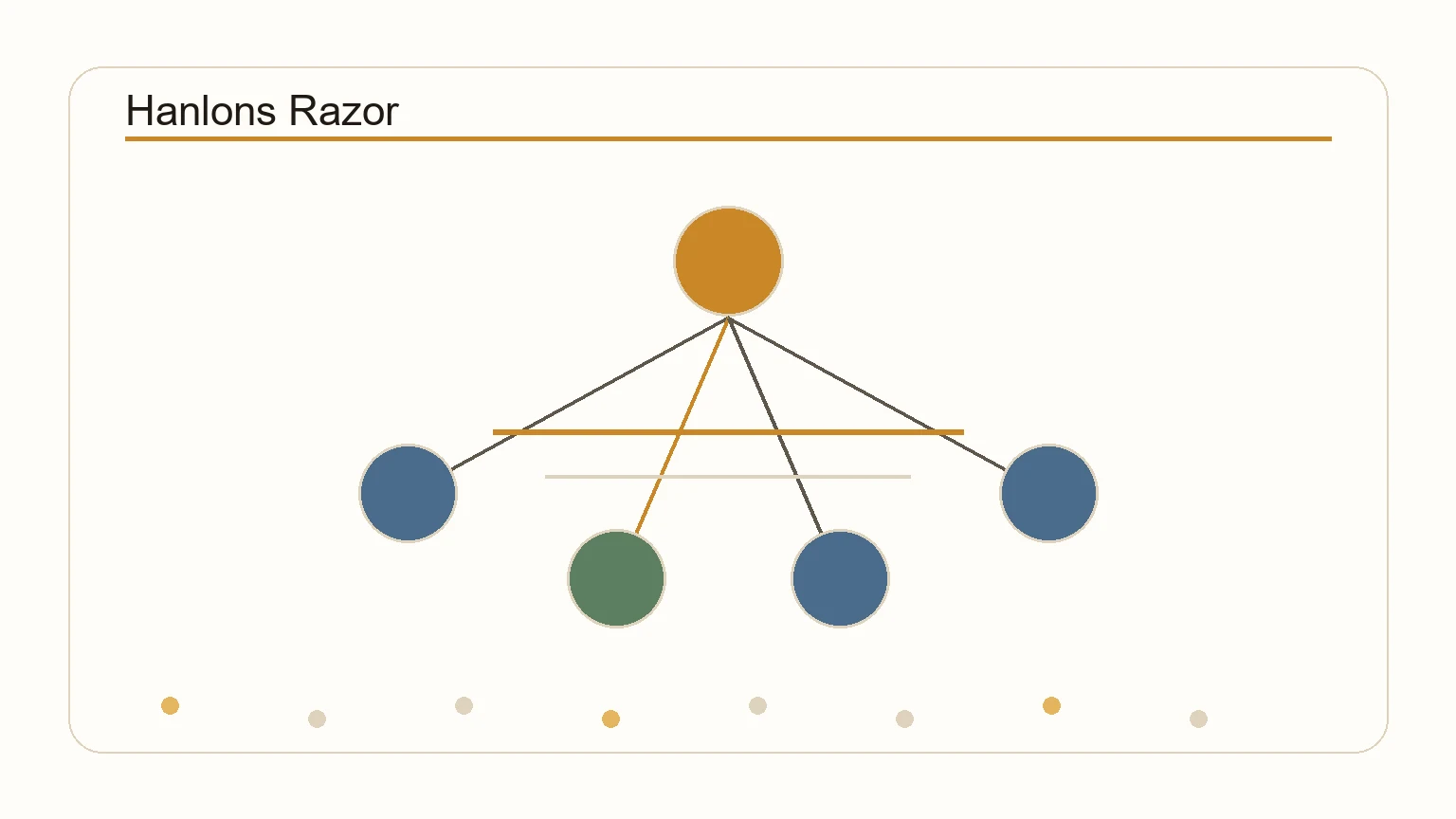
A diagram showing two interpretations of the same action: malice vs. incompetence. Hanlon's Razor prefers incompetence.

Where this idea shows up outside the textbook.

History

The principle was popularized by Robert J. Hanlon in the 1980s. It has been quoted widely ever since.

Workplace

A coworker misses a deadline. You think they are trying to sabotage you. Hanlon's Razor says: maybe they are just overwhelmed. Assume incompetence, not malice.

Everyday Life

A friend says something hurtful. You think they are trying to upset you. Hanlon's Razor says: maybe they are not paying attention. Assume carelessness, not cruelty.

Internet Culture

Someone posts a controversial opinion. You think they are a troll. Hanlon's Razor says: maybe they are genuinely ignorant. Assume ignorance, not ill intent.

CONCEPT MAP

Every idea has neighbors. This is where the current concept sits in the TinyThat knowledge graph.

Current concept

Hanlon's Razor

Do not assume malice when error or incompetence explains it.

What people often get wrong about this idea.

Hanlon's Razor means you should never assume malice.

No. It means you should not assume malice as the first explanation. Sometimes malice is real. But it is often not.

Hanlon's Razor is an excuse for bad behavior.

No. It is a tool for understanding. It is not a permission slip for incompetence. It is a way to avoid unnecessary conflict.

Hanlon's Razor applies to everything.

No. It applies to human behavior. It is a tool for interpreting actions. It is not a law of nature.

Useful ideas become dangerous when they are stretched too far.

Criticisms and Limitations of Hanlon's Razor

Hanlon's Razor is a useful principle, but it has limitations. Sometimes people are malicious. The principle does not deny that. It is a heuristic for first interpretations.

The principle can be misused. Some people use it to excuse bad behavior. They say 'it was not malice, it was incompetence' and avoid accountability. That is a misuse.

The principle can also be overused. Not every mistake is incompetence. Sometimes people are just careless. But incompetence is not always the explanation.

Three simple ways to apply the idea without turning it into a slogan.

1

When someone does something that hurts you, pause

When someone does something that hurts you, pause. Ask: is it malice or incompetence? Choose incompetence first.

2

Give people the benefit of the doubt

Give people the benefit of the doubt. Most people are not trying to hurt you. They are just being human.

3

Use the principle to reduce conflict

Use the principle to reduce conflict. Anger is expensive. Peace is cheap.

EXPLORE NEXT

The best next ideas to read after this one.

Quick answers to common questions.

What is Hanlon's Razor in simple terms?

Never assume someone is trying to hurt you when they could just be making a mistake. Most people are careless, not cruel.

What is an example of Hanlon's Razor?

Someone cuts you off in traffic. Instead of assuming they are a bad person, assume they did not see you. Incompetence over malice.

How do you use Hanlon's Razor?

When someone does something that hurts you, ask: is it malice or incompetence? Choose incompetence first.

Why is Hanlon's Razor a problem?

Sometimes people are malicious. The principle is a heuristic, not a denial of reality. It is a tool for first interpretations, not a final judgment.