Everyone else has always heard your true, air-conducted voice; the recording isn't distorting anything, it's simply the first time you're hearing what they've heard all along.
Body & Brain
Why does your voice sound different when you hear it recorded?
Why Does Your Voice Sound Different on a Recording?
The first time most people hear a recording of their own voice, the reaction is nearly universal: that doesn't sound like me.
On this page
The short answer
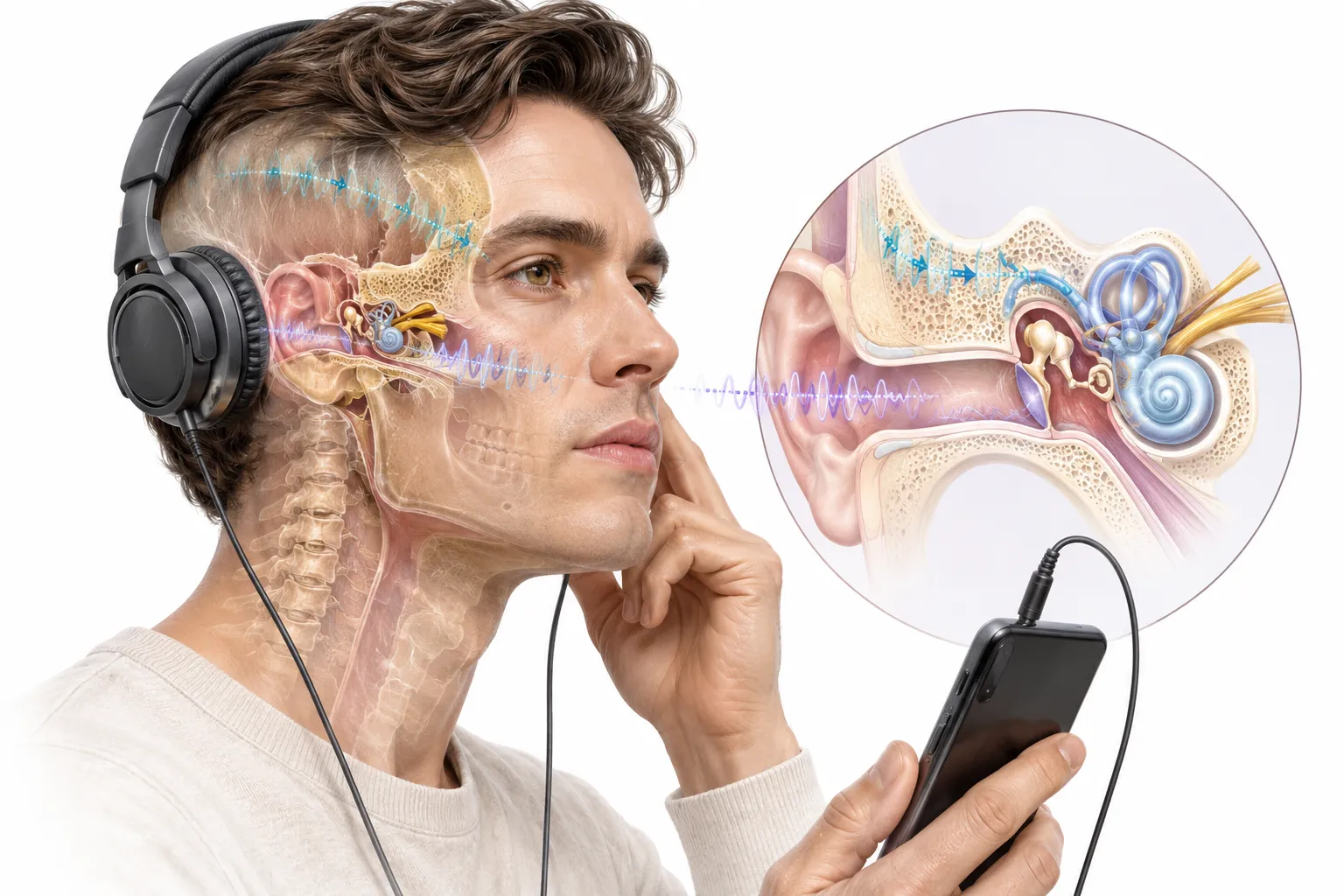
Your recorded voice sounds different because when you speak normally, you hear a blend of sound traveling through the air and sound conducted through the bones of your skull, and bone conduction emphasizes lower frequencies that a recording, capturing only air-conducted sound, doesn't include.
When you speak, sound waves travel two separate paths to your inner ear. The first is the conventional path, sound leaving your mouth, traveling through air, and entering your ear canal, exactly the way it reaches anyone listening to you. The second path is bone conduction, vibrations from your vocal cords traveling directly through the bones of your skull and jaw to your inner ear. Bone conducts lower frequencies more efficiently than air, which means the version of your voice you hear internally sounds richer and deeper than the version everyone else hears. A recording only captures the air-conducted path, the same version other people have heard all along, which is why it sounds thinner, higher-pitched, and unfamiliar compared to what you're used to hearing in your own head.
At a glance
All voice sound starts from the same vibrating source.
Recording equipment distorts or changes your real voice.
When you talk, part of what you hear comes from sound vibrating through the bones of your skull directly into your inner ear, a private channel no recording device can capture.
Imagine listening to a concert with one speaker playing through open air and a second, private speaker wired directly into your skull, both playing at once. Recordings only ever capture the first speaker.
Diagram
Why Does Your Voice Sound Different on a Recording: the idea in one diagram
Voice perception during speech blends two separate transmission pathways, air conduction and bone conduction, and recordings capture only the air-conducted portion.
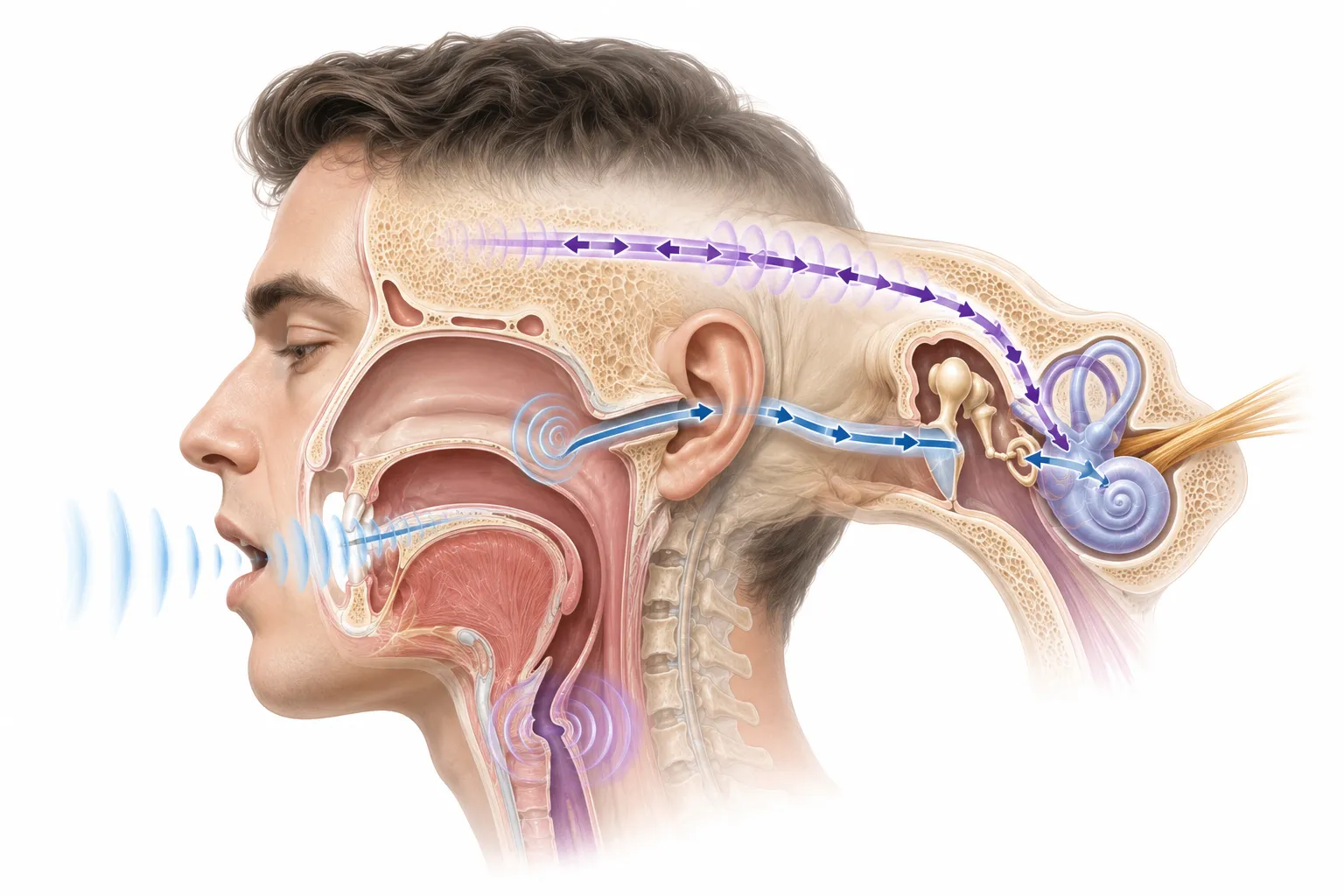
- 1Vocal cords vibrate
All voice sound starts from the same vibrating source.
- 2Sound travels through air to the ear
This is the only pathway a microphone or recording device can capture.
- 3Sound also travels through bone
Bone conduction gives you a private, second version of your own voice.
- 4The brain blends both signals
What you hear yourself say is a personalized mix no one else has access to.
How it works
The mechanism
Voice perception during speech blends two separate transmission pathways, air conduction and bone conduction, and recordings capture only the air-conducted portion.
- Step 01
Vocal cords vibrate
Speaking causes the vocal cords to vibrate, generating sound waves that radiate outward through the throat and mouth.
Like plucking a guitar string, setting off vibrations that travel outward.
All voice sound starts from the same vibrating source.
- Step 02
Sound travels through air to the ear
Part of the sound leaves the mouth, travels through the air, and enters the ear canal in the conventional way, exactly as it reaches anyone else listening.
Like sound traveling from a speaker across a room.
This is the only pathway a microphone or recording device can capture.
- Step 03
Sound also travels through bone
Simultaneously, vibrations from the vocal cords travel directly through the bones of the jaw and skull to the inner ear, a pathway unique to the speaker.
Like feeling a vibration through a table rather than hearing it through the air.
Bone conduction gives you a private, second version of your own voice.
- Step 04
The brain blends both signals
The inner ear and brain combine the air-conducted and bone-conducted signals into a single perceived voice, which sounds fuller and deeper than the air-only version everyone else hears.
Like mixing two audio tracks together into one final sound.
What you hear yourself say is a personalized mix no one else has access to.
Surprises
Facts worth sitting with
Everyone else has always heard your true, air-conducted voice; the recording isn't distorting anything, it's simply the first time you're hearing what they've heard all along.
Surprising facts
What seems backwards
Worth comparing
In everyday life
Easy to get wrong
Pressure points
Where the simple answer gets interesting
Why does bone-conducted sound emphasize lower frequencies?
Bone is a denser medium than air and transmits lower-frequency vibrations more efficiently than higher ones, which naturally boosts the perceived bass of your own voice when you hear it internally.
The physical material your skull is made of quietly shapes how you perceive yourself talking.
Does everyone dislike their recorded voice, or is it just unfamiliar?
Research suggests the negative reaction is driven primarily by unfamiliarity and a mismatch with self-expectation rather than the recorded voice being objectively less pleasant, since outside listeners typically rate it as completely normal.
The discomfort says more about surprise than about actual sound quality.
Can you train yourself to get used to your recorded voice?
Yes, repeated exposure to hearing one's own recorded voice, such as through public speaking practice or podcasting, tends to reduce the discomfort over time as the brain updates its expectation of what your voice sounds like.
Familiarity, not the sound itself, turns out to be the main variable.
Behind the science
The story behind it
Public speakers and podcasters adjusting to recorded voice
Many professional speakers and podcasters report that early recordings of themselves felt jarring, but repeated listening gradually reduced the discomfort.
Their experience illustrates how the brain can adapt its self-expectation with enough exposure.
Discomfort with a true reflection of yourself can fade with familiarity rather than requiring the reflection to change.
Self-perception studies comparing recorded and internal voice ratings
Researchers asked participants to rate their own recorded voice and compared it to ratings from outside listeners hearing the same recording.
Participants consistently rated their own recorded voice less favorably than outside listeners did, despite hearing an identical recording.
Clarify
Myth and reality
Myth
Recording equipment distorts or changes your real voice.
Reality
Modern recording equipment typically captures the air-conducted voice accurately; the perceived difference comes from the missing bone-conduction channel your brain normally adds in.
Evidence
Acoustic analysis shows recorded voices closely match the air-conducted sound others hear when speaking to you directly, not a distorted version of it.
Looking closer
The deeper pattern
The gap between how you sound to yourself and how you sound to everyone else is a small, constant reminder that self-perception is never quite the same as outside perception.
One way to think about it
People often build an internal model of themselves that differs meaningfully from how others actually experience them, and hearing a recorded voice is one of the rare moments that gap becomes undeniably audible.
What you experience from the inside is not always what the world experiences from the outside.
Limits
Where the explanation bends
People who are congenitally deaf receiving cochlear implants later in life.
Because they never developed a lifelong internal voice expectation through bone conduction and air conduction combined the typical way, their reaction to hearing recorded voices, including their own, can differ from typical patterns.
It highlights just how much of the recorded-voice reaction depends on years of built-up expectation rather than the sound itself.
In daily life
What this helps you notice
Understanding the bone-conduction effect can ease anxiety around hearing your own voice in recordings, videos, or voicemail.
Public speaking coaches often explain the bone-conduction phenomenon specifically to reduce clients' self-consciousness about their recorded voice.
Remember
Key takeaways
- 1
Your normal voice perception blends air-conducted and bone-conducted sound, while recordings capture only air conduction.
- 2
Bone conducts lower frequencies more efficiently, making your internally heard voice sound deeper than your recorded voice.
- 3
Everyone else has always heard the air-conducted version of your voice, the same one a recording captures.
- 4
Discomfort with recorded voice is largely about unfamiliarity, not actual sound quality, according to listener studies.
- 5
Repeated exposure to your recorded voice can reduce the discomfort as the brain updates its self-expectation.
The voice in your head has been getting a private bass boost your entire life, courtesy of your own skull, and a recording is simply the first honest playback everyone else has been hearing all along.
That cringe of hearing yourself on a recording isn't a flaw in your voice, it's the sound of your brain meeting a version of you it's never technically heard before.
Read around the idea
More questions with the same curious pull
Nearby doors from the TinyThat archive, chosen by topic, intent, and reader curiosity.

Body & Brain
Why Does Your Voice Crack?
Sudden shifts in vocal cord tension or hormonal changes can cause the voice to briefly break or crack.
Body & Brain
Can the Brain Feel Pain?
The brain controls all pain in your body, yet it cannot feel pain itself. Discover why, and what this strange fact re...

Body & Brain
Does Your Brain Eat Itself?
Your brain really does consume parts of itself. Learn about autophagy, synaptic pruning, and why self-consumption is...