The blind spot in each eye is large enough that an object roughly the size of several full moons placed side by side could disappear into it at arm's length under the right conditions.
Body & Brain
Why does the human eye have a blind spot?
Why Do We Have a Blind Spot?
Right now, each of your eyes is missing a small patch of visual information, and you have never once noticed it.
On this page
The short answer
We have a blind spot because the optic nerve and blood vessels exit through a small area of the retina that contains no light-sensing photoreceptor cells, and the brain compensates by using visual information from the surrounding area and the other eye to seamlessly fill in the gap.
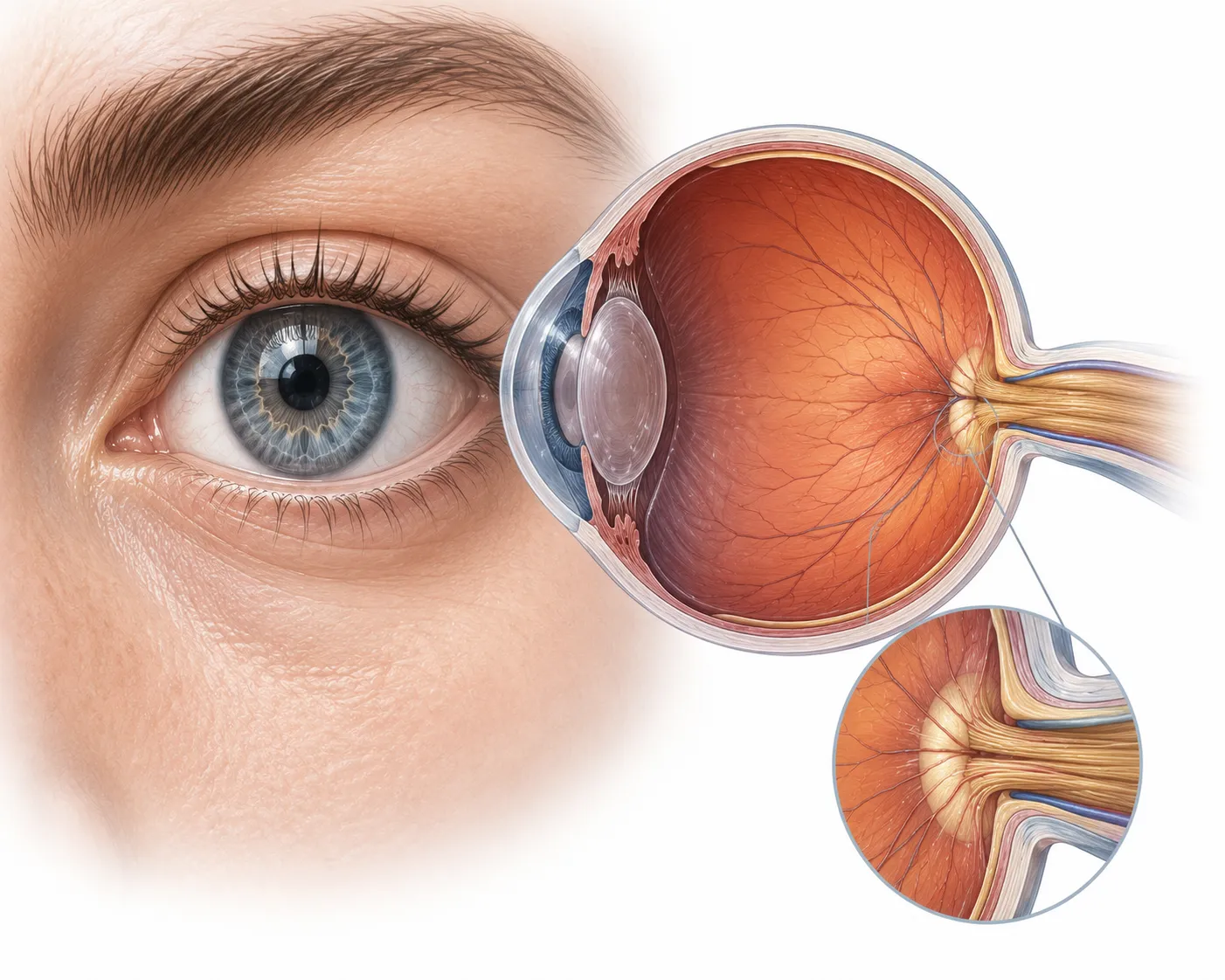
The retina lining the back of each eye is covered with photoreceptor cells that detect light and convert it into signals sent to the brain. Those signals need to travel somewhere, and they exit the eye bundled together as the optic nerve, along with the blood vessels that supply the retina. At the exact point where this bundle passes through the retina to exit the eyeball, there is simply no physical space for photoreceptor cells, creating a small gap with no light detection at all. This gap is called the optic disc, and it produces a genuine blind spot in each eye's field of vision. Under normal circumstances, this blind spot goes completely unnoticed because the brain fills the gap using visual information from the surrounding area, a process sometimes called perceptual filling-in, combined with the fact that both eyes rarely have their blind spots aligned on the same part of a scene at the same time, so one eye typically covers what the other misses.
At a glance
Vision starts with near-complete coverage of light-sensing cells across the retina.
The blind spot is just an area of blurry or weak vision, similar to peripheral vision.
The retina's light-sensing cells cover almost the entire back of the eye except for one small region, the point where the optic nerve and blood vessels bundle together and pass through on their way to the brain.
Picture a security camera feed with a tiny patch permanently blacked out because the camera's own cable runs straight through the middle of the lens.
Diagram
Why Do We Have a Blind Spot: the idea in one diagram
The optic nerve and retinal blood vessels exit the eye through a single point with no room for photoreceptor cells, creating a blind spot that the brain compensates for using surrounding visual information and input from the other eye.
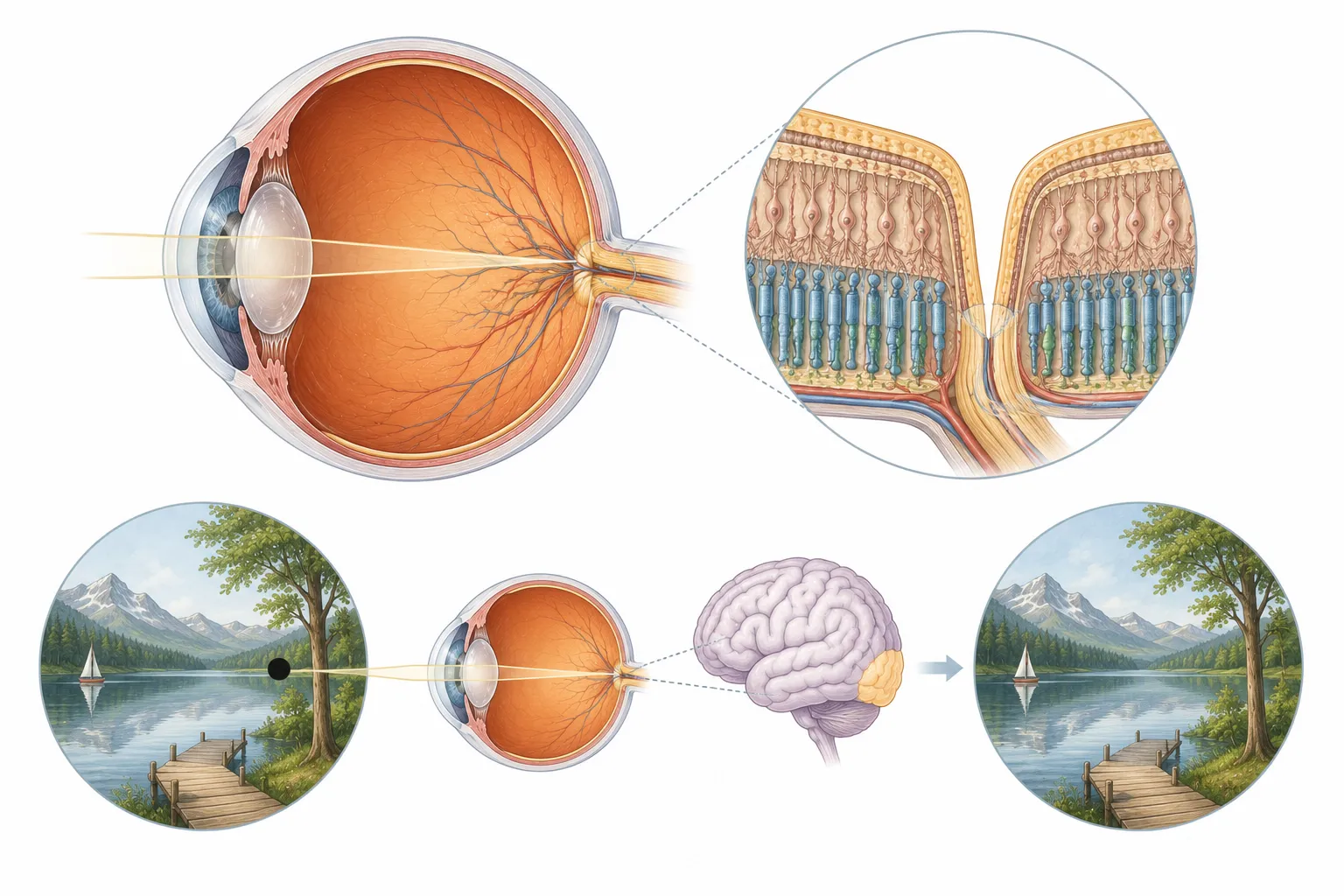
- 1Photoreceptor cells cover most of the retina
Vision starts with near-complete coverage of light-sensing cells across the retina.
- 2The optic nerve must exit through the retina
The optic nerve's exit point requires physical space that photoreceptor cells cannot occupy.
- 3That exit point contains no photoreceptors
This structural necessity creates a genuine gap in visual data for each eye.
- 4The brain fills the gap using context and the other eye
The seamless experience of vision depends on active reconstruction, not just raw sensory input.
How it works
The mechanism
The optic nerve and retinal blood vessels exit the eye through a single point with no room for photoreceptor cells, creating a blind spot that the brain compensates for using surrounding visual information and input from the other eye.
- Step 01
Photoreceptor cells cover most of the retina
The retina lining the back of the eye is covered with light-sensing photoreceptor cells called rods and cones, which detect incoming light and begin the process of converting it into neural signals.
Like the sensor grid inside a digital camera capturing incoming light across nearly its entire surface.
Vision starts with near-complete coverage of light-sensing cells across the retina.
- Step 02
The optic nerve must exit through the retina
Signals from every photoreceptor cell need to travel to the brain, and they converge into the optic nerve, which must physically pass through the retina at a single point to exit the eyeball.
Like a cable bundle that has to pass through the middle of a sensor panel to reach the device that processes its signal.
The optic nerve's exit point requires physical space that photoreceptor cells cannot occupy.
- Step 03
That exit point contains no photoreceptors
At the optic disc, the specific spot where the optic nerve and blood vessels pass through, there is no room for light-sensing cells, creating a small area with zero visual input.
Like a blacked-out patch on a camera sensor exactly where its own cable physically passes through.
This structural necessity creates a genuine gap in visual data for each eye.
- Step 04
The brain fills the gap using context and the other eye
The brain uses surrounding visual patterns and, when both eyes are open, information from the other eye's differing blind spot location, to seamlessly reconstruct a complete-feeling visual scene.
Like photo-editing software intelligently patching a small missing section of an image using the surrounding pixels.
The seamless experience of vision depends on active reconstruction, not just raw sensory input.
Surprises
Facts worth sitting with
The blind spot in each eye is large enough that an object roughly the size of several full moons placed side by side could disappear into it at arm's length under the right conditions.
Surprising facts
What seems backwards
Worth comparing
In everyday life
Easy to get wrong
Pressure points
Where the simple answer gets interesting
Why doesn't the brain just leave the blind spot as a visible black hole?
The brain uses surrounding visual context and pattern information from nearby areas of the retina to construct a plausible continuation of the scene across the blind spot, a process built into how visual perception is assembled rather than passively received.
It reveals that vision is far more of an active construction by the brain than a simple, passive video feed.
Why doesn't having two eyes eliminate the blind spot entirely?
Because each eye's blind spot corresponds to a different part of the visual field, when both eyes are open the other eye typically supplies the missing information for whatever the first eye's blind spot is covering, though brief moments of true overlap can still occur.
Binocular vision quietly solves a problem most people never even realize exists.
Do other animals have a similar blind spot?
Many vertebrate animals with a comparable retinal structure, including most mammals, have an analogous blind spot where their optic nerve exits the eye, though the exact size and impact vary by species and eye anatomy.
A quirk of human vision turns out to be a shared structural trait across a huge portion of the animal kingdom.
Behind the science
The story behind it
Classroom and clinical blind spot demonstrations
Simple paper-based tests involving a dot and a cross, closing one eye and adjusting viewing distance, have been used for generations to let people directly experience their own blind spot.
These demonstrations remain one of the most accessible ways for anyone to personally observe the brain's perceptual filling-in process at work.
Some of the most striking demonstrations of how the brain constructs reality require nothing more than a piece of paper and a pen.
Perceptual filling-in studies using patterned backgrounds
Researchers presented patterned or textured backgrounds positioned over a subject's blind spot to study exactly what the brain generates to fill the gap.
The brain was found to extend surrounding patterns, colors, and textures directly across the blind spot rather than leaving it blank or gray.
Clarify
Myth and reality
Myth
The blind spot is just an area of blurry or weak vision, similar to peripheral vision.
Reality
The blind spot represents a complete absence of visual data at that precise point, structurally different from the naturally lower resolution of peripheral vision.
Evidence
Photoreceptor cell mapping of the retina shows zero photoreceptor coverage specifically at the optic disc location.
Looking closer
The deeper pattern
The brain doesn't show you reality exactly as it is; it shows you a carefully constructed, gap-filled version of reality that feels complete.
One way to think about it
Systems that appear seamless from the outside are often quietly patched together from incomplete raw material, with the seams smoothed over so effectively that the patching itself becomes invisible.
A flawless-seeming experience doesn't mean the underlying system had no flaws, it often means those flaws were successfully compensated for.
Limits
Where the explanation bends
People with certain optic nerve or retinal conditions.
Conditions such as glaucoma can enlarge the blind spot or create additional blind areas, which patients may or may not consciously notice depending on how effectively the brain compensates.
The same filling-in process that hides the normal blind spot can also mask the early stages of certain serious eye conditions.
In daily life
What this helps you notice
Understanding the blind spot explains why closing one eye while focused on a specific point can occasionally make a small object briefly disappear.
Some drivers are taught to be aware of blind spot effects when checking mirrors with one eye effectively dominant in certain viewing angles.
Remember
Key takeaways
- 1
The blind spot exists where the optic nerve and blood vessels exit the eye through the retina.
- 2
This exit point, the optic disc, contains no light-sensing photoreceptor cells.
- 3
The brain fills the resulting gap using surrounding visual information, a process called perceptual filling-in.
- 4
Each eye's blind spot sits in a different part of the visual field, so the two eyes typically cover for each other.
- 5
Simple paper-based demonstrations can make the normally invisible blind spot directly noticeable.
A permanent hole exists in your vision at this very moment, and the fact that you cannot see it is itself a small, ongoing act of construction by your brain.
Every seamless glance around a room is quietly built on top of a gap your brain has been expertly papering over since the moment you opened your eyes.
Read around the idea
More questions with the same curious pull
Nearby doors from the TinyThat archive, chosen by topic, intent, and reader curiosity.

Body & Brain
Why Do We Sneeze in the Sun?
Sudden bright light can trigger a sneeze reflex in some people due to overlapping nerve pathways between the eyes and...

Body & Brain
Why Do We Get Motion Sickness?
Motion sickness arises when the inner ear, eyes, and body send the brain conflicting signals about movement.
Body & Brain
Can the Brain Feel Pain?
The brain controls all pain in your body, yet it cannot feel pain itself. Discover why, and what this strange fact re...