Researchers have used real-time MRI imaging to capture the exact moment a joint cracks, confirming the sound coincides with a visible gas bubble event inside the joint fluid, not bone movement.
Body & Brain
Why does your back crack when you stretch or twist?
Why Does Your Back Crack?
That satisfying pop from twisting your back feels like something shifting into place, but the real story is happening at the microscopic level of gas and fluid.
On this page
The short answer
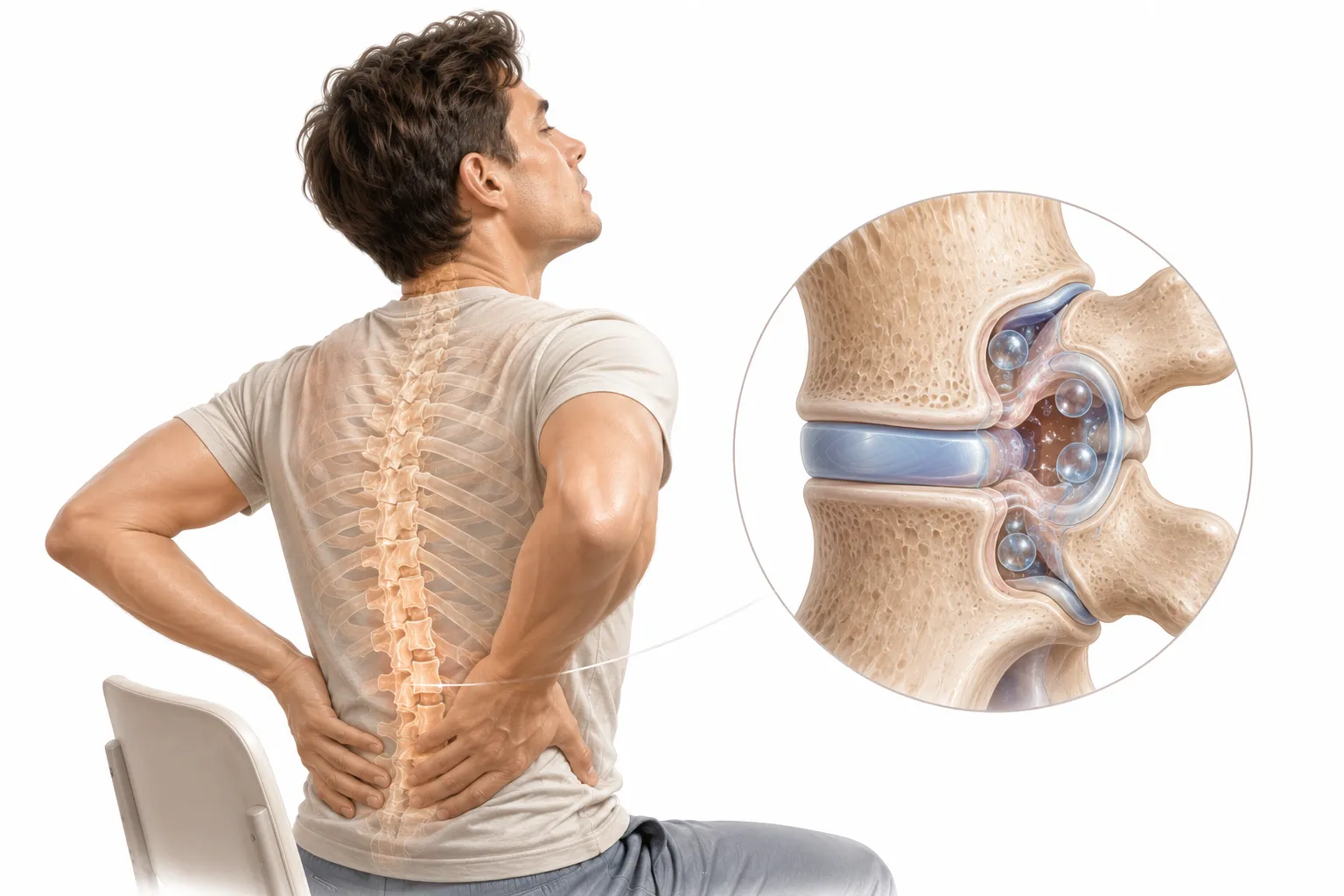
The cracking sound from your back comes from tiny gas bubbles, mostly carbon dioxide, rapidly forming or collapsing within the synovial fluid that lubricates the small joints between spinal vertebrae, triggered by a sudden change in pressure when the joint is stretched or twisted.
The small facet joints between vertebrae, like most joints in the body, are surrounded by a capsule containing synovial fluid, which lubricates and cushions joint movement. This fluid naturally contains dissolved gases. When a joint is stretched, twisted, or pulled beyond its normal resting position, the space within the joint capsule briefly expands, dropping the pressure inside. That pressure drop causes dissolved gas to rapidly form a bubble, or in some explanations causes an existing microbubble to collapse, and either process releases a quick, audible pop. Afterward, the gas gradually redissolves back into the fluid over roughly twenty minutes, which is why the same joint typically can't be cracked again right away.
At a glance
The stretch itself is what sets off the pressure change inside the joint.
Cracking your back causes arthritis over time.
It takes roughly twenty minutes for the gas to fully redissolve back into the joint fluid after a crack, which is why you usually can't crack the same joint again immediately.
Picture pulling apart two suction-cupped surfaces stuck together; the pop you hear is the sudden pressure change as the seal breaks, not the surfaces themselves breaking.
Diagram
Why Does Your Back Crack: the idea in one diagram
Back cracking results from a rapid pressure change inside spinal facet joints, causing dissolved gas in the synovial fluid to form and then collapse as a bubble, producing an audible pop.
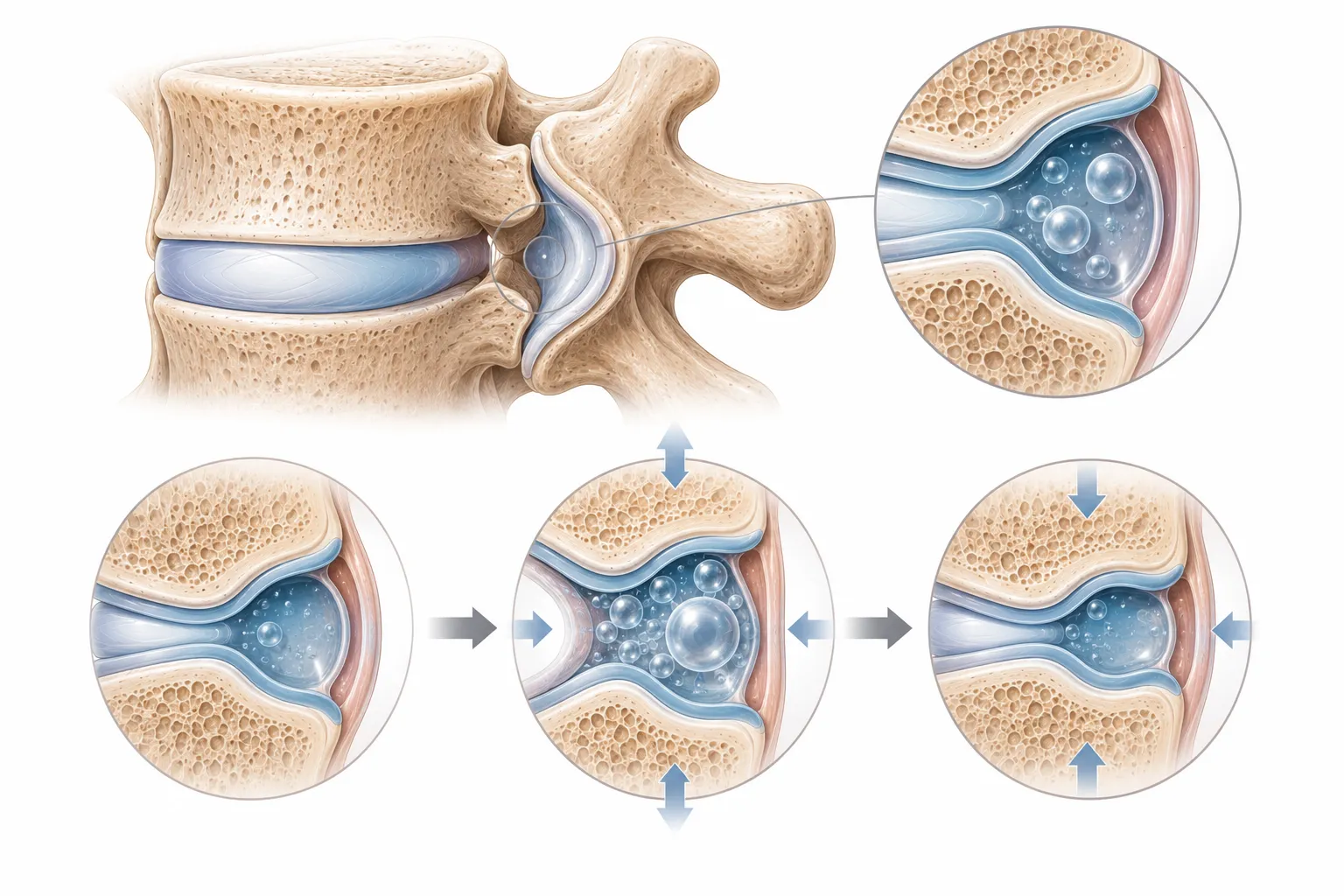
- 1Joint stretches beyond its resting range
The stretch itself is what sets off the pressure change inside the joint.
- 2Pressure inside the joint capsule drops
This pressure change is the direct trigger for what happens next.
- 3A gas bubble forms and collapses
The sound is a physics event in the fluid, not a bone moving into place.
- 4Gas gradually redissolves
This recovery period explains why you can't crack the same joint again immediately.
How it works
The mechanism
Back cracking results from a rapid pressure change inside spinal facet joints, causing dissolved gas in the synovial fluid to form and then collapse as a bubble, producing an audible pop.
- Step 01
Joint stretches beyond its resting range
Twisting or stretching the back pulls the small facet joints between vertebrae slightly beyond their normal resting position.
Like stretching a rubber band slightly past its relaxed length.
The stretch itself is what sets off the pressure change inside the joint.
- Step 02
Pressure inside the joint capsule drops
As the joint capsule expands slightly during the stretch, the pressure of the enclosed synovial fluid drops rapidly.
Like the sudden pressure drop when pulling apart two suction cups.
This pressure change is the direct trigger for what happens next.
- Step 03
A gas bubble forms and collapses
The pressure drop causes dissolved gas, mostly carbon dioxide, to rapidly form a bubble within the fluid, and its formation or collapse generates the popping sound.
Like the pop of a can opening when internal pressure suddenly equalizes with the outside air.
The sound is a physics event in the fluid, not a bone moving into place.
- Step 04
Gas gradually redissolves
Over about twenty minutes, the released gas redissolves back into the synovial fluid, restoring the joint to its pre-crack state.
Like carbonation slowly settling back into a soda after it's been shaken and opened.
This recovery period explains why you can't crack the same joint again immediately.
Surprises
Facts worth sitting with
Researchers have used real-time MRI imaging to capture the exact moment a joint cracks, confirming the sound coincides with a visible gas bubble event inside the joint fluid, not bone movement.
Surprising facts
What seems backwards
Worth comparing
In everyday life
Easy to get wrong
Pressure points
Where the simple answer gets interesting
Why can't you crack the same joint again right away?
After a crack, the released gas takes roughly twenty minutes to fully redissolve back into the surrounding synovial fluid, and until it does, there isn't enough dissolved gas available to form another bubble and produce another pop.
Your joints essentially need a short recovery period before they can perform the same trick again.
Is cracking your back actually bad for you?
Most current research finds no strong link between occasional back or joint cracking and long-term damage or arthritis, though cracking a joint forcefully or in an unnatural direction can strain surrounding muscles or ligaments.
A habit widely assumed to be harmful has held up reasonably well under actual scientific scrutiny.
How did scientists confirm what actually causes the popping sound?
Researchers used real-time MRI imaging of finger joints being cracked, which allowed them to directly observe the formation of a gas cavity within the joint fluid at the exact moment the popping sound occurred.
It took cutting-edge imaging technology to finally settle a debate about something almost everyone has personally experienced.
Behind the science
The story behind it
Real-time MRI research settling the joint-cracking debate
Researchers used specialized real-time MRI to capture finger joints cracking, directly observing the gas cavity formation responsible for the sound.
This resolved decades of scientific debate over whether cracking sounds came from bubble formation or bubble collapse.
Even everyday, universally familiar sensations can take advanced technology to fully explain.
Real-time MRI imaging of cracking finger joints
Researchers at the University of Alberta imaged finger joints during cracking and identified the exact formation of a gas-filled cavity coinciding with the audible pop.
The imaging showed the pop occurs at the moment of cavity formation, resolving a long-standing scientific disagreement about the mechanism.
Clarify
Myth and reality
Myth
Cracking your back causes arthritis over time.
Reality
Current research, including long-term self-experiments and broader studies, has not established a clear link between habitual joint cracking and arthritis development.
Evidence
Comparative studies of cracked versus uncracked joints over many years have failed to show a consistent difference in arthritis rates.
Looking closer
The deeper pattern
The satisfaction of a back crack comes from a release of pressure, not a correction of anything actually misaligned.
One way to think about it
People often interpret a release of built-up tension as evidence that something was fixed, when frequently the sensation of relief and the underlying structural reality are two entirely separate things.
Relief is not always proof that something was actually wrong in the first place.
Limits
Where the explanation bends
Chronic or forceful joint cracking involving underlying joint instability.
In people with ligament laxity or existing joint problems, frequent forceful cracking can occasionally contribute to discomfort or strain, though this differs from the average occasional back crack.
The generally harmless nature of cracking can shift depending on underlying joint health and technique.
In daily life
What this helps you notice
Understanding the gas-bubble mechanism can ease worry about occasional back or joint cracking during stretching or exercise.
Physical therapists often reassure patients that spontaneous joint popping during stretching routines is typically a normal, harmless occurrence.
Remember
Key takeaways
- 1
Back cracking comes from gas bubbles forming and collapsing in the synovial fluid of spinal joints, not bones grinding.
- 2
A sudden pressure drop inside the joint capsule, caused by stretching or twisting, triggers the gas bubble event.
- 3
It takes about twenty minutes for released gas to redissolve, explaining why you can't immediately re-crack the same joint.
- 4
Long-term studies have not established a clear link between habitual cracking and arthritis.
- 5
Real-time MRI imaging finally confirmed the precise physical mechanism behind the popping sound.
That satisfying crack from your spine has nothing to do with bones snapping into place, it's a tiny bubble of gas living its entire brief life, born and collapsed, in the space of a single pop.
The next time your back cracks, you're not realigning anything, you're just briefly disturbing a small pocket of dissolved gas that was minding its own business inside your joint fluid.
Read around the idea
More questions with the same curious pull
Nearby doors from the TinyThat archive, chosen by topic, intent, and reader curiosity.
Body & Brain
Can the Brain Feel Pain?
The brain controls all pain in your body, yet it cannot feel pain itself. Discover why, and what this strange fact re...
Body & Brain
Does Your Brain Eat Itself?
Your brain really does consume parts of itself. Learn about autophagy, synaptic pruning, and why self-consumption is...
Body & Brain
Why Does Brain Fog Happen?
Brain fog is not imaginary. Learn what actually causes that thick, cloudy feeling in your head and what science says...