Jaw clicking is extremely common, with studies estimating that a substantial portion of the general population experiences some degree of temporomandibular joint clicking at some point in their lives.
Body & Brain
Why does your jaw sometimes click or pop when you open your mouth?
Why Does Your Jaw Click?
Open your mouth wide enough on the wrong day, and a distinct, audible click or pop can sound right from the hinge of your jaw.
On this page
The short answer
Jaw clicking usually happens because the small cartilage disc inside the temporomandibular joint, which normally glides smoothly between the jawbone and skull, has shifted slightly out of its ideal position, causing an audible click or pop as the jaw moves around it and the disc briefly snaps back into place.
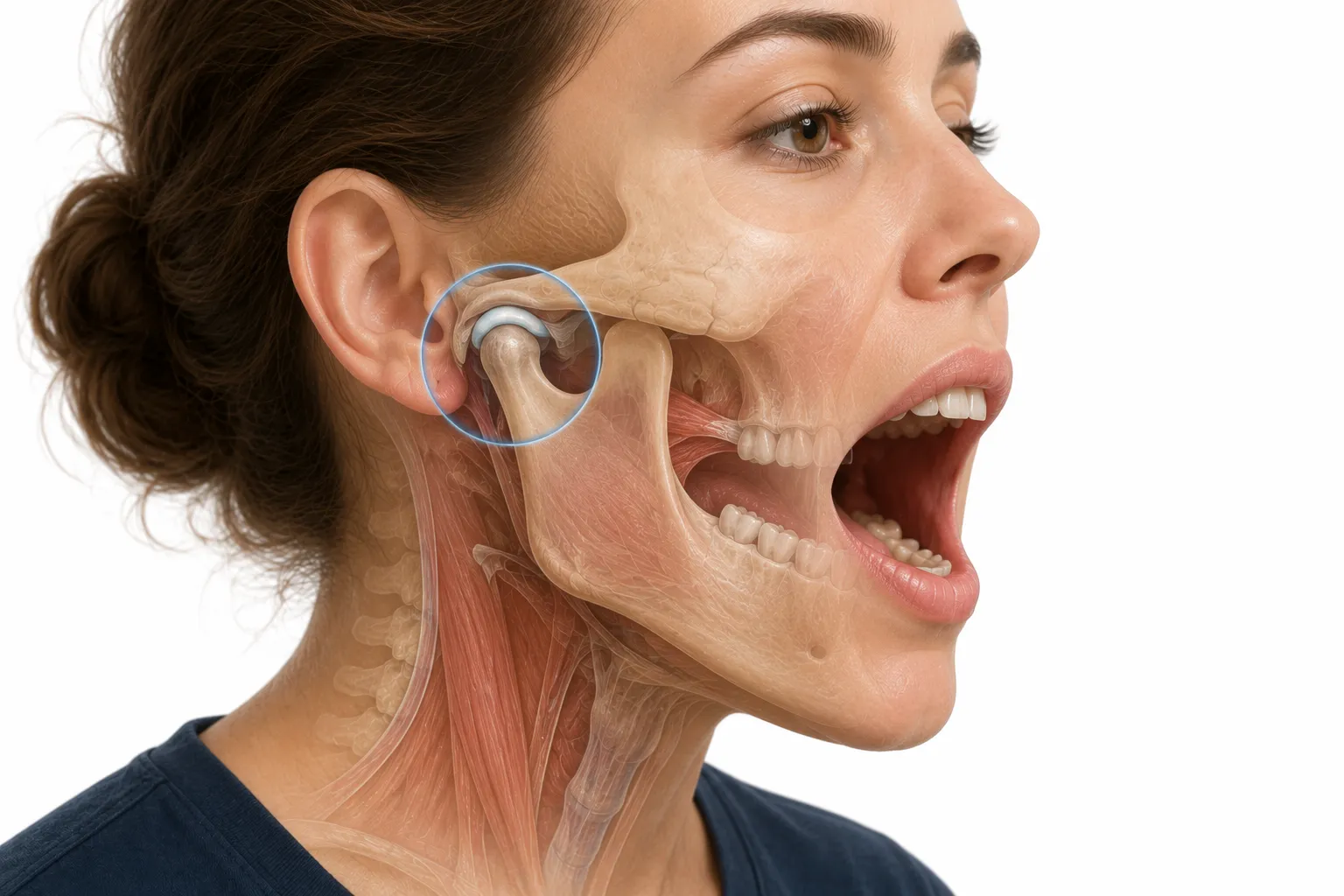
The temporomandibular joint, commonly abbreviated TMJ, connects the lower jawbone to the skull just in front of each ear and allows the wide range of motion needed for talking, chewing, and yawning. Nestled within this joint is a small, flexible disc of cartilage that acts as a cushion, allowing the jawbone to glide smoothly against the skull during movement. In many people, this disc can shift slightly out of its normal, centered position, sometimes due to jaw muscle tension, teeth grinding, previous jaw injury, or simply natural anatomical variation. When the disc is displaced, the jawbone may momentarily catch against it during certain movements, and then suddenly slip back into a more normal position as the mouth continues opening or closing, producing the characteristic clicking or popping sound. In many cases, this clicking is painless and doesn't significantly affect jaw function, though in some people it can be accompanied by discomfort, particularly if it's linked to broader temporomandibular joint dysfunction involving inflammation, muscle tension, or more significant joint misalignment.
At a glance
This joint's complex range of motion is what makes it more prone to certain mechanical quirks than a simple hinge joint.
A clicking jaw always means something is seriously wrong and needs immediate treatment.
The jaw joint, or temporomandibular joint, contains a small disc of cartilage that's supposed to glide smoothly between the jawbone and skull, and when that disc shifts even slightly out of its ideal position, it can produce an audible click as the jaw works around it.
Picture a small rubber gasket meant to sit perfectly centered between two moving metal parts; if it slips even slightly off-center, the parts can catch and pop against its edge with every movement.
Diagram
Why Does Your Jaw Click: the idea in one diagram
The temporomandibular joint contains a small cartilage disc that normally cushions movement between the jawbone and skull, and when this disc shifts slightly out of position, the jawbone can catch and then release against it during movement, producing an audible click.
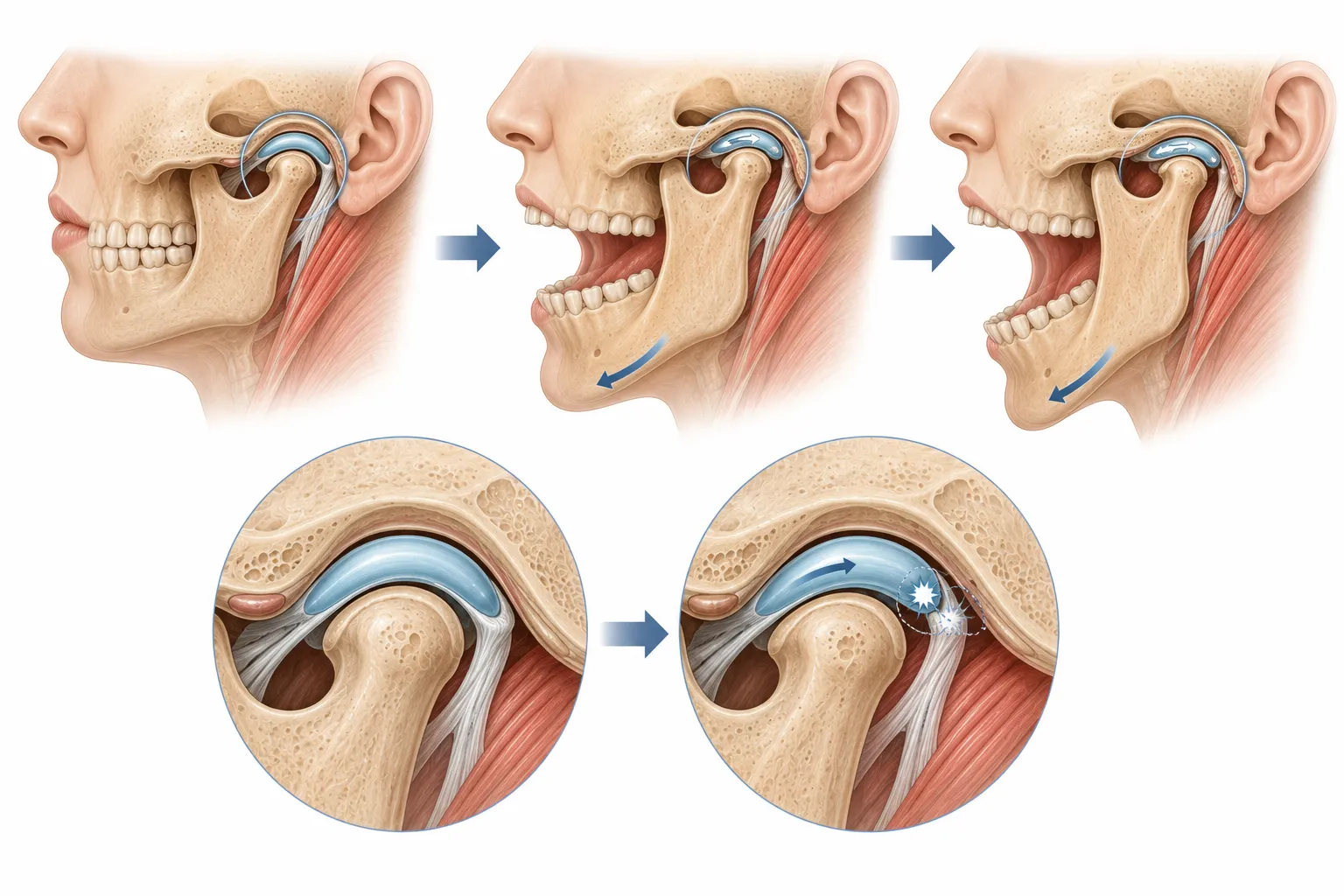
- 1The temporomandibular joint connects jaw to skull
This joint's complex range of motion is what makes it more prone to certain mechanical quirks than a simple hinge joint.
- 2A cartilage disc cushions movement within the joint
This disc's proper positioning is essential for smooth, quiet jaw movement.
- 3The disc can shift slightly out of position
This displacement is the specific root mechanical cause of most jaw clicking.
- 4Jaw movement causes the disc to catch and release
This catch-and-release motion is exactly what produces the sound most people associate with jaw clicking.
How it works
The mechanism
The temporomandibular joint contains a small cartilage disc that normally cushions movement between the jawbone and skull, and when this disc shifts slightly out of position, the jawbone can catch and then release against it during movement, producing an audible click.
- Step 01
The temporomandibular joint connects jaw to skull
This joint, located just in front of each ear, allows the lower jaw to open, close, and shift side to side, enabling talking, chewing, and yawning.
Like a highly mobile hinge designed to allow movement in multiple directions rather than just a single simple swing.
This joint's complex range of motion is what makes it more prone to certain mechanical quirks than a simple hinge joint.
- Step 02
A cartilage disc cushions movement within the joint
A small, flexible disc of cartilage sits between the jawbone and skull within the joint, normally gliding smoothly to cushion and guide movement.
Like a gasket positioned precisely between two moving mechanical surfaces to prevent direct friction.
This disc's proper positioning is essential for smooth, quiet jaw movement.
- Step 03
The disc can shift slightly out of position
Factors like muscle tension, teeth grinding, or anatomical variation can cause this disc to shift away from its ideal centered position within the joint.
Like a gasket slipping slightly off-center between two moving parts it was meant to sit perfectly between.
This displacement is the specific root mechanical cause of most jaw clicking.
- Step 04
Jaw movement causes the disc to catch and release
As the jaw opens or closes, the jawbone can momentarily catch against the displaced disc before suddenly slipping past it, producing the audible click or pop.
Like a door hinge catching briefly on a slightly worn spot before releasing with a sudden, audible pop.
This catch-and-release motion is exactly what produces the sound most people associate with jaw clicking.
Surprises
Facts worth sitting with
Jaw clicking is extremely common, with studies estimating that a substantial portion of the general population experiences some degree of temporomandibular joint clicking at some point in their lives.
Surprising facts
What seems backwards
Worth comparing
In everyday life
Easy to get wrong
Pressure points
Where the simple answer gets interesting
Why does the jaw joint's cartilage disc shift out of position in the first place?
Factors such as jaw muscle tension, teeth grinding, prior jaw injury, and individual anatomical variation in the shape and looseness of surrounding ligaments can all contribute to the disc gradually shifting away from its ideal centered position.
Something as ordinary as unconscious nighttime teeth grinding can quietly reshape the mechanics of a joint used for talking and eating every single day.
Why is jaw clicking sometimes painless and sometimes uncomfortable?
Painless clicking often reflects a disc that's displaced but still moving relatively smoothly around the joint, while pain tends to develop when the displacement is accompanied by inflammation, muscle tension, or more significant joint stress.
The exact same underlying mechanical issue can feel completely different from one person to another, depending on how the surrounding tissue responds.
Why does jaw clicking sometimes go away on its own over time?
In some cases, surrounding jaw muscles and ligaments gradually adapt to the disc's new position, allowing smoother movement to develop again even without the disc returning to its original exact location.
The body's ability to adapt around a structural change can sometimes resolve a noisy, noticeable symptom without ever technically fixing the original cause.
Behind the science
The story behind it
Clinical research into temporomandibular joint disorders
Dental and medical researchers have extensively studied temporomandibular joint dysfunction, including clicking, popping, pain, and restricted movement, to better understand causes and treatment options.
This research established temporomandibular joint disorders as a distinct, well-recognized clinical category with dedicated diagnostic and treatment approaches.
A common, often dismissed symptom can, with sustained research attention, become the basis for an entire recognized area of clinical study and care.
Imaging studies of jaw joint disc position and movement
Researchers used magnetic resonance imaging to directly observe the position and movement of the temporomandibular joint's cartilage disc in patients with and without jaw clicking.
The imaging confirmed that disc displacement correlates closely with audible clicking, providing direct visual evidence for the underlying mechanical cause.
Clarify
Myth and reality
Myth
A clicking jaw always means something is seriously wrong and needs immediate treatment.
Reality
Painless jaw clicking is extremely common and often doesn't require any treatment at all, though clicking accompanied by pain or limited movement is worth having evaluated.
Evidence
Population studies estimate a large proportion of people experience some jaw clicking at some point without significant associated symptoms or complications.
Looking closer
The deeper pattern
A small, seemingly minor structural shift, like a displaced cartilage disc, can produce an outsized, very noticeable symptom purely because of its critical, high-traffic location.
One way to think about it
The significance of a small malfunction often depends far more on where it occurs, especially in a heavily used, high-traffic system, than on how large the underlying problem actually is.
A minor shift in a critical, frequently used part of a system can produce a symptom disproportionately larger than the underlying issue itself.
Limits
Where the explanation bends
People experiencing jaw clicking accompanied by pain or restricted movement.
When clicking is paired with pain, difficulty opening the mouth fully, or jaw locking, it may indicate a more significant temporomandibular joint disorder requiring evaluation and treatment from a dental or medical professional.
The exact same underlying joint mechanism can range from a completely harmless quirk to a genuinely limiting medical condition depending on its severity.
In daily life
What this helps you notice
Understanding the mechanical cause of jaw clicking can reduce unnecessary worry for people who notice the sound without any accompanying pain or dysfunction.
Many people mention jaw clicking to their dentist during a routine visit and learn it's a common, generally harmless finding.
Remember
Key takeaways
- 1
Jaw clicking often comes from the small cartilage disc inside the temporomandibular joint shifting out of its ideal position.
- 2
This displaced disc can cause the jawbone to catch and then release against it during movement, producing a click.
- 3
Factors like teeth grinding, jaw muscle tension, and prior injury can contribute to disc displacement.
- 4
Painless jaw clicking is very common and often doesn't require treatment.
- 5
Clicking accompanied by pain or restricted jaw movement may indicate a more significant joint disorder worth evaluating.
That familiar click when you open your mouth wide isn't bone grinding against bone, it's a tiny cushion inside your jaw quietly slipping out of place and snapping right back, thousands of times without you ever noticing until now.
Every jaw click is a small, mechanical footnote to one of the hardest-working joints in the entire body, still doing its job perfectly well despite the occasional noisy reminder.
Read around the idea
More questions with the same curious pull
Nearby doors from the TinyThat archive, chosen by topic, intent, and reader curiosity.
Body & Brain
Why Do We Bite Our Tongues?
Chewing is a fast, largely automatic process, and small timing errors occasionally let the tongue get caught between...
Body & Brain
Why Do We Have an Adam's Apple?
The Adam's apple is a projection of cartilage around the voice box that becomes more prominent after puberty due to h...
Body & Brain
Can the Brain Feel Pain?
The brain controls all pain in your body, yet it cannot feel pain itself. Discover why, and what this strange fact re...