Studies estimate that a majority of people, though not everyone, are genetically able to smell the sulfur compounds in asparagus-affected urine, with rates varying somewhat across different populations studied.
Body & Brain
Why does urine smell different after eating asparagus?
Why Does Urine Smell After Eating Asparagus?
Within about fifteen to thirty minutes of eating asparagus, many people notice a sudden, unmistakable change in the smell of their urine.
On this page
The short answer
Asparagus contains sulfur-containing compounds that the body breaks down into volatile, strong-smelling byproducts excreted in urine, and while most people's bodies produce these compounds, only a genetically determined subset of people are actually able to smell them, which is why the effect seems inconsistent from person to person.
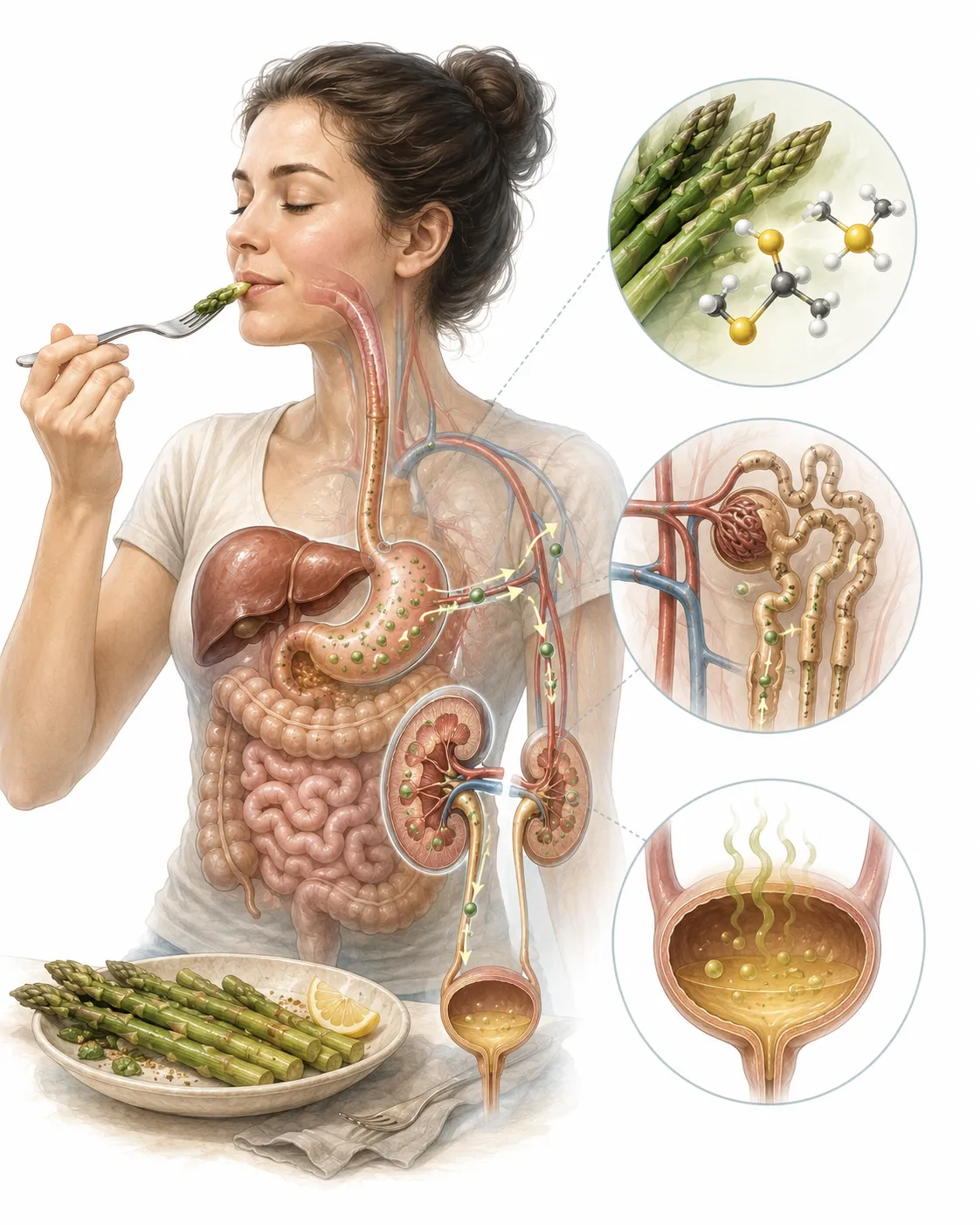
Asparagus contains a compound called asparagusic acid, which is metabolized during digestion into several sulfur-containing byproducts, including methanethiol and related volatile compounds. These compounds are excreted in urine and can produce a distinctive, often described as sulfurous or cabbage-like, odor. For a long time, scientists debated whether some people simply didn't produce these compounds at all, but later research clarified that nearly everyone metabolizes asparagus into the same odorous byproducts; the real variability lies in smell perception. Genetic differences in olfactory receptor genes determine whether a person can detect the specific volatile compounds at the concentrations typically present in urine, meaning some people who do produce the smell simply cannot perceive it.
At a glance
The starting compound is unique to asparagus, which is why the effect is specific to this vegetable.
Only some people's bodies produce the smelly compounds after eating asparagus.
Researchers have identified specific genetic variants tied both to whether a person's body breaks asparagus down into odorous compounds and to whether their nose is even capable of detecting them.
Picture two separate locked doors, one controlling whether a chemical signal gets sent at all, the other controlling whether anyone's even able to hear it arrive. Asparagus urine odor depends on both doors independently.
Diagram
Why Does Urine Smell After Eating Asparagus: the idea in one diagram
Asparagus is metabolized into sulfur-containing volatile compounds excreted in urine, and whether a person perceives the resulting smell depends on genetically determined differences in odor detection.
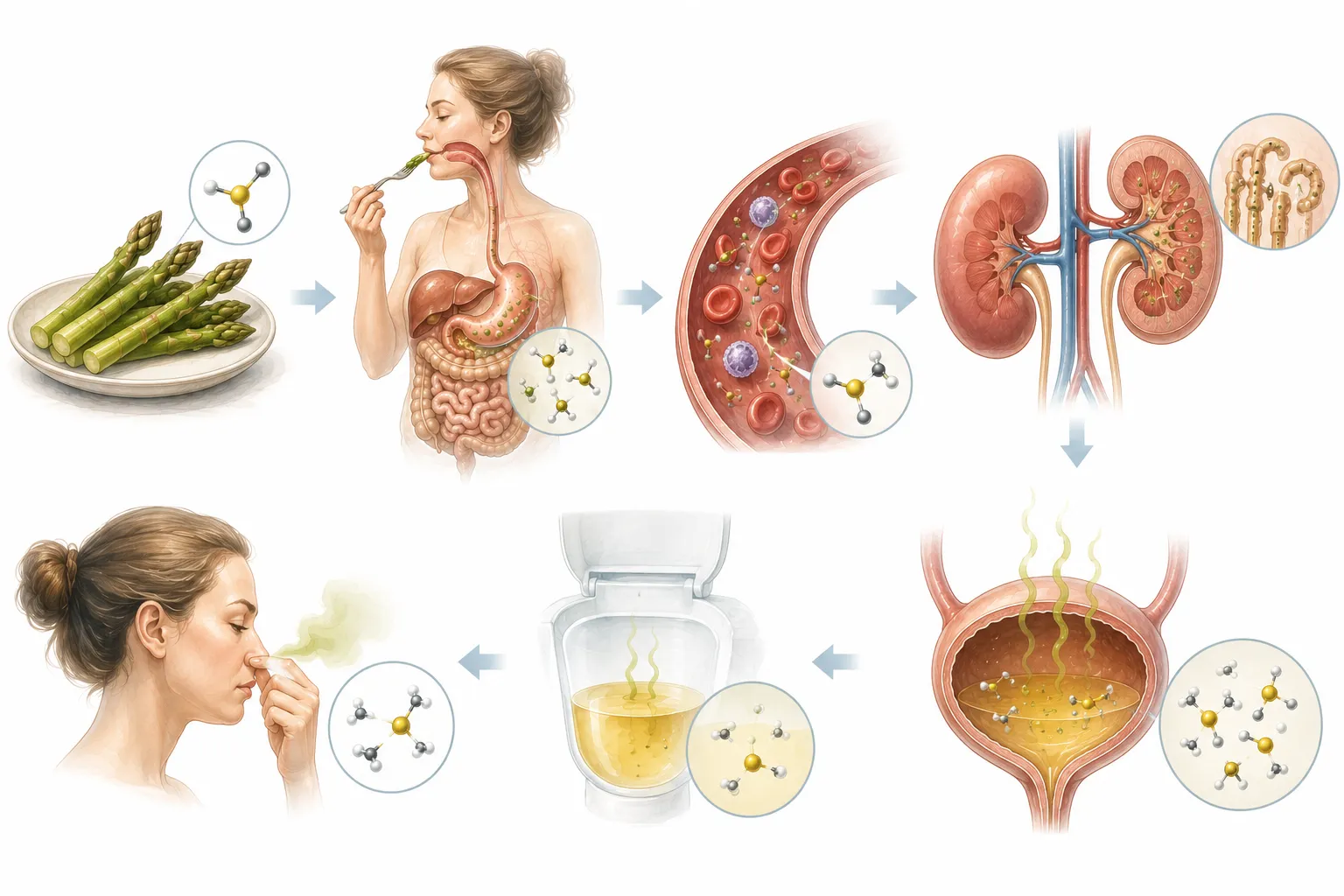
- 1Asparagusic acid is digested
The starting compound is unique to asparagus, which is why the effect is specific to this vegetable.
- 2Sulfur byproducts are excreted in urine
Nearly everyone's body produces these compounds after eating asparagus.
- 3Volatile compounds create a detectable odor
The chemical properties of the compounds themselves make them easy to notice, for those who can smell them.
- 4Genetic variation determines perception
Whether someone notices the smell depends more on their nose's genetics than on their digestive system.
How it works
The mechanism
Asparagus is metabolized into sulfur-containing volatile compounds excreted in urine, and whether a person perceives the resulting smell depends on genetically determined differences in odor detection.
- Step 01
Asparagusic acid is digested
A sulfur-containing compound unique to asparagus, asparagusic acid, is broken down during digestion into several smaller volatile byproducts.
Like breaking a large molecule down into smaller, more volatile fragments during processing.
The starting compound is unique to asparagus, which is why the effect is specific to this vegetable.
- Step 02
Sulfur byproducts are excreted in urine
The resulting sulfur-containing compounds, including methanethiol, are excreted through the kidneys into urine within a relatively short timeframe.
Like waste products being routed out through a plumbing system shortly after processing.
Nearly everyone's body produces these compounds after eating asparagus.
- Step 03
Volatile compounds create a detectable odor
These sulfur compounds are highly volatile, meaning they evaporate readily and can be detected by smell when urine is exposed to air.
Like a strong perfume that releases scent quickly once uncapped.
The chemical properties of the compounds themselves make them easy to notice, for those who can smell them.
- Step 04
Genetic variation determines perception
Differences in olfactory receptor genes determine whether an individual's nose can detect these specific compounds at the concentrations typically present.
Like a radio receiver that's only able to pick up certain frequencies.
Whether someone notices the smell depends more on their nose's genetics than on their digestive system.
Surprises
Facts worth sitting with
Studies estimate that a majority of people, though not everyone, are genetically able to smell the sulfur compounds in asparagus-affected urine, with rates varying somewhat across different populations studied.
Surprising facts
What seems backwards
Worth comparing
In everyday life
Easy to get wrong
Pressure points
Where the simple answer gets interesting
Why can some people smell it and others can't, even after eating the exact same meal?
Genetic variation in olfactory receptor genes affects whether a person's nose can detect the specific sulfur compounds at the concentrations typically present in urine after eating asparagus, independent of whether their body produced those compounds in the first place.
Two people can share an identical biochemical outcome and still have a completely different sensory experience of it.
Does everyone's body actually produce the smelly compounds?
Current research suggests nearly everyone metabolizes asparagusic acid into the same sulfur-containing byproducts, meaning the earlier belief that some people simply don't produce the compounds at all has largely been revised in favor of a perception-based explanation.
A mystery long assumed to be about who makes the smell turned out to mostly be about who can detect it.
How quickly does the smell appear and disappear?
The odor typically becomes noticeable within fifteen to thirty minutes of eating asparagus and usually fades within a few hours as the volatile compounds are cleared from the body through urination.
The entire phenomenon runs its course faster than most people expect, often within a single afternoon.
Behind the science
The story behind it
Genetic studies resolving the asparagus urine debate
Large genetic studies, including research using consumer genetic testing data, identified specific gene variants linked to the ability to smell asparagus metabolites in urine.
This research helped settle a long-standing scientific debate about whether the variation was in production or perception of the odor.
Large-scale genetic data can resolve questions that smaller studies struggled to fully explain for decades.
Large-scale genetic association study on asparagus anosmia
Researchers analyzed genetic data from tens of thousands of participants alongside self-reported ability to smell asparagus-affected urine.
The study identified specific genetic variants near olfactory receptor genes strongly associated with the ability to detect the odor, clarifying that perception, not production, was the main source of variability.
Clarify
Myth and reality
Myth
Only some people's bodies produce the smelly compounds after eating asparagus.
Reality
Current research suggests nearly everyone's body produces the same sulfur-containing compounds; the real variability lies in genetically determined differences in smell perception.
Evidence
Large genetic association studies have linked specific olfactory receptor gene variants to the ability to detect the odor, rather than to differences in metabolism.
Looking closer
The deeper pattern
The asparagus urine mystery persisted for so long because researchers were looking for a single explanation when two separate biological variables were actually at play.
One way to think about it
Puzzling inconsistencies often resist explanation not because the underlying mechanism is unusually complex, but because more than one independent variable is quietly shaping the outcome at once.
When an effect seems inconsistent, it's worth checking whether you're actually looking at two separate questions disguised as one.
Limits
Where the explanation bends
People who report smelling it inconsistently across different meals.
Variation in the amount of asparagus eaten, how it was prepared, hydration levels, and urine concentration can all affect how strong and detectable the odor is, even for people who are generally able to smell it.
Even for people with the ability to detect the smell, the experience isn't perfectly consistent every single time.
In daily life
What this helps you notice
Understanding the perception-based explanation can settle friendly debates among family or friends about why some people notice the smell and others insist they don't.
It's common for two people who ate the same asparagus dish to disagree entirely on whether they noticed any change in urine odor afterward.
Remember
Key takeaways
- 1
Asparagus contains asparagusic acid, which digestion converts into sulfur-containing, strong-smelling compounds.
- 2
Nearly everyone's body produces these compounds, contrary to earlier beliefs that some people simply didn't.
- 3
The real variability lies in genetically determined differences in the ability to smell the compounds.
- 4
The odor typically appears within fifteen to thirty minutes and fades within a few hours.
- 5
Large genetic studies have identified specific olfactory receptor gene variants linked to detecting the smell.
The asparagus urine mystery was never really about who produces the smell, almost everyone does, it was about whose nose happened to come with the right genetic receiver installed.
The next disagreement over whether asparagus really changes urine smell isn't a matter of opinion, it's a genetics test neither person in the argument has actually taken.
Read around the idea
More questions with the same curious pull
Nearby doors from the TinyThat archive, chosen by topic, intent, and reader curiosity.
Body & Brain
What Happens to Your Body If You Don't Shower?
Sweat, oil, and dead skin cells accumulate, feeding bacteria that produce noticeable odor within a day or two.
Body & Brain
Can the Brain Feel Pain?
The brain controls all pain in your body, yet it cannot feel pain itself. Discover why, and what this strange fact re...

Body & Brain
Does Your Brain Eat Itself?
Your brain really does consume parts of itself. Learn about autophagy, synaptic pruning, and why self-consumption is...