Fresh sweat is nearly odorless; body odor develops only after skin bacteria metabolize compounds within sweat over the course of a few hours to a couple of days.
Body & Brain
What happens to your body if you stop showering?
What Happens to Your Body If You Don't Shower?
Stop showering for a week and your skin doesn't just get dirtier in a straight line, it goes through distinct, predictable phases.
On this page
The short answer
Without showering, sweat, dead skin cells, and natural oils accumulate on the skin, feeding the resident bacterial population and typically producing noticeable odor within one to three days, though the skin barrier itself often becomes more balanced over longer stretches.
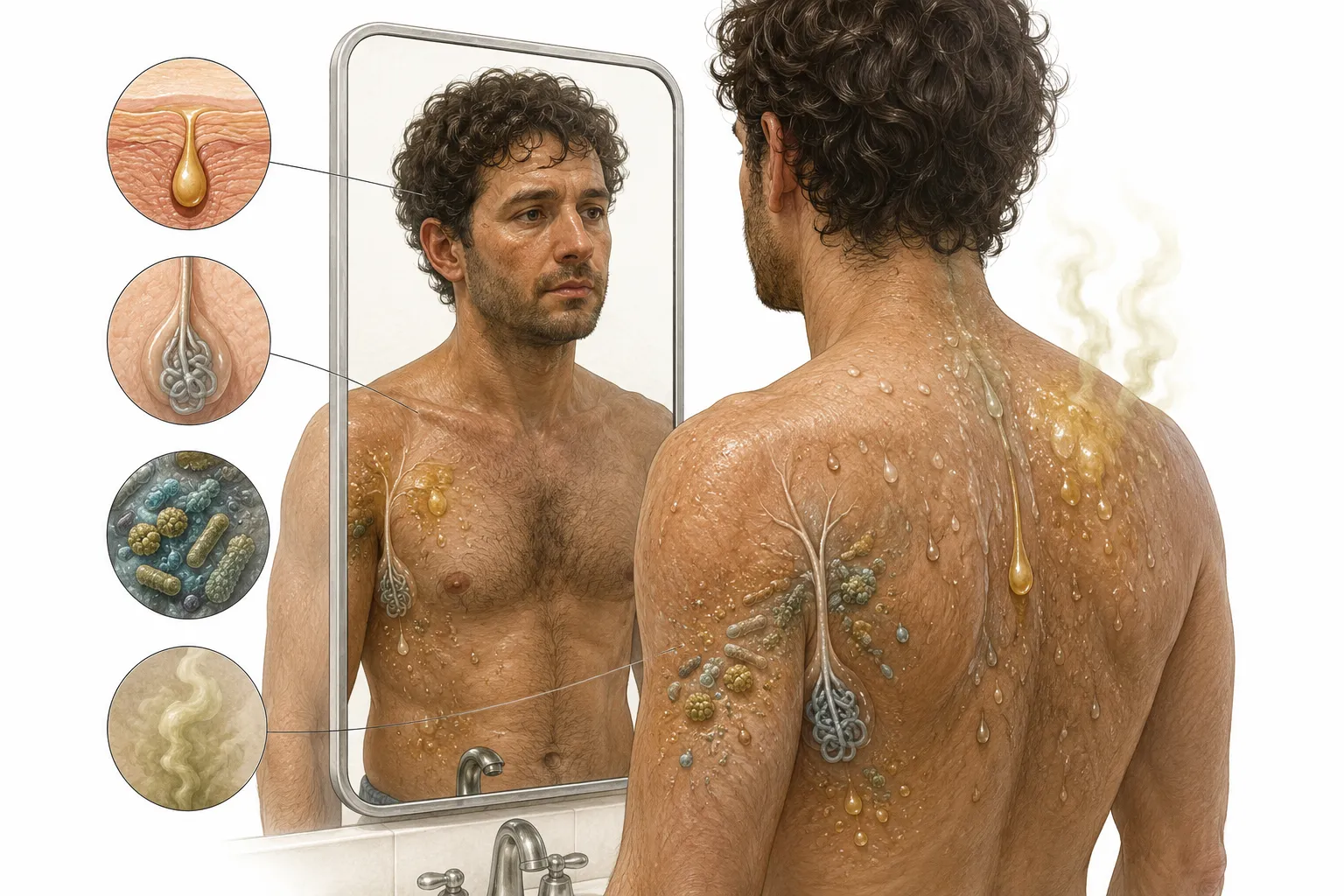
In the first day or two without washing, sweat and sebum build up on the skin's surface, and bacteria that normally live there begin breaking down sweat compounds into odor-causing byproducts, particularly in areas like the armpits and groin. Dead skin cells that would normally be washed away start to accumulate visibly. Over several days, oil production can paradoxically stabilize in some people, since skin no longer needs to overcompensate for oils stripped by frequent washing. However, without regular exfoliation and cleansing, clogged pores, breakouts, and skin irritation become more likely, and the buildup of bacteria and yeast can trigger fungal or bacterial skin issues, especially in warm, moist areas of the body.
At a glance
The buildup itself is gradual and continuous, not sudden.
Skipping a shower even for one day is unhygienic and unhealthy.
Dermatologists have found that daily showering, especially with hot water and harsh soap, can strip away oils faster than skin can replace them, which sometimes triggers even more oil production in response.
Picture a garden that gets watered too aggressively every single day; eventually the soil stops holding moisture well on its own. Skin can behave in a similar way when it's stripped and reset daily.
Diagram
What Happens to Your Body If You Don't Shower: the idea in one diagram
Skipping showers triggers a predictable sequence: oil and sweat accumulate, bacteria metabolize sweat into odor, dead cells build up, and over longer periods the skin barrier and oil production gradually rebalance.
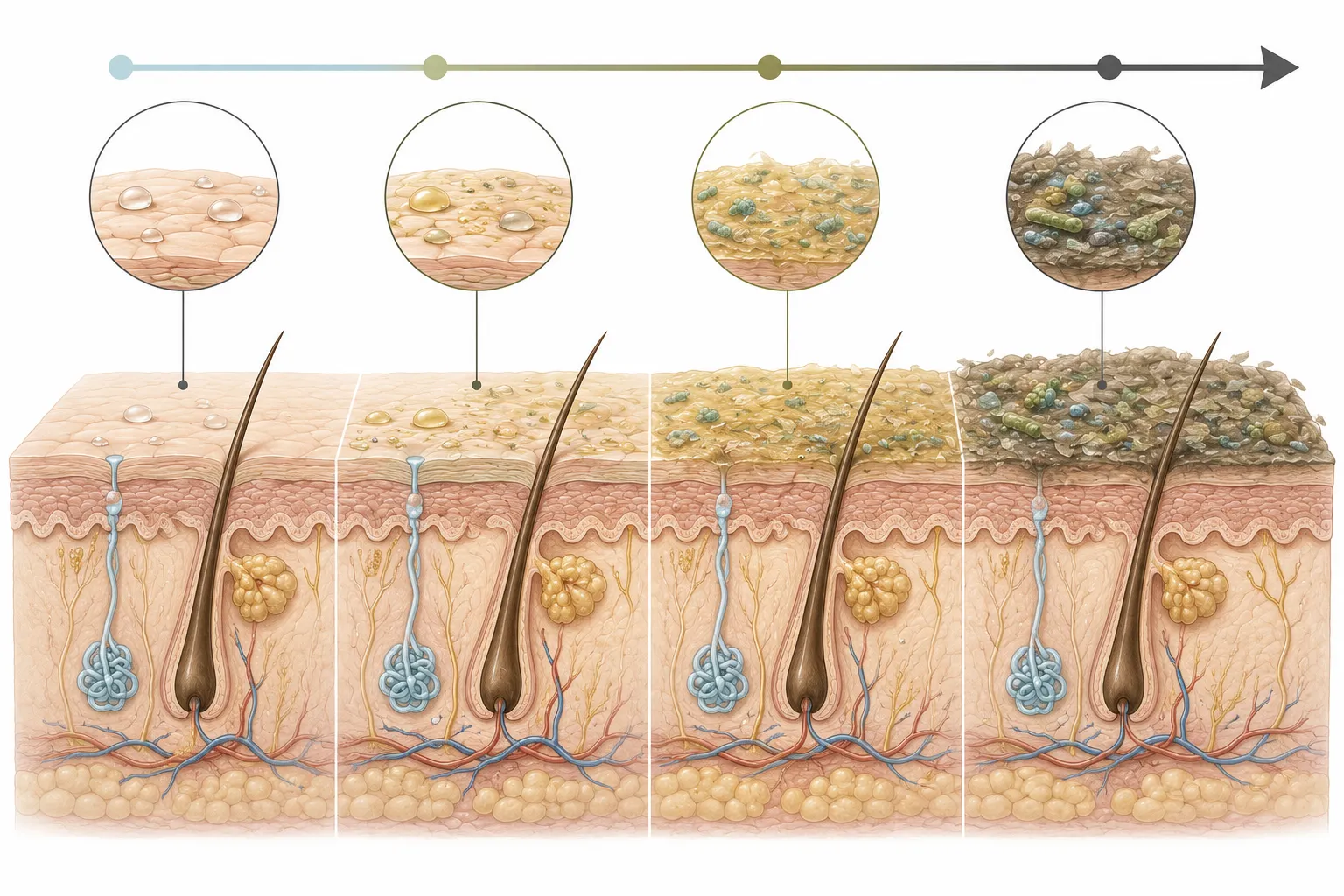
- 1Sweat and oil accumulate
The buildup itself is gradual and continuous, not sudden.
- 2Bacteria metabolize sweat into odor
Odor is a bacterial byproduct, not sweat itself.
- 3Dead skin cells build up
Surface texture and appearance change even without infection.
- 4Oil production and barrier gradually rebalance
The skin's own regulatory system reasserts control when left undisturbed.
How it works
The mechanism
Skipping showers triggers a predictable sequence: oil and sweat accumulate, bacteria metabolize sweat into odor, dead cells build up, and over longer periods the skin barrier and oil production gradually rebalance.
- Step 01
Sweat and oil accumulate
Without washing, sebum from oil glands and sweat from sweat glands continue accumulating on the skin's surface throughout the day.
Like dishes piling up in a sink that never gets emptied.
The buildup itself is gradual and continuous, not sudden.
- Step 02
Bacteria metabolize sweat into odor
Resident skin bacteria break down proteins and fatty acids in sweat, producing compounds responsible for body odor, particularly in warm, moist areas like the armpits.
Like fermentation turning grape juice into wine, a byproduct of bacterial activity.
Odor is a bacterial byproduct, not sweat itself.
- Step 03
Dead skin cells build up
Without regular washing and mild exfoliation, dead skin cells that would normally be sloughed off accumulate on the surface.
Like dust settling on furniture in an unused room.
Surface texture and appearance change even without infection.
- Step 04
Oil production and barrier gradually rebalance
Over several days to weeks, skin that isn't repeatedly stripped of oil can settle into a more stable rate of oil production and improved barrier function.
Like a thermostat settling once no one keeps adjusting it.
The skin's own regulatory system reasserts control when left undisturbed.
Clarify
Myth and reality
Myth
Skipping a shower even for one day is unhygienic and unhealthy.
Reality
For most healthy people, missing a day or two of showering has minimal health impact beyond odor and comfort, and skin barrier function may even benefit from reduced washing frequency.
Evidence
Dermatological research on skin barrier health increasingly supports moderate rather than daily washing for many skin types.
Surprises
Facts worth sitting with
Fresh sweat is nearly odorless; body odor develops only after skin bacteria metabolize compounds within sweat over the course of a few hours to a couple of days.
Surprising facts
What seems backwards
Worth comparing
In everyday life
Easy to get wrong
Pressure points
Where the simple answer gets interesting
Why does skipping showers sometimes make oily skin less oily over time?
Frequent washing, especially with hot water and harsh soap, strips natural oils faster than skin can regenerate them, which can trigger oil glands to overcompensate; reducing shower frequency lets that overproduction settle.
The habit meant to control oily skin can sometimes be the very thing causing it.
How quickly does body odor actually develop without showering?
Because fresh sweat is nearly odorless, noticeable body odor typically takes several hours to a couple of days to develop, once skin bacteria have had time to metabolize sweat compounds into smellier byproducts.
The smell isn't sweat itself, it's bacteria's leftovers.
Is it actually unhealthy to shower less often?
For most healthy people, reducing shower frequency to a few times a week isn't medically harmful and may even benefit skin barrier health, though individual factors like activity level, climate, and skin conditions matter.
A daily habit widely treated as mandatory turns out to be more of a cultural norm than a medical necessity.
Behind the science
The story behind it
Dermatologists reconsidering daily showering advice
In recent years, a number of dermatologists have publicly questioned whether daily showering is necessary for most people, citing skin barrier research.
The shift reflects growing evidence that over-washing can do more harm than good for many skin types.
Even well-established health habits are worth periodically re-examining against the evidence.
Skin microbiome sampling studies
Researchers sampling skin bacteria before and after showering found that washing temporarily reduces bacterial density without eliminating the broader microbiome community.
Bacterial populations largely rebounded within hours, showing showering's effect on the microbiome is more temporary than commonly assumed.
Looking closer
The deeper pattern
The body's oil production respondsto disruption by overcorrecting, then settling once the disruption stops.
One way to think about it
Systems that are frequently reset from the outside often lose their own internal equilibrium and start overcompensating, a pattern that shows up in biology as much as in habits and routines.
Sometimes the more consistent intervention is the one that creates the instability it's trying to fix.
Limits
Where the explanation bends
Extended periods without showering in hot, humid climates.
Warm, moist conditions accelerate bacterial and yeast growth, increasing the risk of skin irritation, rashes, or fungal infections compared to drier climates.
The same behavior can range from harmless to genuinely risky depending entirely on environmental conditions.
In daily life
What this helps you notice
People with naturally dry or sensitive skin may benefit from showering less frequently to preserve the skin's protective oil barrier.
Dermatologists often recommend shorter, cooler showers and reduced frequency for patients dealing with eczema or chronic dry skin.
Remember
Key takeaways
- 1
Skipping showers leads to buildup of sweat, oil, and dead skin cells, with bacteria producing odor within hours to days.
- 2
Fresh sweat is nearly odorless; body odor develops from bacterial breakdown of sweat compounds.
- 3
Frequent hot showers can strip skin oils faster than they regenerate, sometimes triggering oilier skin over time.
- 4
Extended periods without washing allow the skin's oil production and barrier function to rebalance.
- 5
Daily showering is a relatively modern cultural habit rather than a strict medical necessity for most healthy people.
Skip a shower and your skin doesn't spiral into crisis, it quietly runs its own experiment in self-regulation, one that daily washing rarely gives it the chance to complete.
The ritual that feels like the bare minimum of hygiene is, biologically speaking, more of a negotiation with your skin than a non-negotiable requirement.
Read around the idea
More questions with the same curious pull
Nearby doors from the TinyThat archive, chosen by topic, intent, and reader curiosity.
Body & Brain
Why Do We Have Earwax?
Earwax traps dust and debris while lubricating and protecting the ear canal from infection.
Body & Brain
Why Do Bruises Change Color?
As the body breaks down and reabsorbs leaked blood, different pigment byproducts form in sequence, shifting the bruis...
Body & Brain
Can the Brain Feel Pain?
The brain controls all pain in your body, yet it cannot feel pain itself. Discover why, and what this strange fact re...