The nose can warm inhaled air from well below freezing to close to body temperature in the brief span of time it takes to travel through the nasal passages.
Body & Brain
Why does your nose run in cold weather?
Why Does Your Nose Run When It's Cold?
Step outside on a cold day and within minutes your nose starts running, even though you feel perfectly healthy.
On this page
The short answer
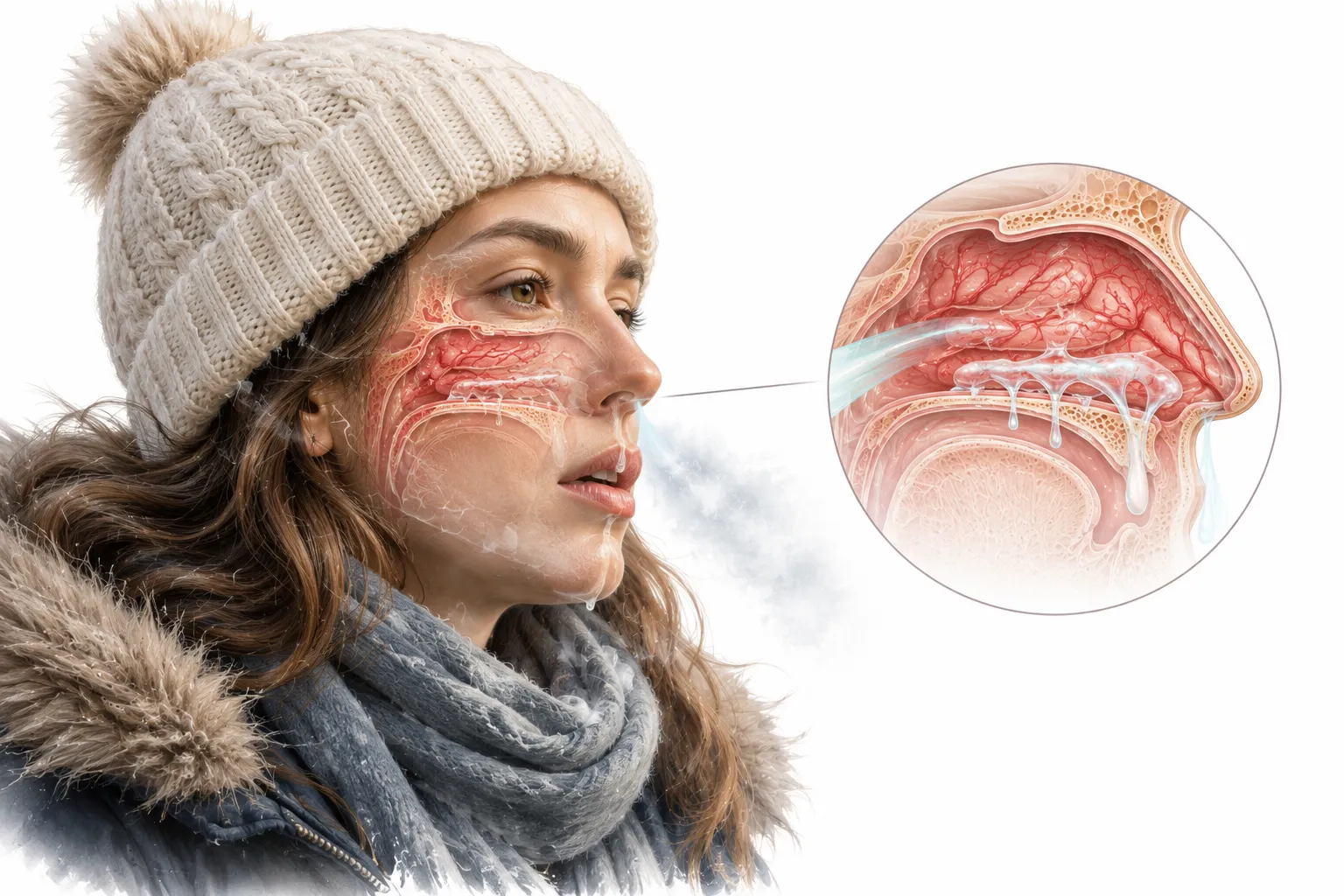
Cold air causes blood vessels in the nose to dilate and mucus production to increase as part of the nose's job of warming and humidifying inhaled air before it reaches the lungs, and cold temperatures also slow the tiny hair-like structures that normally move mucus backward, causing it to pool and drip forward instead.
One of the nose's core functions is conditioning the air you breathe, warming it to body temperature and adding moisture before it reaches the sensitive tissue of the lungs. When cold, dry air enters the nasal passages, blood vessels in the nasal lining dilate, increasing blood flow to help warm the incoming air, and mucus glands increase production to add humidity. At the same time, cold temperatures slow the normal function of cilia, tiny hair-like structures that continuously sweep mucus backward toward the throat to be swallowed. With cilia moving more sluggishly in the cold, mucus accumulates faster than it can be cleared through its usual pathway, and gravity pulls the excess forward and out the front of the nose instead, producing the familiar cold-weather runny nose.
At a glance
The nose's response begins the moment cold air makes contact with nasal tissue.
A runny nose in cold weather means you're getting sick.
Cold air causes blood vessels in the nose to actually expand rather than contract, flooding nasal tissue with warm blood specifically to heat incoming air.
Picture a home's radiator kicking into overdrive the moment cold air rushes in through an open window, working harder specifically because the incoming air is cold. Your nose does something remarkably similar.
Diagram
Why Does Your Nose Run When It's Cold: the idea in one diagram
Cold, dry air triggers increased blood flow and mucus production in the nose to warm and humidify incoming air, while simultaneously slowing the cilia responsible for normally clearing mucus backward, leading to forward drip.
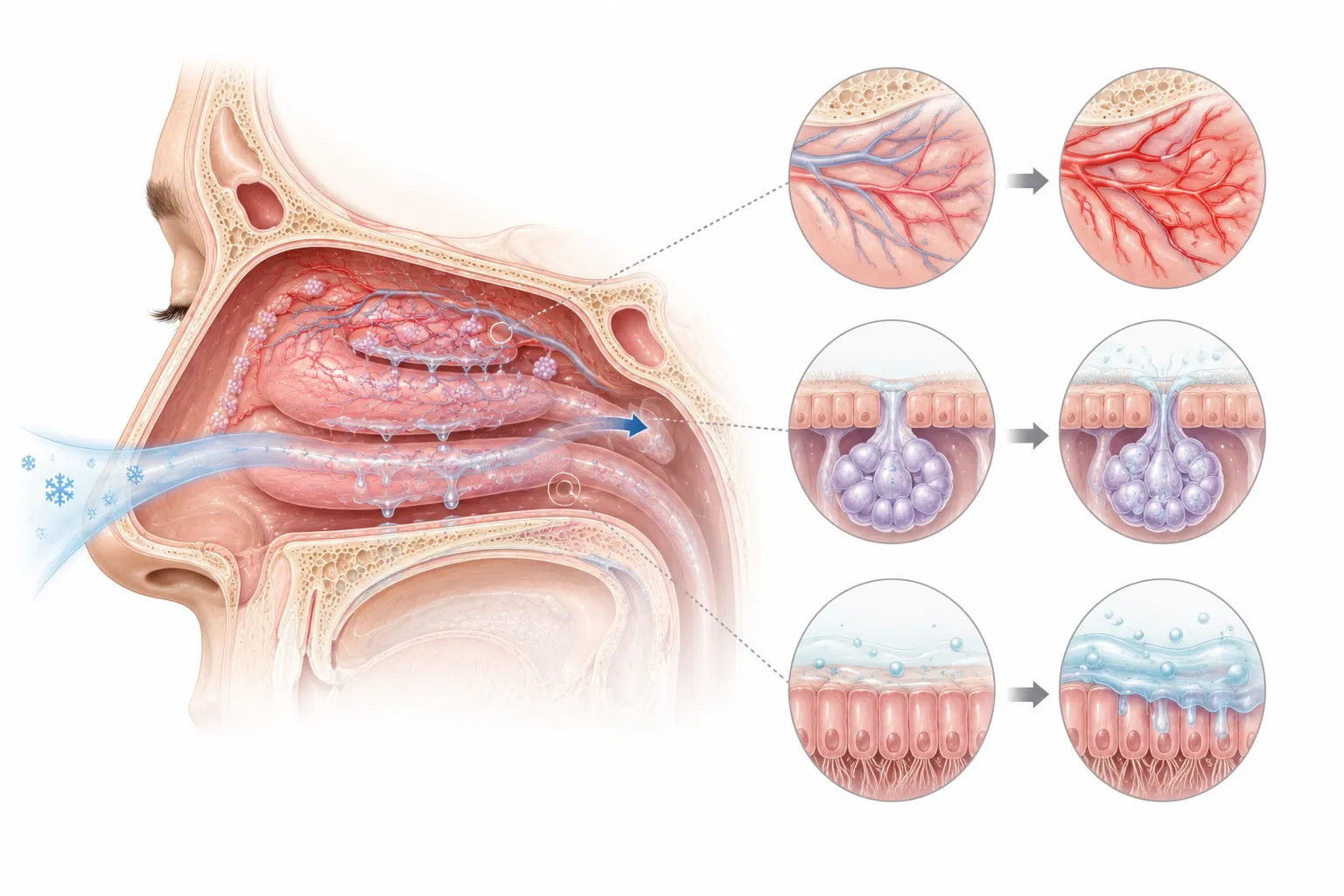
- 1Cold air enters the nasal passages
The nose's response begins the moment cold air makes contact with nasal tissue.
- 2Blood vessels dilate to add warmth
This dilation is a deliberate warming response, not an accident of cold exposure.
- 3Mucus production increases
More mucus is produced specifically to counteract the dryness of cold air.
- 4Slowed cilia cause mucus to run forward
The visible runny nose is the direct result of production outpacing clearance in cold conditions.
How it works
The mechanism
Cold, dry air triggers increased blood flow and mucus production in the nose to warm and humidify incoming air, while simultaneously slowing the cilia responsible for normally clearing mucus backward, leading to forward drip.
- Step 01
Cold air enters the nasal passages
Inhaled cold air first contacts the nasal lining, which is tasked with warming and humidifying it before it travels further into the respiratory system.
Like cold outdoor air first passing through an entryway before reaching the rest of a heated house.
The nose's response begins the moment cold air makes contact with nasal tissue.
- Step 02
Blood vessels dilate to add warmth
Blood vessels within the nasal lining expand, increasing blood flow to help transfer heat into the cold incoming air.
Like a radiator's fluid flow increasing to add more heat to a cold room.
This dilation is a deliberate warming response, not an accident of cold exposure.
- Step 03
Mucus production increases
Glands in the nasal lining increase mucus output to add moisture to the dry, cold incoming air, protecting the delicate tissue further down the respiratory tract.
Like a humidifier kicking into higher output when the surrounding air becomes drier.
More mucus is produced specifically to counteract the dryness of cold air.
- Step 04
Slowed cilia cause mucus to run forward
Cold temperatures reduce the normal sweeping action of cilia that move mucus backward toward the throat, causing excess mucus to accumulate and drip forward out of the nose instead.
Like a conveyor belt slowing down and causing material to pile up and spill over the front.
The visible runny nose is the direct result of production outpacing clearance in cold conditions.
Surprises
Facts worth sitting with
The nose can warm inhaled air from well below freezing to close to body temperature in the brief span of time it takes to travel through the nasal passages.
Surprising facts
What seems backwards
Worth comparing
In everyday life
Easy to get wrong
Pressure points
Where the simple answer gets interesting
Why does the nose warm incoming air so effectively?
The nasal passages are lined with a rich network of blood vessels and a large surface area created by turbinate structures, both of which maximize contact time and heat transfer between incoming air and warm, blood-rich tissue.
A structure most people think of as simple plumbing is actually a finely tuned heat exchanger.
Why do cilia slow down in cold temperatures?
Cilia function relies on temperature-sensitive cellular processes, and cold exposure reduces their beating frequency, slowing the normal backward movement of mucus toward the throat.
A microscopic biological motor is directly affected by the same cold that's triggering the runny nose in the first place.
Is a cold-weather runny nose the same as one caused by a cold virus?
No, cold-induced rhinorrhea is a direct physiological response to temperature and airflow conditions, distinct from the immune-driven mucus production triggered by a viral infection, even though both produce a similar-looking runny nose.
Two very different underlying causes can produce an almost identical visible symptom.
Behind the science
The story behind it
Sports physiology research on skier's nose
Researchers studying endurance athletes in cold climates have specifically documented and studied cold-induced rhinorrhea as a common, distinct physiological response.
This research helped formally distinguish cold-triggered runny nose from illness-related nasal symptoms.
Even minor everyday physiological quirks can attract dedicated scientific study once their real-world impact becomes apparent.
Studies measuring nasal airflow temperature and humidity changes
Researchers measured the temperature and humidity of air at different points along the nasal passage during cold air inhalation.
The studies confirmed the nose can warm and humidify air dramatically within a very short physical distance and time frame.
Clarify
Myth and reality
Myth
A runny nose in cold weather means you're getting sick.
Reality
In most cases, a runny nose triggered by cold air is a normal, healthy physiological response related to warming and humidifying incoming air, distinct from illness-related mucus production.
Evidence
Physiological studies show cold-induced rhinorrhea occurs predictably in healthy individuals exposed to cold air, independent of any viral infection.
Looking closer
The deeper pattern
A runny nose in the cold is a visible side effect of an invisible, highly effective air-conditioning system working overtime.
One way to think about it
Systems working hardest under difficult conditions often produce visible, sometimes messy, byproducts, and those byproducts are frequently mistaken for malfunction rather than evidence of effective effort.
What looks like a problem on the surface can be direct evidence that an underlying system is doing exactly what it's supposed to do.
Limits
Where the explanation bends
People with underlying nasal or sinus conditions exposed to cold air.
Individuals with conditions like allergic rhinitis or chronic sinusitis may experience a significantly more pronounced runny nose response to cold air than people with typical nasal function.
The same normal cold-air response can be dramatically amplified depending on the underlying condition of a person's nasal passages.
In daily life
What this helps you notice
Understanding cold-induced runny nose can reduce unnecessary worry about catching a cold every time nasal symptoms appear in cold weather.
Winter athletes often carry tissues as a standard part of cold-weather gear, treating a runny nose as an expected side effect of outdoor activity rather than a sign of illness.
Remember
Key takeaways
- 1
Cold air triggers blood vessel dilation in the nose to help warm incoming air before it reaches the lungs.
- 2
Mucus production increases to add humidity to dry, cold air passing through the nasal passages.
- 3
Cold temperatures slow cilia, the structures that normally move mucus backward toward the throat.
- 4
Slowed cilia cause mucus to accumulate and drip forward, producing the familiar runny nose.
- 5
A cold-weather runny nose is a normal physiological response, distinct from illness-related nasal symptoms.
A runny nose on a cold day isn't your body breaking down, it's the visible overflow of an extremely effective, mostly invisible air-warming system working exactly as intended.
Every drip is a small sign that your nose just successfully turned freezing outdoor air into something your lungs can actually handle, all in the span of a single breath.
Read around the idea
More questions with the same curious pull
Nearby doors from the TinyThat archive, chosen by topic, intent, and reader curiosity.

Body & Brain
Why Do We Have Tonsils?
Tonsils help filter and sample airborne and ingested pathogens as part of early immune defense.

Body & Brain
Can the Brain Feel Pain?
The brain controls all pain in your body, yet it cannot feel pain itself. Discover why, and what this strange fact re...

Body & Brain
Does Your Brain Eat Itself?
Your brain really does consume parts of itself. Learn about autophagy, synaptic pruning, and why self-consumption is...