Some people never develop wisdom teeth at all; agenesis, the congenital absence of one or more wisdom teeth, is a documented and increasingly common trait in modern populations.
Body & Brain
Why do humans have wisdom teeth?
Why Do We Have Wisdom Teeth?
Somewhere between the ages of seventeen and twenty-five, a third and final set of molars tries to push through the back of the jaw, and for most people today, there simply isn't room.
On this page
The short answer
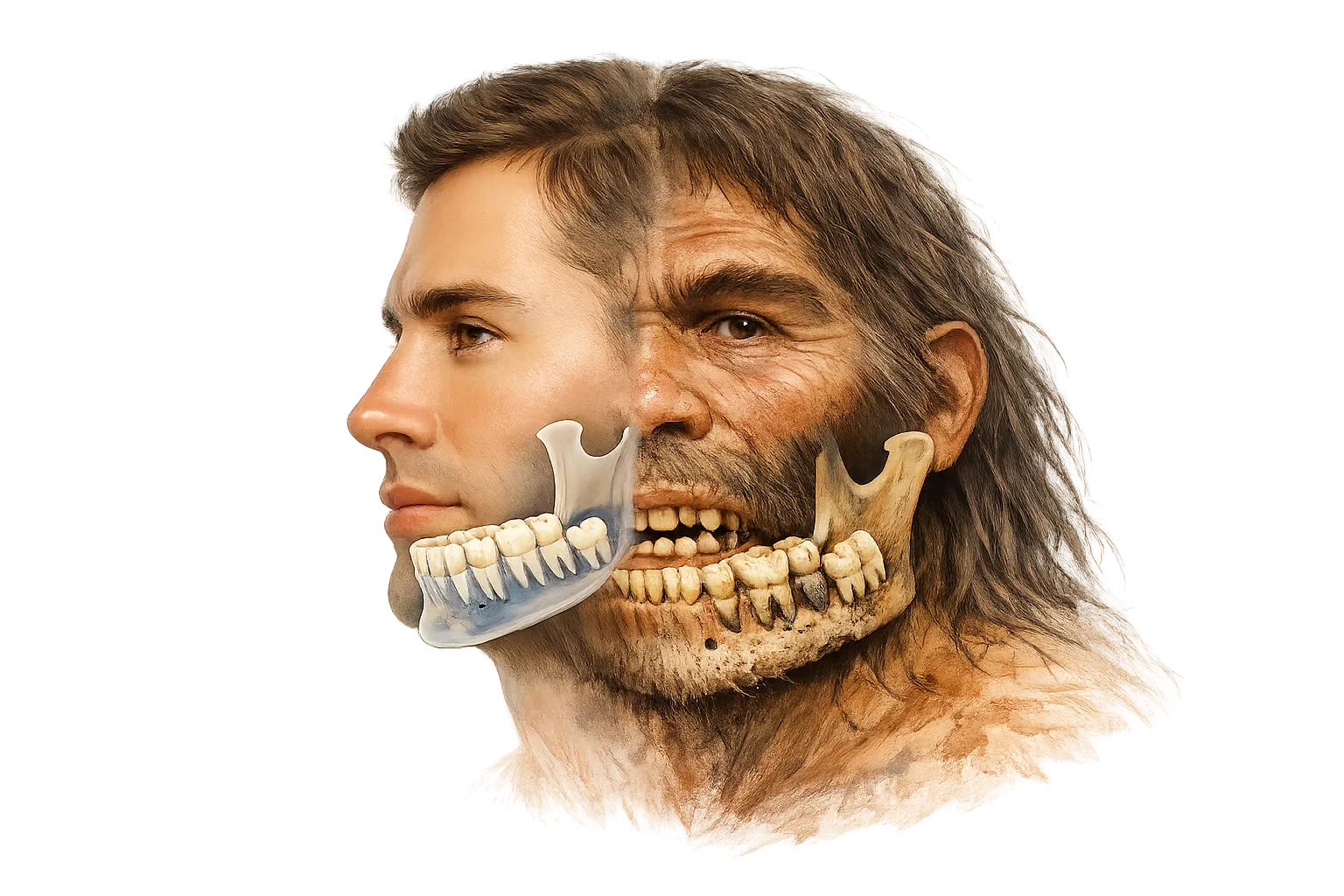
Wisdom teeth are a third set of molars that were fully functional in ancestral human jaws, which were larger and adapted to a coarser, harder-to-chew diet, but modern jaws have shrunk over thousands of years, leaving many people without enough space to accommodate them.
Early human diets consisted largely of tough, fibrous, and raw foods that required extensive chewing, and larger jaws with a full complement of thirty-two teeth, including wisdom teeth, were well suited to that demand. As diets shifted toward cooked, processed, and softer foods, particularly over the last several thousand years, less chewing force and jaw development was needed during growth, and human jaw size gradually decreased. Tooth size, however, has decreased more slowly than jaw size, creating a mismatch where the jaw often no longer has enough room for the last teeth to erupt, in many cases causing wisdom teeth to grow in at odd angles, become impacted, or crowd neighboring teeth.
At a glance
Jaw size and diet were closely matched for most of human evolutionary history.
Wisdom teeth are useless vestigial organs that never served any real purpose.
Ancient human skulls show noticeably larger jaws than modern ones, easily large enough to fit a full set of thirty-two teeth, wisdom teeth included, without any crowding at all.
Picture a garage built decades ago for a smaller car, still getting a delivery meant for the bigger car it was originally designed to hold. The jaw shrank; the delivery of teeth didn't get the memo.
Diagram
Why Do We Have Wisdom Teeth: the idea in one diagram
Wisdom tooth crowding results from a lag between rapid dietary-driven jaw-size reduction and slower evolutionary change in tooth size, creating a spatial mismatch during late adolescence.
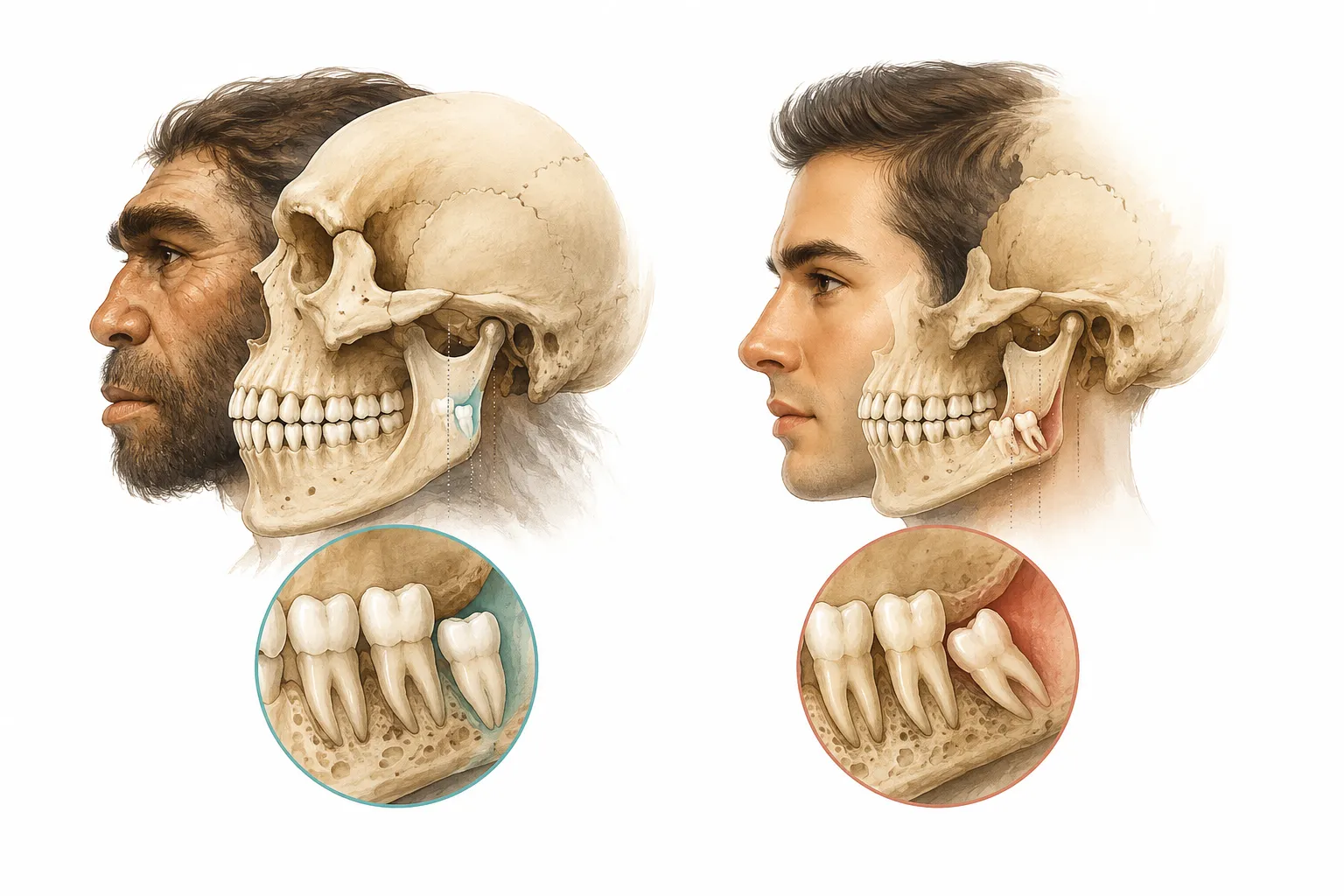
- 1Ancestral diets required larger jaws
Jaw size and diet were closely matched for most of human evolutionary history.
- 2Diets shifted toward softer foods
Less chewing stress during growth led to measurably smaller jaws over generations.
- 3Jaw size decreased faster than tooth size
The mismatch itself, not the teeth, is the root of most modern wisdom tooth problems.
- 4Wisdom teeth emerge into insufficient space
The timing of eruption collides directly with the space shortage left by generations of jaw shrinkage.
How it works
The mechanism
Wisdom tooth crowding results from a lag between rapid dietary-driven jaw-size reduction and slower evolutionary change in tooth size, creating a spatial mismatch during late adolescence.
- Step 01
Ancestral diets required larger jaws
Coarse, raw, and fibrous ancestral diets demanded substantial chewing force, favoring the development of larger jaws capable of housing a full set of thirty-two teeth.
Like building a larger workshop to accommodate heavier daily use.
Jaw size and diet were closely matched for most of human evolutionary history.
- Step 02
Diets shifted toward softer foods
The rise of cooking, food processing, and agriculture reduced the chewing demands placed on the jaw during childhood development.
Like a gym that gets used less intensely over time, gradually losing some of its built-up capacity.
Less chewing stress during growth led to measurably smaller jaws over generations.
- Step 03
Jaw size decreased faster than tooth size
While jaw dimensions responded relatively quickly to reduced developmental chewing demands, tooth size remained comparatively stable, creating a growing space mismatch.
Like shrinking a bookshelf without removing any of the books meant to go on it.
The mismatch itself, not the teeth, is the root of most modern wisdom tooth problems.
- Step 04
Wisdom teeth emerge into insufficient space
By the time wisdom teeth attempt to erupt in late adolescence, many modern jaws no longer have adequate room, leading to impaction, crowding, or angled growth.
Like the last guests arriving to a party with no seats left.
The timing of eruption collides directly with the space shortage left by generations of jaw shrinkage.
Surprises
Facts worth sitting with
Some people never develop wisdom teeth at all; agenesis, the congenital absence of one or more wisdom teeth, is a documented and increasingly common trait in modern populations.
Surprising facts
What seems backwards
Worth comparing
In everyday life
Easy to get wrong
Pressure points
Where the simple answer gets interesting
Why did human jaws shrink over time if teeth didn't shrink at the same rate?
Jaw size responds more directly to chewing demands during development, and as diets became softer and required less chewing force, jaw bones grew smaller across generations faster than tooth size adjusted through evolution.
Two connected body parts can evolve on different timelines, leaving a lingering mismatch.
Why do wisdom teeth so often grow in sideways or impacted?
When there isn't enough space at the back of the jaw for wisdom teeth to erupt normally, they can be forced to grow at an angle, push against neighboring teeth, or become trapped partially or fully beneath the gum line.
The pain most people associate with wisdom teeth is really a spatial problem, not a design flaw in the tooth itself.
Do all humans still get wisdom teeth?
No, a meaningful and apparently growing percentage of people are congenitally missing one or more wisdom teeth entirely, a trait some researchers see as a sign of ongoing evolutionary change.
Evolution may already be quietly phasing out the very teeth that cause so much modern dental trouble.
Behind the science
The story behind it
Comparative studies of ancient versus modern human jaws
Anthropologists comparing skeletal remains across thousands of years have documented a consistent trend of shrinking jaw size correlating with dietary shifts toward agriculture and cooking.
This research helped establish the currently accepted explanation for widespread modern wisdom tooth crowding.
Long-term trends in diet can leave a physical signature on the human body that outlasts the diet itself.
Skeletal jaw-size comparisons across historical populations
Researchers measured jaw dimensions across skeletal samples spanning thousands of years and multiple dietary transitions.
Jaw size consistently correlated with the estimated chewing demands of each population's typical diet, strongly supporting the diet-driven shrinkage explanation.
Clarify
Myth and reality
Myth
Wisdom teeth are useless vestigial organs that never served any real purpose.
Reality
Wisdom teeth were fully functional molars in ancestral human jaws large enough to accommodate them; the problems people experience today stem from a jaw-size mismatch, not a flaw in the teeth themselves.
Evidence
Comparative skeletal studies show ancestral jaws routinely fit all thirty-two teeth without the crowding common in modern populations.
Looking closer
The deeper pattern
Wisdom teeth problems aren't a flaw in the teeth themselves but a mismatch between an old biological feature and a rapidly changed environment.
One way to think about it
Traits that once fit perfectly can become liabilities not because they changed, but because the surrounding conditions changed around them faster than they could adapt.
Sometimes the problem isn't the tool, it's that the world it was built for no longer exists.
Limits
Where the explanation bends
People with naturally larger jaws or wisdom tooth agenesis.
Some individuals retain enough jaw space to accommodate fully erupted, properly aligned wisdom teeth without any crowding, while others never develop wisdom teeth at all.
The mismatch that causes so much modern dental trouble isn't universal, it depends heavily on individual jaw size and genetics.
In daily life
What this helps you notice
Dentists recommend early imaging of wisdom teeth in the teenage years to assess whether there's enough jaw space before problems develop.
Many people have wisdom teeth removed proactively in their late teens or early twenties specifically to prevent future crowding or impaction.
Remember
Key takeaways
- 1
Wisdom teeth were fully functional molars in ancestral jaws adapted to a coarser, harder-to-chew diet.
- 2
Modern human jaws have shrunk over thousands of years due to softer, cooked, and processed diets.
- 3
Tooth size hasn't shrunk as quickly as jaw size, creating a common space mismatch.
- 4
Impaction and crowding result from insufficient jaw space, not a flaw in the wisdom teeth themselves.
- 5
A growing number of people are congenitally missing one or more wisdom teeth entirely.
Wisdom teeth aren't evolution's mistake, they're evolution running slightly behind a diet that changed faster than the jaw around it could keep up.
Every wisdom tooth extraction is, in a strange way, a small correction for a dietary shift that happened generations before the patient in the chair was even born.
Read around the idea
More questions with the same curious pull
Nearby doors from the TinyThat archive, chosen by topic, intent, and reader curiosity.
Body & Brain
Why Do We Have Fingerprints?
Ridged skin improves grip and touch sensitivity, giving fingertips better friction and finer tactile resolution.
Body & Brain
Can the Brain Feel Pain?
The brain controls all pain in your body, yet it cannot feel pain itself. Discover why, and what this strange fact re...

Body & Brain
Does Your Brain Eat Itself?
Your brain really does consume parts of itself. Learn about autophagy, synaptic pruning, and why self-consumption is...