Fingerprint patterns are fully formed by around six months of fetal development and remain unchanged, aside from size, for the rest of a person's life.
Body & Brain
Why do humans have fingerprints?
Why Do We Have Fingerprints?
Every single fingertip is covered in tiny ridged whorls, and forensic science has trained most people to think of them purely as an identity marker.
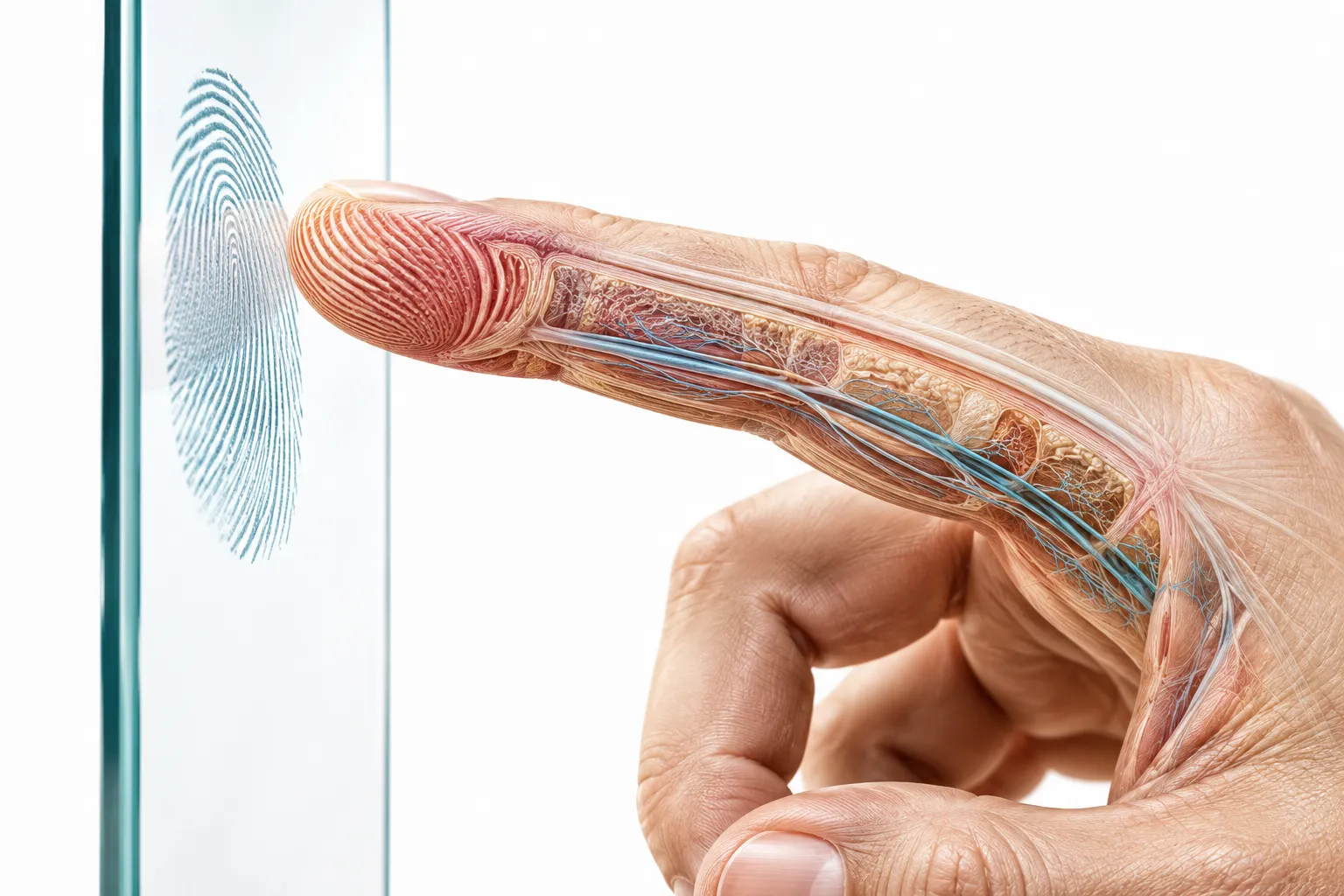
On this page
The short answer
Fingerprints evolved primarily to improve grip on textured or uneven surfaces and to enhance touch sensitivity, with their usefulness for individual identification being a side effect of how their pattern forms rather than the reason they exist.
The ridges that make up a fingerprint increase the surface area of the fingertip and create channels that help manage moisture, both of which improve friction when gripping objects, particularly surfaces that are uneven, wet, or textured. The ridges also amplify vibrations when the skin moves across a surface, which enhances the sensitivity of touch receptors just beneath the skin, helping fingertips detect fine texture and detail. The specific swirling pattern of any individual's fingerprint is shaped by a combination of genetics and random variation in pressure, position, and amniotic fluid flow during fetal development, which is why even identical twins, who share nearly identical genetics, end up with different fingerprint patterns.
At a glance
No two fingerprints form under identical enough conditions to be exactly alike.
Fingerprints exist so that people can be identified.
Koala fingerprints are so similar to human fingerprints that forensic experts have reportedly had difficulty telling them apart under a microscope.
Picture the tread on a tire, grooved specifically to grip the road better in wet or uneven conditions. Fingerprint ridges are doing something remarkably similar for your fingertips.
Diagram
Why Do We Have Fingerprints: the idea in one diagram
Fingerprint ridges improve grip through friction and moisture management while amplifying touch sensitivity, and their unique patterns form through a combination of genetic and random developmental factors.
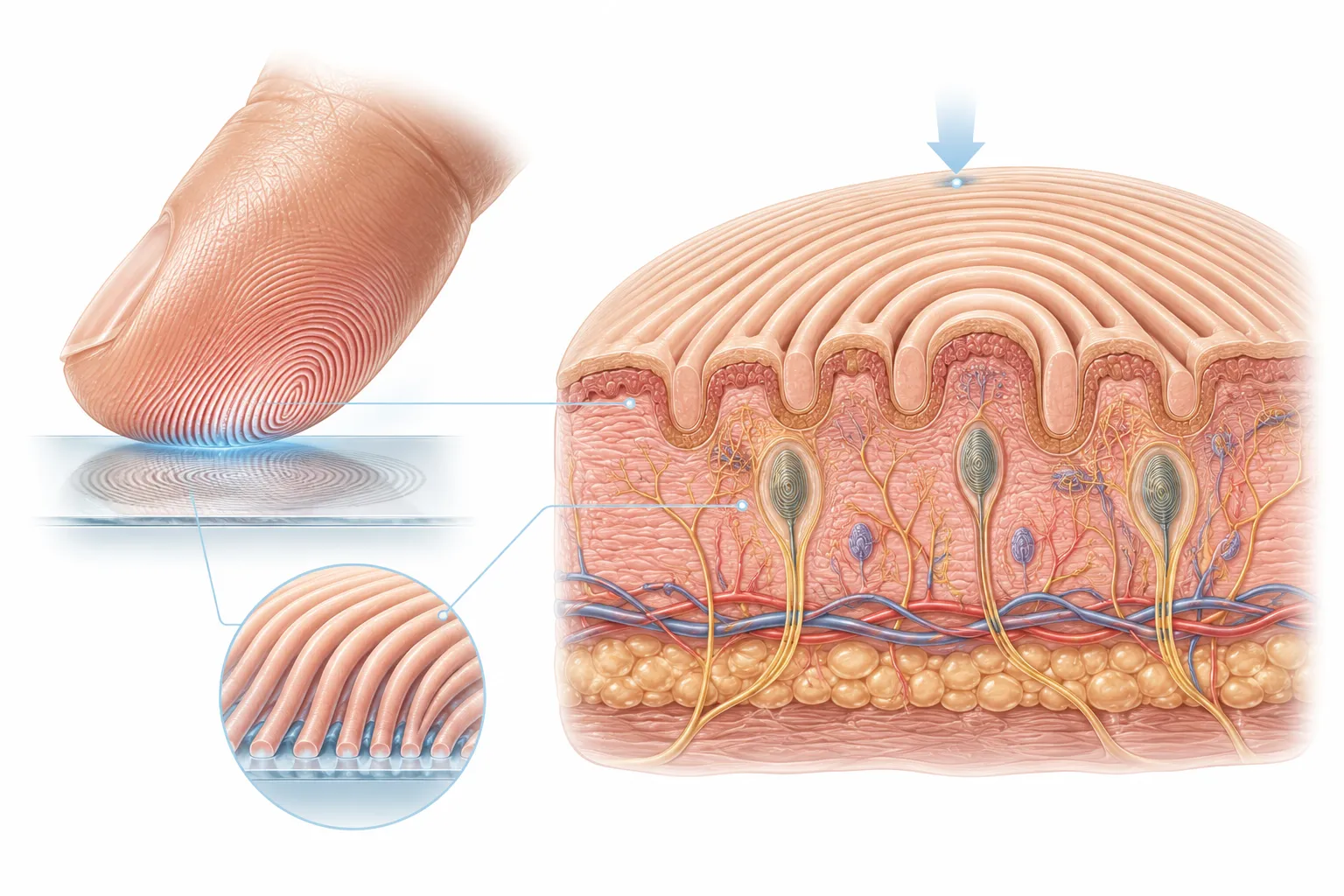
- 1Ridges form during fetal development
No two fingerprints form under identical enough conditions to be exactly alike.
- 2Ridges increase friction and manage moisture
Grip improvement is most noticeable in exactly the conditions where smooth skin would struggle most.
- 3Ridges amplify tactile signals
Fingerprints enhance the fine detail your fingertips can feel, not just how well they grip.
How it works
The mechanism
Fingerprint ridges improve grip through friction and moisture management while amplifying touch sensitivity, and their unique patterns form through a combination of genetic and random developmental factors.
- Step 01
Ridges form during fetal development
Between roughly the tenth and twenty-fourth week of fetal development, ridges form on the fingertips, shaped by genetics as well as random variation in pressure and fluid movement in the womb.
Like footprints left in wet sand, shaped by both the foot and the exact, unrepeatable conditions of that particular step.
No two fingerprints form under identical enough conditions to be exactly alike.
- Step 02
Ridges increase friction and manage moisture
The grooves between ridges channel away excess moisture and increase the effective surface area in contact with an object, improving grip especially on uneven or damp surfaces.
Like tire tread channeling water away to maintain road contact in the rain.
Grip improvement is most noticeable in exactly the conditions where smooth skin would struggle most.
- Step 03
Ridges amplify tactile signals
As fingertip ridges move across a textured surface, they generate vibrations that are amplified and transmitted more effectively to touch receptors beneath the skin.
Like a needle tracing grooves on a record to produce clearer sound.
Fingerprints enhance the fine detail your fingertips can feel, not just how well they grip.
Surprises
Facts worth sitting with
Fingerprint patterns are fully formed by around six months of fetal development and remain unchanged, aside from size, for the rest of a person's life.
Surprising facts
What seems backwards
Worth comparing
In everyday life
Easy to get wrong
Pressure points
Where the simple answer gets interesting
Why do koalas have fingerprints so similar to humans?
Koalas and humans are not closely related evolutionarily, but both independently evolved similar ridged fingertip patterns because both rely heavily on precise gripping and manipulation, an example of convergent evolution solving a similar problem separately.
Two completely unrelated species arrived at almost the same biological solution for handling objects.
Why don't identical twins have the same fingerprints?
Fingerprint ridge patterns are influenced not just by genetics but by subtle, random variation in factors like finger position, pressure, and amniotic fluid flow during fetal development, which differ even between genetically identical individuals.
Even nature's closest copy-paste job, identical twins, can't produce identical fingerprints.
Do fingerprints actually help you grip things better?
Yes, particularly on uneven or moist surfaces, where the ridges create channels that manage moisture and increase effective friction, though the advantage is less pronounced on perfectly smooth, dry surfaces.
The exact conditions where fingerprints help most turn out to be surprisingly specific.
Behind the science
The story behind it
Forensic use of fingerprints beginning in the nineteenth century
Fingerprint identification became a formal forensic tool in the late nineteenth century, well after the biological structure itself had existed for millions of years.
It illustrates how a feature that evolved for one purpose, grip and touch, was later repurposed by humans for an entirely different application.
Practical human applications often arrive long after nature has already found its own use for a trait.
Friction studies comparing ridged and smooth fingertip surfaces
Researchers tested grip performance of ridged versus theoretically smooth fingertip surfaces across different textures and moisture levels.
Ridges provided a clear advantage on rough and moist surfaces but showed little to no advantage, and sometimes a slight disadvantage, on perfectly smooth dry surfaces.
Clarify
Myth and reality
Myth
Fingerprints exist so that people can be identified.
Reality
Fingerprints evolved to improve grip and touch sensitivity; their usefulness for identification is a much later human application built on top of their naturally unique patterns.
Evidence
The biological structure of fingerprints predates any human use of them for identification by millions of years of evolutionary history.
Looking closer
The deeper pattern
The uniqueness of fingerprints wasn't the evolutionary goal, it was a side effect of a grip-and-touch system that happens to be shaped by unpredictable developmental noise.
One way to think about it
Some of the most useful applications of a trait are discovered long after the trait evolved for an entirely different reason.
A feature's original purpose and its most famous use can end up being almost completely unrelated.
Limits
Where the explanation bends
Rare genetic conditions causing absent fingerprints, known as adermatoglyphia.
People with this rare condition are born without fingerprint ridges entirely, which can complicate identification processes like biometric scanning but doesn't appear to significantly impair grip or touch in daily life.
It shows fingerprints, while useful, aren't strictly essential for basic hand function.
In daily life
What this helps you notice
Understanding fingerprint function explains why gripping wet objects, like a soap bar in the shower, can still be surprisingly difficult despite having ridged fingertips.
Manufacturers design textured, grooved grips on tools and sports equipment based on similar friction principles to fingertip ridges.
Remember
Key takeaways
- 1
Fingerprints evolved primarily to improve grip and enhance touch sensitivity, not for identification.
- 2
Ridges channel moisture and increase friction, especially helpful on uneven or wet surfaces.
- 3
Fingerprint patterns form through a mix of genetics and random developmental variation, even differing between identical twins.
- 4
Koalas independently evolved fingerprints strikingly similar to human ones, an example of convergent evolution.
- 5
Forensic use of fingerprints for identification only began in the late nineteenth century, far more recently than the trait itself.
Fingerprints were solving a grip-and-touch problem millions of years before anyone thought to use them for identification, and a koala's paw is quiet proof that evolution found the same solution more than once.
Every unique swirl on your fingertip started out as a practical grip upgrade, and only became a signature by accident of biology no one designed on purpose.
Read around the idea
More questions with the same curious pull
Nearby doors from the TinyThat archive, chosen by topic, intent, and reader curiosity.
Body & Brain
Can the Brain Feel Pain?
The brain controls all pain in your body, yet it cannot feel pain itself. Discover why, and what this strange fact re...
Body & Brain
Does Your Brain Eat Itself?
Your brain really does consume parts of itself. Learn about autophagy, synaptic pruning, and why self-consumption is...
Body & Brain
Why Does Brain Fog Happen?
Brain fog is not imaginary. Learn what actually causes that thick, cloudy feeling in your head and what science says...