Individual hair follicles are wrapped with nerve endings sensitive enough to detect a single hair being touched or moved, part of the body's broader sense of touch.
Body & Brain
Why does plucking a hair hurt while cutting it feels like nothing?
Why Does Plucking Hair Hurt But Cutting It Doesn't?
A haircut removes inches of hair without a single flicker of pain, but pulling out a single strand can make you wince instantly.
On this page
The short answer
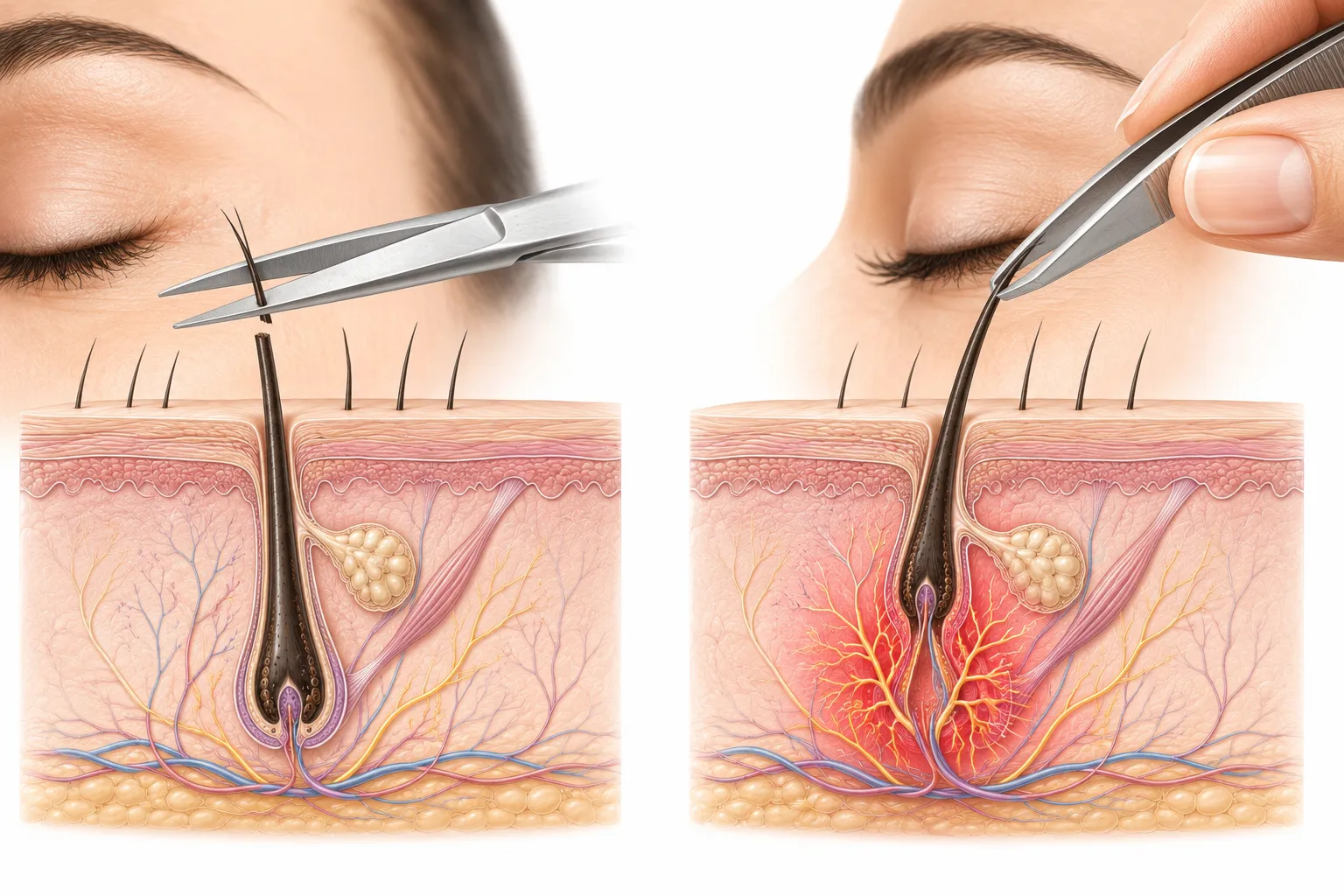
Cutting hair doesn't hurt because the visible hair shaft is made entirely of dead, keratinized cells with no nerve supply, while plucking hurts because it disturbs the living hair follicle beneath the skin, which is surrounded by a rich network of sensory nerve endings.
Hair is produced by a follicle, a small structure embedded in the skin containing living cells that continuously generate new hair. As those cells push upward and away from the follicle, they die and become filled with a tough structural protein called keratin, forming the hair shaft, the part of the hair visible above the skin's surface. Because the hair shaft consists entirely of dead cells with no blood supply or nerve endings, cutting it produces no sensation whatsoever, just as trimming fingernails, also made of dead keratin, causes no pain. The hair follicle itself, however, is very much alive and surrounded by a dense network of sensory nerve endings, some of which specifically wrap around the follicle to detect even the slightest movement of the hair, a system also responsible for the sensation of a hair being gently brushed or tugged. When a hair is plucked, the entire follicle is disturbed and its root is forcibly pulled from its anchoring position within the skin, directly stimulating these nerve endings and producing a genuine, sharp sensation of pain.
At a glance
This is the only living part of the entire hair structure.
Hair must be at least partially alive since it's attached to the body and can be affected by health and nutrition.
Only the hair follicle, the living structure anchoring the hair beneath the skin, is surrounded by sensory nerves, while the hair shaft itself, everything you can see and touch above the skin's surface, is made of dead, keratinized cells incapable of feeling anything.
Picture a flagpole with a fully alive, richly wired base buried underground, while the pole itself, the part sticking up in the air, is simply a lifeless, insensate rod.
Diagram
Why Does Plucking Hair Hurt But Cutting It Doesn't: the idea in one diagram
The hair shaft is made of dead keratinized cells with no nerve supply, so cutting it produces no sensation, while the living hair follicle beneath the skin is surrounded by sensory nerves, so plucking disturbs those nerves and causes pain.
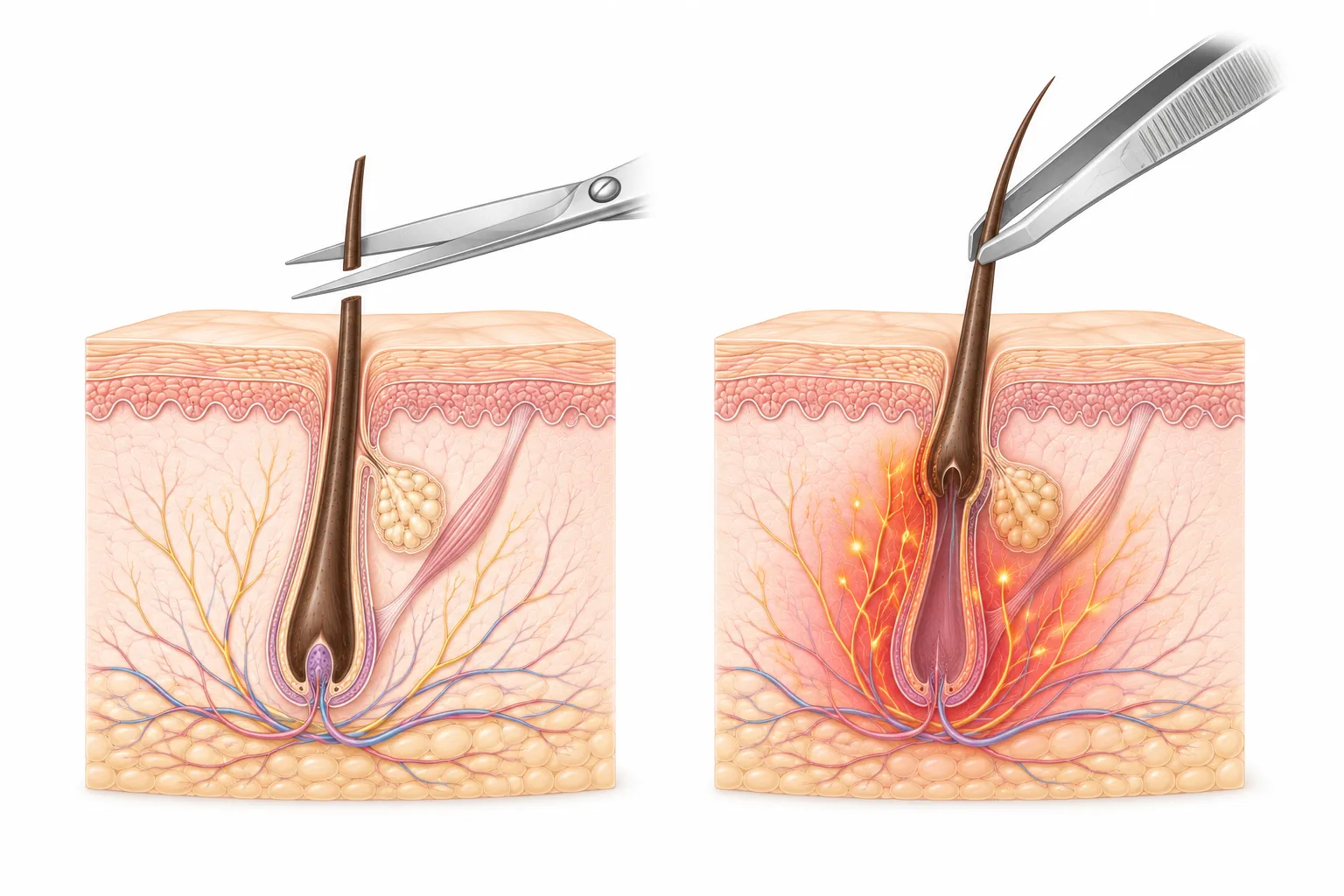
- 1The hair follicle produces living cells
This is the only living part of the entire hair structure.
- 2Cells die and keratinize as they move upward
This is the exact point where the hair transitions from living tissue to dead structural material.
- 3The hair shaft has no nerve supply
This explains why haircuts and shaving are completely painless.
- 4The follicle itself is surrounded by nerve endings
Disturbing the follicle, as in plucking, directly triggers these nerve endings and produces real pain.
How it works
The mechanism
The hair shaft is made of dead keratinized cells with no nerve supply, so cutting it produces no sensation, while the living hair follicle beneath the skin is surrounded by sensory nerves, so plucking disturbs those nerves and causes pain.
- Step 01
The hair follicle produces living cells
A small structure called the hair follicle, embedded in the skin, contains actively dividing living cells responsible for generating new hair growth.
Like a factory floor where raw material is actively produced before being pushed out the door.
This is the only living part of the entire hair structure.
- Step 02
Cells die and keratinize as they move upward
As newly produced cells are pushed away from the follicle, they die and fill with the structural protein keratin, forming the visible, solid hair shaft.
Like factory output hardening into a finished, inert product the moment it leaves the production line.
This is the exact point where the hair transitions from living tissue to dead structural material.
- Step 03
The hair shaft has no nerve supply
Because the hair shaft is composed entirely of dead cells, it contains no nerve endings and cannot transmit any pain signal, allowing it to be cut or trimmed without sensation.
Like clipping a fingernail, cutting dead material produces no feeling because there's nothing alive there to register it.
This explains why haircuts and shaving are completely painless.
- Step 04
The follicle itself is surrounded by nerve endings
Unlike the hair shaft, the living follicle beneath the skin is wrapped in sensory nerve endings that detect movement and disturbance of the hair at its root.
Like a motion sensor installed specifically around the base of a structure to detect any disturbance at its foundation.
Disturbing the follicle, as in plucking, directly triggers these nerve endings and produces real pain.
Surprises
Facts worth sitting with
Individual hair follicles are wrapped with nerve endings sensitive enough to detect a single hair being touched or moved, part of the body's broader sense of touch.
Surprising facts
What seems backwards
Worth comparing
In everyday life
Easy to get wrong
Pressure points
Where the simple answer gets interesting
Why does the body wrap nerve endings around hair follicles at all?
Nerve endings around hair follicles allow the body to detect very light touch and movement, such as an insect landing on the skin or a breeze moving through arm hair, functioning as an early warning and sensory system.
The reason plucking hurts is really a side effect of a sensory system that exists for an entirely different, protective purpose.
Why does the hair shaft grow as dead tissue instead of staying alive?
Keratinizing and dying off as it moves away from the follicle gives hair its characteristic strength and durability, properties that would be difficult to maintain in living, more fragile tissue exposed to constant friction and the elements.
The very thing that makes hair strong and functional is the same process that makes it completely unable to feel anything.
Why does waxing hurt more than plucking a single hair?
Waxing removes many hairs simultaneously from their follicles across a wider area, stimulating a much larger number of nerve endings at once compared to plucking a single strand.
The intensity of hair-removal pain scales directly with how many living follicle nerve endings are disturbed at the same time.
Behind the science
The story behind it
Cosmetic and dermatological research on hair removal methods
Dermatology research comparing pain levels across hair removal methods, including shaving, waxing, and plucking, has consistently linked pain intensity to whether the follicle itself is disturbed.
This research helped formalize practical guidance around hair removal techniques and expected discomfort levels for cosmetic and medical purposes.
A close look at ordinary personal care routines can reveal a surprisingly precise, testable underlying biological pattern.
Sensory nerve mapping studies of skin and hair follicles
Researchers used detailed microscopic and neurological studies to map the density and type of nerve endings surrounding individual hair follicles.
The studies confirmed a dense, specialized network of nerve endings specifically wrapped around the follicle, distinct from the complete absence of nerves in the hair shaft itself.
Clarify
Myth and reality
Myth
Hair must be at least partially alive since it's attached to the body and can be affected by health and nutrition.
Reality
The visible hair shaft is entirely dead tissue; only the follicle beneath the skin is alive, though the health of that living follicle does influence the quality of the hair it produces.
Evidence
Microscopic analysis of hair shaft structure confirms it consists of fully keratinized, non-living cells with no cellular metabolic activity.
Looking closer
The deeper pattern
Pain is a signal generated by living, connected tissue, and its complete absence is just as informative as its presence.
One way to think about it
The boundary between what can and cannot feel pain often reveals a deeper structural truth about a system, distinguishing its living, functional core from its more disposable, expendable extensions.
Where sensation stops often marks the exact boundary between a system's vital core and the parts it can afford to lose without consequence.
Limits
Where the explanation bends
People with certain skin or nerve conditions affecting follicle sensitivity.
Conditions that alter nerve sensitivity in the skin can make hair removal feel significantly more or less painful than typical, reflecting how directly follicle nerve activity determines the sensation.
A near-universal experience like the pain of plucking can vary meaningfully based on the underlying state of a person's nervous system.
In daily life
What this helps you notice
Understanding this difference explains why methods like shaving are painless while methods like waxing or tweezing consistently cause discomfort.
People choosing between hair removal methods often weigh the trade-off between shaving's painlessness and the longer-lasting results of more uncomfortable follicle-disturbing methods.
Remember
Key takeaways
- 1
The visible hair shaft is made entirely of dead, keratinized cells with no nerve supply.
- 2
Cutting or trimming hair produces no pain because there is no living tissue in the shaft to register sensation.
- 3
The hair follicle beneath the skin is alive and surrounded by a dense network of sensory nerve endings.
- 4
Plucking disturbs the living follicle directly, triggering these nerve endings and producing real pain.
- 5
Hair removal methods that disturb the follicle, like waxing or tweezing, are consistently more painful than shaving.
Every hair on your body is a strange kind of living export, produced by a fully alive root but sent out into the world as completely lifeless material.
The sting of a plucked hair isn't the hair complaining, it's the one truly living part of the whole structure making its presence unmistakably known.
Read around the idea
More questions with the same curious pull
Nearby doors from the TinyThat archive, chosen by topic, intent, and reader curiosity.
Body & Brain
Why Does Hair Turn Gray?
Hair turns gray when the pigment-producing melanocyte stem cells supplying a hair follicle gradually deplete with age.
Body & Brain
Why Do Nails Grow Faster Than Hair?
Nail cells and hair follicle cells divide at different inherent rates, driven by differences in their underlying grow...
Body & Brain
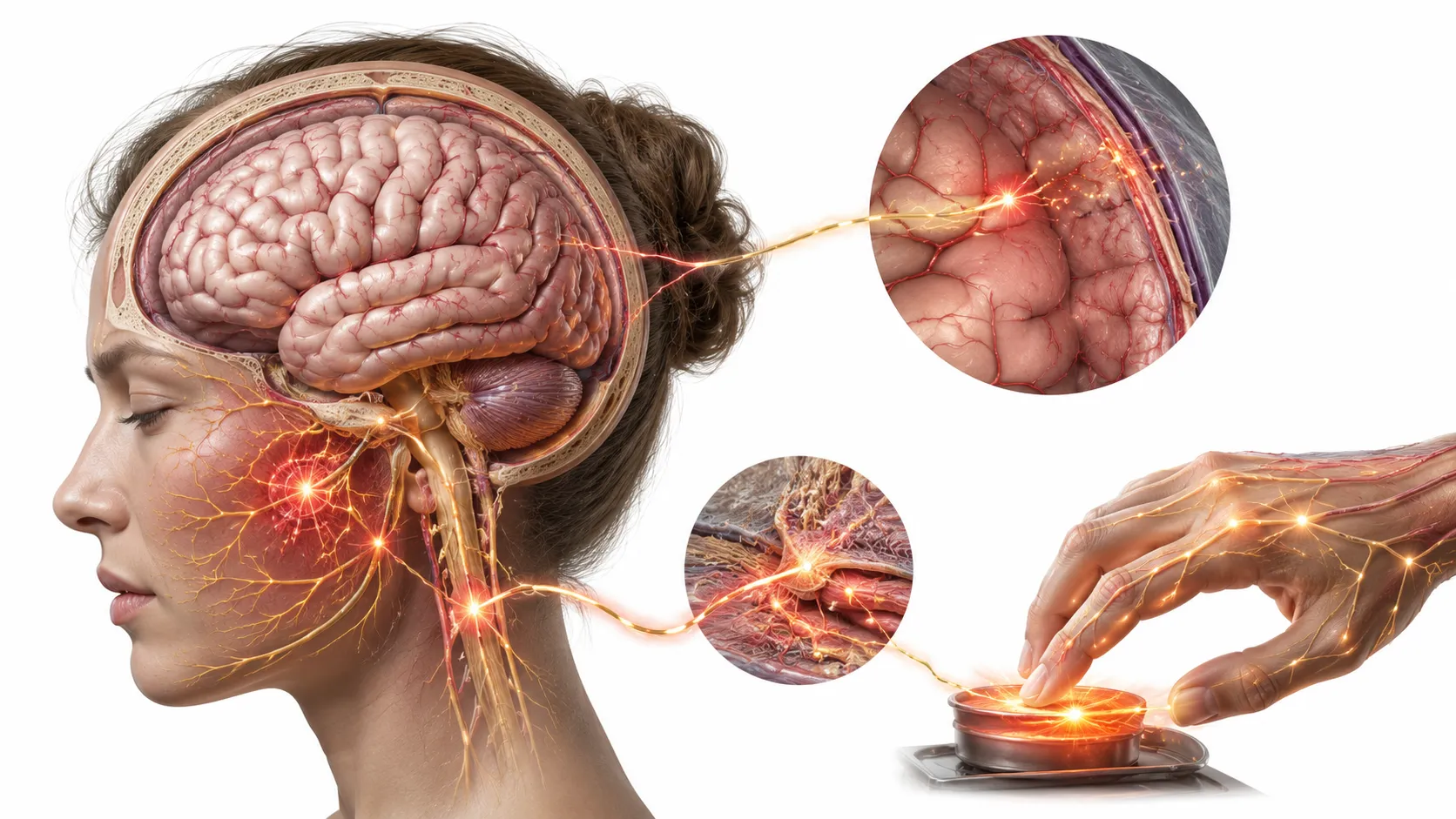
Can the Brain Feel Pain?
The brain controls all pain in your body, yet it cannot feel pain itself. Discover why, and what this strange fact re...