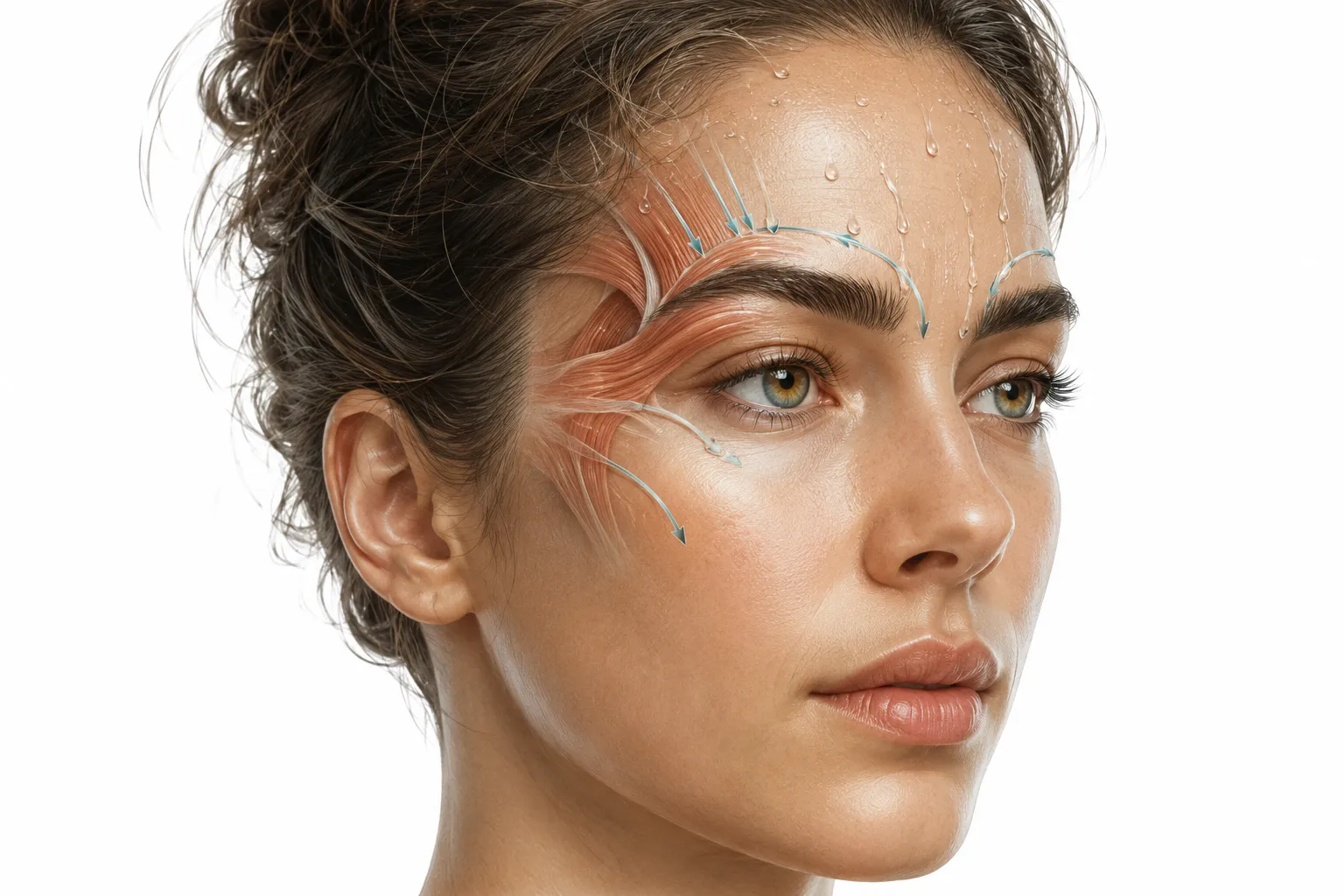
The individual hairs of an eyebrow point outward and downward in a specific pattern, engineered by growth direction to funnel liquid away from the eye rather than into it.
Body & Brain
Why do humans have eyebrows?
Why Do We Have Eyebrows?
Two thin strips of hair sit above your eyes and do more work than almost any other patch of hair on your body.
On this page
The short answer
Eyebrows evolved primarily to keep sweat, rain, and debris from running directly into the eyes, and secondarily became a major tool for nonverbal communication once early humans developed flatter, more mobile foreheads.
The arch and position of the eyebrow channel moisture from the forehead sideways, toward the temples, rather than straight down into the eyes, where it would blur vision at exactly the wrong moment. Because eyebrow hair is coarser and grows in a directional pattern, it also traps and diverts fine dust and debris. Once early hominins lost the heavy, fixed brow ridge that earlier ancestors had, the skin above the eyes became independently mobile for the first time, and eyebrows took on a second major role: broadcasting emotion. A raised brow, a furrowed brow, or a single skeptical arch can communicate faster and more precisely than words, which is one reason the muscles controlling eyebrow movement are unusually fine-tuned compared to muscles elsewhere on the face.
At a glance
The direction of hair growth alone does most of the moisture-diverting work.
Eyebrows are a vestigial leftover with no real function today.
Some researchers argue eyebrows became more expressive precisely because humans lost the heavy brow ridge our ancestors had, freeing a strip of skin to move independently for the first time.
Picture the little awning above a shop window, angled just enough to shed rain before it hits the glass. Your eyebrows are doing the same job, arched over your eyes for exactly that reason.
Diagram
Why Do We Have Eyebrows: the idea in one diagram
Eyebrows function through hair direction, position, and coarse texture, all working together to intercept moisture and debris before it reaches the eye, while the muscles beneath them provide fine expressive control.
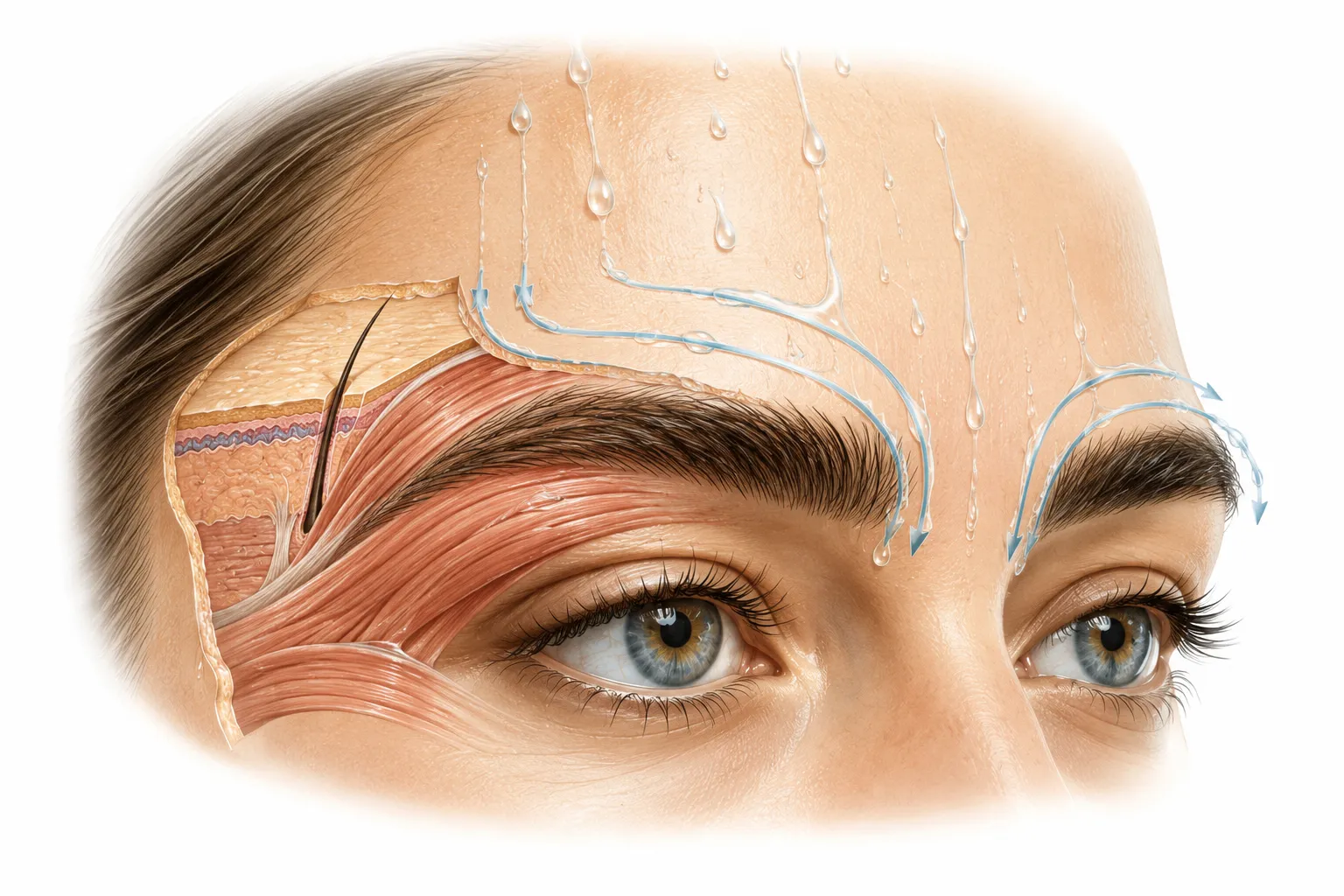
- 1Hair grows in a diverting pattern
The direction of hair growth alone does most of the moisture-diverting work.
- 2Position above the eye socket creates a barrier
Location matters as much as the hair itself.
- 3Coarse texture traps debris
Texture adds a filtering function on top of redirection.
- 4Underlying muscles enable expression
Mobility freed up by skull evolution turned a protective feature into a communication tool.
How it works
The mechanism
Eyebrows function through hair direction, position, and coarse texture, all working together to intercept moisture and debris before it reaches the eye, while the muscles beneath them provide fine expressive control.
- Step 01
Hair grows in a diverting pattern
Eyebrow hairs grow at an angle, generally pointing outward from the center of the face, which physically redirects downward-moving liquid sideways.
Like shingles on a roof, angled to shed water in one consistent direction.
The direction of hair growth alone does most of the moisture-diverting work.
- Step 02
Position above the eye socket creates a barrier
Sitting on the ridge just above the eye socket, eyebrows form a physical ledge that intercepts sweat and rain before it can drip straight down.
Like an awning positioned just above a window.
Location matters as much as the hair itself.
- Step 03
Coarse texture traps debris
Compared to finer facial hair, eyebrow hair is thicker and coarser, which helps catch dust, sweat, and small particles before they reach the eye.
Like a doormat catching dirt before it enters the house.
Texture adds a filtering function on top of redirection.
- Step 04
Underlying muscles enable expression
The frontalis, corrugator, and related muscles attach beneath the eyebrows and allow fine, independent movement once the human forehead lost its heavy fixed brow ridge.
Like unlocking a joint that used to be fused solid.
Mobility freed up by skull evolution turned a protective feature into a communication tool.
Surprises
Facts worth sitting with
The individual hairs of an eyebrow point outward and downward in a specific pattern, engineered by growth direction to funnel liquid away from the eye rather than into it.
Surprising facts
What seems backwards
Worth comparing
In everyday life
Easy to get wrong
Pressure points
Where the simple answer gets interesting
Why did eyebrows become more expressive in humans than in other primates?
As early hominins evolved flatter foreheads and lost the heavy fixed brow ridge of earlier ancestors, the skin above the eyes gained independent mobility for the first time, allowing fine-grained muscle control that other primates, constrained by bone, never developed.
A change in skull shape millions of years ago accidentally gave humans a whole new communication channel.
Why do eyebrows never grow as long as scalp hair?
Eyebrow hair follicles operate on a much shorter growth cycle, typically lasting only a few months before the hair sheds, compared to years for scalp hair follicles.
The same body can run wildly different internal clocks for hair just inches apart.
Can people still communicate effectively without eyebrows?
Studies show people missing eyebrows are read more slowly and less accurately by others, particularly for subtle emotions like surprise or concern, even though speech and other facial cues remain intact.
A tiny strip of hair turns out to carry a surprising share of the emotional bandwidth on a human face.
Behind the science
The story behind it
Facial recognition research on eyebrow importance
Researchers digitally removed eyebrows from photographs of familiar faces and found recognition accuracy dropped more than when eyes themselves were removed.
The finding surprised researchers who expected the eyes to dominate facial recognition, and instead pointed to eyebrows as an underrated identity cue.
The features we consciously notice least are sometimes doing the most unconscious work.
Digital eyebrow removal facial recognition studies
Psychologists tested how quickly and accurately people could identify familiar faces from photos with eyebrows digitally removed versus other features removed.
Recognition accuracy dropped more sharply without eyebrows than without eyes, defying most participants' expectations going into the study.
Clarify
Myth and reality
Myth
Eyebrows are a vestigial leftover with no real function today.
Reality
Eyebrows continue to actively divert sweat and debris away from the eyes and serve as one of the most information-dense tools for nonverbal communication on the human face.
Evidence
Facial recognition and expression-reading studies consistently show measurable functional loss when eyebrows are removed or absent.
Looking closer
The deeper pattern
The eyebrow's dual role, part rain gutter and part emotional broadcast system, shows how evolution rarely designs anything for a single purpose.
One way to think about it
Structures that survive over evolutionary time tend to accumulate second and third functions, repurposed opportunistically rather than engineered from a blank page.
The most useful tools are often the ones that quietly do two jobs at once.
Limits
Where the explanation bends
Alopecia or medical conditions causing eyebrow loss.
People without eyebrows lose both the physical moisture-diverting function and a significant portion of their expressive range, which studies show slows how quickly others read their emotions.
Losing a feature most people never consciously think about reveals just how much work it was quietly doing.
In daily life
What this helps you notice
Understanding the protective function of eyebrows explains why heavy sweating during exercise doesn't immediately blind a person.
Athletes rely on eyebrow shape, along with headbands, to keep sweat from streaming directly into their eyes during intense activity.
Remember
Key takeaways
- 1
Eyebrows physically divert sweat, rain, and debris away from the eyes through hair direction and position.
- 2
The loss of the heavy fixed brow ridge in human evolution freed the skin above the eyes to become independently mobile.
- 3
Eyebrows carry a surprisingly large share of human emotional expression and identity recognition.
- 4
Studies show people are slower to read emotion in faces missing eyebrows, even with the eyes intact.
- 5
Eyebrow hair grows on a much shorter cycle than scalp hair, which is why it never needs trimming.
The eyebrow started its evolutionary life as plumbing, a simple gutter to keep sweat out of the eyes, and only later became one of the richest channels of human emotional expression.
Every skeptical arch of an eyebrow, every flash of surprise, is running on hardware that was originally installed for a much less glamorous job: keeping your eyes dry.
Read around the idea
More questions with the same curious pull
Nearby doors from the TinyThat archive, chosen by topic, intent, and reader curiosity.
Body & Brain
Why Do We Have Fingerprints?
Ridged skin improves grip and touch sensitivity, giving fingertips better friction and finer tactile resolution.
Body & Brain
Can the Brain Feel Pain?
The brain controls all pain in your body, yet it cannot feel pain itself. Discover why, and what this strange fact re...
Body & Brain
Does Your Brain Eat Itself?
Your brain really does consume parts of itself. Learn about autophagy, synaptic pruning, and why self-consumption is...