The three semicircular canals in each ear are oriented roughly perpendicular to each other, allowing the inner ear to detect rotation in any direction, not just one plane.
Body & Brain
Why does spinning around make us feel dizzy?
Why Do We Get Dizzy When Spinning?
Spin around several times and stop, and the world keeps spinning anyway, even though every part of you knows you've stopped moving.
On this page
The short answer
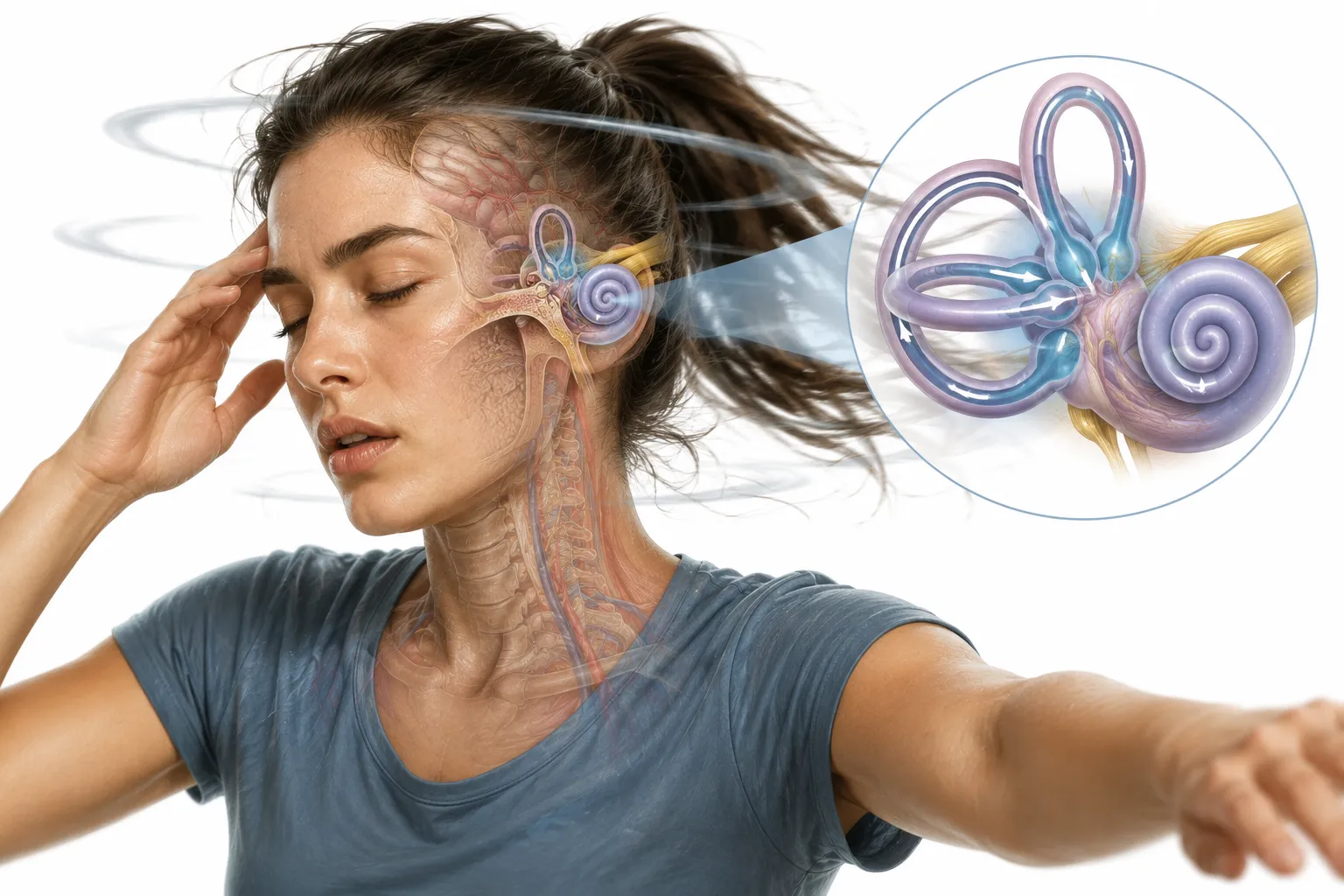
Dizziness from spinning happens because fluid inside the semicircular canals of the inner ear continues moving briefly after your body stops, sending your brain a false signal that you're still rotating, which conflicts with what your eyes and body are telling you and produces the sensation of dizziness.
The inner ear contains three fluid-filled semicircular canals oriented in different planes, which detect rotational movement of the head. When you spin, the fluid inside these canals moves along with your head, bending tiny hair-like sensors that signal the direction and speed of rotation to your brain. When you suddenly stop spinning, your body stops immediately, but the fluid inside the canals, due to its own momentum, continues moving for a short period afterward. This continued fluid movement keeps sending a signal to your brain indicating you're still rotating, even though your eyes and other senses are now reporting that you've stopped. This mismatch between conflicting sensory signals, called sensory conflict, is what produces the disorienting sensation of dizziness, along with the visual illusion that the room is still spinning.
At a glance
This fluid movement is how the inner ear normally detects rotational movement accurately.
Dizziness from spinning is purely a mental or psychological effect.
The same tiny fluid-filled canals responsible for post-spin dizziness are also what let you sense you're turning your head, even with your eyes completely closed.
Picture a snow globe that keeps swirling for a few seconds after you stop shaking it. The fluid inside your inner ear behaves in a strikingly similar way after you spin your body.
Diagram
Why Do We Get Dizzy When Spinning: the idea in one diagram
Spinning causes fluid in the inner ear's semicircular canals to move along with rotation, and its continued momentum after stopping creates a temporary mismatch with other sensory input, producing dizziness.
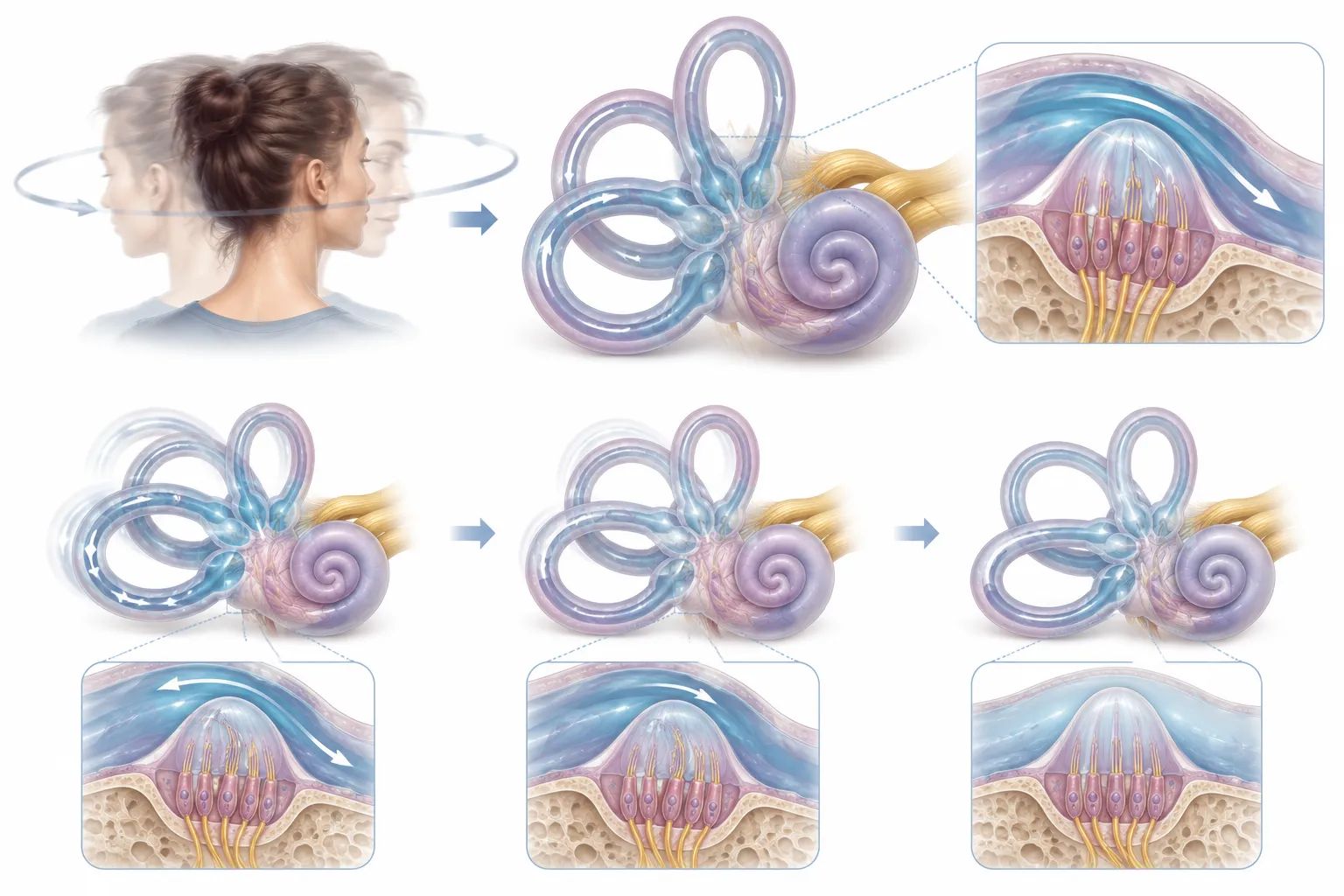
- 1Fluid moves with the head during spinning
This fluid movement is how the inner ear normally detects rotational movement accurately.
- 2The body stops but the fluid keeps moving
This brief lag is the direct physical cause of lingering dizziness.
- 3The brain receives conflicting signals
This sensory conflict is the direct trigger for the disorienting sensation of dizziness.
- 4Fluid settles and the sensation resolves
Dizziness from spinning is inherently temporary, resolving as soon as the fluid catches up.
How it works
The mechanism
Spinning causes fluid in the inner ear's semicircular canals to move along with rotation, and its continued momentum after stopping creates a temporary mismatch with other sensory input, producing dizziness.
- Step 01
Fluid moves with the head during spinning
As the head rotates, fluid inside the semicircular canals moves along with it, bending tiny hair-like sensory structures that detect the direction and speed of rotation.
Like water sloshing inside a spinning bucket, moving along with the container.
This fluid movement is how the inner ear normally detects rotational movement accurately.
- Step 02
The body stops but the fluid keeps moving
When spinning suddenly stops, the fluid's own momentum causes it to keep moving briefly, continuing to bend the sensory hair cells even though the head is now still.
Like a snow globe that keeps swirling for a few seconds after you stop shaking it.
This brief lag is the direct physical cause of lingering dizziness.
- Step 03
The brain receives conflicting signals
While the inner ear continues signaling rotation, the eyes and other body senses report that movement has stopped, creating a mismatch the brain struggles to reconcile.
Like a car's speedometer reading a high speed even though the car has already come to a stop.
This sensory conflict is the direct trigger for the disorienting sensation of dizziness.
- Step 04
Fluid settles and the sensation resolves
Within roughly twenty to thirty seconds, the fluid inside the semicircular canals settles to a resting state, resolving the conflicting signal and ending the dizziness.
Like waves in a pool gradually calming after the disturbance that caused them has stopped.
Dizziness from spinning is inherently temporary, resolving as soon as the fluid catches up.
Surprises
Facts worth sitting with
The three semicircular canals in each ear are oriented roughly perpendicular to each other, allowing the inner ear to detect rotation in any direction, not just one plane.
Surprising facts
What seems backwards
Worth comparing
In everyday life
Easy to get wrong
Pressure points
Where the simple answer gets interesting
Why does dancers' spotting technique reduce dizziness?
By fixing their gaze on a single point for as long as possible during each rotation and then quickly whipping their head around to find it again, dancers reduce the amount of continuous visual and vestibular mismatch their brain has to process, lessening the sensory conflict that causes dizziness.
A performance technique developed for artistic precision turns out to be a clever workaround for basic inner ear physics.
Why does dizziness go away after a short time even without doing anything?
The fluid inside the semicircular canals gradually settles back to a resting, non-moving state within roughly twenty to thirty seconds after spinning stops, which resolves the conflicting sensory signal and ends the dizziness.
The dizziness has a built-in expiration date, set entirely by the physics of fluid settling inside your skull.
Can you train yourself to get less dizzy from spinning?
Yes, with repeated practice and exposure, such as in gymnasts, dancers, and figure skaters, the brain can adapt to partially suppress the conflicting sensory signals, reducing the intensity of dizziness over time.
A seemingly hardwired reflex turns out to be surprisingly trainable with enough repetition.
Behind the science
The story behind it
Training techniques among professional dancers and skaters
Ballet dancers and figure skaters use the spotting technique specifically to manage and reduce dizziness during repeated turns.
Their techniques demonstrate a practical, real-world application of vestibular science developed independently through performance training.
Practical solutions to biological quirks sometimes emerge from artistic or athletic tradition well before, or independent of, formal scientific explanation.
Caloric and rotational testing of the vestibular system
Researchers developed testing methods, including controlled rotation and temperature stimulation of the ear, to study how the semicircular canals detect movement.
These tests confirmed that eye movements and dizziness sensations correspond directly and predictably to fluid movement patterns within the semicircular canals.
Clarify
Myth and reality
Myth
Dizziness from spinning is purely a mental or psychological effect.
Reality
Dizziness from spinning is a physical sensory phenomenon, caused directly by lingering fluid movement in the inner ear conflicting with other sensory input.
Evidence
Vestibular research using rotational testing consistently shows a direct, measurable link between inner ear fluid movement and reported dizziness.
Looking closer
The deeper pattern
Dizziness is what happens when two normally cooperative sensory systems briefly disagree about reality.
One way to think about it
Confusion and disorientation often arise not from a single system failing outright, but from otherwise reliable systems giving conflicting information at the same time.
Sometimes the most disorienting experiences come not from a lack of information, but from too much information that doesn't agree with itself.
Limits
Where the explanation bends
Vestibular disorders such as benign paroxysmal positional vertigo.
In these conditions, small calcium particles can become dislodged within the inner ear canals, causing false rotational signals and severe dizziness even without any actual spinning.
The same system responsible for harmless playground dizziness can, when disrupted by a medical condition, cause severe, disabling vertigo without any spinning at all.
In daily life
What this helps you notice
Understanding the inner ear's role in dizziness explains why closing your eyes doesn't stop the spinning sensation after a fast ride or a childhood spinning game.
Amusement parks often include warnings about dizziness and disorientation specifically for rides involving rapid spinning.
Remember
Key takeaways
- 1
Dizziness from spinning results from fluid in the inner ear's semicircular canals lagging behind the body after rotation stops.
- 2
The continued fluid movement sends a false rotation signal that conflicts with input from the eyes and body.
- 3
This sensory mismatch, called sensory conflict, produces the disorienting sensation of dizziness.
- 4
Dizziness typically resolves within twenty to thirty seconds as the inner ear fluid settles back to rest.
- 5
Trained dancers and skaters use techniques like spotting to reduce the sensory conflict during repeated spins.
That dizzy, spinning-room feeling isn't your brain glitching, it's a tiny amount of fluid inside your skull briefly refusing to admit you've already stopped moving.
Long after your feet have stopped, a small swirl of fluid deep inside your ear is still finishing its own private spin, and your brain is simply waiting for it to catch up.
Read around the idea
More questions with the same curious pull
Nearby doors from the TinyThat archive, chosen by topic, intent, and reader curiosity.
Body & Brain
Can the Brain Feel Pain?
The brain controls all pain in your body, yet it cannot feel pain itself. Discover why, and what this strange fact re...

Body & Brain
Does Your Brain Eat Itself?
Your brain really does consume parts of itself. Learn about autophagy, synaptic pruning, and why self-consumption is...
Body & Brain
Why Does Brain Fog Happen?
Brain fog is not imaginary. Learn what actually causes that thick, cloudy feeling in your head and what science says...