The eyeball myth is anatomically impossible; eyes are held in place by six extraocular muscles and are not connected to the sinuses or nasal pressure system in any way that a sneeze could affect.
Body & Brain
Why do our eyes automatically close when we sneeze?
Why Do We Close Our Eyes When We Sneeze?
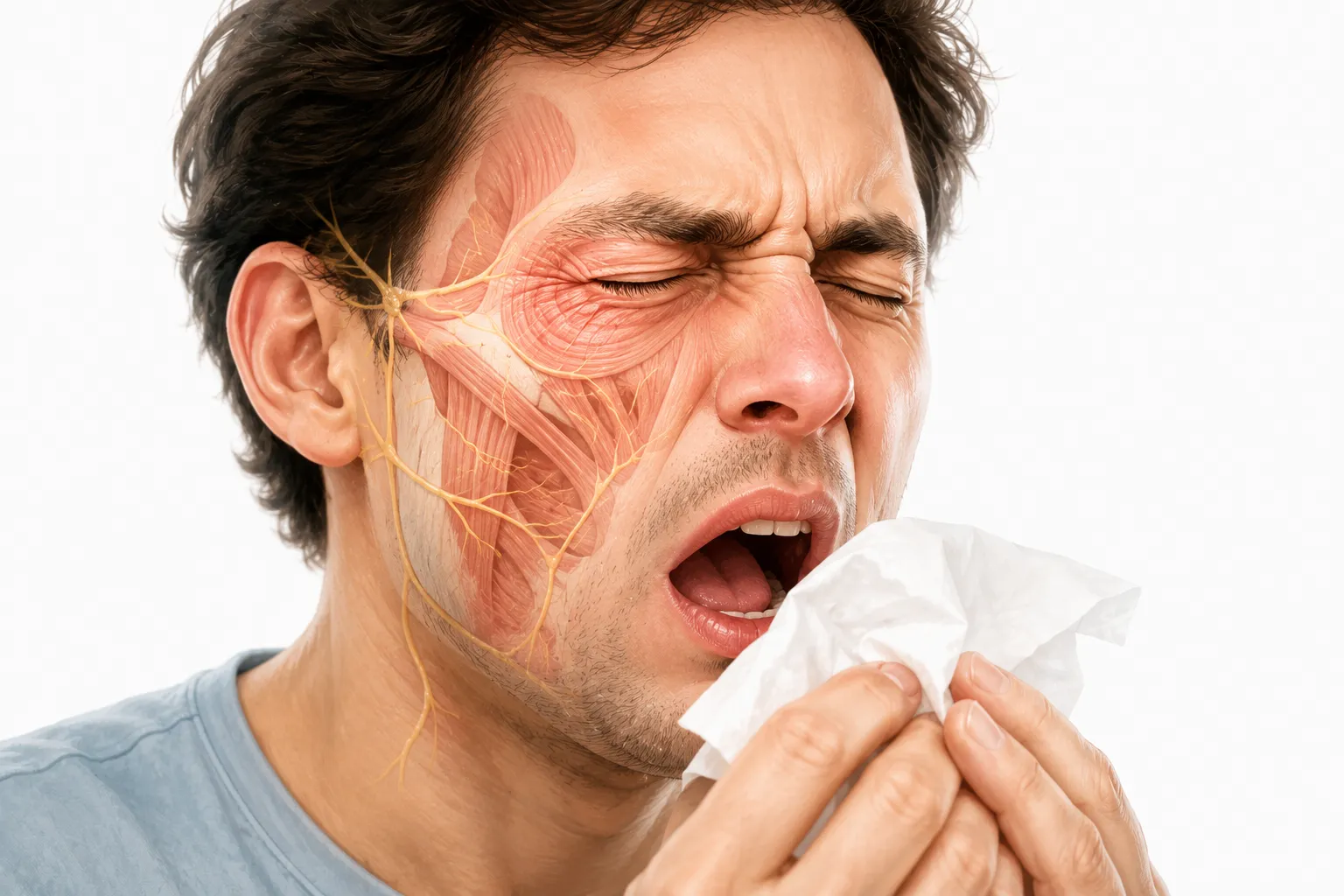
Somewhere, someone once told you that if you sneeze with your eyes open, your eyeballs will pop out of your head. It's completely untrue, and yet the reflex it was trying to explain is real, automatic, and almost impossible to override.
On this page
The short answer
Eyes close during a sneeze because the sneeze reflex is controlled by a network of nerves in the brainstem that trigger multiple muscle groups simultaneously, including the eyelid muscles, as part of one coordinated involuntary reflex arc. It's not to prevent your eyes from popping out; that's a myth with no basis in anatomy.
A sneeze begins when sensory nerves in the nasal passages detect an irritant and send a signal to the brainstem's sneeze center. From there, the brainstem coordinates a rapid, forceful sequence involving the diaphragm, chest muscles, throat, and facial muscles, all firing together to expel the irritant explosively through the nose and mouth. The eyelid closure is triggered by this same reflex arc, likely because the nerve pathways controlling eyelid muscles are closely linked to the trigeminal and facial nerve circuits involved in the broader sneeze reflex. Researchers believe the eye closure may serve a modest protective function, shielding the eyes from expelled droplets and particles, but it isn't a mechanical necessity like the popular myth suggests, and there's no anatomical mechanism by which keeping your eyes open during a sneeze could cause them to dislodge.
At a glance
The sneeze reflex begins with a very sensitive early detection system.
Your eyeballs could pop out if you sneeze with your eyes open.
A sneeze is one of the most complex involuntary reflexes your body performs, involving a coordinated firing sequence across dozens of muscles, and the eye-closing is just one small, oddly persistent part of that sequence.
Imagine a single master switch in a control room that, when flipped, automatically triggers ten different systems at once, some of them useful, some of them just wired in because they happened to share the same circuit.
Diagram
Why Do We Close Our Eyes When We Sneeze: the idea in one diagram
The sneeze reflex is coordinated by the brainstem, which triggers eyelid closure alongside respiratory and facial muscle contractions as part of one shared involuntary nerve pathway.
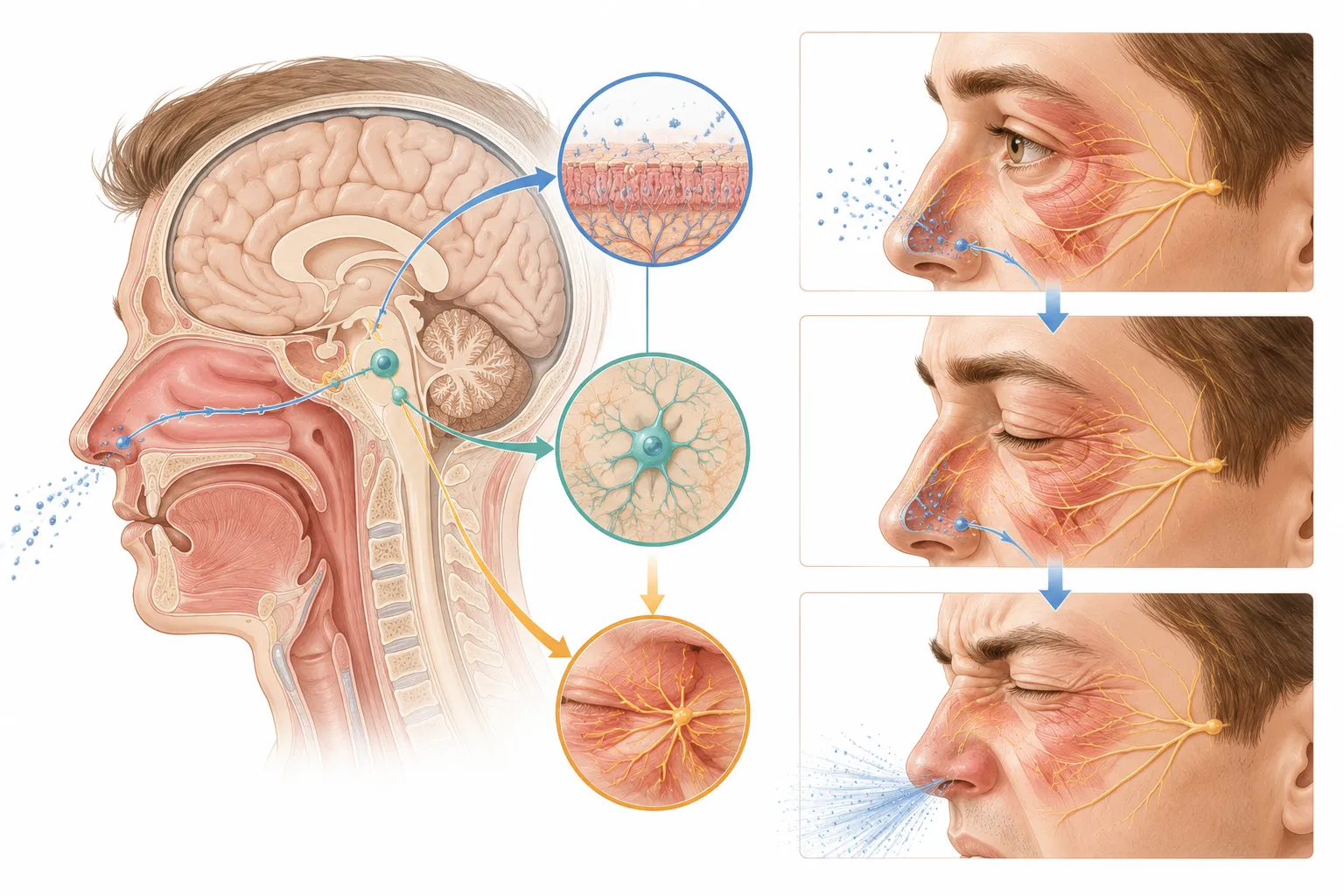
- 1An irritant triggers nasal sensory nerves
The sneeze reflex begins with a very sensitive early detection system.
- 2The brainstem coordinates the full response
A sneeze is not one action, but many coordinated actions triggered together.
- 3Eyelid muscles fire along the shared pathway
Eye closure isn't a separate decision; it's a passenger on the same reflex arc.
- 4The full reflex executes in a fraction of a second
The speed and coordination of a sneeze make it nearly impossible to consciously interrupt any single part of it.
How it works
The mechanism
The sneeze reflex is coordinated by the brainstem, which triggers eyelid closure alongside respiratory and facial muscle contractions as part of one shared involuntary nerve pathway.
- Step 01
An irritant triggers nasal sensory nerves
Sensory nerves lining the nasal passages, largely part of the trigeminal nerve, detect an irritant like dust, pollen, or a sudden bright light and send a signal toward the brainstem.
Like a smoke detector picking up the first trace of smoke.
The sneeze reflex begins with a very sensitive early detection system.
- Step 02
The brainstem coordinates the full response
A network of neurons in the brainstem, sometimes called the sneeze center, receives the signal and coordinates a rapid, simultaneous firing sequence across multiple muscle groups.
Like a control tower issuing one command that multiple departments respond to at once.
A sneeze is not one action, but many coordinated actions triggered together.
- Step 03
Eyelid muscles fire along the shared pathway
Because the nerve circuits controlling eyelid closure are closely linked to the trigeminal and facial nerve pathways involved in the sneeze reflex, they get triggered as part of the same coordinated firing sequence.
Like two wires bundled in the same cable carrying separate but simultaneous signals.
Eye closure isn't a separate decision; it's a passenger on the same reflex arc.
- Step 04
The full reflex executes in a fraction of a second
Respiratory, throat, facial, and eyelid muscles all contract together in a rapid, largely uncontrollable sequence that expels the irritant forcefully.
Like a synchronized fireworks display, all triggered from a single ignition point.
The speed and coordination of a sneeze make it nearly impossible to consciously interrupt any single part of it.
Surprises
Facts worth sitting with
The eyeball myth is anatomically impossible; eyes are held in place by six extraocular muscles and are not connected to the sinuses or nasal pressure system in any way that a sneeze could affect.
Surprising facts
What seems backwards
Worth comparing
In everyday life
Easy to get wrong
Pressure points
Where the simple answer gets interesting
Why does the myth about eyeballs popping out persist despite being completely false?
The myth offers an intuitive, mechanical-sounding explanation for a mysterious involuntary reflex, and because almost no one ever tests it by trying to keep their eyes open, there's little everyday opportunity to disprove it firsthand.
A wrong explanation can survive indefinitely as long as the actual experiment needed to disprove it feels too risky for most people to casually try.
Can some people sneeze with their eyes open on purpose?
Yes, with conscious effort and practice, some people can partially or fully override the automatic eye-closing reflex during a sneeze, demonstrating that while the reflex is strong and default, it isn't entirely beyond conscious control for everyone.
One of the body's most automatic reflexes turns out to have a small crack of voluntary control for those determined enough to find it.
Does closing your eyes during a sneeze actually protect them from anything?
It likely offers modest protection from expelled droplets and particles that could otherwise land directly on the eye's surface, even though this isn't believed to be the primary evolutionary driver of the reflex.
A reflex that seems to have started as an incidental side effect of shared nerve wiring may have picked up a genuinely useful side benefit along the way.
Behind the science
The story behind it
Documented cases of sneezing with eyes open
Ophthalmologists and physiologists have documented rare instances, including some captured on video, of individuals sneezing with their eyes fully open, with no resulting eye injury or dislodgement.
These cases provided direct, observable evidence debunking the popular eyeball-popping myth and confirming the reflex is neurological rather than mechanically necessary.
Sometimes the most effective way to bust a myth is simply finding someone willing to test it directly.
High-speed video analysis of the sneeze reflex
Researchers used high-speed cameras to capture the full sequence of a sneeze in extreme slow motion, documenting the precise timing and coordination between respiratory, facial, and eyelid muscle activity.
The footage confirmed that eyelid closure begins essentially simultaneously with the rest of the sneeze reflex sequence, supporting the shared-nerve-pathway explanation over any pressure-based protective theory.
Clarify
Myth and reality
Myth
Your eyeballs could pop out if you sneeze with your eyes open.
Reality
There is no anatomical mechanism connecting nasal or sinus pressure during a sneeze to the muscles and tissue holding the eyeball in place; documented cases of people sneezing with eyes open show no injury whatsoever.
Evidence
Ophthalmological literature and recorded footage of open-eyed sneezing confirm the eyes remain completely unaffected structurally.
Looking closer
The deeper pattern
The eye-closing reflex persists not because it was purpose-built for protection, but because it happens to share a nerve pathway with a much bigger, more important reflex.
One way to think about it
Some behaviors that look intentional and purposeful are actually just incidental passengers riding along on a system built for something else entirely, and their apparent purpose is a story we tell after the fact.
Not every consistent behavior has a dedicated reason behind it. Some are just close neighbors to something that does.
Limits
Where the explanation bends
Photic sneeze reflex triggered by bright light.
Roughly a quarter of people sneeze involuntarily when suddenly exposed to bright light, a genetic quirk believed to result from crossed signaling between the optic and trigeminal nerves, triggering the same eye-closing sneeze reflex without any nasal irritant at all.
An entirely different trigger, light instead of an irritant, can set off the exact same coordinated reflex, further showing how tangled these nerve pathways really are.
In daily life
What this helps you notice
Understanding the sneeze reflex's shared nerve pathway helps explain related phenomena like the photic sneeze reflex, giving doctors a clearer framework for reassuring patients about unusual but harmless reflex quirks.
People who sneeze uncontrollably when stepping into sunlight can be reassured this is a well-documented, benign genetic trait rather than a sign of any underlying health problem.
Remember
Key takeaways
- 1
Eyes close during a sneeze because eyelid muscles are triggered by the same shared nerve pathway that coordinates the entire sneeze reflex.
- 2
The popular belief that your eyeballs could pop out if you sneeze with your eyes open is a complete myth with no anatomical basis.
- 3
Documented cases of people sneezing with their eyes open show no injury or issue whatsoever.
- 4
Eye closure may offer modest protection from expelled droplets, but this isn't believed to be the reflex's primary evolutionary purpose.
- 5
The related photic sneeze reflex, triggered by bright light in about a quarter of people, further shows how tangled the nerve pathways involved really are.
Your eyes don't close during a sneeze to protect them from popping out. They close because of a wiring coincidence deep in your brainstem that happened to bundle two unrelated systems onto the same circuit.
Somewhere in your brainstem, a switch built for one job quietly does a second one every single time you sneeze, and it's been doing it your entire life without you ever noticing the wiring underneath.
Read around the idea
More questions with the same curious pull
Nearby doors from the TinyThat archive, chosen by topic, intent, and reader curiosity.

Body & Brain
Can You Sneeze With Your Eyes Open?
Yes, it's physically possible and harmless, though the reflex to close them is very strong and largely involuntary.
Body & Brain
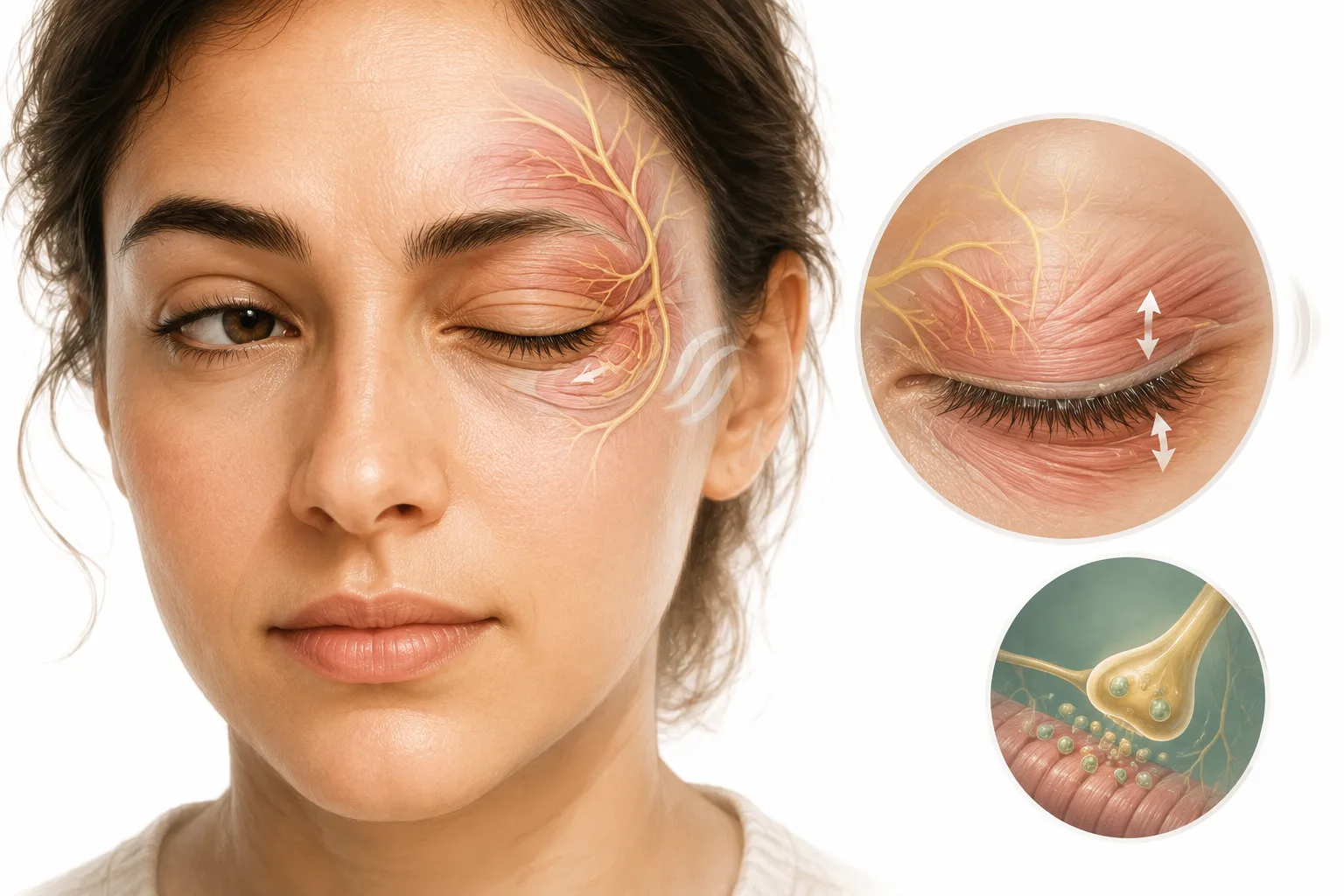
Why Do My Eyes Twitch?
Eye twitching results from an overexcited nerve triggering small, involuntary contractions in the thin eyelid muscle.
Body & Brain
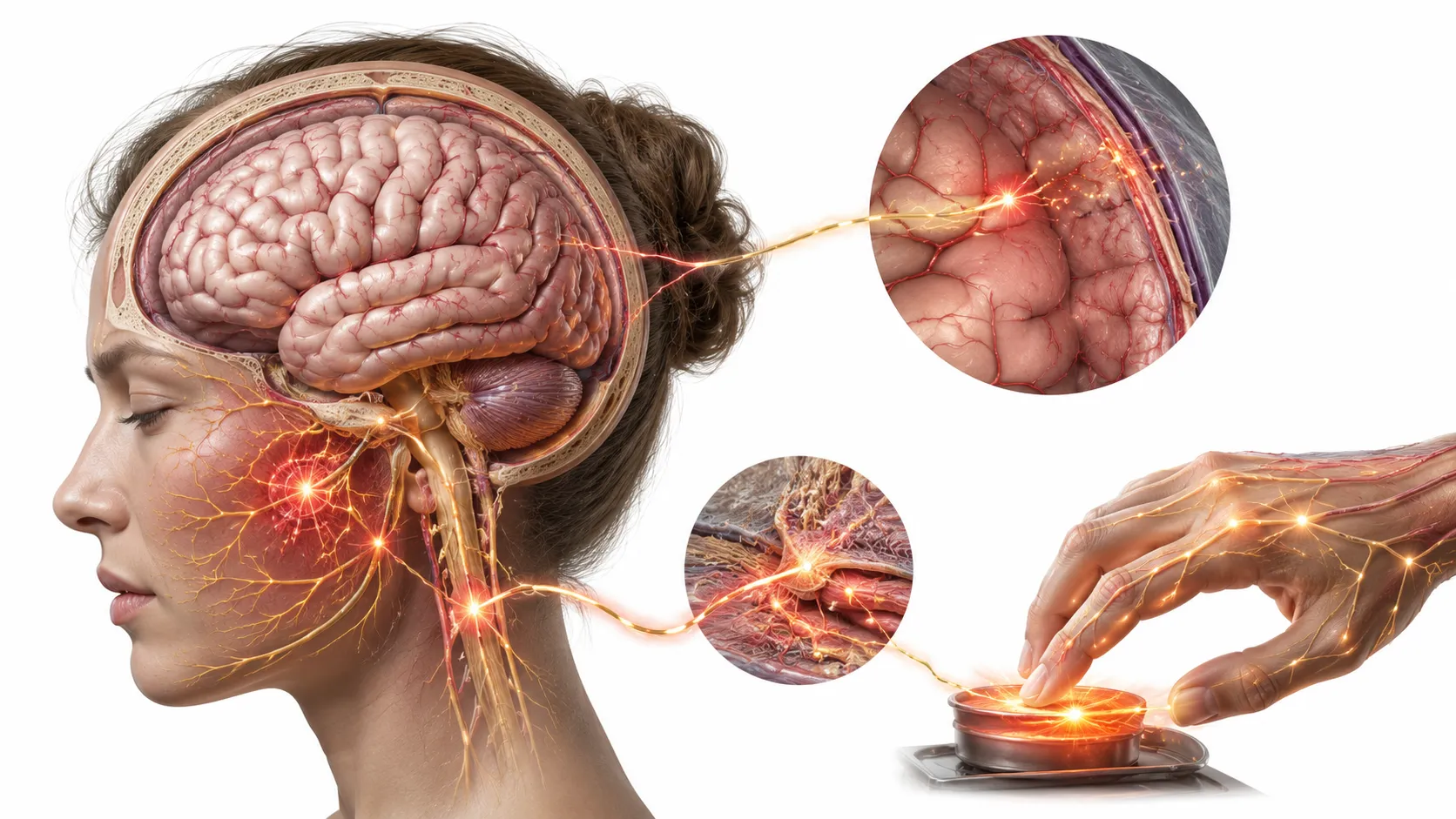
Can the Brain Feel Pain?
The brain controls all pain in your body, yet it cannot feel pain itself. Discover why, and what this strange fact re...