The medical term for common eyelid twitching, myokymia, refers to fine, continuous muscle contractions that are visible but generally harmless, distinct from more serious neurological twitching conditions.
Body & Brain
Why does the skin around my eye twitch involuntarily?
Why Do My Eyes Twitch?
For a few seconds, sometimes longer, a tiny patch of skin near your eye starts fluttering completely on its own, and no amount of willpower can make it stop immediately.
On this page
The short answer
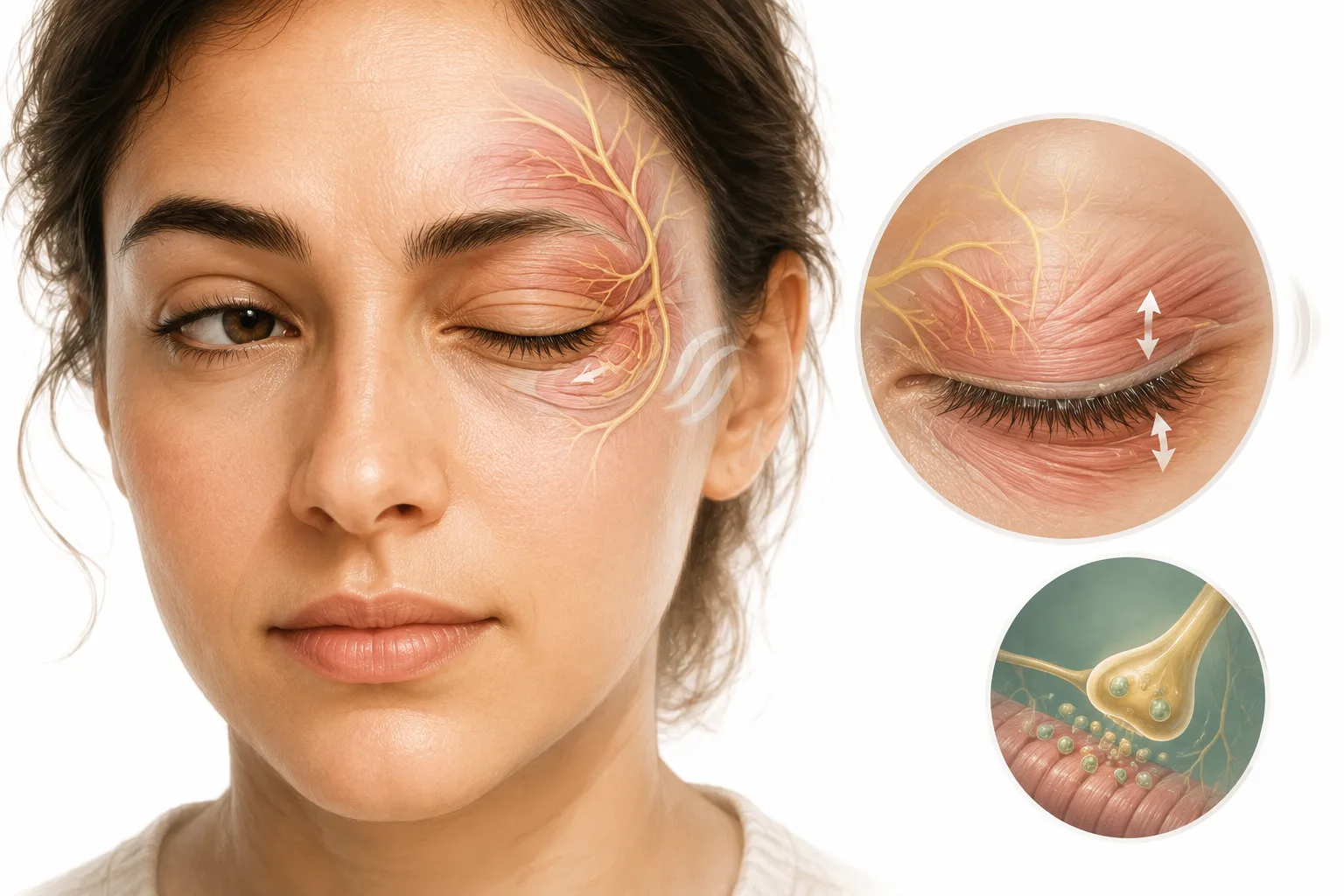
Eye twitching, medically called myokymia, happens when the nerve controlling a small muscle around the eyelid becomes overexcited and fires repeatedly on its own. It's usually triggered by fatigue, stress, caffeine, or eye strain, and it typically resolves on its own within a few days.
The eyelid is controlled by a very thin, delicate muscle called the orbicularis oculi, wrapped around the eye and responsible for blinking and closing the eye. This muscle is controlled by a facial nerve that, under normal conditions, fires only when you consciously or reflexively blink. Certain conditions, including sleep deprivation, high caffeine intake, alcohol, stress, and dry or strained eyes, can lower the threshold at which this nerve fires, causing it to spontaneously trigger small, repeated contractions in a tiny section of the muscle. Because the muscle involved is so small and thin, even a slight nerve misfire is easily visible as a twitch, unlike similar misfires in larger muscles elsewhere in the body that would be far less noticeable.
At a glance
The twitch begins with the nervous system becoming generally more reactive.
An eye twitch is usually a sign something is seriously wrong neurologically.
The twitch isn't random. It's a single, tiny muscle firing repeatedly because the nerve controlling it has become slightly overexcited, usually for a specific, identifiable reason.
Picture a single guitar string that's been tuned slightly too tight, vibrating on its own every time the air in the room shifts even a little, while every other string on the instrument stays perfectly still.
Diagram
Why Do My Eyes Twitch: the idea in one diagram
Eyelid twitching occurs when a facial nerve controlling the thin orbicularis oculi muscle becomes overexcited from fatigue, stress, or stimulants and fires spontaneously and repeatedly.
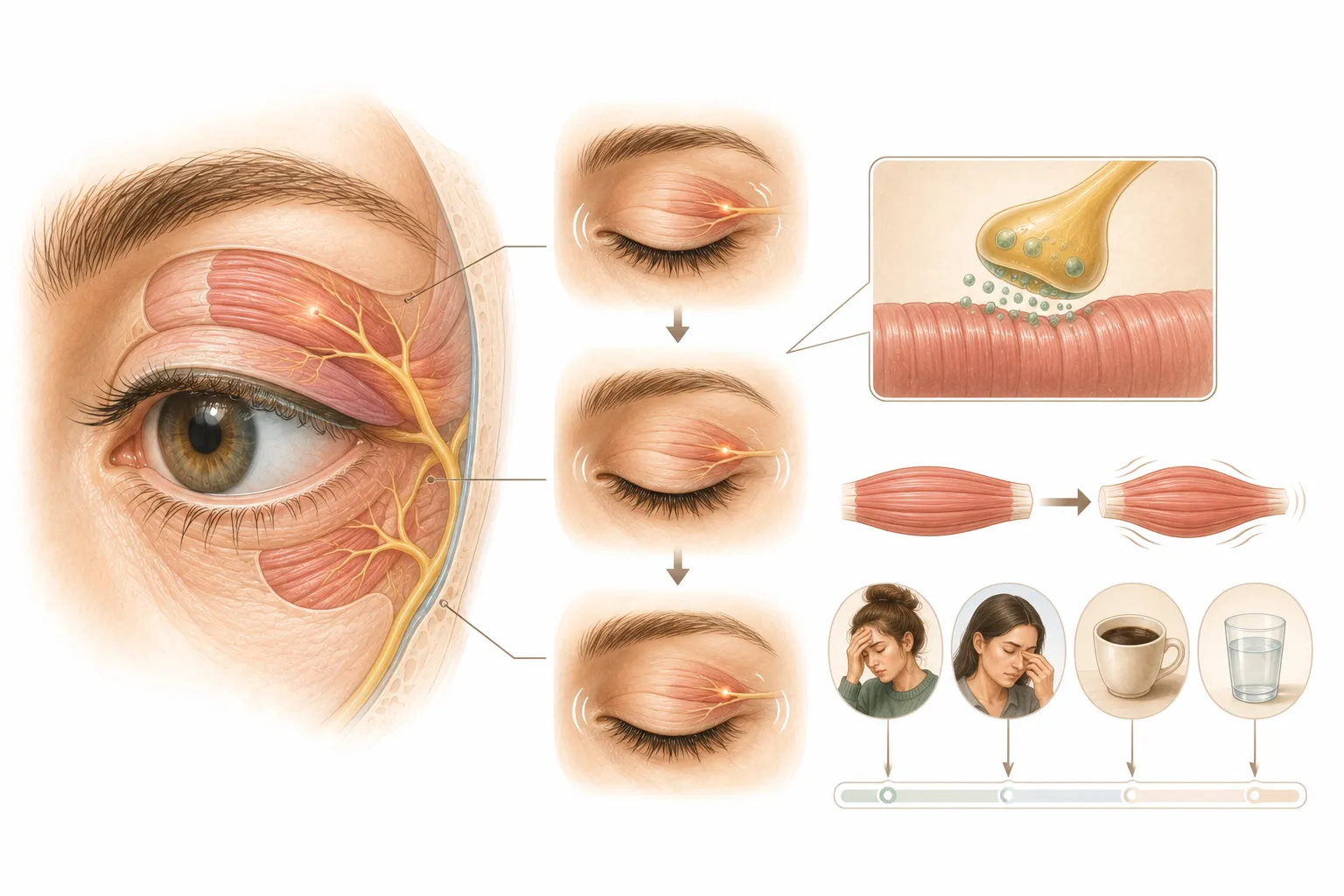
- 1Triggers lower the nerve's firing threshold
The twitch begins with the nervous system becoming generally more reactive.
- 2The facial nerve misfires
This is an involuntary, localized nerve event, not a decision your brain is making.
- 3The thin eyelid muscle contracts visibly
The visibility of the twitch is a direct result of how thin and delicate the eyelid muscle is.
- 4The twitch resolves as triggers subside
Most eye twitches resolve simply by addressing their underlying trigger.
How it works
The mechanism
Eyelid twitching occurs when a facial nerve controlling the thin orbicularis oculi muscle becomes overexcited from fatigue, stress, or stimulants and fires spontaneously and repeatedly.
- Step 01
Triggers lower the nerve's firing threshold
Sleep deprivation, stress, caffeine, and alcohol all increase neural excitability, making motor neurons more likely to fire without a deliberate signal from the brain.
Like turning up the sensitivity on a motion-activated light until it starts triggering from tiny movements.
The twitch begins with the nervous system becoming generally more reactive.
- Step 02
The facial nerve misfires
The nerve controlling the eyelid muscle fires spontaneously, without any conscious blink command from the brain.
Like a switch flipping on its own due to a loose wire.
This is an involuntary, localized nerve event, not a decision your brain is making.
- Step 03
The thin eyelid muscle contracts visibly
Because the orbicularis oculi is extremely thin compared to most other muscles, even a small, isolated misfire produces a visible flutter of the skin.
Like a thin sheet of fabric rippling from even a light breeze, while a heavy curtain nearby stays perfectly still.
The visibility of the twitch is a direct result of how thin and delicate the eyelid muscle is.
- Step 04
The twitch resolves as triggers subside
Once sleep, stress, and stimulant levels return to normal, the nerve's excitability drops back down and the spontaneous firing typically stops within days.
Like a jittery machine settling down once its power supply stabilizes.
Most eye twitches resolve simply by addressing their underlying trigger.
Surprises
Facts worth sitting with
The medical term for common eyelid twitching, myokymia, refers to fine, continuous muscle contractions that are visible but generally harmless, distinct from more serious neurological twitching conditions.
Surprising facts
What seems backwards
Worth comparing
In everyday life
Easy to get wrong
Pressure points
Where the simple answer gets interesting
Why does eye twitching seem to get worse the more tired or stressed you become?
Fatigue and stress both increase levels of certain neurotransmitters and lower the threshold at which motor neurons fire, making the already delicate nerve-muscle connection in the eyelid more prone to spontaneous, repeated firing.
A twitch that feels completely random is actually tracking your stress and sleep levels with surprising precision.
Is there a difference between ordinary eye twitching and a more serious condition?
Yes, ordinary myokymia is typically brief, mild, and confined to one small area of the eyelid, while benign essential blepharospasm involves more forceful, sometimes bilateral eyelid spasms that can interfere with vision and generally requires medical evaluation and treatment.
The same basic phenomenon, an eyelid twitching, spans a spectrum from a harmless nuisance to a diagnosable neurological condition, and the difference is mainly about intensity and duration.
Why does reducing caffeine actually help stop a twitch?
Caffeine increases neural excitability throughout the nervous system, including at the neuromuscular junctions controlling the eyelid, so reducing intake lowers the overall likelihood that the already-sensitive nerve will misfire.
A drink you have every morning is directly dialing up or down the excitability of one of the smallest, most delicate muscles in your body.
Behind the science
The story behind it
Clinical differentiation of myokymia from blepharospasm
Neurologists and ophthalmologists established clear diagnostic criteria distinguishing common, benign eyelid myokymia from the more serious neurological condition benign essential blepharospasm, based on duration, intensity, and whether the twitch affects vision.
This distinction allows most patients experiencing occasional eye twitching to be reassured it's harmless, while directing the smaller number with more serious symptoms toward appropriate treatment.
A precise diagnostic line separating harmless from serious symptoms can spare most people unnecessary worry.
Caffeine and sleep deprivation trigger studies for eyelid myokymia
Researchers tracked self-reported eyelid twitching frequency against caffeine intake and sleep patterns in study participants over extended periods.
Both reduced sleep and higher caffeine intake independently correlated with increased twitching frequency, and the combination of both factors together showed an even stronger association.
Clarify
Myth and reality
Myth
An eye twitch is usually a sign something is seriously wrong neurologically.
Reality
The vast majority of eye twitches are benign myokymia caused by everyday factors like fatigue, stress, or caffeine, and resolve on their own without any medical intervention.
Evidence
Ophthalmologists and neurologists consistently report that persistent, vision-affecting twitching serious enough to require treatment is far less common than the brief, self-resolving twitching most people experience occasionally.
Looking closer
The deeper pattern
An eye twitch isn't a malfunction appearing out of nowhere; it's a visible, external signal of an internal threshold, fatigue, stress, or stimulant load, quietly being crossed.
One way to think about it
Small, seemingly disconnected physical symptoms often function as early external indicators of internal states that would otherwise stay completely invisible until they became much more serious.
The body sometimes shows its hand in small, twitchy tells long before it shows it in anything more serious.
Limits
Where the explanation bends
Benign essential blepharospasm.
In this less common condition, both eyelids can spasm forcefully and involuntarily, sometimes severely enough to temporarily impair vision, requiring treatments like botulinum toxin injections to manage.
The same basic muscle and nerve system responsible for a harmless daily annoyance can, in rare cases, escalate into a condition serious enough to require targeted medical intervention.
In daily life
What this helps you notice
Tracking sleep, caffeine, and stress levels alongside eye twitching episodes can help most people identify and reduce their specific personal trigger without needing medical treatment.
Many people find that simply prioritizing a few nights of better sleep or temporarily cutting back on coffee resolves an ongoing bout of eye twitching within days.
Remember
Key takeaways
- 1
Eye twitching, or myokymia, happens when the nerve controlling the thin eyelid muscle fires spontaneously and repeatedly.
- 2
Common triggers include sleep deprivation, stress, caffeine, and alcohol, all of which increase nerve excitability.
- 3
The eyelid muscle's thinness is why even a tiny nerve misfire is visibly noticeable, unlike similar misfires in thicker muscles.
- 4
Most eye twitches are harmless and resolve within days once the underlying trigger is addressed.
- 5
Persistent, forceful, or vision-affecting twitching can indicate a distinct condition called benign essential blepharospasm, which may require medical treatment.
The twitch you can't stop with willpower is one of the rare moments your body openly admits it's overloaded, using a muscle too thin to keep the secret.
Every other overworked muscle in your body suffers in silence. The eyelid, thin enough to betray its own nerve, is the one part of you that simply can't help but show it.
Read around the idea
More questions with the same curious pull
Nearby doors from the TinyThat archive, chosen by topic, intent, and reader curiosity.

Body & Brain
Can You Sneeze With Your Eyes Open?
It's physically possible but extremely difficult, because the eye-closing reflex during a sneeze is largely involuntary.
Body & Brain
Why Do We Sweat When Nervous?
The sympathetic nervous system's stress response activates sweat glands independently of temperature.
Body & Brain
Can the Brain Feel Pain?
The brain controls all pain in your body, yet it cannot feel pain itself. Discover why, and what this strange fact re...