Scar tissue never fully regains the original skin's tensile strength; even fully healed scars typically reach only around eighty percent of the strength of undamaged skin.
Body & Brain
Why do scars form after skin heals?
Why Do Scars Form?
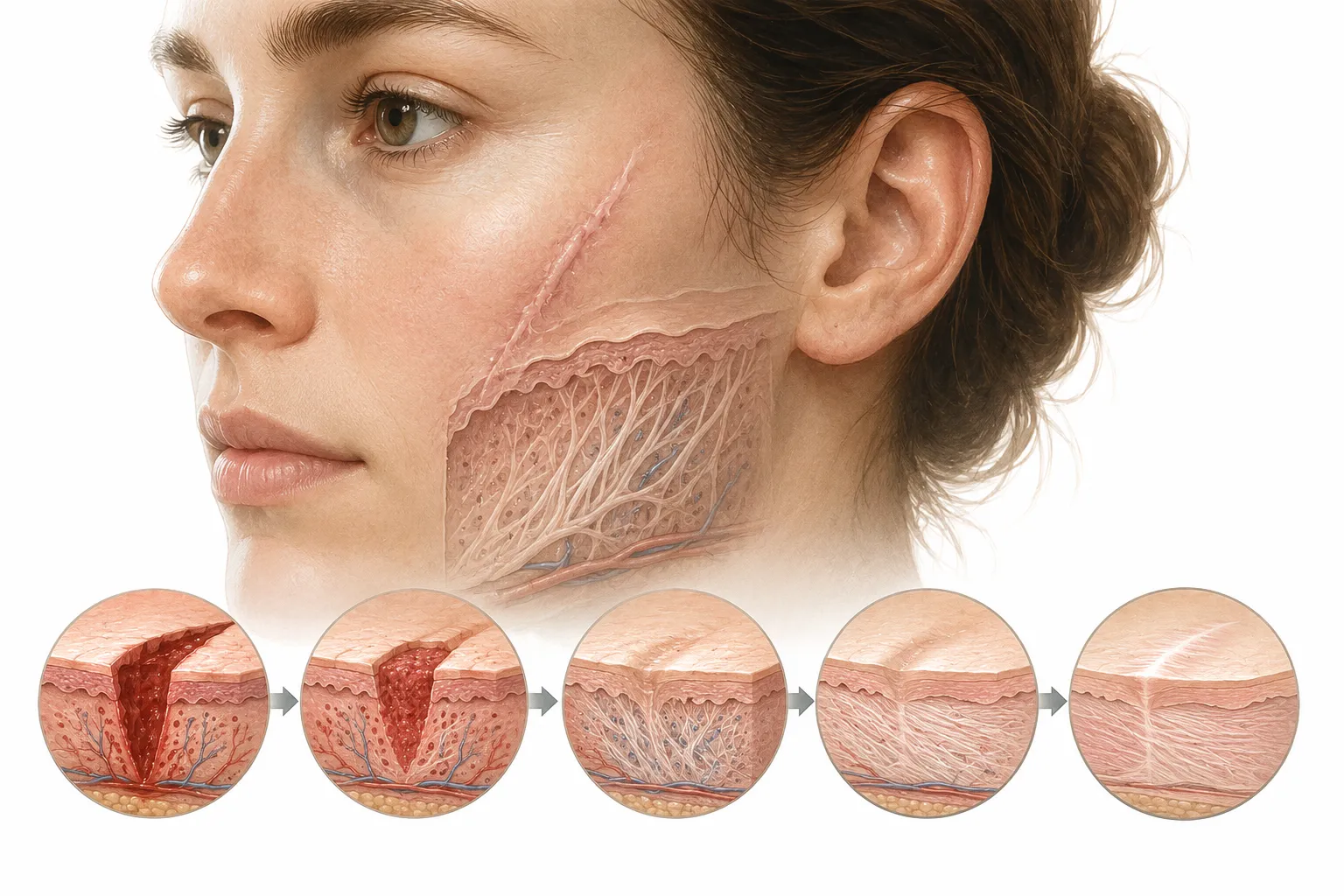
A deep cut heals, the pain fades, and yet a mark remains, permanently different in texture and appearance from the surrounding skin.
On this page
The short answer
Scars form when skin damage extends deep enough to reach the dermis, and the body repairs the area by rapidly producing collagen fibers arranged in a dense, aligned pattern rather than the more random, woven structure of undamaged skin, resulting in tissue that looks and feels different from the surrounding area.
Skin's outermost layer, the epidermis, can regenerate itself without leaving a lasting mark, since it constantly renews through normal cell turnover. But when an injury penetrates deeper into the dermis, where collagen and elastin fibers give skin its strength and flexibility, the healing process changes. Fibroblasts, cells responsible for producing collagen, rush to the wound site and rapidly generate new collagen fibers to close the gap and restore structural integrity as quickly as possible. Unlike the flexible, basket-weave arrangement of collagen in undamaged skin, this new collagen is laid down in a denser, more aligned pattern, which is faster to produce but results in tissue with different texture, strength, and appearance. Scar tissue also generally lacks hair follicles, sweat glands, and some of the fine sensory nerve endings present in normal skin, since these specialized structures aren't rebuilt during the rapid repair process.
At a glance
Scarring only occurs once an injury reaches this deeper structural layer of skin.
Scars are just a discolored patch of otherwise normal skin.
Scar tissue is made of the same basic building block as normal skin, collagen, but it's laid down in a hastily arranged pattern instead of the original skin's carefully woven structure.
Picture a construction crew rebuilding a damaged wall after an emergency, using straight, quickly stacked bricks rather than replicating the original decorative brickwork. Functional, fast, but visibly different.
Diagram
Why Do Scars Form: the idea in one diagram
Scars form when injury reaches the dermis and fibroblasts rapidly deposit collagen in a dense, aligned pattern to restore structural integrity quickly, producing tissue with a different texture and appearance than the original skin.
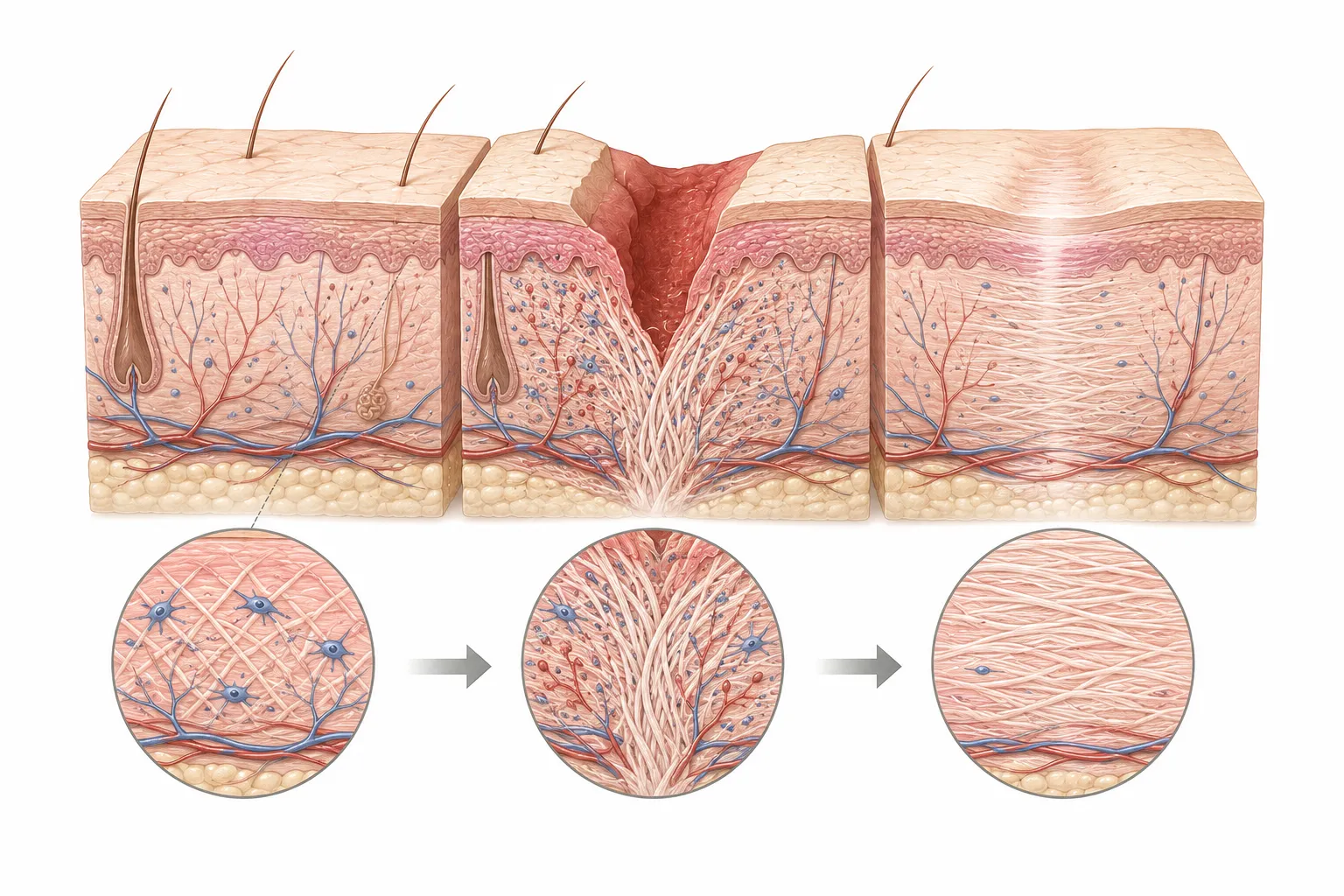
- 1Injury reaches the dermis
Scarring only occurs once an injury reaches this deeper structural layer of skin.
- 2Fibroblasts rush to produce collagen
Speed, not precision, is the priority during this repair phase.
- 3Collagen is laid down in a dense, aligned pattern
This structural difference is what gives scar tissue its distinct look and feel.
- 4The scar gradually remodels over time
A scar continues evolving long after the original wound has closed.
How it works
The mechanism
Scars form when injury reaches the dermis and fibroblasts rapidly deposit collagen in a dense, aligned pattern to restore structural integrity quickly, producing tissue with a different texture and appearance than the original skin.
- Step 01
Injury reaches the dermis
When damage penetrates past the outer epidermis into the deeper dermis layer, the skin's normal regenerative capacity is no longer sufficient to fully restore the original structure.
Like damage that goes beyond a building's surface paint and into its structural framework.
Scarring only occurs once an injury reaches this deeper structural layer of skin.
- Step 02
Fibroblasts rush to produce collagen
Specialized cells called fibroblasts migrate to the wound site and rapidly begin producing collagen fibers to close the gap and restore tissue strength.
Like an emergency repair crew rushing to patch a structural breach as quickly as possible.
Speed, not precision, is the priority during this repair phase.
- Step 03
Collagen is laid down in a dense, aligned pattern
Unlike the flexible, woven arrangement of collagen in undamaged skin, new scar collagen forms in a denser, more uniformly aligned pattern that's faster to produce but less flexible.
Like quickly stacked bricks replacing intricate original masonry.
This structural difference is what gives scar tissue its distinct look and feel.
- Step 04
The scar gradually remodels over time
Over months to years, the body continues slowly reorganizing scar collagen, which often causes scars to soften, flatten, and fade somewhat, though rarely disappearing entirely.
Like gradual renovations slowly improving the finish of an initial emergency repair.
A scar continues evolving long after the original wound has closed.
Surprises
Facts worth sitting with
Scar tissue never fully regains the original skin's tensile strength; even fully healed scars typically reach only around eighty percent of the strength of undamaged skin.
Surprising facts
What seems backwards
Worth comparing
In everyday life
Easy to get wrong
Pressure points
Where the simple answer gets interesting
Why don't scars ever fully match the surrounding skin?
Because scar tissue forms through rapid collagen deposition in a dense, aligned pattern rather than the original skin's more random, woven structure, it never fully replicates the original tissue's flexibility, texture, or appearance, even after years of gradual remodeling.
The body's repair process trades precision for speed, and that trade leaves a permanent visual signature.
Why do surgical scars often improve over the first couple of years?
In the months and years following an injury, the body continues gradually remodeling scar collagen, breaking down and reorganizing some of the initial dense fibers into a somewhat more flexible arrangement, which often makes scars fade and flatten over time.
A scar isn't a finished, static mark the moment a wound closes, it keeps quietly evolving for years afterward.
Why do some minor wounds scar more than deeper ones?
Scarring severity depends heavily on factors beyond wound depth alone, including the amount of tension on the healing skin, its location on the body, and individual differences in collagen production, which is why wound severity alone doesn't reliably predict how visible a scar will be.
The size of the injury and the size of the resulting scar don't always line up the way you'd expect.
Behind the science
The story behind it
Research into scar-free fetal wound healing
Researchers studying wound healing in fetal tissue discovered that early-stage fetal skin can heal certain injuries without leaving a scar, a capability lost later in development.
This research has driven ongoing efforts to develop treatments that might replicate scar-free healing in postnatal skin.
Understanding an ability the body once had, even briefly, can point toward future medical treatments.
Comparative studies of fetal versus adult wound healing
Researchers compared collagen deposition patterns in wounded fetal tissue versus adult tissue at a cellular level.
Fetal tissue was found to lay down collagen in a pattern much more similar to undamaged skin, largely avoiding the dense, misaligned structure responsible for adult scarring.
Clarify
Myth and reality
Myth
Scars are just a discolored patch of otherwise normal skin.
Reality
Scars involve a genuinely different internal structure of collagen, arranged more densely and uniformly than in undamaged skin, which is why they differ in texture, flexibility, and appearance, not just color.
Evidence
Microscopic studies of scar tissue consistently show a distinct collagen fiber arrangement compared to surrounding undamaged skin.
Looking closer
The deeper pattern
Scarring is the visible cost of a body prioritizing rapid closure of a wound over precise, long-term reconstruction.
One way to think about it
Systems under pressure to respond quickly often trade long-term elegance for immediate function, leaving behind a permanent, visible record of that tradeoff.
Speed and precision are frequently in tension, and choosing speed under pressure often leaves a lasting mark.
Limits
Where the explanation bends
Keloid scar formation.
In some individuals, the body continues producing excess collagen well beyond what's needed to close the wound, resulting in a raised, sometimes significantly enlarged scar that extends beyond the original injury site.
The same repair process responsible for normal scarring can, in certain people, become significantly overactive.
In daily life
What this helps you notice
Understanding how scars form explains why early wound care, including proper closure and reduced tension on the wound, can meaningfully affect the appearance of the resulting scar.
Surgeons often use specific suturing techniques and recommend scar-care products specifically to help minimize excess or misaligned collagen deposition during healing.
Remember
Key takeaways
- 1
Scars form when injury reaches the dermis, triggering rapid collagen production to restore structural integrity.
- 2
Scar collagen is arranged in a dense, aligned pattern, unlike the woven structure of undamaged skin.
- 3
Scar tissue lacks hair follicles, sweat glands, and some sensory nerve endings present in normal skin.
- 4
Fetal skin can heal certain wounds without scarring, a capability lost later in development.
- 5
Scars continue gradually remodeling for months to years, often fading and flattening but rarely disappearing entirely.
A scar isn't proof your body did a sloppy repair job, it's proof your body made a deliberate tradeoff, choosing speed and closure over matching the original craftsmanship of your skin.
Every scar is a small, permanent record of your body's emergency decision-making, a repair job that prioritized getting you back together quickly over getting you back together exactly as you were.
Read around the idea
More questions with the same curious pull
Nearby doors from the TinyThat archive, chosen by topic, intent, and reader curiosity.
Body & Brain
Why Do Bruises Change Color?
As the body breaks down and reabsorbs leaked blood, different pigment byproducts form in sequence, shifting the bruis...
Body & Brain
Why Do Cuts Itch When Healing?
Cuts itch during healing due to histamine release, regenerating nerve fibers, and tightening new tissue, all peaking...
Body & Brain
Can the Brain Feel Pain?
The brain controls all pain in your body, yet it cannot feel pain itself. Discover why, and what this strange fact re...