Histamine, the same compound responsible for allergic itching and hives, is directly involved in the normal wound-healing process, not just in allergic reactions.
Body & Brain
Why do cuts and wounds itch while they're healing?
Why Do Cuts Itch When Healing?
Somewhere around day three or four after a cut, right when it starts looking better, it starts itching worse, and that timing is not a coincidence.
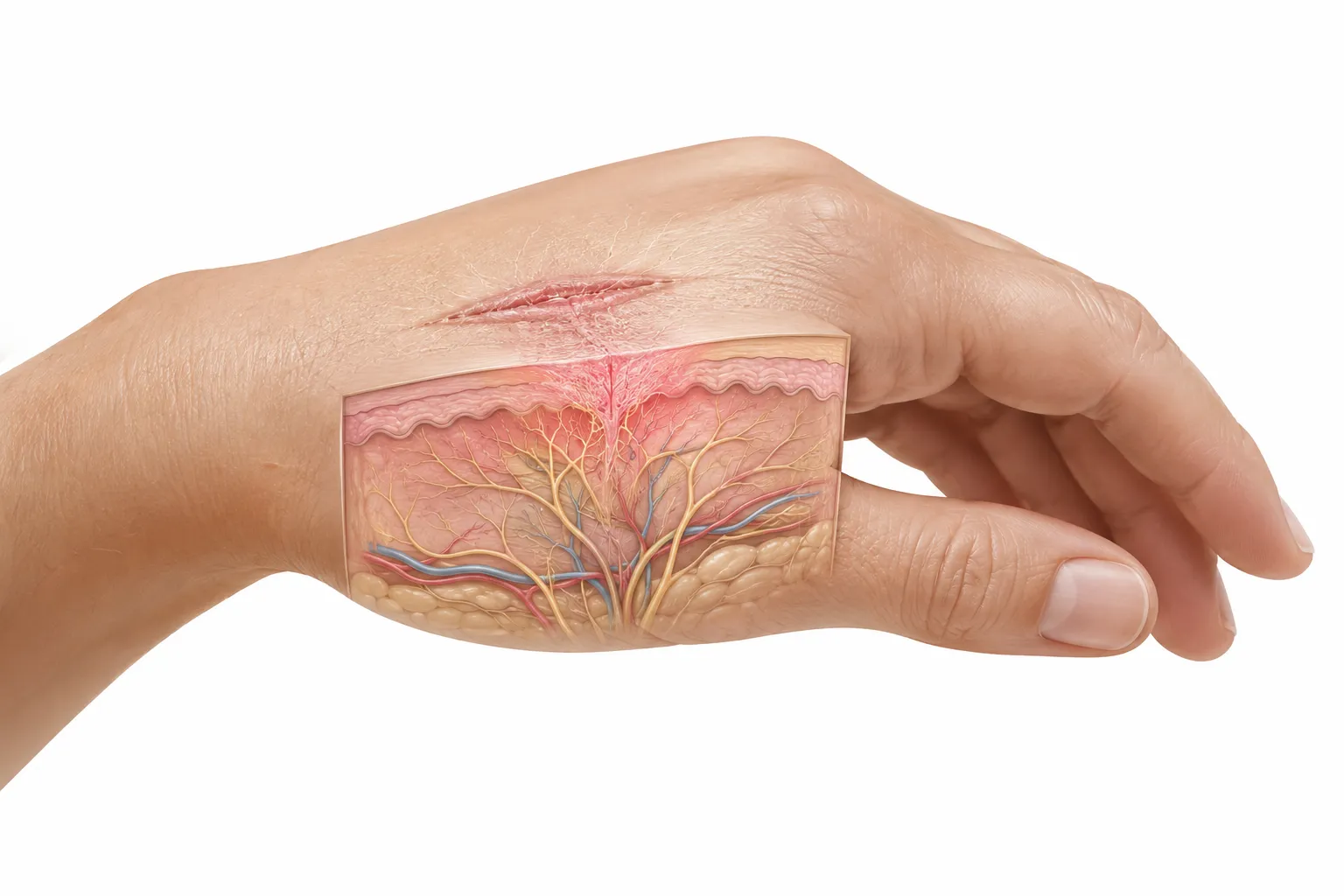
On this page
The short answer
Cuts itch while healing because the body releases histamine and other chemical signals as new skin cells, blood vessels, and nerve fibers regenerate, and these signals stimulate the same nerve pathways responsible for the itch sensation.
As a wound heals, cells called mast cells release histamine to help regulate blood flow and immune activity in the area, which supports tissue repair but also directly stimulates nearby itch-sensitive nerve fibers. At the same time, new nerve endings are regenerating inside the healing tissue, and these still-developing nerves fire more erratically than mature ones, contributing to unusual sensations including itching. The tightening and contracting of new skin as it forms, especially around a scab, can also mechanically stimulate nerve endings. All three factors, the chemical signal, the regenerating nerves, and the physical tightening, tend to peak in the middle stage of healing, which is exactly when itching is usually at its worst.
At a glance
The same molecule behind allergic itching also plays a legitimate role in healthy healing.
An itchy wound always means it's infected or something is wrong.
The same molecule your body releases when you touch poison ivy or get stung by a mosquito is also released, deliberately, as part of the repair process inside a healing cut.
Picture a construction site where the crew is stretching new scaffolding across a gap, and every time the scaffolding shifts or tugs at a nearby wire, it sets off a small alarm. The itch is that alarm going off, over and over, as the new tissue takes shape.
Diagram
Why Do Cuts Itch When Healing: the idea in one diagram
Wound itch arises from a combination of histamine release, immature nerve regeneration, and physical tightening of new tissue, all occurring simultaneously during the middle stage of healing.
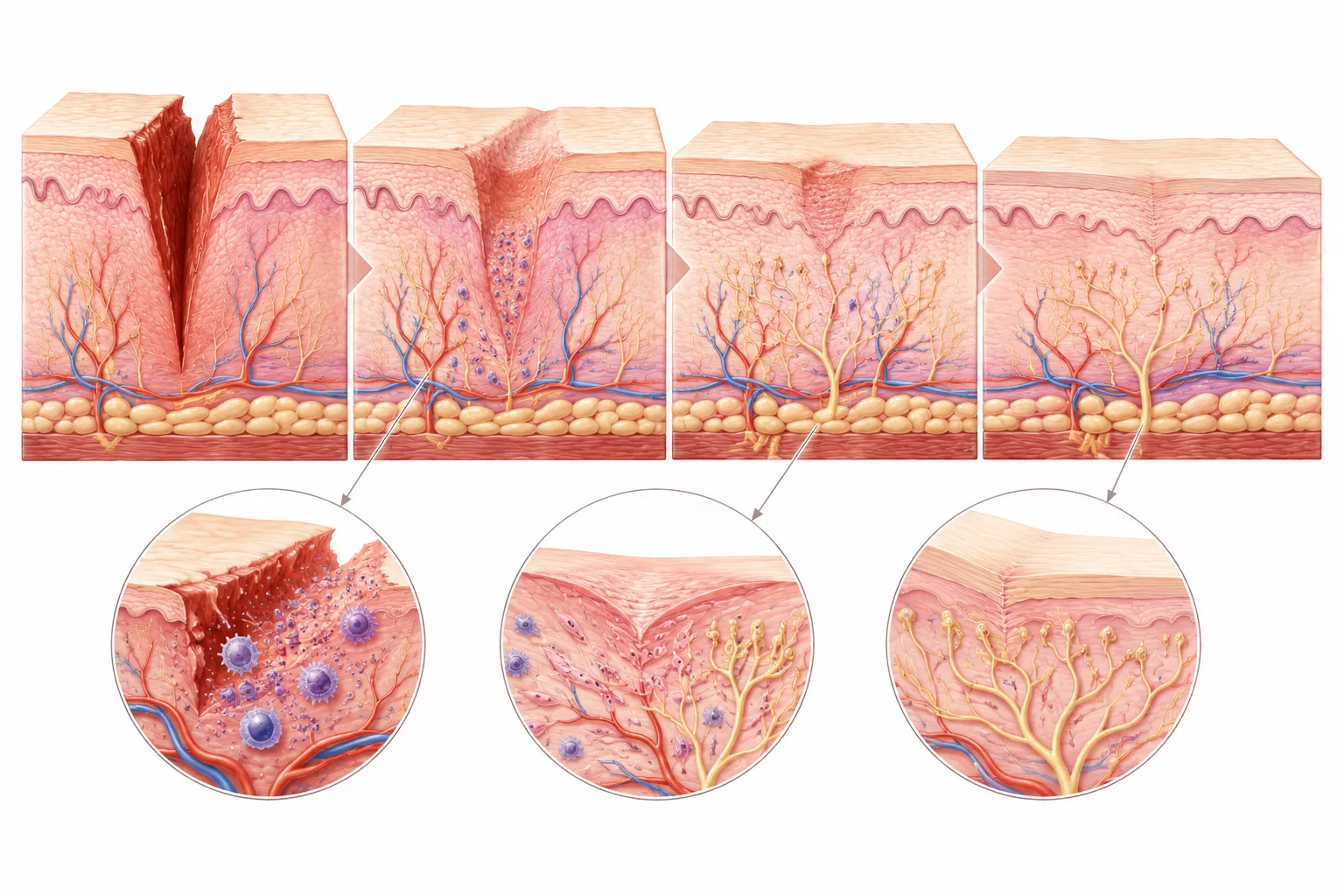
- 1Mast cells release histamine
The same molecule behind allergic itching also plays a legitimate role in healthy healing.
- 2Nerve fibers regenerate
Immature regenerating nerves contribute directly to unusual sensations like itching.
- 3New tissue tightens and contracts
Physical tension adds a mechanical trigger on top of the chemical one.
- 4Signals combine into the itch sensation
The itch you feel is the integrated output of several separate healing processes happening together.
How it works
The mechanism
Wound itch arises from a combination of histamine release, immature nerve regeneration, and physical tightening of new tissue, all occurring simultaneously during the middle stage of healing.
- Step 01
Mast cells release histamine
As part of the normal inflammatory and repair response, mast cells near the wound release histamine, which helps regulate blood flow and immune activity in the healing area.
Like a foreman calling in extra supplies and workers to a job site.
The same molecule behind allergic itching also plays a legitimate role in healthy healing.
- Step 02
Nerve fibers regenerate
Damaged nerve endings begin regrowing into the healing tissue, and these newly forming, thinner fibers fire more unpredictably than mature nerves.
Like a newly laid wire that hasn't been fully insulated yet, prone to occasional static.
Immature regenerating nerves contribute directly to unusual sensations like itching.
- Step 03
New tissue tightens and contracts
As collagen forms and the wound closes, the new tissue and any overlying scab contract and tighten, physically stimulating nearby nerve endings.
Like a drying piece of tape gently tugging at the skin beneath it.
Physical tension adds a mechanical trigger on top of the chemical one.
- Step 04
Signals combine into the itch sensation
The brain receives combined chemical and mechanical signals from the healing site through itch-specific nerve pathways, producing the conscious sensation of itchiness.
Like multiple alarms triggering the same central alert system at once.
The itch you feel is the integrated output of several separate healing processes happening together.
Surprises
Facts worth sitting with
Histamine, the same compound responsible for allergic itching and hives, is directly involved in the normal wound-healing process, not just in allergic reactions.
Surprising facts
What seems backwards
Worth comparing
In everyday life
Easy to get wrong
Pressure points
Where the simple answer gets interesting
Why does scratching a healing wound often make the itch worse instead of better?
Scratching irritates the healing tissue and can trigger additional histamine release from mast cells in the area, which increases inflammation and reactivates the itch signal shortly after the temporary relief of scratching fades.
The instinctive response to itching is often the exact mechanism that resets and intensifies it.
Why do some scars stay itchy for months after the wound has closed?
Deeper collagen remodeling and nerve fiber regeneration continue well beneath the visible surface long after a wound looks fully healed, and this ongoing internal activity can continue triggering itch signals for an extended period.
What looks finished on the surface can still be under active construction well beneath it.
Is itching a reliable sign that a wound is healing well?
Generally yes, mild to moderate itching during the middle stages of healing is a normal and often reassuring sign of active tissue regeneration, though itching combined with redness, swelling, or discharge can indicate infection rather than normal healing.
The same sensation can be either a good sign or a warning sign, and the difference comes down to what else is happening around it.
Behind the science
The story behind it
Clinical use of antihistamines for post-surgical itch
Surgeons and dermatologists began recommending antihistamine treatments for patients experiencing significant itching during recovery after finding a clear link between histamine activity and healing-related itch.
Recognizing the histamine connection gave doctors a targeted, evidence-based way to help patients manage a previously frustrating and poorly understood symptom of recovery.
Understanding the precise chemical cause of a symptom can turn a vague discomfort into something specifically treatable.
Nerve regeneration imaging in healing skin
Researchers used imaging techniques to track how sensory nerve fibers regrow into healing wounds over time, observing the pattern and timing of regeneration relative to reported itching.
The peak period of nerve fiber regrowth closely matched the period patients most commonly reported the most intense itching, directly linking nerve regeneration timing to the itch sensation.
Clarify
Myth and reality
Myth
An itchy wound always means it's infected or something is wrong.
Reality
In most cases, itching during the middle stage of healing is a completely normal sign of active tissue repair, driven by histamine release and nerve regeneration rather than infection.
Evidence
Clinical observation consistently shows itching peaking during the proliferative phase of wound healing in uncomplicated wounds, well before any sign of infection would typically appear.
Looking closer
The deeper pattern
The itch of a healing wound is a side effect of construction, not damage; it appears precisely because repair is actively underway, not despite it.
One way to think about it
Discomfort is often mistaken for a sign that something is going wrong, when in many biological and non-biological systems alike, it's actually the direct byproduct of active, necessary rebuilding.
Not all irritation signals a problem. Some of it is simply the noise of something being repaired.
Limits
Where the explanation bends
Keloid and hypertrophic scar formation.
In some people, excessive collagen production during healing creates raised, thickened scars that can itch far more intensely and for much longer than typical healing wounds.
The same repair mechanisms responsible for ordinary healing itch can, in some individuals, become significantly amplified, producing a distinct and more persistent condition.
In daily life
What this helps you notice
Understanding that wound itch is usually a normal part of healing can help people resist the urge to scratch, which reduces the risk of reopening the wound or introducing infection.
Doctors commonly recommend gently moisturizing a healing wound or applying a cool compress instead of scratching, both of which can ease itch without disrupting the delicate new tissue.
Remember
Key takeaways
- 1
Wound itch is caused by a combination of histamine release, nerve fiber regeneration, and physical tightening of new tissue.
- 2
Histamine plays a genuine role in normal wound healing, not just in allergic reactions.
- 3
Newly regenerating nerve fibers fire more erratically than mature ones, contributing directly to itch sensations.
- 4
Scratching a healing wound tends to worsen itching by triggering more histamine release and inflammation.
- 5
Itching during healing is usually a normal, reassuring sign, though itching paired with redness or discharge can indicate infection.
The itch you feel while a cut heals isn't your body malfunctioning. It's the exact same chemical alarm system used for allergies, repurposed to announce that new tissue is being built.
By the time a scab stops itching, an entire microscopic rebuilding project, chemical signals, regrowing nerves, tightening tissue, has quietly finished its work, all without you ever seeing a single part of it happen.
Read around the idea
More questions with the same curious pull
Nearby doors from the TinyThat archive, chosen by topic, intent, and reader curiosity.
Body & Brain
Why Do Feet Smell?
Bacteria metabolizing sweat and dead skin cells on the feet produce the characteristic odor.
Body & Brain
Why Do We Sweat When Nervous?
The nervous system's stress response activates sweat glands independently of temperature.
Body & Brain
Can the Brain Feel Pain?
The brain controls all pain in your body, yet it cannot feel pain itself. Discover why, and what this strange fact re...