A 2008 study found that people who grew up with access to black-and-white television as children reported significantly more black-and-white dreams as adults than people who grew up exclusively with color television.
Body & Brain
Can people dream in color, or are dreams normally in black and white?
Can You Dream in Color?
In the 1940s, when researchers asked people whether their dreams were in color or black and white, the overwhelming majority said black and white. Ask that same question today, and the overwhelming majority says color.

On this page
The short answer
Yes, most people dream in color, and modern research using more reliable methods, like waking people mid-dream, confirms this. The historical belief that dreams were commonly black and white appears to have been strongly influenced by exposure to black-and-white film and television, not by an actual difference in how the brain generates dreams.
Studies from the mid-twentieth century, when black-and-white film and television dominated visual media, found that most people reported their dreams as black and white. Later studies, conducted after color media became the norm, found the opposite: most people reported dreaming in color, with estimates suggesting the large majority of dreams include color when subjects are asked immediately upon waking. Researchers now believe the earlier results were heavily shaped by cultural exposure and the language people had available to describe their dreams, since black-and-white imagery was simply the dominant visual reference point of the era. When researchers switched to more reliable methods, like waking subjects during REM sleep and asking them immediately, rather than relying on delayed recall the next morning, color reports became even more consistent, suggesting that color dreaming was likely always the norm and earlier surveys were picking up a reporting bias rather than a real biological shift.
At a glance
Dream visuals, including color, are actively constructed by the brain, not passively received.
Human brains are naturally wired to dream in black and white, and color dreaming is a modern development.
The shift lines up almost perfectly with something that has nothing to do with neuroscience: the rise and fall of black-and-white television and film as the dominant visual medium people grew up with.
Imagine two generations asked to describe the color of a memory they can't fully verify, one raised entirely on black-and-white screens, one raised on color screens, both equally convinced they're simply reporting a fact about their own mind.
Behind the science
The story behind it
The 2008 Schwitzgebel study on television exposure and dream color
Philosopher and researcher Eric Schwitzgebel compared dream color reports between people who grew up primarily watching black-and-white television and those who grew up with color television, finding a significant difference correlated with childhood media exposure.
The study provided direct evidence that cultural visual exposure, not underlying brain biology, was likely the main driver of the historical shift in reported dream color.
A mystery that looked biological turned out to be a story about media history instead.
REM-stage waking and immediate dream recall studies
Researchers woke subjects directly during REM sleep, rather than relying on delayed recall after a full night's sleep, and asked them to describe the dream's visual content immediately.
Immediate recall consistently produced dramatically higher color reporting rates than delayed recall, revealing how much dream memory degrades and how much that degradation affects scientific conclusions about dream content.
Diagram
Can You Dream in Color: the idea in one diagram
Dream color perception arises from the same visual cortex activity used in waking visual imagination, drawing on stored visual memories rather than direct sensory input.
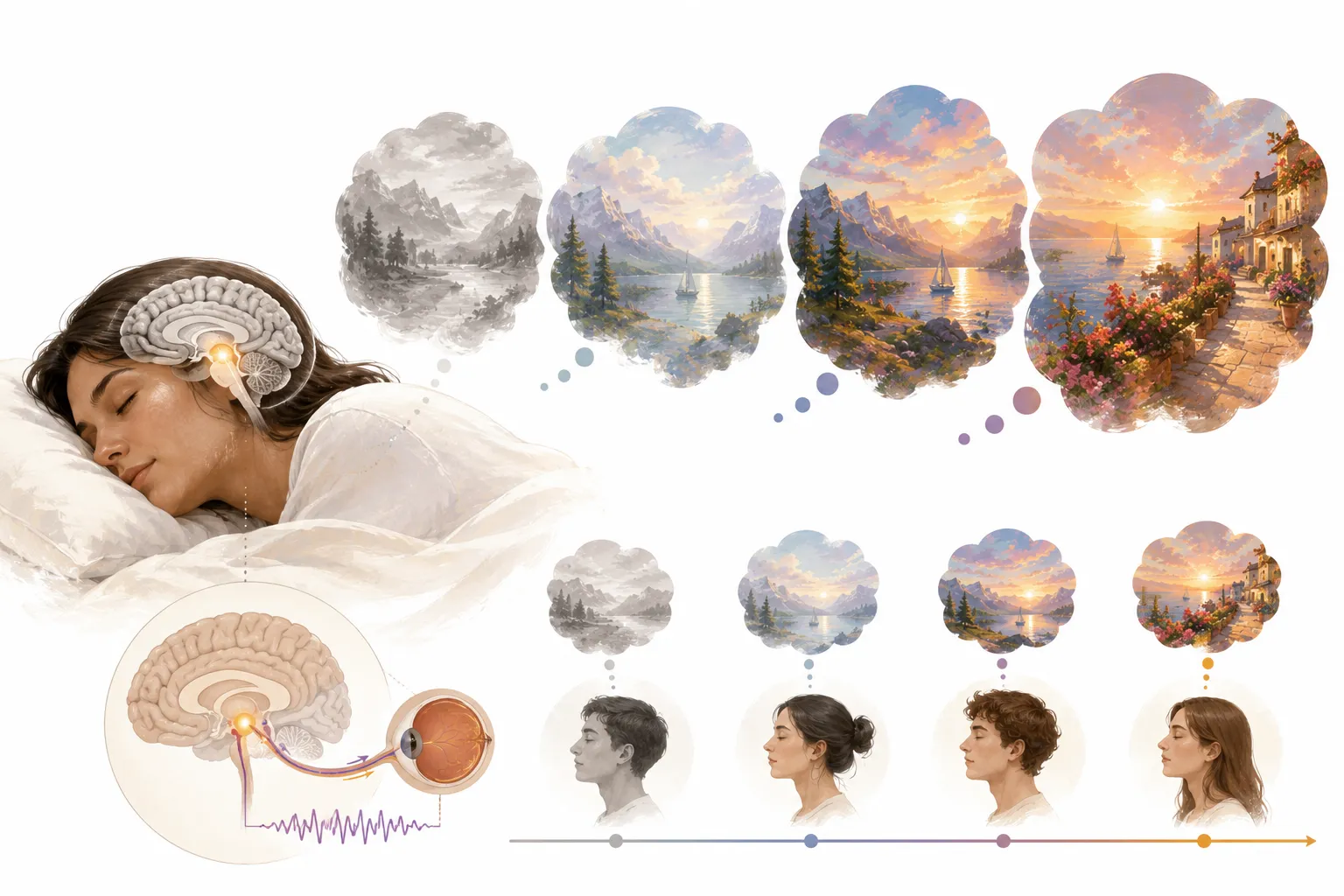
- 1REM sleep activates the visual cortex
Dream visuals, including color, are actively constructed by the brain, not passively received.
- 2The dream draws on stored visual memory
The colors available in your dreams depend on the colors you've actually seen while awake.
- 3Recall and reporting shape what gets remembered
What people report about their dreams depends heavily on how and when they're asked.
How it works
The mechanism
Dream color perception arises from the same visual cortex activity used in waking visual imagination, drawing on stored visual memories rather than direct sensory input.
- Step 01
REM sleep activates the visual cortex
During REM sleep, brain regions involved in visual processing, including areas responsible for color perception, become highly active, generating the imagery experienced as a dream.
Like a movie projector running using footage the brain has already stored, rather than a live camera feed.
Dream visuals, including color, are actively constructed by the brain, not passively received.
- Step 02
The dream draws on stored visual memory
Because there's no external light entering the eyes during sleep, the color and imagery in a dream are built from a person's accumulated lifetime of visual experience and memory.
Like an artist painting from memory rather than from a live model.
The colors available in your dreams depend on the colors you've actually seen while awake.
- Step 03
Recall and reporting shape what gets remembered
Upon waking, memory of the dream degrades quickly, and details like color are often among the first elements to fade unless captured immediately.
Like a photograph left in the sun, the fine details fade first while the general outline remains.
What people report about their dreams depends heavily on how and when they're asked.
Surprises
Facts worth sitting with
A 2008 study found that people who grew up with access to black-and-white television as children reported significantly more black-and-white dreams as adults than people who grew up exclusively with color television.
Surprising facts
What seems backwards
Worth comparing
In everyday life
Easy to get wrong
Pressure points
Where the simple answer gets interesting
If color dreaming was always biologically normal, why did so many people in the 1940s sincerely believe they dreamed in black and white?
Researchers believe the dominance of black-and-white film and television gave people a readily available visual vocabulary and mental template for describing dreams, making black-and-white the default assumption even when the dream itself may have included color that simply wasn't consciously registered or remembered as notable.
An entire generation's sincere, first-person account of their own inner experience was shaped by the technology sitting in their living room.
Does the method used to ask about dream color actually change the answer people give?
Yes, significantly. Studies that wake subjects during REM sleep and ask immediately report far higher and more consistent color rates than studies relying on people describing a dream after fully waking up and going about their morning, since color details are often among the first things forgotten during normal memory decay.
Something as simple as when you ask the question can change the scientific conclusion about what your brain is actually doing.
Do blind people dream in color?
People who lost their sight after early childhood typically continue to dream in color, drawing on visual memories formed before blindness, while people who were born blind or lost sight very early in life generally do not experience visual imagery in dreams at all, relying instead on sound, touch, and other senses.
Dream color isn't generated independently by the brain; it's built entirely from a person's accumulated visual experience of the world.
Clarify
Myth and reality
Myth
Human brains are naturally wired to dream in black and white, and color dreaming is a modern development.
Reality
There's no evidence of a biological shift in how brains generate dreams; the change in reported dream color closely tracks the shift from black-and-white to color visual media.
Evidence
Studies comparing people by childhood television exposure, rather than by birth year alone, found media exposure to be a stronger predictor of reported dream color than age.
Looking closer
The deeper pattern
An entire generation's confident, first-person testimony about their own private inner experience turned out to be substantially shaped by external technology, without any of them realizing it.
One way to think about it
Subjective self-report, even about something as intimate and internal as dreams, is never as pure or unfiltered as it feels; it's always built from the vocabulary, imagery, and reference points a person's era hands them.
Even your most private experiences are described using borrowed language, and that language quietly shapes what you believe you experienced.
Limits
Where the explanation bends
Congenitally blind individuals and dream content.
People blind from birth or very early childhood typically report no visual imagery in dreams at all, relying instead on auditory, tactile, and other sensory content, since there's no stored visual memory for the brain to draw from.
It's direct evidence that dream color is entirely dependent on prior visual experience rather than some independent, built-in feature of the dreaming brain.
In daily life
What this helps you notice
The dream-color phenomenon is now used as a case study in psychology and media studies courses to illustrate how subjective self-report can be shaped by cultural context rather than pure biological experience.
Researchers studying memory and perception often cite the black-and-white dream shift as a caution against treating any single generation's confident self-report as automatically representative of universal human biology.
Remember
Key takeaways
- 1
Most people today report dreaming in color, and modern research using immediate recall confirms this is the norm.
- 2
Mid-twentieth century surveys found the opposite, with most people reporting black-and-white dreams.
- 3
This historical shift closely tracks the transition from black-and-white to color film and television, not a change in brain biology.
- 4
People who grew up primarily watching black-and-white television report more black-and-white dreams even decades later.
- 5
Dream color depends entirely on a person's accumulated visual memory, which is why people born blind typically have no visual dream content at all.
An entire generation was sincerely, confidently wrong about the color of their own dreams, not because their brains worked differently, but because of what was playing on their television.
Your dreams have probably always been in color. What changed wasn't your mind. It was the only reference point your mind had ever been given for describing itself.
Read around the idea
More questions with the same curious pull
Nearby doors from the TinyThat archive, chosen by topic, intent, and reader curiosity.

Body & Brain
Why Do My Eyes Twitch?
Eye twitching is usually caused by fatigue, stress, or stimulant intake affecting small facial muscles.

Body & Brain
Why Do We See Floaters?
Floaters are shadows cast by small clumps of protein or cells inside the eye's vitreous gel.
Body & Brain
Can the Brain Feel Pain?
The brain controls all pain in your body, yet it cannot feel pain itself. Discover why, and what this strange fact re...