Floaters become dramatically more common after age fifty, as the vitreous gel undergoes a natural process called vitreous liquefaction that most people experience to some degree.
Body & Brain
Why do I see small floating shapes drifting across my vision?
Why Do I See Floaters?
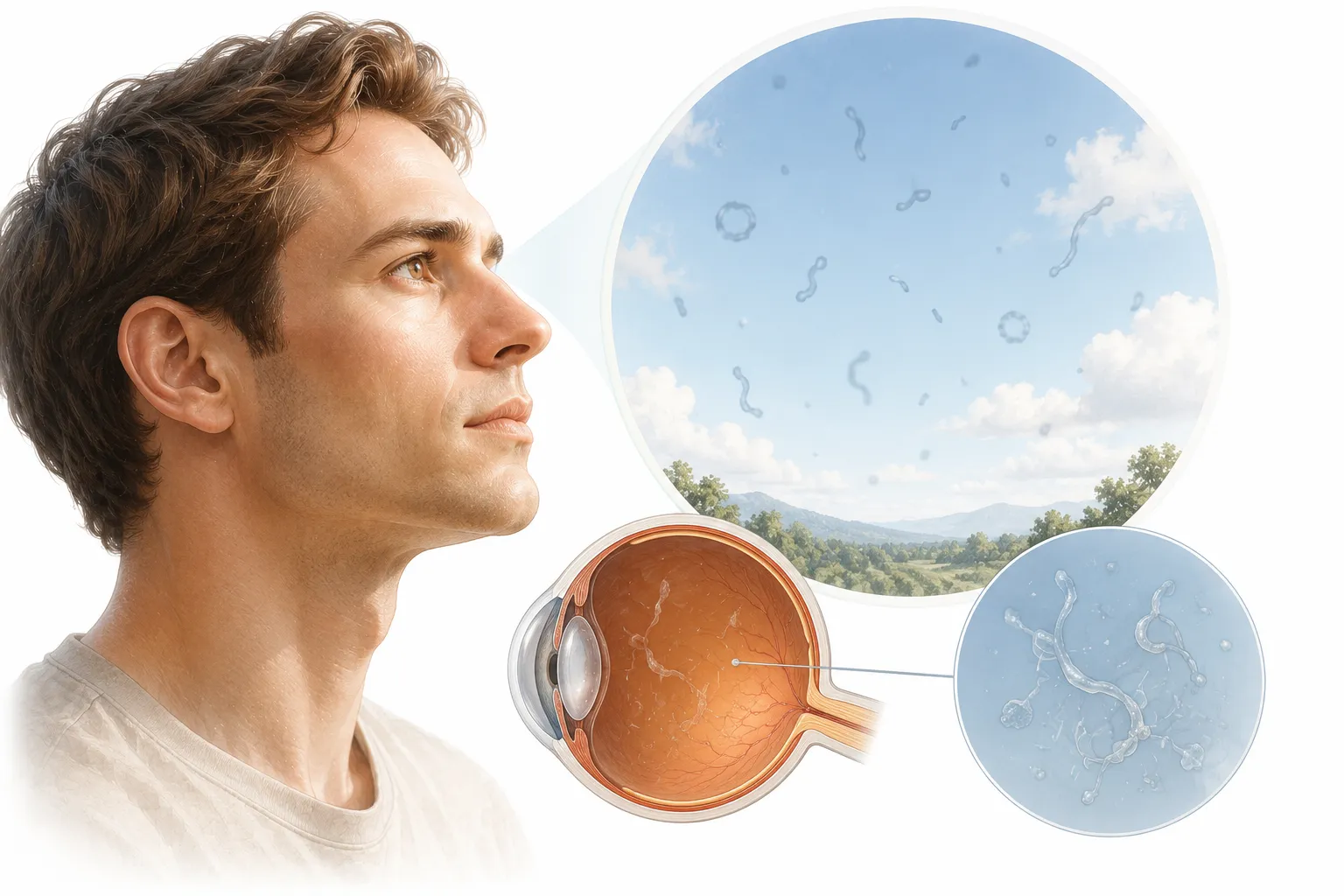
Look at a bright, plain surface, like a clear sky or a blank wall, and you might notice small, semi-transparent specks or squiggly lines drifting slowly through your field of vision, following your eye no matter where you look.
On this page
The short answer
Floaters are small clumps of protein or cells inside the vitreous, the clear gel that fills the back of your eyeball, casting shadows on the retina as they drift. They become more common with age as the vitreous naturally changes texture and starts to shrink and liquefy.
The vitreous is a clear, gel-like substance that fills the large chamber between the eye's lens and the retina, helping the eyeball maintain its shape. In early life, this gel is mostly uniform and dense, but as people age, it gradually liquefies and shrinks in certain areas, causing tiny fibers and clumps of collagen protein within it to clump together more visibly. Light entering the eye passes through the vitreous before reaching the retina, and these small clumps cast faint shadows onto the retina as they drift through the gel with eye movement. Because the retina interprets any pattern of light and shadow as visual information, these shadows appear as small specks, threads, or cobweb-like shapes that seem to float and drift, always slightly ahead of where you're directly trying to look, since they're moving within the fluid inside the eye rather than staying fixed in the outside world.
At a glance
The vitreous is a normal, essential structural feature of the eye, not a byproduct of aging on its own.
Any floaters in your vision mean you should be worried about your eyesight.
What you're seeing is a shadow, cast by something drifting inside your eye onto the light-sensitive tissue at the back, the same basic principle as a hand casting a shadow on a wall.
Imagine the inside of your eye as a snow globe filled with clear gel instead of water, and picture tiny bits of debris slowly drifting through that gel every time you tilt your head, casting faint shadows onto a screen behind them.
Diagram
Why Do I See Floaters: the idea in one diagram
Floaters occur when clumps of protein or collagen fibers within the vitreous gel cast shadows on the retina as they drift with eye movement.
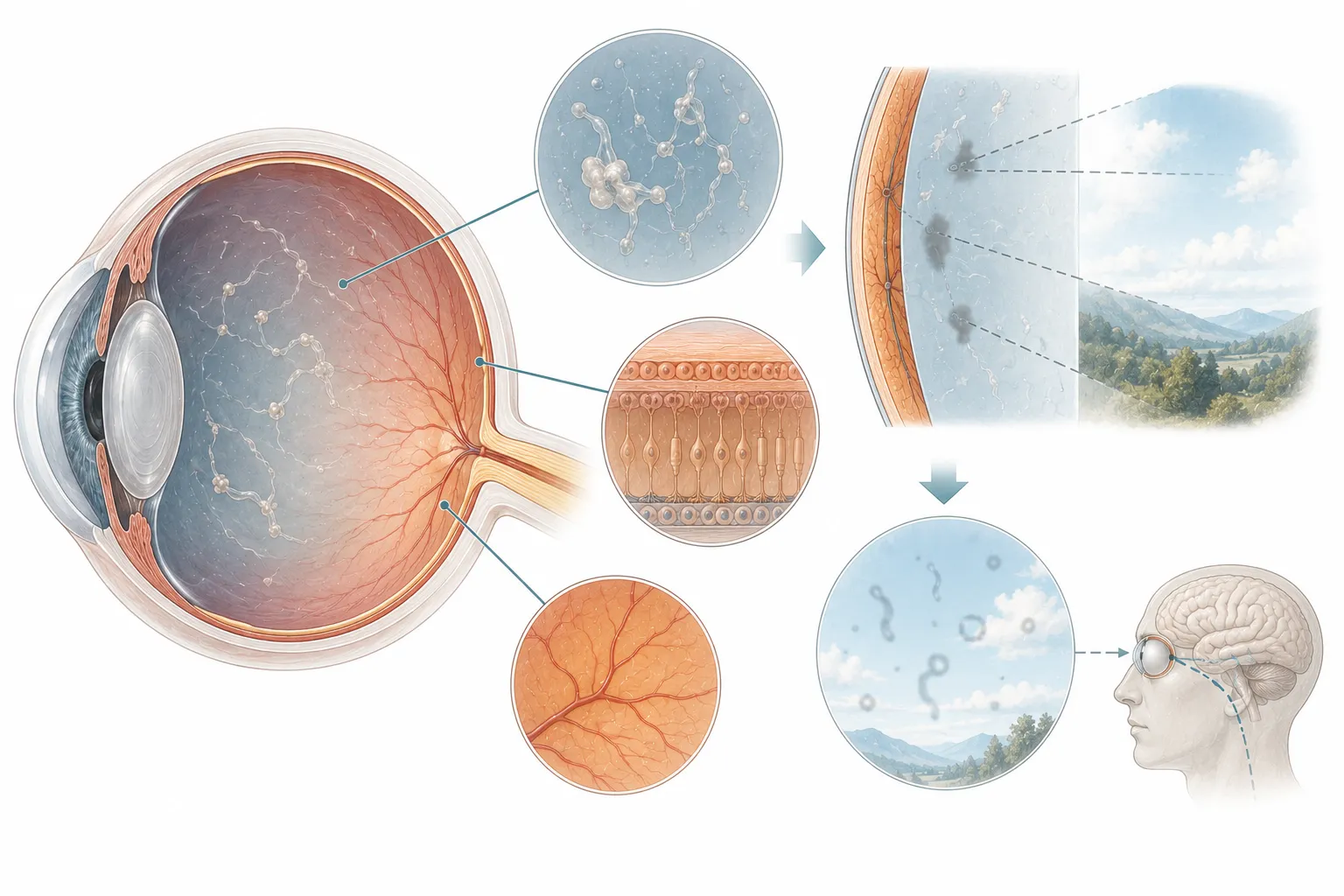
- 1The vitreous gel fills the eye's interior
The vitreous is a normal, essential structural feature of the eye, not a byproduct of aging on its own.
- 2The gel gradually changes with age
The structural change producing floaters is a normal, gradual part of eye aging for most people.
- 3Clumps cast shadows on the retina
Floaters are shadows, not physical objects you're directly seeing.
- 4Eye movement makes the shadows drift
The drifting, dodging quality of floaters comes directly from fluid movement inside the eye.
How it works
The mechanism
Floaters occur when clumps of protein or collagen fibers within the vitreous gel cast shadows on the retina as they drift with eye movement.
- Step 01
The vitreous gel fills the eye's interior
A clear, gel-like substance called the vitreous fills the large chamber between the eye's lens and the retina, helping maintain the eye's round shape.
Like clear gel filling a snow globe, providing structure and support inside a sealed sphere.
The vitreous is a normal, essential structural feature of the eye, not a byproduct of aging on its own.
- Step 02
The gel gradually changes with age
Over years and decades, the vitreous undergoes liquefaction, a natural process where parts of it become more watery while collagen fibers within it clump together in certain spots.
Like gelatin slowly separating and becoming uneven as it sits.
The structural change producing floaters is a normal, gradual part of eye aging for most people.
- Step 03
Clumps cast shadows on the retina
As light passes through the vitreous on its way to the light-sensitive retina, these small protein clumps block portions of that light, casting faint shadows.
Like a hand casting a shadow on a wall when placed between a lamp and the surface.
Floaters are shadows, not physical objects you're directly seeing.
- Step 04
Eye movement makes the shadows drift
As the eye moves, the fluid vitreous shifts slightly, causing the clumps and their shadows to drift across the field of vision before settling.
Like debris slowly swirling and settling after stirring a snow globe.
The drifting, dodging quality of floaters comes directly from fluid movement inside the eye.
Surprises
Facts worth sitting with
Floaters become dramatically more common after age fifty, as the vitreous gel undergoes a natural process called vitreous liquefaction that most people experience to some degree.
Surprising facts
What seems backwards
Worth comparing
In everyday life
Easy to get wrong
Pressure points
Where the simple answer gets interesting
Why do floaters seem to move away when you try to focus directly on them?
Floaters are suspended within the vitreous gel, and while the fluid briefly continues drifting due to inertia even after your eye stops moving, this creates the sensation that the floater is dodging your direct gaze rather than settling in place.
The elusiveness of floaters is a straightforward physics phenomenon, fluid momentum, dressed up as an almost teasing visual illusion.
Why do floaters become so much more common with age?
As people age, the vitreous gel naturally undergoes liquefaction, gradually losing its uniform density and causing collagen fibers within it to clump together more visibly, a structural change that becomes increasingly common after middle age.
Floaters are essentially a visible signature of a slow structural transformation happening deep inside the eye over decades.
When do floaters signal a genuine medical emergency instead of a harmless nuisance?
A sudden shower of many new floaters, especially combined with flashes of light or a shadow or curtain effect across part of the visual field, can indicate a retinal tear or detachment, which requires immediate medical evaluation to prevent permanent vision loss.
The exact same basic phenomenon, tiny shadows cast inside the eye, spans everything from a lifelong harmless quirk to a genuine ophthalmic emergency, and the warning signs make all the difference.
Behind the science
The story behind it
Clinical differentiation of benign floaters from retinal emergencies
Ophthalmologists established clear diagnostic criteria distinguishing common, harmless age-related floaters from the sudden onset of floaters associated with retinal tears or detachment, based on quantity, onset speed, and accompanying symptoms like light flashes.
This distinction allows most patients experiencing occasional floaters to be reassured, while ensuring patients with genuine warning signs get urgent care that can prevent permanent vision loss.
A precise clinical line between harmless and urgent versions of the same basic symptom can be the difference between reassurance and saved eyesight.
Optical coherence tomography imaging of vitreous liquefaction
Modern imaging technology allowed researchers to directly visualize the structural changes occurring within the vitreous gel over time, including the formation of liquid pockets and collagen clumping associated with floaters.
The imaging confirmed a clear, measurable progression of vitreous liquefaction with age that directly correlated with the onset and increase of reported floaters in patients.
Clarify
Myth and reality
Myth
Any floaters in your vision mean you should be worried about your eyesight.
Reality
The vast majority of floaters are a normal, harmless part of age-related vitreous changes and don't indicate any threat to vision on their own.
Evidence
Ophthalmologists consistently describe floaters as an extremely common finding in eye exams, especially in adults over fifty, without any accompanying vision problems in most cases.
Looking closer
The deeper pattern
Floaters aren't a flaw appearing suddenly; they're the visible tail end of an extremely slow structural change that's been quietly underway inside the eye since childhood.
One way to think about it
Many things we perceive as sudden, new problems are actually the first visible evidence of gradual changes that had been building invisibly for a very long time before crossing a threshold of noticeability.
By the time something becomes visible, it's rarely actually new. It's usually just finally loud enough to notice.
Limits
Where the explanation bends
Posterior vitreous detachment.
As the vitreous continues to shrink with age, it can eventually separate from the retina entirely, an event called posterior vitreous detachment, often producing a sudden noticeable increase in floaters and flashes of light, usually harmless but occasionally accompanied by a genuine retinal tear.
A single underlying process, vitreous aging, can culminate in an event dramatic enough to send people to the eye doctor, even though the vast majority of these cases turn out to be benign.
In daily life
What this helps you notice
Knowing the specific warning signs that distinguish dangerous floaters from harmless ones, like sudden onset, high volume, or accompanying flashes, empowers people to seek urgent care exactly when it matters most.
Eye doctors commonly advise patients to seek same-day evaluation if they experience a sudden shower of new floaters or flashes of light, since prompt treatment of a retinal tear can prevent permanent vision loss.
Remember
Key takeaways
- 1
Floaters are shadows cast on the retina by tiny protein or collagen clumps drifting inside the vitreous gel.
- 2
They become significantly more common with age as the vitreous gradually liquefies and its fibers clump together.
- 3
Floaters appear to dodge your gaze because the vitreous fluid continues moving briefly after your eye stops.
- 4
Most floaters are completely harmless, but a sudden increase paired with light flashes can signal a retinal emergency.
- 5
The vitreous gel is nearly all water, held in a gel structure by collagen fibers and hyaluronic acid.
Every floater drifting across your vision right now is a shadow, cast from inside your own eyeball, by a structural change that's been happening since long before you ever noticed it.
You've been carrying a tiny, ongoing shadow show inside your own eye for years. It just took a bright enough sky, and a slow enough process, for you to finally catch the performance.
Read around the idea
More questions with the same curious pull
Nearby doors from the TinyThat archive, chosen by topic, intent, and reader curiosity.

Body & Brain
Can You Dream in Color?
Yes, most people dream in color, and the historical belief in black-and-white dreaming was likely a media-driven repo...
Body & Brain
Can the Brain Feel Pain?
The brain controls all pain in your body, yet it cannot feel pain itself. Discover why, and what this strange fact re...

Body & Brain
Does Your Brain Eat Itself?
Your brain really does consume parts of itself. Learn about autophagy, synaptic pruning, and why self-consumption is...