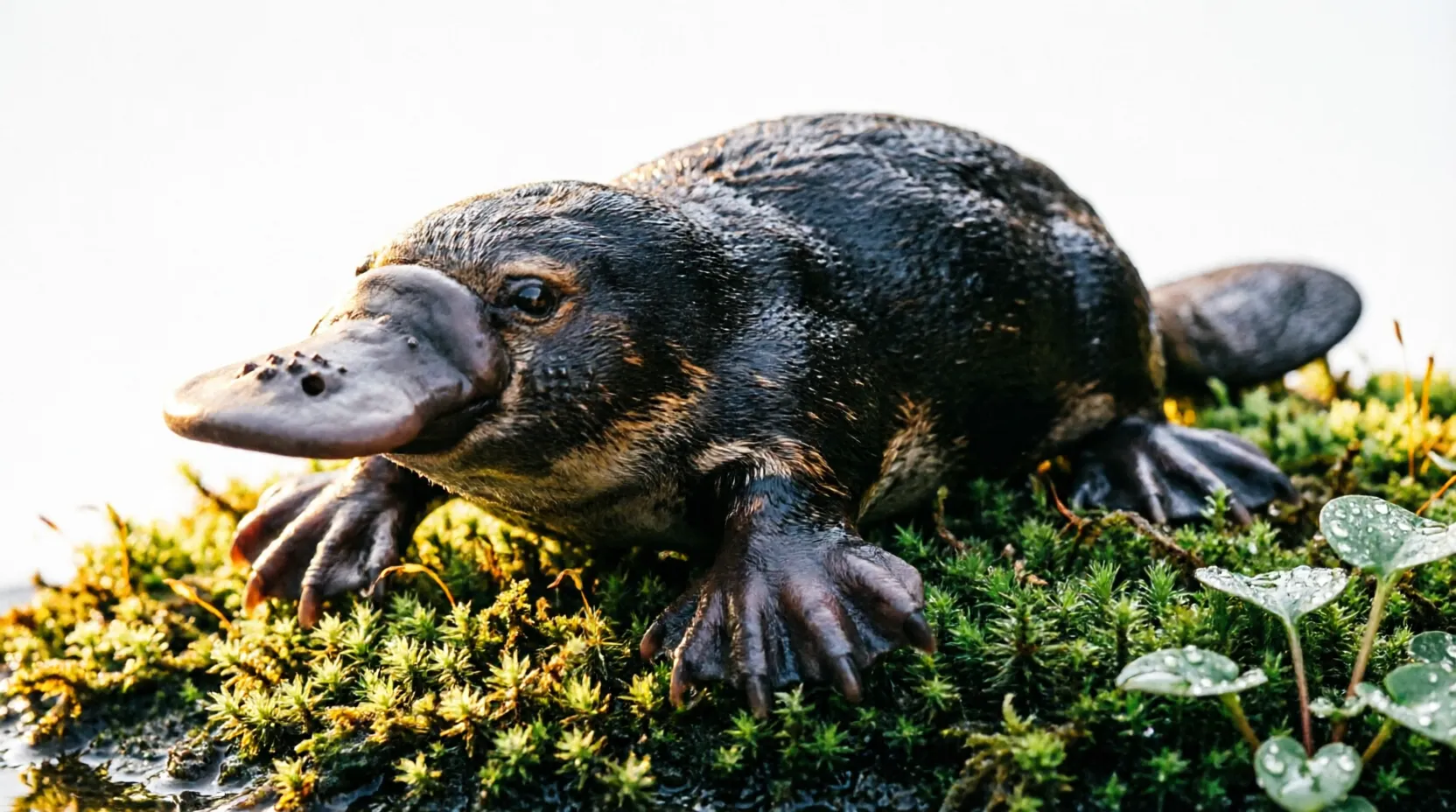
Visual answer
The Mammal Family Tree: Where Monotremes Fit
All mammals share a common reptilian ancestor. Monotremes (platypus + echidnas) branched off first, around 166 million years ago before the split between marsupials and placental mammals. This early exit is why they kept so many reptile-like features.
Common reptilian ancestor
All mammals including you trace back to a shared reptile-like ancestor. This is why some reptile traits still linger in the most primitive mammals.
Monotreme split (~166 million years ago)
The platypus and echidna lineage branched off here far earlier than any other living mammals. They kept egg-laying and several reptilian body features because they left the party before the upgrades arrived.
Marsupial split (~180 million years ago)
Kangaroos, koalas, and wombats evolved live birth, but their young are born extremely undeveloped and finish growing in a pouch.
Placental mammals
Everything from mice to whales to humans. Young develop fully inside the mother via a placenta the most recent mammalian innovation.
The analogy
Think of it like software that never got the update
The familiar part
Imagine your office still runs Windows XP. It does the job mostly but it's missing years of patches, features, and security upgrades that everyone else has. It's still a Windows computer. It's just running a very old version.
How it applies
The platypus is Windows XP. It branched off from the mammal family tree 166 million years ago before live birth, before nipples, before a lot of things we now consider standard mammal equipment. It still qualifies as a mammal because it has the core features: fur, warm blood, and milk for its young. But it never received the later upgrades that the rest of us take for granted. It's not broken. It's just deeply, magnificently old.
Where the analogy breaks
Unlike Windows XP, the platypus is not being replaced. It has survived 166 million years with its outdated architecture intact. The joke, if there is one, is on us.
What makes a mammal
What actually makes something a mammal?
Here is the thing about definitions: they were built around the animals we knew first. When Carl Linnaeus set up his classification system in the 18th century, he named the class *Mammalia* after the Latin *mamma*, meaning breast. The defining trait, in his view, was nursing young with milk.
Modern biology has refined this to three core criteria: the animal must have fur or hair, must be warm-blooded (endothermic), and must produce milk to feed its offspring. That's the membership card. Notably absent from that list: how you reproduce.
The platypus clears all three hurdles. It has dense waterproof fur. It regulates its own body temperature. And after its eggs hatch, the mother feeds her young with milk though in a manner that would baffle a dairy farmer. Because female platypuses have no nipples, the milk simply oozes through pores in the skin of the belly, forming small pools on the fur that the puggle (yes, the baby platypus is called a puggle) laps up.
So the platypus is a mammal in the same way that a flying squirrel is still a squirrel. The unusual feature gliding, egg-laying, echolocation in bats doesn't disqualify the animal from its broader category. It just means evolution had other ideas.
Why it lays eggs
Why the platypus lays eggs and other mammals don't
The platypus didn't choose to lay eggs any more than you chose to have a spine. It's a feature inherited from a distant past and never replaced, because it worked well enough not to need replacing.
Step 1: The common ancestor was a reptile
All mammals evolved from reptile-like ancestors. Reptiles lay eggs. This is the factory setting. The entire mammalian class started from egg-laying stock, and the platypus simply never updated that particular setting.
Analogy
It's like inheriting your grandmother's cast-iron pan. Everyone else bought non-stick. You still have the original. It works fine.
Step 2: Monotremes left the evolutionary party early
Around 166 million years ago when dinosaurs were still the dominant life form on earth the lineage that would become platypuses and echidnas split off from the rest of the mammals. The innovations that came later, including a uterus and a placenta, happened after this split. Monotremes simply weren't there to receive them.
Step 3: They retained one crucial egg-related gene
A 2021 study published in Nature mapping the full platypus genome found that monotremes still carry one copy of the vitellogenin gene the gene that produces the proteins that make egg yolk. Birds have three copies. Humans have none (our copies were switched off around 130 million years ago as placental reproduction took over). The platypus kept the one copy it needed to keep laying eggs.
Analogy
Imagine a library that threw away all its encyclopaedias except one. That one volume is the difference between 'lays eggs' and 'gives live birth'.
Step 4: The eggs spend most of their time inside the mother anyway
This is the part that tends to surprise people. Platypus eggs are only outside the mother for about ten days before they hatch. For the six weeks prior, they develop inside the uterus, nourished by yolk. The eggs are soft-shelled, marble-sized, and the mother incubates them by curling her tail to her belly. In terms of total development time, it's not as different from live birth as it might sound.
Myth vs reality
"The platypus is a primitive, inferior animal"
What people think
The myth
Because the platypus has old-fashioned features egg-laying, a cloaca (a single opening for waste and reproduction), no nipples, lower body temperature it is often described as 'primitive' or less evolved than 'proper' mammals. Some textbooks still use this framing, which implies the platypus is somehow behind, unfinished, a biological rough draft.
What actually happens
The reality
The platypus has survived for at least 166 million years, which is considerably longer than Homo sapiens has been around (roughly 300,000 years). It has not failed to evolve it has evolved precisely. It developed electroreception so sensitive it can hunt with its eyes, ears, and nose closed, detecting the electric fields generated by the muscle contractions of shrimp underwater. It produces venom complex enough to cause prolonged pain in humans. It glows biofluorescent blue-green under ultraviolet light, for reasons we still don't fully understand. The platypus is not primitive. It is extraordinarily, specifically, brilliantly itself.
The evidence
Why the scientific case for 'mammal' is airtight
Has fur and is warm-blooded
StrongFeeds young with milk produced by the mother
StrongShares genetic markers with all other mammals
StrongBranched from the mammal lineage 166 million years ago (confirmed by genome sequencing)
StrongLays eggs like a reptile or bird
CircumstantialHas a cloaca (shared opening) like birds and reptiles
CircumstantialHas a lower body temperature than most mammals (~32°C vs 37°C average)
CircumstantialRetained one vitellogenin (egg yolk) gene still functional unlike all other mammals
ModerateWhat if it went extinct?
What if the platypus had gone extinct like its relatives did?
Imagine this
Monotremes were once far more widespread. Fossil evidence suggests they existed across South America and possibly beyond. Today, only five species survive, all in Oceania. What if the platypus had followed its extinct relatives into oblivion?
What would happen
We would have lost our clearest living window into early mammalian evolution. The platypus is not just an animal it is a biological archive. Its genome, its egg-laying, its cloaca, its electroreception: all of these are data points that help scientists reconstruct how mammals evolved from reptiles. Without monotremes, our understanding of that 166-million-year journey would have a significant gap where the evidence used to be.
Why this matters
There is a kind of luck in the platypus's survival. It made it through the K-Pg extinction event that killed the dinosaurs. It made it through ice ages. It is now threatened principally by habitat destruction and climate change the first dangers in 166 million years that it cannot simply outlast.
Final insight
The platypus is not the exception. It's the proof.
We tend to think of evolution as a march toward increasing complexity reptiles giving way to primitive mammals, primitive mammals giving way to us. The platypus interrupts this story rather usefully. It has been laying eggs and detecting electricity and sweating milk for 166 million years. It outlasted the dinosaurs. It outlasted every mammal lineage that did not make it. Whatever we mean when we say an animal is 'well-designed,' the platypus qualifies. It just got there a different way, via a different road, carrying a very old toolkit. The fact that it still confuses us still prompts the question 'but is it really a mammal?' says less about the platypus than it does about our habit of treating our own version of things as the standard by which all others should be measured.
Quick answers
Common questions
Is the platypus really a mammal? +
Yes. Despite laying eggs, the platypus qualifies as a mammal because it has fur, is warm-blooded, and feeds its young with milk. These are the three defining characteristics of all mammals. The egg-laying is an ancient inherited trait from its reptilian ancestors the platypus lineage split from other mammals 166 million years ago, before live birth became standard.
Why do only platypuses and echidnas lay eggs? +
They are the only surviving members of a group called monotremes, which branched off from the mammal family tree before the evolution of live birth. The other four species of echidna are the only other monotremes. All other mammals marsupials and placental mammals evolved live birth after the monotreme lineage had already split off.
How does a mother platypus feed her babies without nipples? +
Milk seeps through pores in the skin of the mother's belly and pools in grooves in her fur. The babies called puggles lap the milk directly from the fur surface. The platypus is believed to have arrived at lactation independently from other mammals, through a different evolutionary path, yet milk is the result either way.
What makes the platypus venomous? +
Male platypuses have a hollow spur on each hind ankle connected to a crural (venom) gland. The venom causes intense, long-lasting pain in humans and is thought to be used primarily in competition between males during breeding season rather than for predator defence. Interestingly, the venom contains proteins structurally similar to those found in reptile venoms another inherited ancient feature.
Does the platypus really glow in the dark? +
Under ultraviolet light, yes. In 2020, researchers examining platypus specimens under UV lamps discovered that the fur absorbs ultraviolet and re-emits it as blue-green biofluorescence. This property was unknown until that point. The biological purpose if any remains under investigation.