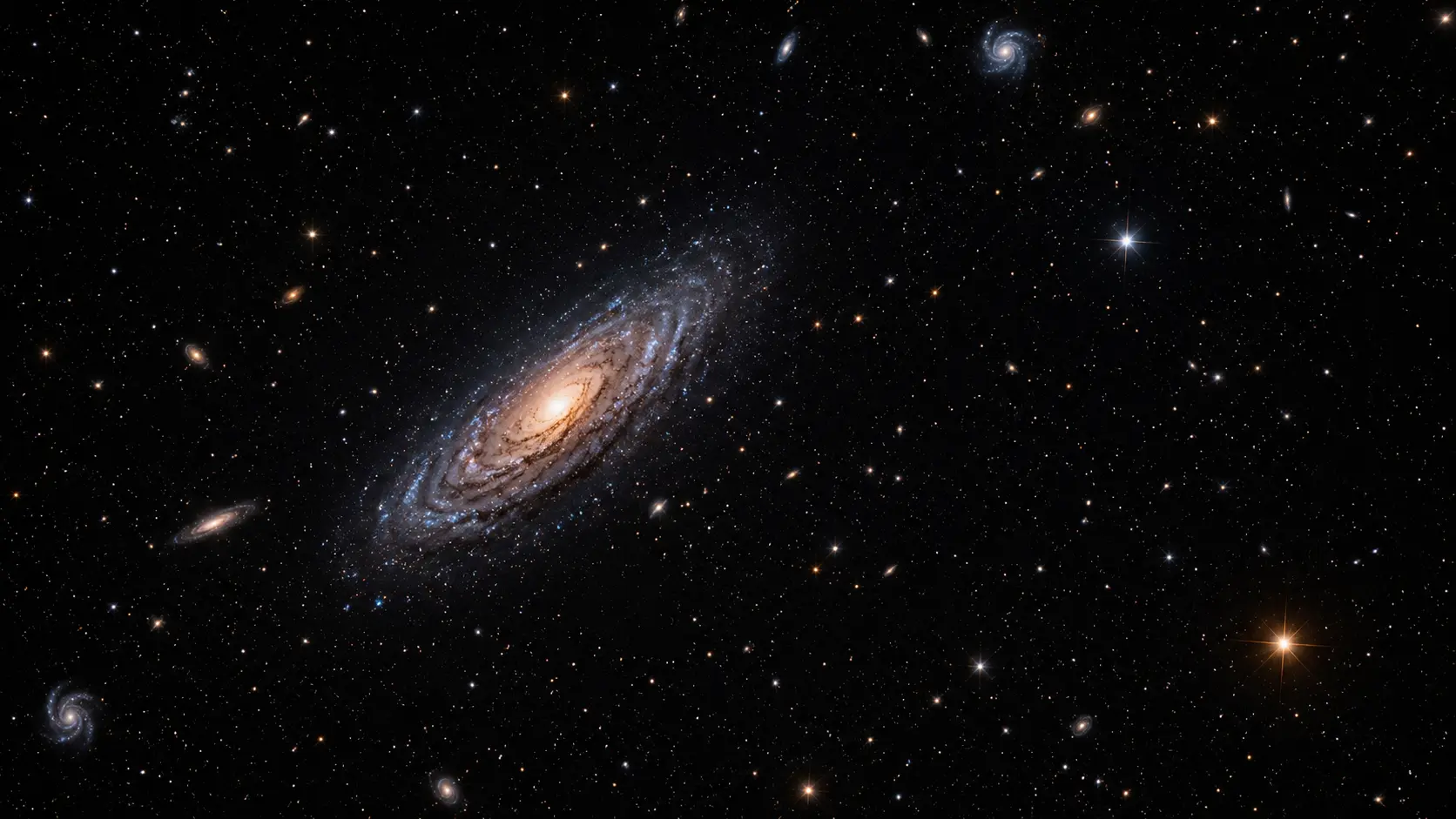
Visual answer
Why the Universe Full of Stars Produces a Dark Sky
Two reasons the light from billions of stars does not fill our night sky with brightness.
The observable universe has a boundary
The universe is about 13.8 billion years old. Light travels at a finite speed. Stars beyond roughly 46 billion light-years, accounting for expansion, have not had enough time to send light that can reach us yet.
Most of the universe's light never arrives
Because of the finite speed of light and the universe's age, the vast majority of stars are outside our observable horizon. Their light is still traveling toward us but has not arrived.
Expansion redshifts distant light
The universe is expanding, stretching the space between us and distant objects. This stretches light waves to longer wavelengths. Starlight that started as visible has been shifted into infrared or microwave by the time it arrives.
Our eyes only see a small slice of the spectrum
Human eyes detect a narrow band of wavelengths. Most of the light reaching us from distant stars has been redshifted outside that window. The sky is full of invisible radiation but appears dark to the naked eye.
Real reason
The Sky Is Dark Because the Universe Is Young and Growing
Olbers' Paradox was a genuine problem for scientists who assumed the universe was infinite, eternal, and unchanging. In that model, every line of sight would eventually terminate on a star's surface, no matter how far away. The total brightness of the sky should equal the surface brightness of an average star, making night as bright as day. The dark sky seemed to contradict the idea of an infinite universe.
The resolution came in the 20th century with two discoveries. The first was that the universe had a beginning, the Big Bang, around 13.8 billion years ago. Light travels at a fixed speed. Any star that is further than the light travel distance since the Big Bang is invisible to us because its light simply has not arrived yet. This puts a hard cap on how many stars we can actually see.
The second was that the universe is expanding. Edwin Hubble demonstrated in 1929 that distant galaxies are moving away from us, and the further they are, the faster they recede. This expansion stretches the wavelength of light traveling through it, a process called cosmological redshift. Light that left a distant star as ultraviolet or visible has been stretched into infrared or microwave radiation by the time it reaches us. The universe is actually full of this radiation, but it is invisible to the human eye.
Myth vs reality
Myth vs Reality
What people think
Space is black because there are not enough stars
There are estimated to be more stars in the observable universe than grains of sand on all of Earth's beaches. The darkness of space is not about a shortage of stars. It is about physics: the finite speed of light, the finite age of the universe, and the stretching of light by expansion.
What actually happens
Space is dark because of the universe's age and expansion, not a lack of stars
Most starlight from distant objects has either not reached us yet or has been redshifted into invisible wavelengths. The night sky is actually filled with radiation across the entire electromagnetic spectrum. It is only dark in the narrow visible range that human eyes can detect.
Observable vs total universe
Observable Universe vs Total Universe
Size of observable universe
About 93 billion light-years in diameter, accounting for expansion since the Big Bang
Why it is not the whole universe
Space beyond the observable boundary exists, but light from it has not had time to reach us in the 13.8 billion years since the Big Bang
What lies beyond the observable edge
Almost certainly more stars and galaxies, but permanently invisible to us unless the universe stops expanding
Cosmic microwave background
The faint afterglow of the Big Bang, now redshifted to microwave frequencies, fills all of space uniformly. It is invisible to the naked eye but detectable with radio telescopes.
Quick answers
Common questions
If the universe is expanding, does that mean space will get even darker over time? +
Yes. As the universe expands, distant galaxies will recede past the observable horizon. Starlight will be redshifted further out of the visible spectrum. In the very distant future, most galaxies will be invisible from the Milky Way, and the night sky will be far darker than it is today.
Can we see light from the Big Bang? +
Not directly. The Big Bang's initial light has been redshifted into the microwave band and is now the cosmic microwave background. Detected by radio telescopes, it appears as a faint uniform glow in all directions at a temperature of about 2.7 Kelvin.
Why does space look black in astronaut photos? +
Cameras aboard spacecraft are pointed at specific bright objects like Earth or the sun. The exposure settings are adjusted to capture those bright objects properly, making the much dimmer background of faint stars and galaxies invisible in the photo. Deep space images from telescopes like Hubble use very long exposures to reveal the enormous number of faint objects that are otherwise invisible.
What is Olbers' Paradox exactly? +
Olbers' Paradox is the observation that in an infinite, eternal, static universe, every line of sight in the sky would eventually hit a star. The total light from all those stars would make the night sky as bright as a star's surface. The fact that the sky is dark is the paradox. It was resolved by discovering the universe has a finite age and is expanding.
Is the space between galaxies completely empty? +
Not quite. Intergalactic space contains extremely thin gas, stray particles, magnetic fields, dark matter, and pervasive radiation including the cosmic microwave background. It is the closest thing to empty that exists, but it is not perfectly empty.