Quick Facts
Quick Facts
Diogenes was exiled from Sinope for defacing currency.
He moved to Athens and became a follower of Antisthenes, the founder of Cynicism.
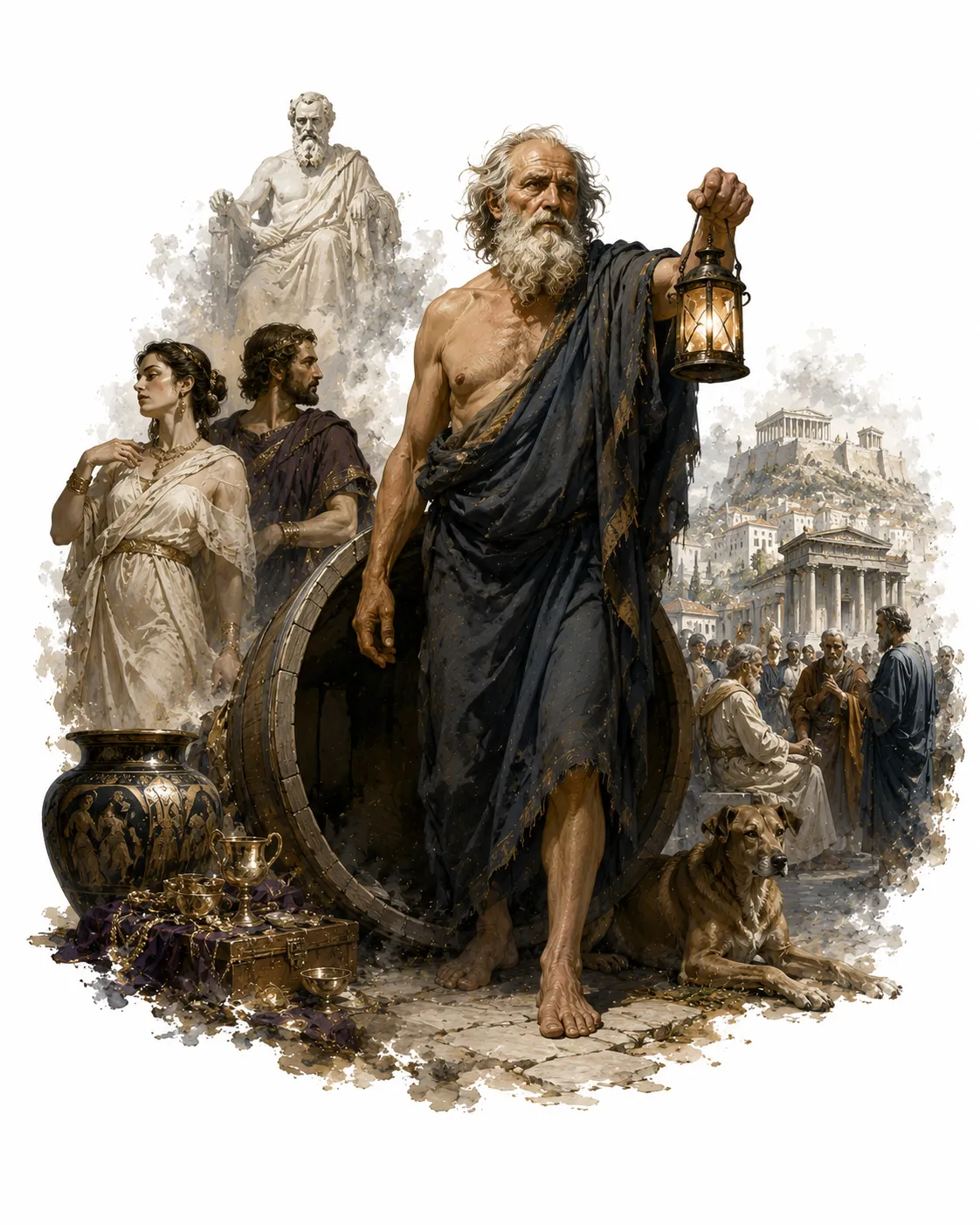
He lived in a pithos, a large ceramic jar used for storage, not a wooden barrel.
He carried a lamp in daylight, claiming to be looking for an honest man.
He was captured by pirates and sold into slavery. He became a tutor.
Visual answer
Diogenes's Philosophy in Action
His famous provocations and what they meant.
Living in a Barrel
Rejection of material wealth. Happiness does not require a house, furniture, or possessions.
Get Out of My Sunlight
Rejection of power and status. Alexander had everything. Diogenes needed nothing. The king was in his way.
Carrying a Lamp in Daylight
Searching for an honest man. He found no one. The lamp was a critique of hypocrisy.
Eating in Public
Rejection of social conventions. Why hide something as natural as eating?
Public Acts
He did not hide bodily functions. He argued that social taboos were arbitrary and hypocritical.
Story in brief
Story in Brief
c. 412 BC
Diogenes is born in Sinope, on the Black Sea coast.
c. 390 BC
He is exiled from Sinope for defacing currency.
The story is symbolic. He 'defaced' the currency of social convention for the rest of his life.
c. 380 BC
He moves to Athens and becomes a disciple of Antisthenes, the founder of Cynicism.
c. 340 BC
Alexander the Great visits Diogenes in Corinth. He offers anything. Diogenes says: 'Stand a little out of my sunlight.'
Alexander later said, 'If I were not Alexander, I would be Diogenes.'
c. 323 BC
Diogenes dies. He requested to be thrown outside the city walls, his body left for animals.
Even in death, he rejected social conventions.
The Story
How a Homeless Philosopher Became a Legend
Diogenes had nothing. He lived in a pithos, a large ceramic jar used for storing grain or oil. It was the ancient Greek equivalent of a dumpster. He begged for food. He owned a single cloak and a staff. He was free.
When Alexander the Great visited him, the conqueror was impressed. He asked Diogenes what he wanted. 'Stand a little out of my sunlight,' Diogenes replied. He did not want money. He did not want power. He wanted the most powerful man in the world to move so he could feel the sun on his face.
Alexander was not offended. He later said, 'If I were not Alexander, I would be Diogenes.' The king recognized that the homeless philosopher was happier than he was. Diogenes had nothing. He wanted nothing. He was free. Alexander had everything. He was a prisoner of his own ambition.
Famous Quote
"Stand a little out of my sunlight."
, Diogenes to Alexander the Great
This is one of the most famous retorts in history. It sums up his philosophy: power is meaningless. Sunlight is real.
Evidence
Why Diogenes Is Remembered
He is the founder of Cynicism, a major philosophical school.
StrongHis encounter with Alexander the Great is legendary.
StrongHe influenced later philosophers, including the Stoics.
StrongHis extreme lifestyle has fascinated people for centuries.
StrongKey Points
Key Points So Far
Diogenes lived in a barrel and owned almost nothing.
He rejected all social conventions, including privacy and modesty.
He famously told Alexander the Great to 'get out of my sunlight.'
He carried a lamp in daylight, claiming to be looking for an honest man.
He is the founder of Cynicism, a philosophy of radical simplicity.
Analogy
Like a Homeless Man Who Is Happier Than a King
The familiar part
Imagine a homeless man on a street corner. He has nothing. A billionaire walks by. The billionaire is stressed, anxious, and exhausted. The homeless man smiles.
How it applies
That was Diogenes and Alexander. The king had everything. The philosopher had nothing. The philosopher was happier. Diogenes proved that wealth and power do not bring happiness.
Where the analogy breaks
Most homeless people are not happy. Diogenes chose his poverty. He was not a victim. He was a rebel.
Curiosity Notes
Details Most People Miss
Why this still matters
Why This Still Matters
Diogenes is still famous because he asks a question that never gets old: what do you really need to be happy? His answer: nothing. He proved it by living in a barrel. Most of us cannot live that way. But the question still haunts us. We spend our lives accumulating things. Diogenes spent his life throwing things away. Who was happier? Diogenes said he was. And he had no reason to lie.
Key Findings
- ✓Core findingDiogenes was a Cynic philosopher who rejected all social conventions.
- ✓Strong evidenceHe lived in a barrel, owned almost nothing, and begged for food.
- ⚠Main consequenceHe told Alexander the Great to 'get out of my sunlight.'
- ✓Wider legacyHe carried a lamp in daylight, claiming to be looking for an honest man.
- ★Bottom lineHis philosophy influenced later thinkers, including the Stoics.
Final insight
A Last Thought
Why is Diogenes famous? Because he was free. He owned nothing. He wanted nothing. He was not afraid of anything. He told the most powerful man in the world to move out of his sunlight. That is freedom. Most of us will never be that free. But we can admire it. Diogenes is famous because he showed us what is possible. Not comfortable. Not practical. But possible.
Quick answers
Common questions
Was Diogenes crazy? +
No. He was making a point. He was not mentally ill. He was a philosopher performing a radical experiment in living.
What is the difference between a Cynic and a Stoic? +
Cynics reject all social conventions and material goods. Stoics accept social conventions but are indifferent to them. Diogenes was a Cynic. Seneca was a Stoic.