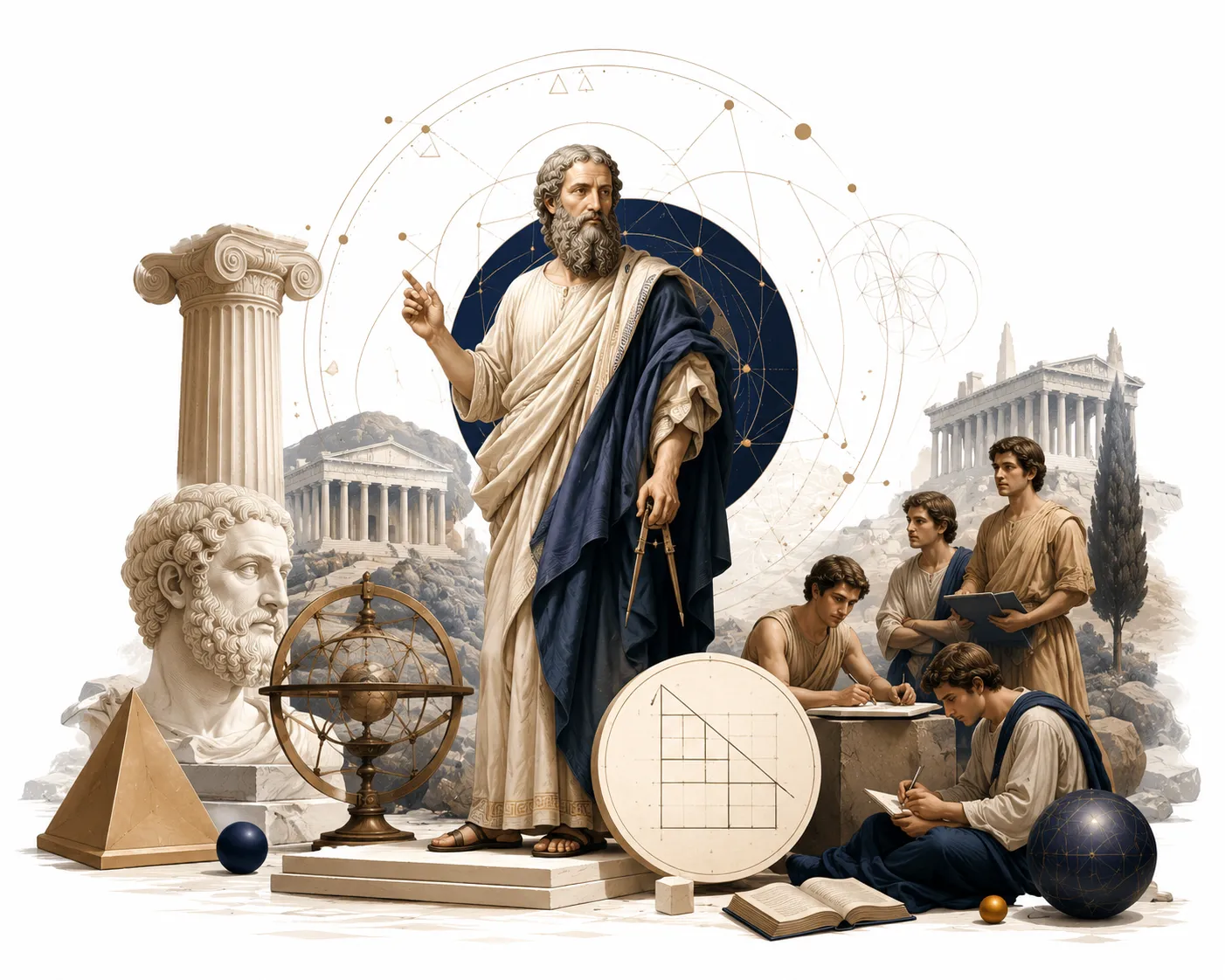
Quick Facts
Quick Facts
The Pythagorean theorem was known in Babylon 1,000 years before Pythagoras lived.
Pythagoras may have been the first to prove the theorem, or his followers may have.
He founded a secretive community that worshipped numbers and believed in reincarnation.
His followers believed that the planets made music (the 'harmony of the spheres').
He is also famous for banning beans, which he believed contained human souls.
Visual answer
The Two Legacies of Pythagoras
Mathematical and mystical.
Mathematical Legacy
Pythagorean theorem, number theory, irrational numbers, proof techniques.
Mystical Legacy
Numerology, reincarnation, vegetarianism, bean ban, harmony of the spheres.
Influence on Plato
Plato adopted Pythagorean ideas, including the immortality of the soul and the mathematical structure of the universe.
Influence on Science
The idea that the universe is mathematical, that it can be understood through numbers, is Pythagorean.
Story in brief
Story in Brief
c. 530 BCE
Pythagoras founds the Pythagorean Brotherhood in Croton, Italy.
He creates a community that will develop and preserve his teachings.
Unknown
The Pythagorean theorem is attributed to Pythagoras. It was actually known earlier.
The attribution sticks. The theorem becomes synonymous with his name.
c. 5th-4th century BCE
The Pythagorean Brotherhood influences Plato. Plato incorporates Pythagorean ideas into his philosophy.
Pythagorean thought enters the mainstream of Western philosophy.
Renaissance
Pythagorean ideas are revived. The Pythagorean theorem becomes a standard part of education.
Every schoolchild learns a² + b² = c². The name becomes immortal.
The Story
Why We Still Remember Him
Pythagoras is famous for a theorem he probably did not discover. The relationship between the sides of a right triangle was known in ancient Babylon 1,000 years before he was born. The Egyptians knew the 3-4-5 triangle. The Indians knew it too. Pythagoras may have been the first to prove it. Or his followers may have been. Or the attribution is simply wrong. But the name stuck. Today, every geometry student learns the Pythagorean theorem.
But the theorem is only half the story. Pythagoras is also famous for starting a cult. The Pythagorean Brotherhood was a secretive community that worshipped numbers. They believed that the universe was made of mathematics. They believed in reincarnation. They believed that beans contained human souls. They swore oaths of secrecy. They shared all property. They were a cult in every sense of the word.
The cult was destroyed by political enemies. But its ideas lived on. Plato was influenced by Pythagorean thought. The Neoplatonists revived it. The Renaissance rediscovered it. The idea that the universe is mathematical, that it can be understood through numbers, is Pythagorean. That idea is still with us. It is the foundation of modern science.
From Plato
"The heavens are full of numbers."
, Plato, influenced by Pythagorean ideas
This is the Pythagorean legacy. The universe is not chaotic. It is mathematical. It can be understood.
Evidence
Why His Name Endures
The Pythagorean theorem is taught to every geometry student.
StrongHe founded the Pythagorean Brotherhood, a influential philosophical cult.
StrongHis ideas influenced Plato and Neoplatonism.
StrongThe concept of a mathematical universe is foundational to modern science.
StrongKey Points
Key Points So Far
Pythagoras is famous for the Pythagorean theorem, though he probably did not discover it.
He is also famous for founding the Pythagorean Brotherhood, a secretive cult.
The cult worshipped numbers, believed in reincarnation, and banned beans.
Pythagorean ideas influenced Plato and, through him, Western philosophy.
The idea that the universe is mathematical is foundational to modern science.
Analogy
Like a Songwriter Who Never Wrote the Song
The familiar part
Imagine a songwriter who becomes famous for a song he did not write. He performs it. He records it. The song is associated with him forever.
How it applies
That is Pythagoras. He did not discover the theorem. But he taught it. His followers developed it. The theorem is associated with him. It will be forever.
Where the analogy breaks
Songwriters usually do not start cults. Pythagoras did.
Curiosity Notes
Details Most People Miss
Why this still matters
Why This Still Matters
Pythagoras is still famous because he asked a question that never gets old: what is the universe made of? His answer: numbers. That answer was wrong in detail but right in spirit. The universe is mathematical. It can be understood through equations. That idea is the foundation of modern physics. Every time a physicist writes an equation, they are channeling Pythagoras. The theorem is a relic. The idea is eternal.
Key Findings
- ✓Core findingPythagoras is famous for the Pythagorean theorem, though he probably did not discover it.
- ✓Strong evidenceHe founded the Pythagorean Brotherhood, a secretive cult that worshipped numbers.
- ⚠Main consequenceHe believed in reincarnation, banned beans, and thought the planets made music.
- ✓Wider legacyHis ideas influenced Plato and, through him, Western philosophy.
- ★Bottom lineThe idea that the universe is mathematical is foundational to modern science.
Final insight
A Last Thought
Pythagoras is famous for a theorem he did not discover and a cult he definitely started. The theorem is taught in schools. The cult is studied by historians. Both have kept his name alive for 2,500 years. That is the paradox of legacy. You do not need to be right. You need to be memorable. Pythagoras was both wrong and weird. He is also unforgettable. That is why we still say his name.
Quick answers
Common questions
Did Pythagoras discover the Pythagorean theorem? +
No. It was known in Babylon 1,000 years before he lived. He may have been the first to prove it. Or his followers may have been. The name is a misattribution.
Why did Pythagoras ban beans? +
He believed beans contained the souls of the dead. He also thought beans caused flatulence, which expelled the breath of life. He also thought beans resembled testicles. He had many reasons. All of them were strange.