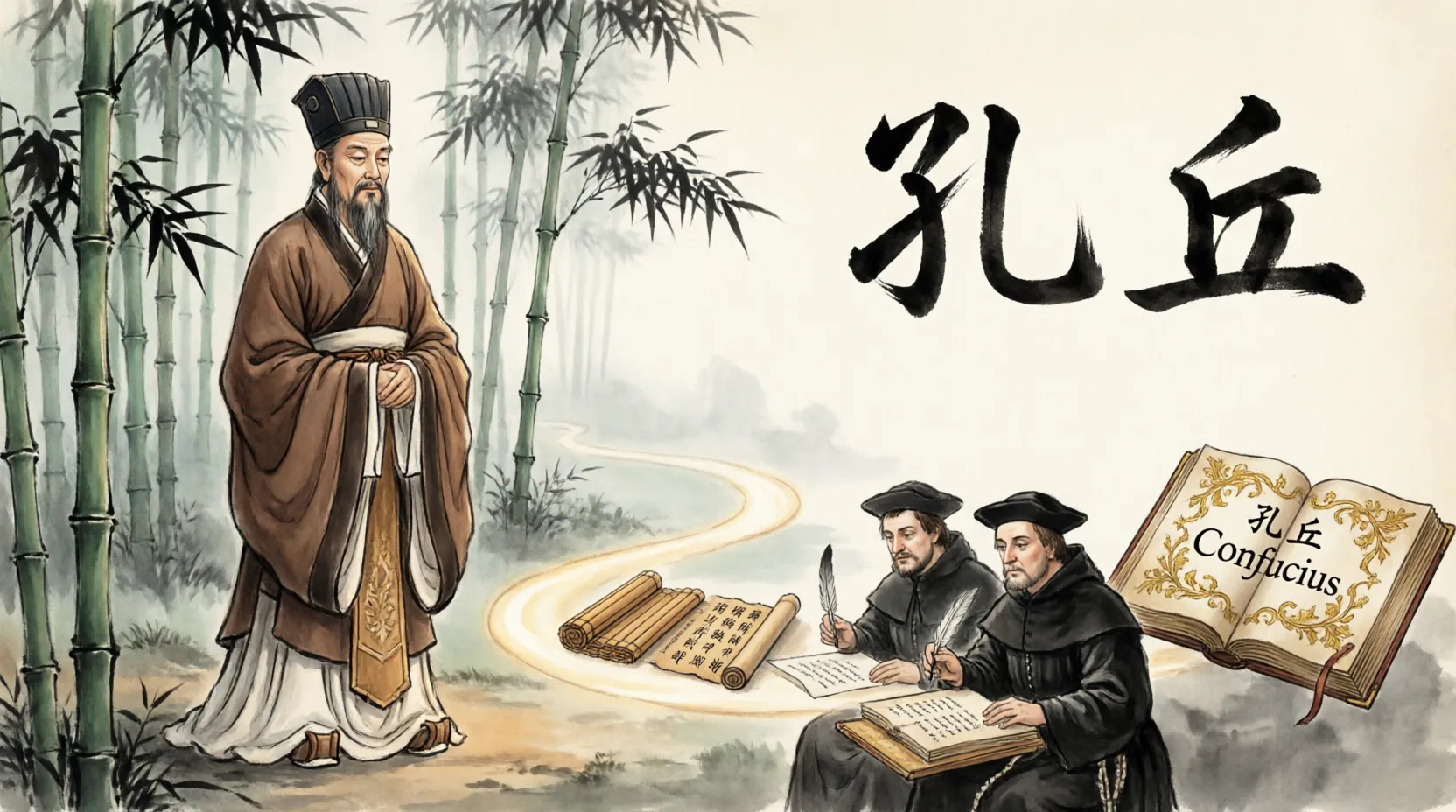
Visual answer
The Evolution of a Name: From Kong Qiu to Confucius
A five-stage journey across time and culture, transforming a Chinese honorific into a Latin scholarly name.
Kong Qiu (551 BCE)
Birth name of the philosopher. Family name Kong, given name Qiu.
Kong Fuzi (Honorific title)
Given by followers after his death. Means 'Great Master Kong'.
Jesuit Missionaries (1580s)
Matteo Ricci and colleagues encounter Chinese texts and adapt the name.
Latin Adaptation
Kong Fuzi becomes Confucius - a Latin-friendly scholarly name.
Modern Standard
Confucius becomes the universal Western name for the philosopher.
Short answer
The Short Answer
Confucius is not a Chinese name at all. It is a Latin invention.
His real birth name was Kong Qiu. His respectful title, used by his students and later followers, was Kong Fuzi - which translates roughly as Master Kong.
When Jesuit missionaries arrived in China in the late 1500s, they were fascinated by Chinese philosophy and wanted to bring it back to European audiences. But Kong Fuzi was a difficult sound for Latin-speaking scholars to work with. So they adapted it. Kong Fuzi became Confucius - a Latinized form that fit neatly into the scholarly language of the day.
The name traveled from those Jesuit manuscripts into European books, universities, and eventually into everyday English. Today, almost no one outside of East Asian scholarship uses Kong Qiu or Kong Fuzi in casual conversation. The Latin version won.
Real name
What Was Confucius's Real Name?
His birth name was Kong Qiu. He was born around 551 BCE in the state of Lu, in what is now Shandong Province in eastern China.
In Chinese naming tradition, Kong is the family name - equivalent to a surname. Qiu was his personal given name. So if he had lived today, he might go by Qiu Kong, or more formally, Kong Qiu.
His courtesy name - a name given to Chinese scholars when they reached adulthood - was Zhongni. Courtesy names were used by peers and social equals as a respectful alternative to the given name. Close associates would use Zhongni rather than Qiu.
The name Kong Fuzi came later. Fuzi is an honorific title in classical Chinese, meaning something close to Master or Great Teacher. His followers began calling him Kong Fuzi - Master Kong - as a sign of immense respect. It is not a personal name so much as a title of honor.
He has also sometimes been called Kongzi, a shorter version of the same honorific, dropping the fu prefix. Both versions acknowledge him as Kong the Master.
So to recap: Kong Qiu is the birth name. Kong Fuzi or Kongzi is the title of respect. Confucius is the European invention.
Pronunciation
How Do You Pronounce Confucius?
Confucius is pronounced: kon-FYOO-shuss. The stress falls on the second syllable. The ending sounds like the word 'itious' or '-shus'. Say it as three syllables: kon - FYOO - shuss.
Now for the original Chinese version. Kong Fuzi is pronounced roughly: KONG FOO-dzuh. Kong rhymes with song. Fuzi breaks into two syllables: fu sounds like foo, and zi sounds like dzuh or dzih - a sound that does not exist in English and requires some practice to produce naturally. The zi sound in Mandarin Chinese is somewhere between the dz in adze and the ts in its, spoken quickly.
Kongzi - the shorter honorific - is pronounced: KONG-dzuh. And his birth name, Kong Qiu, is pronounced: KONG chyo (approximately). The Qiu in Mandarin is a falling-then-rising tone and sounds a little like the English word 'chew' spoken quickly with a slight y sound.
If you want to impress people, use Kong Fuzi. If you are speaking English in everyday conversation, Confucius is perfectly correct and universally understood.
Meaning of Kong Fuzi
What Does Kong Fuzi Mean?
The name Kong Fuzi breaks down into three parts.
Kong is his family name - the Chinese equivalent of his surname. It is one of the oldest and most distinguished surnames in Chinese history. The Kong family still exists today, and some members trace their lineage directly back to the philosopher himself across more than eighty generations.
Fu is a classical Chinese character that can be translated as great, accomplished, or senior. It elevates the honorific beyond a simple title of politeness into something closer to veneration.
Zi means master or teacher in classical Chinese. It was used to honor scholars, philosophers, and great thinkers. Many famous Chinese philosophers carry the zi suffix in their titles. Laozi, the founder of Taoism, means Old Master. Mengzi - known in the West as Mencius - means Master Meng. Mozi means Master Mo.
So Kong Fuzi literally translates as Great Master Kong, or more naturally in English: the Revered Master Kong.
It is a title that his followers created for him after his death became legend. During his lifetime, he was a teacher, a scholar, and an often frustrated government reformer who struggled to find rulers willing to follow his advice. The great reverence built slowly over centuries.
How it changed
How Kong Fuzi Became Confucius
The transformation from Kong Fuzi to Confucius happened in stages.
The first critical step was the arrival of Jesuit missionaries in China during the late 16th century. The Society of Jesus was a Roman Catholic religious order with a strong intellectual tradition. When missionaries like Matteo Ricci reached China around 1582, they were not just spreading religion - they were also scholars conducting one of the first serious Western encounters with Chinese philosophy.
Ricci and his colleagues studied Chinese texts carefully. They were deeply impressed by the teachings attributed to Kong Fuzi - the emphasis on moral order, virtue, education, and good governance. They saw potential parallels with European thought and wanted to introduce these ideas to readers back home.
But their audience read Latin. And Latin readers needed Latin-friendly names.
Kong Fuzi went through a process of phonetic adaptation. The K sound was retained. The ong vowel was preserved. The fuzi ending was reshaped into a Latin suffix that felt comfortable and scholarly - the kind of ending found on Roman names.
What emerged was Confucius - a name that sounded vaguely ancient and respectable to European ears while still being recognizable as an approximation of the original Chinese.
Ricci and other Jesuit scholars used the name in manuscripts, letters, and published translations. Those texts spread across Europe. By the 17th and 18th centuries, Confucius had become standard.
Why Europeans changed it
Why Europeans Changed The Name
The short answer is: Latin was the language of European scholarship, and Kong Fuzi did not fit into it.
In the 17th century, educated Europeans wrote and read in Latin the way people today use English as an international language. Scientific papers, philosophical texts, church documents, diplomatic correspondence - all of it moved through Latin. A name had to function in Latin sentences, take Latin grammatical endings, and feel at home on a Latin page.
Kong Fuzi posed several problems. The sounds were unfamiliar. The structure did not map onto any Latin pattern. And Chinese naming conventions - where the family name comes first and an honorific title replaces the given name - were completely foreign to European audiences who expected a first name and a surname.
Latinization was a standard practice at the time. European scholars routinely Latinized each other's names too. The Dutch philosopher Erasmus of Rotterdam was born Desiderius Gerhard Gerhards. The Polish astronomer Copernicus was born Mikolaj Kopernik. The assumption was that great thinkers belonged to a universal intellectual tradition that expressed itself in Latin.
Bringing Kong Fuzi into that tradition meant giving him a Latin name. Confucius was the result.
There is no disrespect in the original intention. The Jesuits genuinely admired the philosopher and wanted European scholars to take him seriously. But it does mean that the world's most famous Chinese thinker is remembered everywhere outside East Asia by a name he never used.
Not used in China
Was Confucius Ever Called Confucius In Ancient China?
Never. Not once. The name Confucius did not exist until European scholars created it more than two thousand years after his birth.
In ancient China, he was Kong Qiu in formal contexts and Zhongni among peers. His students and later Confucian scholars referred to him as Kong Fuzi or the shortened Kongzi. Chinese texts written about him over the centuries always use these Chinese forms.
Even today in China, he is still Kongzi or Kong Fuzi. The name Confucius is recognized as a foreign rendering of his title, but it is not used in Chinese-language scholarship, education, or daily speech.
This is worth pausing on. One of the most famous names in world intellectual history - a name recognizable to billions of people - is essentially a European nickname for a Chinese thinker who lived in a world where that nickname would have meant nothing.
The same pattern appears elsewhere in history. The ancient Greek philosopher Aristotle was known in the Islamic world as Aristu. The Persian mathematician Al-Khwarizmi gave his name to the word algorithm through a similar chain of linguistic translation and adaptation. Names travel across cultures and transform as they go.
Confucius is one of the most dramatic examples of that transformation.
Other examples
Other Historical Figures Whose Names Changed
Confucius is not alone in being remembered by a name very different from the one he used himself.
Avicenna is the Latinized name of Ibn Sina, the Persian philosopher and physician born in 980 CE. His full name was Abu Ali al-Husayn ibn Abd Allah ibn Sina. European scholars shortened and Latinized this into Avicenna for their texts.
Averroes is the Latinized name of Ibn Rushd, the Andalusian philosopher who wrote influential commentaries on Aristotle. His real name was Abu al-Walid Muhammad ibn Ahmad ibn Rushd.
Copernicus, as mentioned, was born Mikolaj Kopernik. The Latin version became the standard form used in scientific history.
Even Jesus of Nazareth is an example of this kind of transformation. His original name in Aramaic was most likely Yeshua. This became Iesous in Greek, then Iesus in Latin, then Jesus in English - a chain of transliterations across three languages.
The pattern reflects something important about how ideas and reputations cross cultural boundaries. When a thinker becomes famous enough to matter beyond their home culture, their name often gets adapted to fit the new audience. The thinker's ideas travel; the original name sometimes does not.
For Confucius, the ideas traveled so far and so powerfully that the Latin nickname outlasted the original Chinese title everywhere outside East Asia.
Myths vs reality
Common Myths About Confucius's Name
What people think
Confucius means 'wise man' or 'great philosopher' in Chinese
The name Confucius has a deep philosophical meaning in Chinese.
What actually happens
Confucius has no meaning in Chinese at all
It is a Latinized approximation of Kong Fuzi. The Chinese title Kong Fuzi means Master Kong - not 'wise man' in a generic sense.
Name myths
More Name Myths Debunked
Myth: Confucius was a name given to him at birth
Reality: He was born Kong Qiu. Confucius did not exist as a name until the 16th or 17th century CE.
Myth: His students called him Confucius
Reality: His students called him Kong Fuzi. The name Confucius was invented roughly two thousand years after his death.
Myth: Confucius was his surname
Reality: His surname was Kong. Confucius is a Latinized rendering of his honorific title, not his family name.
Myth: Chinese people use the name Confucius today
Reality: In China, he is still Kongzi or Kong Fuzi. Confucius is understood as a foreign form but not used in Chinese.
Myth: The name change was an act of cultural disrespect
Reality: Jesuit missionaries who created the Latinized form genuinely respected his philosophy and wanted to share it. The adaptation was practical, not dismissive.
Surprising facts
Surprising Facts About Confucius's Name
The name Confucius was invented more than two thousand years after he was born.
The Kong family still exists today, with some members tracing their lineage back over eighty generations to the philosopher himself.
In China, he is never called Confucius - he is always Kongzi or Kong Fuzi.
The missionary Matteo Ricci, who helped Latinize the name, was also the first Westerner permitted to enter the Forbidden City.
Fuzi is a title, not a name - it is the same honorific used in Laozi (Old Master) and Mengzi (Master Meng).
His courtesy name Zhongni was used by social equals and has almost completely disappeared from modern usage.
Quick answers
Common questions
Why was Confucius named that? +
He was not originally named Confucius. He was born Kong Qiu. The name Confucius is a Latinized form of his honorific title Kong Fuzi, created by Jesuit missionaries in the 16th and 17th centuries to introduce his philosophy to European audiences.
What is the nickname of Confucius? +
His most common Chinese title is Kongzi, a respectful shortening of Kong Fuzi meaning Master Kong. In the West, Confucius itself functions as the standard name, derived from that same honorific title.
What was Confucius's real name? +
His real birth name was Kong Qiu. His family name was Kong and his given name was Qiu. He was also known by his courtesy name Zhongni among social equals.
How do you pronounce Confucius? +
Confucius is pronounced kon-FYOO-shuss, with the stress on the second syllable. The original Chinese title Kong Fuzi is pronounced approximately KONG FOO-dzuh.
Why do we call him Confucius? +
Because Jesuit missionaries Latinized his Chinese honorific title Kong Fuzi into Confucius in the 16th and 17th centuries. Latin was the scholarly language of Europe at the time, and the Latinized form spread through academic texts and books across the continent.
Why does Confucius have a Latin name? +
Latin was the international language of European scholarship when Jesuit missionaries first introduced his philosophy to Western audiences. Giving him a Latin name was standard practice - European scholars Latinized their own names too.
What does Kong Fuzi mean? +
Kong Fuzi means Great Master Kong or the Revered Master Kong. Kong is his family name. Fu means great or accomplished. Zi is a classical Chinese honorific meaning master or teacher.