Visual answer
The Chemistry of a Safety Match Strike
Follow the sequence of chemical reactions from friction to flame.
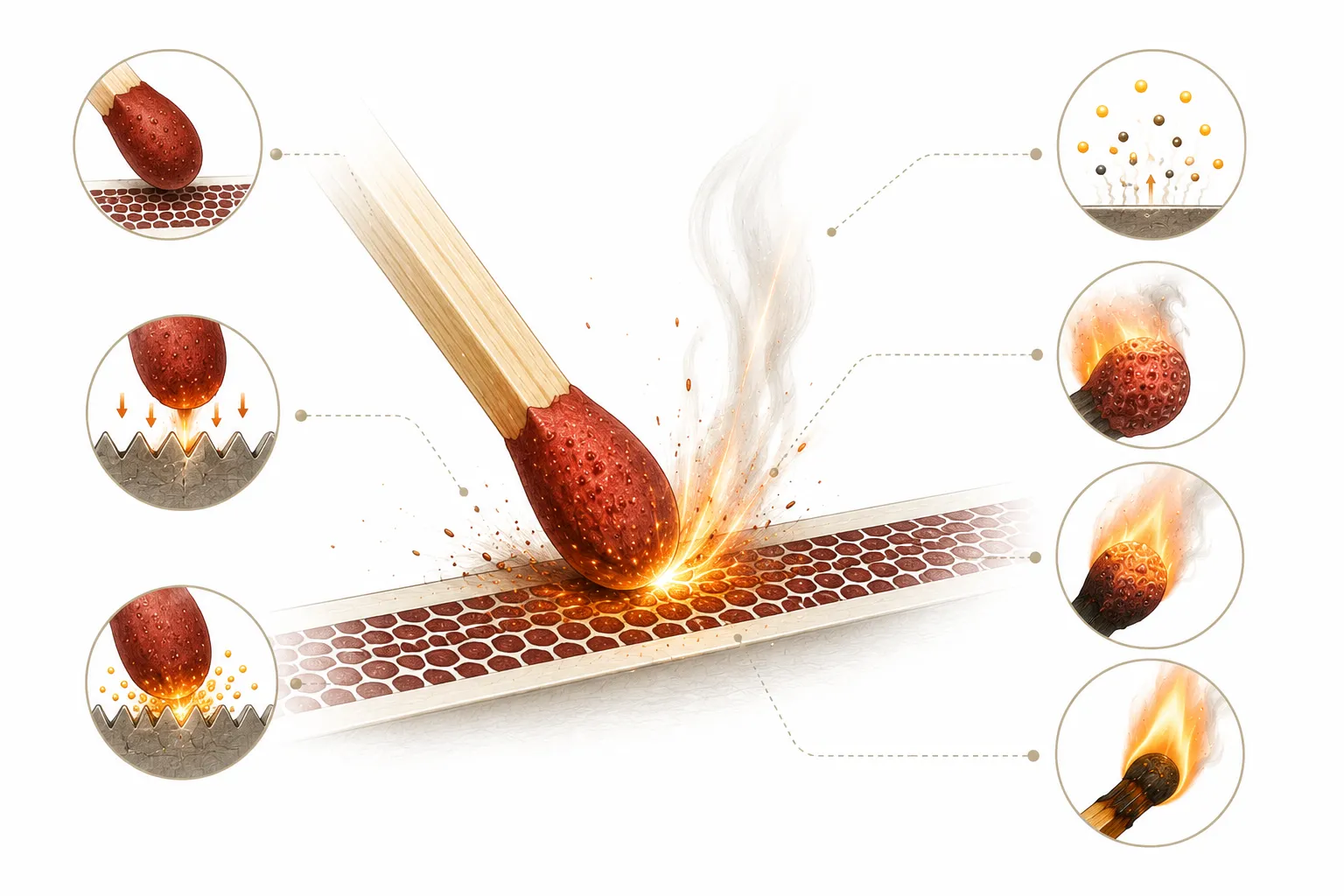
Friction on Striker
Abrasive (e.g., powdered glass) on strip creates heat. Converts red phosphorus (P₄) to white phosphorus (P₄).
White P Ignites
White phosphorus (P₄) ignites spontaneously in air, producing a small, initial flame.
KClO₃ Decomposes
Flame's heat causes potassium chlorate (KClO₃) in the head to decompose, releasing oxygen (O₂).
Sulfur Burns
The released oxygen supports rapid combustion of sulfur (S₈) in the head, creating a sustained flame that ignites the paraffin and wood.
Where We Stand
A Deliberate Chemical Separation
Current state
The modern 'safety match' is a triumph of chemical design. Its key innovation is separating the two essential reactive components, the phosphorus and the oxidizer, between the match head and the striking strip. This makes it much safer to handle and store than earlier 'strike-anywhere' matches.
What supports this
This separation was the direct result of the horrific health crisis caused by earlier white phosphorus matches, which gave factory workers 'phossy jaw' (a devastating bone disease). The solution, using stable red phosphorus on the box, was pioneered in the mid-19th century and remains the global standard today.
What could change this
A new ignition method would need to be safer, cheaper, and more environmentally friendly. Smokeless, non-toxic alternatives are researched, but the chemistry of the safety match is so well-optimized and inexpensive that it remains dominant.
The Core Idea
Think of It Like a Two-Key Launch System
The familiar part
In a nuclear launch or a secure safe, two keys or codes are required, kept by different people. This ensures the critical action cannot happen by accident.
How it applies
A safety match has a similar 'two-key' system. Key 1 (The Match Head): Contains the oxidizer (potassium chlorate) and fuel (sulfur), but is missing the crucial heat source to start the reaction. Key 2 (The Striking Strip): Contains the heat source (phosphorus that can be ignited by friction) but is physically separated. Only when the two are brought together by the mechanical action of striking do both 'keys' turn, allowing the reaction to proceed.
Where the analogy breaks
Unlike a digital code, the 'keys' are chemical. The phosphorus on the strip isn't just a heat source; it undergoes a transformation (from red to white) upon friction, making it the actual ignition trigger. The system relies on a specific, controlled chemical reaction sequence.
The Chemistry Sequence
The Three-Step Dance to Flame
Step 1: The Friction Trigger. When you strike the match, the abrasive powdered glass on the strip creates friction, generating heat. This heat is enough to cause a tiny amount of the red phosphorus on the strip to undergo a phase change into white phosphorus. White phosphorus is extremely pyrophoric, it ignites spontaneously in air.
Step 2: The Ignition. The tiny flame from the white phosphorus provides the initial activation energy. This heat immediately ignites the potassium chlorate (KClO₃) in the match head. Potassium chlorate is a powerful oxidizer, meaning it readily releases oxygen when heated.
Step 3: The Sustained Flame. The oxygen released from the decomposing potassium chlorate now supports the rapid combustion of the sulfur (S₈) or antimony sulfide (Sb₂S₃) in the match head, which acts as the primary fuel. This creates a hot, sustained flame. The heat from this flame then vaporizes the paraffin wax coating on the match stick and eventually ignites the wood itself (cellulose).
The Evidence
The Chemical Blueprint
Red phosphorus on the striking strip is converted to white phosphorus by friction.
StrongPotassium chlorate in the head decomposes to release oxygen, fueling combustion.
StrongSulfur in the head is the initial fuel that sustains the flame.
StrongThe match stick is impregnated with ammonium phosphate to prevent afterglow.
ModerateThe entire reaction sequence happens in a fraction of a second.
Strong'Strike-anywhere' matches contain phosphorus sesquisulfide (P₄S₃) in the head.
StrongThe Big Myth
The Most Common Misconception
What people think
"The friction alone creates enough heat to light the match."
It's a common belief that simply rubbing two rough things together gets hot enough to start a fire, like rubbing sticks in the wild.
What actually happens
Friction is just the matchmaker; chemistry is the fire
The heat from friction is indeed the initial trigger, but it is not enough to directly ignite the match head chemicals. The friction's critical role is to convert red phosphorus to white phosphorus. It's this white phosphorus, a chemical with a low ignition temperature (~30°C), that then provides the focused, intense heat needed to decompose the potassium chlorate. Friction is the catalyst; white phosphorus is the spark.
What If It's True?
What If the Chemicals Were Mixed?
Imagine this
Imagine a match head that contained both the phosphorus (as red P) and the potassium chlorate mixed together.
What would happen
This match would be extraordinarily dangerous. It could ignite from accidental friction, heat, or even impact. This was the exact problem with early 'strike-anywhere' matches and the toxic white phosphorus matches of the 19th century, which could ignite from a mere rub against a rough surface, causing countless accidental fires and horrific factory health issues like 'phossy jaw'.
Why this matters
The safety match's brilliance is in its deliberate inconvenience. By forcing the user to strike it against a specially prepared strip, it makes ignition intentional and controlled. It's a perfect example of a safety feature designed directly into the fundamental chemistry of an object.
Final insight
Chemistry's Controlled Burn
A match is not just a stick with a flammable head. It is a microcosm of chemical engineering where reactivity, safety, and user experience are balanced in a single, elegant design. The next time you light a candle, take a second to appreciate the silent, instantaneous, and perfectly sequenced chemical reaction dancing on the end of that tiny stick. It's a small miracle of applied science.
Quick answers
Common questions
Who invented the modern safety match? +
The safety match was developed in the mid-19th century as a safer alternative to the toxic white phosphorus matches. The key discovery was that red phosphorus was non-toxic and stable, and could be placed on the striking strip. This innovation is often attributed to the Swedish match industry led by Johan Edvard Lundström in the 1850s.
What is 'phossy jaw'? +
Phossy jaw was a devastating occupational disease affecting match factory workers who handled white phosphorus. It caused the jawbone to literally rot and glow in the dark, leading to severe disfigurement and often death. This public health crisis was a major driver in banning white phosphorus from matches and developing the safer red phosphorus safety match.
What is the difference between 'safety' and 'strike-anywhere' matches? +
Safety matches only ignite on the prepared striking strip (which contains red phosphorus). Strike-anywhere matches have the phosphorus (as phosphorus sesquisulfide) included in the match head itself, allowing them to ignite on any rough surface. This makes them more versatile but also more hazardous.
Why don't matches ignite in the box? +
Because the red phosphorus is on the striking strip, and the match head lacks the necessary chemical to ignite it. The two reactive components are kept separate until the deliberate act of striking brings them together.
Why do matches sometimes not light? +
This can be due to several reasons: the match may be old and the chemicals have degraded (especially the flammable paraffin on the stick), the head may be damp, the striking strip may be worn out (loss of abrasive grit or red phosphorus), or the user may not be striking with enough force or speed to generate sufficient heat.