American History

Why Is the Liberty Bell Cracked?

The story of how America's most famous bell broke, was badly repaired, broke again, and became iconic anyway. The Liberty Bell is one of the most recognized symbols in American history. It is also, technically speaking, a failed bell - one that cracked almost immediately, was improperly repaired, then cracked again and never properly rang again after 1846. By most functional standards it is a broken object. By cultural standards, it might be the most successful bell ever cast. The answer involves poor casting, a botched repair, and the moment a cracked bell became, paradoxically, more symbolically powerful than an intact one.

Quick answer

The Liberty Bell cracked initially due to a flaw in its casting when first rung in 1752, was twice recast and returned to service, but cracked again irreparably in 1846 while ringing to celebrate George Washington's birthday, and has remained silent and cracked ever since. No one recorded exactly when the famous crack appeared in its final form, and historians still debate precisely which ringing event caused the crack that ended the bell's career permanently.
Why Is the Liberty Bell Cracked? hero image

The mystery

The answer involves poor casting, a botched repair, and the moment a cracked bell became, paradoxically, more symbolically powerful than an intact one.

The short answer

The Liberty Bell cracked initially due to a flaw in its casting when first rung in 1752, was twice recast and returned to service, but cracked again irreparably in 1846 while ringing to celebrate George Washington's birthday, and has remained silent and cracked ever since.

The twist

No one recorded exactly when the famous crack appeared in its final form, and historians still debate precisely which ringing event caused the crack that ended the bell's career permanently.

Common mistake

A popular belief holds that the Liberty Bell rang in celebration of the Declaration of Independence.

A bell that never quite worked the way it was supposed to

The Liberty Bell's troubled physical history began almost immediately after it arrived in Philadelphia.

It cracked almost immediately upon arrival

The bell arrived from a London foundry in 1752 and cracked on its very first ringing, leading to questions about the quality of the casting or the metal composition.

Philadelphia foundrymen John Pass and John Stow recast the bell twice, adding more copper to adjust the tone, before producing the version that hung for nearly a century.

The bell that became America's most beloved symbol cracked the first time anyone rang it.

A botched repair created the visible crack and its famous companion

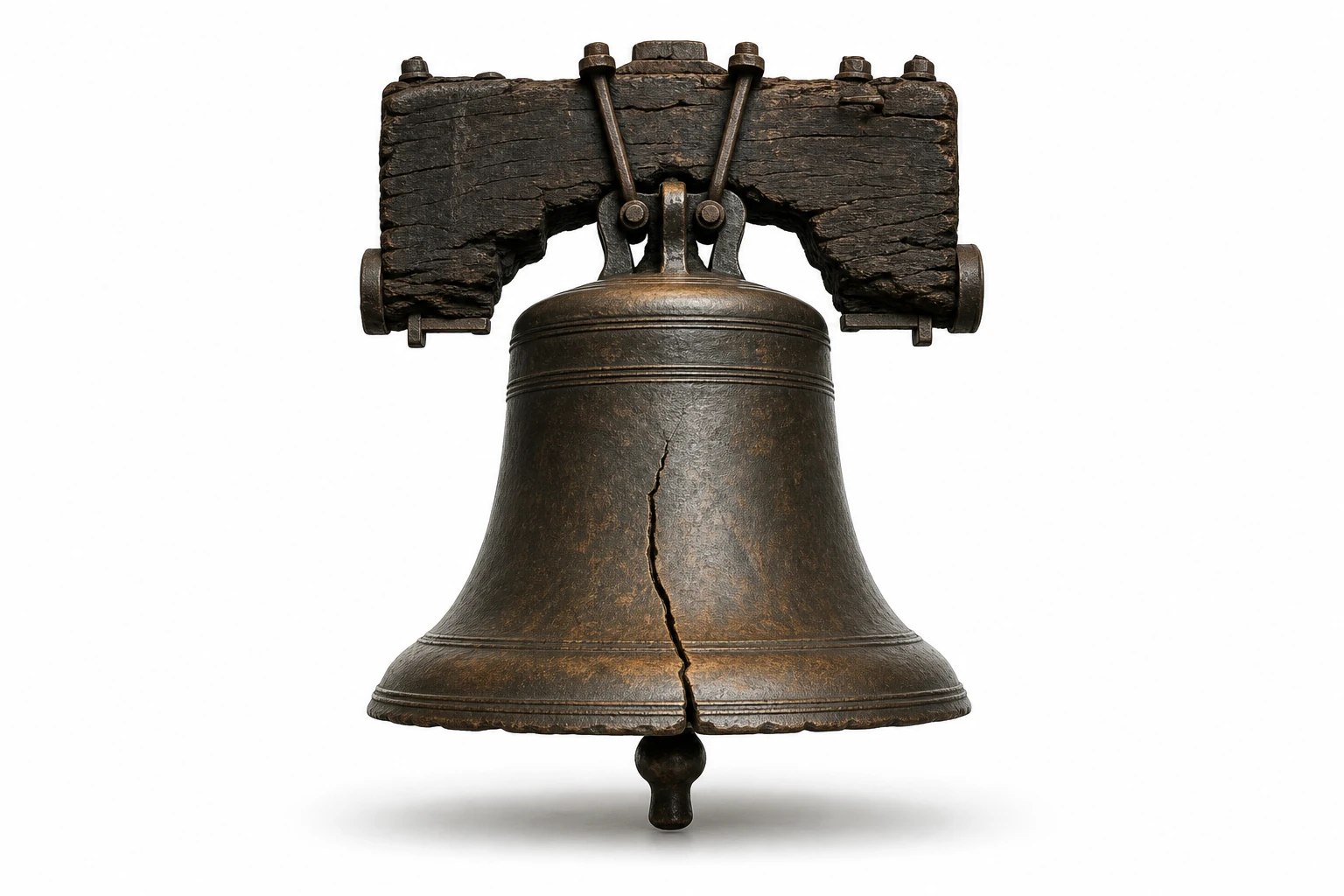
At some point in its service life, a hairline crack developed, and in an attempt to prevent it from spreading, craftsmen drilled a wider slot alongside it to reduce vibration stress - this widened slot is what most people see as the famous crack today.

Despite the repair, the bell cracked again in a different location in 1846, producing a second, wider fracture that silenced it permanently.

The famous crack is actually the repair. The crack that broke the bell for good arrived quietly afterward.

Abolitionists gave the broken bell its name and its power

The bell had been known simply as the Pennsylvania State House Bell for most of its existence. Abolitionists in the 1830s adopted it as a symbol of freedom and gave it the name Liberty Bell, quoting the inscription on its side.

A cracked, silent bell turned out to be a more powerful symbol of imperfect but striving liberty than a perfectly functional one would have been.

The abolitionist movement chose a broken bell as their symbol, and in doing so made it considerably more powerful than it had ever been while it was intact.

How a working bell became a national symbol

A short sequence of events transformed a flawed instrument into an icon.

1

01. The bell arrived flawed from London and cracked immediately

Initial poor casting required recasting before the bell could be used.

2

02. Decades of service produced hairline cracking

The bell rang for major civic occasions until a crack required repair.

3

03. A widened slot repair could not prevent further cracking

The drilling repair visible today did not prevent the bell from cracking again in 1846.

4

04. Abolitionists named and transformed it

The bell's political adoption gave its imperfection a symbolic resonance its wholeness never had.

Why the crack made it more powerful, not less

A cracked Liberty Bell, permanently silent, turned out to be a more potent symbol of the ongoing struggle for liberty than a functional one would have been. Its imperfection mirrored the imperfection of American democracy itself.

This transformation from broken tool to national icon is one of history's clearest examples of how symbolic meaning can completely overtake physical function.

Surprising Liberty Bell facts

The bell was not famous during the Revolutionary War
The Liberty Bell's association with American independence developed largely in the 19th century, long after the Revolution.
No one knows exactly when the famous crack appeared
Historical records do not precisely document when the hairline crack that led to the repair slot first formed.
It has been tapped, not rung, for symbolic events since 1846
On significant occasions, the bell is gently tapped rather than swung to produce a soft tone without risk of further damage.

Did the Liberty Bell ring on July 4, 1776?

Myth

A popular belief holds that the Liberty Bell rang in celebration of the Declaration of Independence.

A 19th-century story popularized the image and proved impossible to dislodge despite lack of evidence.

Reality

There is no contemporaneous historical record confirming the bell rang specifically on July 4, 1776, and historians consider this story largely mythological.

There is no contemporaneous historical record confirming the bell rang specifically on July 4, 1776, and historians consider this story largely mythological.

Where the Liberty Bell's symbolism endures

Civil rights movement
The Liberty Bell was invoked repeatedly by civil rights leaders as a symbol of the country's unfinished commitment to equality.
The bell's international tour
The bell traveled to various expositions in the late 19th and early 20th centuries, becoming an internationally recognized symbol before returning permanently to Philadelphia.

Why a cracked bell became more important than a whole one

The Liberty Bell's story demonstrates that physical imperfection does not diminish symbolic power - it can enhance it by making the symbol feel more honest.

It remains one of the most visited historic artifacts in the United States, with its crack serving as a feature rather than a flaw.

Worth noting

The bell that succeeded by failing

The Liberty Bell rang imperfectly, was repaired imperfectly, cracked again, and fell permanently silent in 1846 - which may be exactly why it became the enduring symbol it is. No intact, well-functioning bell could ever carry quite the weight of meaning that a cracked and silent one can.

Quick answers

Common questions

What does the inscription on the Liberty Bell say?

The most famous portion reads 'Proclaim Liberty Throughout All the Land Unto All the Inhabitants Thereof,' a quote from the Book of Leviticus.

Who made the Liberty Bell?

The final, historically known version was cast by Philadelphia founders John Pass and John Stow after the original London-cast bell cracked.

American History

Related questions

Metallurgists have studied this, but the crack's geometry and the bell's cultural status make repair impractical and undesirable.

The abolitionists who named a bell

The Abolitionist Movement

American abolitionists of the 1830s first published the name Liberty Bell and used the cracked bell as a symbol of the freedom they were fighting to extend.

Related questions

Where is the Liberty Bell today?

It is housed at the Liberty Bell Center in Philadelphia, Pennsylvania, near Independence Hall.

Where the Liberty Bell's symbolism endures

Civil rights movement

The Liberty Bell was invoked repeatedly by civil rights leaders as a symbol of the country's unfinished commitment to equality.

Where the Liberty Bell's symbolism endures

The bell's international tour

The bell traveled to various expositions in the late 19th and early 20th centuries, becoming an internationally recognized symbol before returning permanently to Philadelphia.

Did the Liberty Bell ring on July 4, 1776?

There is no contemporaneous historical record confirming the bell rang specifically on July 4, 1776, and historians consider this story largely mythological.

There is no contemporaneous historical record confirming the bell rang specifically on July 4, 1776, and historians consider this story largely mythological.