Art & Philosophy

Why Does Plato Point Up and Aristotle Point Down?

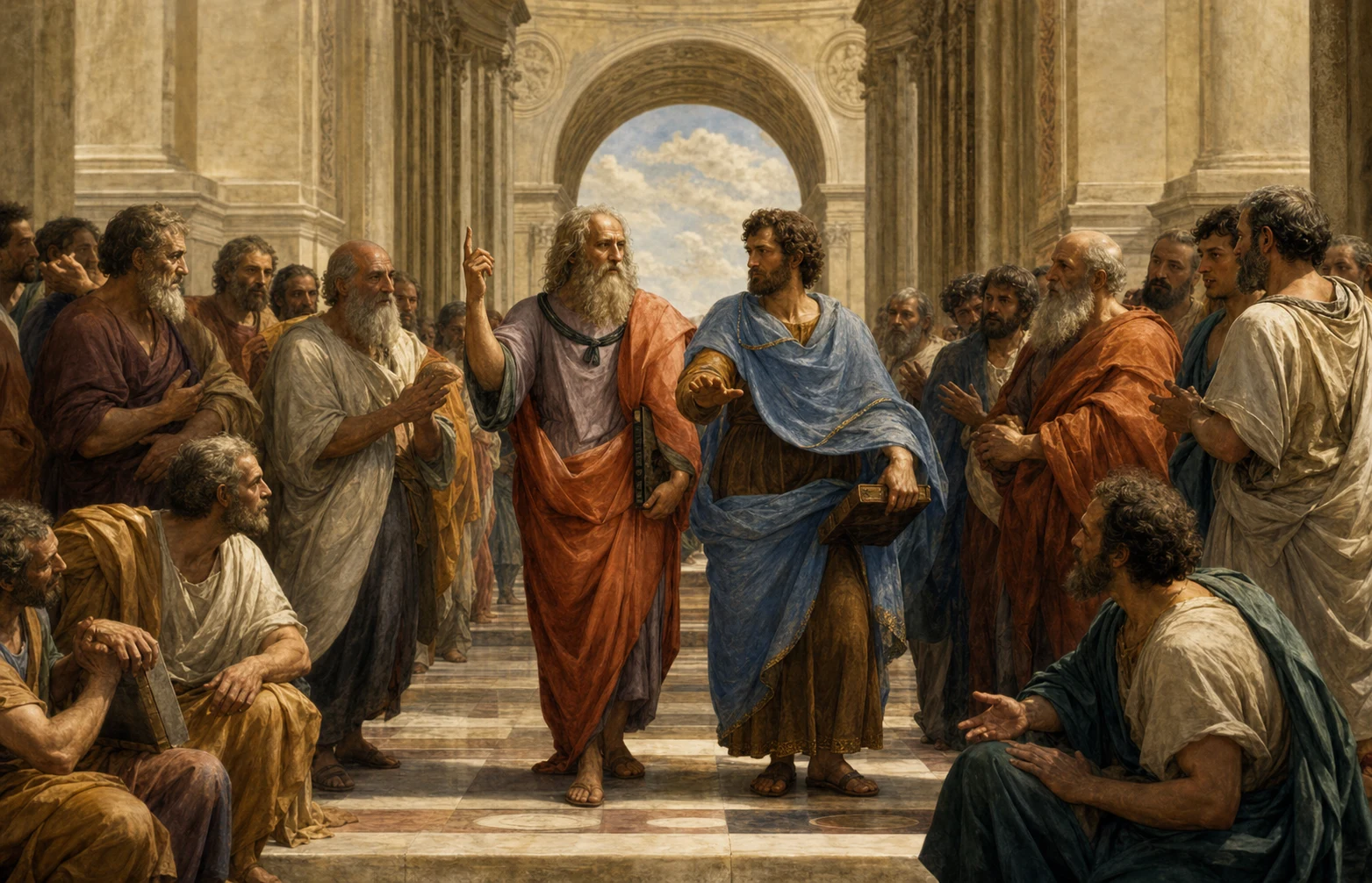
Hidden inside Raphael's most famous fresco is a silent argument that has never stopped. Stand in the Vatican's Apostolic Palace and look at the wall. Five hundred years ago, a young painter from Urbino - not yet thirty - filled it with fifty-eight philosophers arguing, reading, calculating, and debating. It is one of the most crowded rooms ever painted. And yet the eye goes immediately to the center, where two men walk toward you, side by side, each with one hand outstretched. One points up. One points down. That's it. That's the whole argument. And it is an argument that was already two thousand years old when Raphael painted it. Those two gestures encode a philosophical war about the nature of reality - and once you see it, you'll never look at the painting the same way.

Quick answer

Plato points upward because he believed that ultimate reality exists in an invisible realm of perfect, eternal Forms - the physical world is just a shadow of that higher truth. Aristotle points downward because he believed reality lives here, in the physical world, observable and measurable. The gestures are Raphael's brilliant shorthand for the deepest split in Western philosophy. Raphael likely never studied philosophy formally. He was a painter. Yet he managed to compress 2,000 years of intellectual debate into two pointing fingers.

Why Does Plato Point Up and Aristotle Point Down? hero image

The mystery

Those two gestures encode a philosophical war about the nature of reality - and once you see it, you'll never look at the painting the same way.

The short answer

Plato points upward because he believed that ultimate reality exists in an invisible realm of perfect, eternal Forms - the physical world is just a shadow of that higher truth. Aristotle points downward because he believed reality lives here, in the physical world, observable and measurable. The gestures are Raphael's brilliant shorthand for the deepest split in Western philosophy.

The twist

Raphael likely never studied philosophy formally. He was a painter. Yet he managed to compress 2,000 years of intellectual debate into two pointing fingers.

Common mistake

Some viewers assume the gestures are simply artistic convention - a generic sign of wisdom or speech.
The war of the hands

Raphael finished The School of Athens around 1511. He was twenty-six. The men at the center - Plato on the left, Aristotle on the right - are the painting's beating heart, and their gestures were not decorative choices. They were a philosophical position statement painted in fresco on a pope's wall.

Plato's finger and the world above

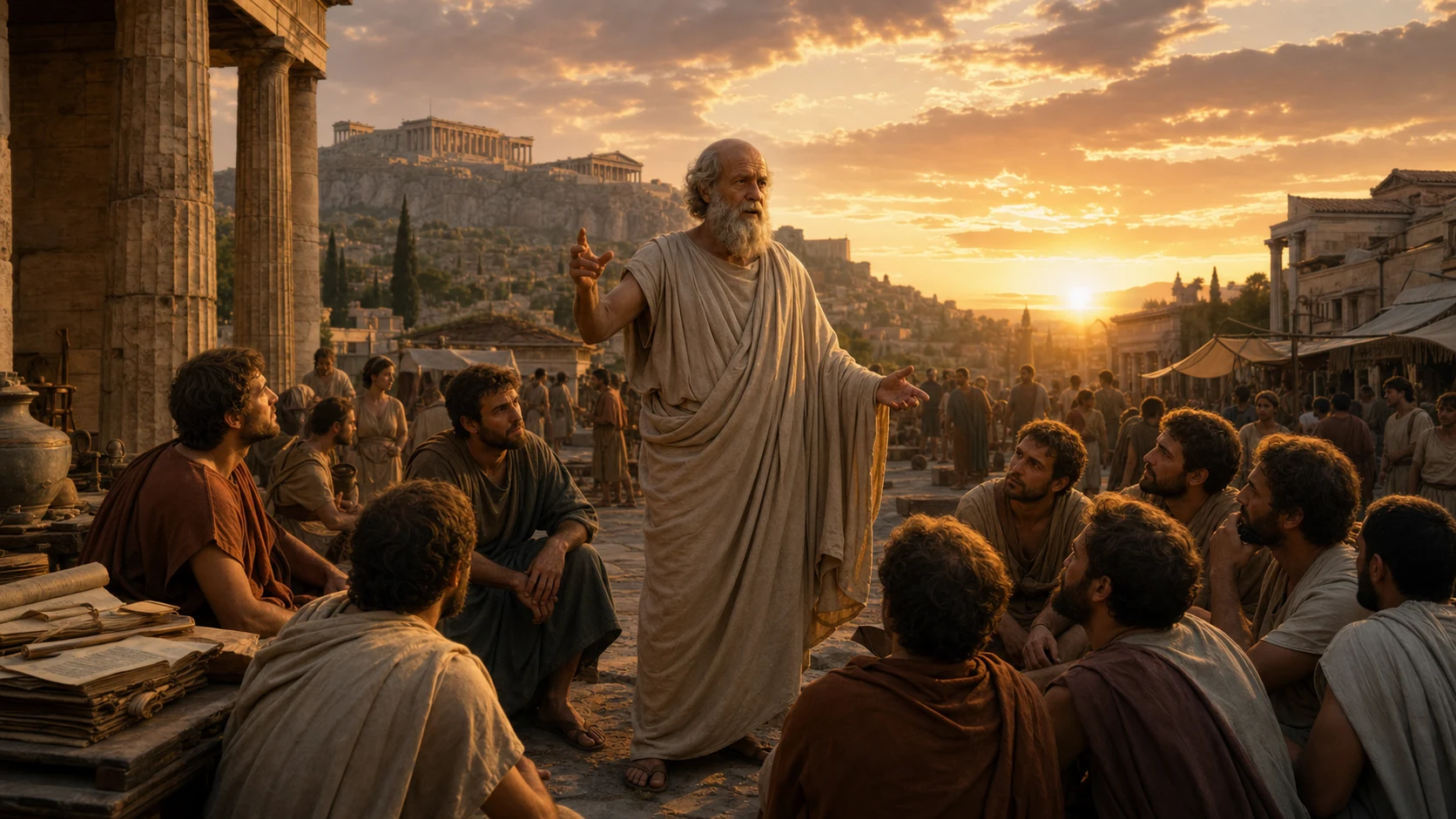
Plato spent his career arguing that the things we see around us - chairs, trees, human faces - are imperfect copies of perfect, unchanging originals that exist in a non-physical realm he called the World of Forms. The chair in your kitchen is just a rough approximation of the ideal Form of Chair, which exists somewhere beyond sight and touch, perfect and eternal. Beauty, Justice, Goodness: all of them exist in this higher realm, more real than anything you can hold in your hand.

This is why Plato points upward. Not at the ceiling. At the invisible. At the place where real knowledge lives - beyond the senses, accessible only through the mind. His other hand carries the Timaeus, his dialogue about the creation of the cosmos, a book about how the heavens gave birth to everything below. Even his reading material is pointing skyward.

For Plato, the world you can touch is the least real version of the world.

Aristotle's palm and the world beneath your feet

Aristotle was Plato's most brilliant student. He attended Plato's Academy for twenty years. Then he politely, systematically, and thoroughly disagreed with almost everything his teacher had said.

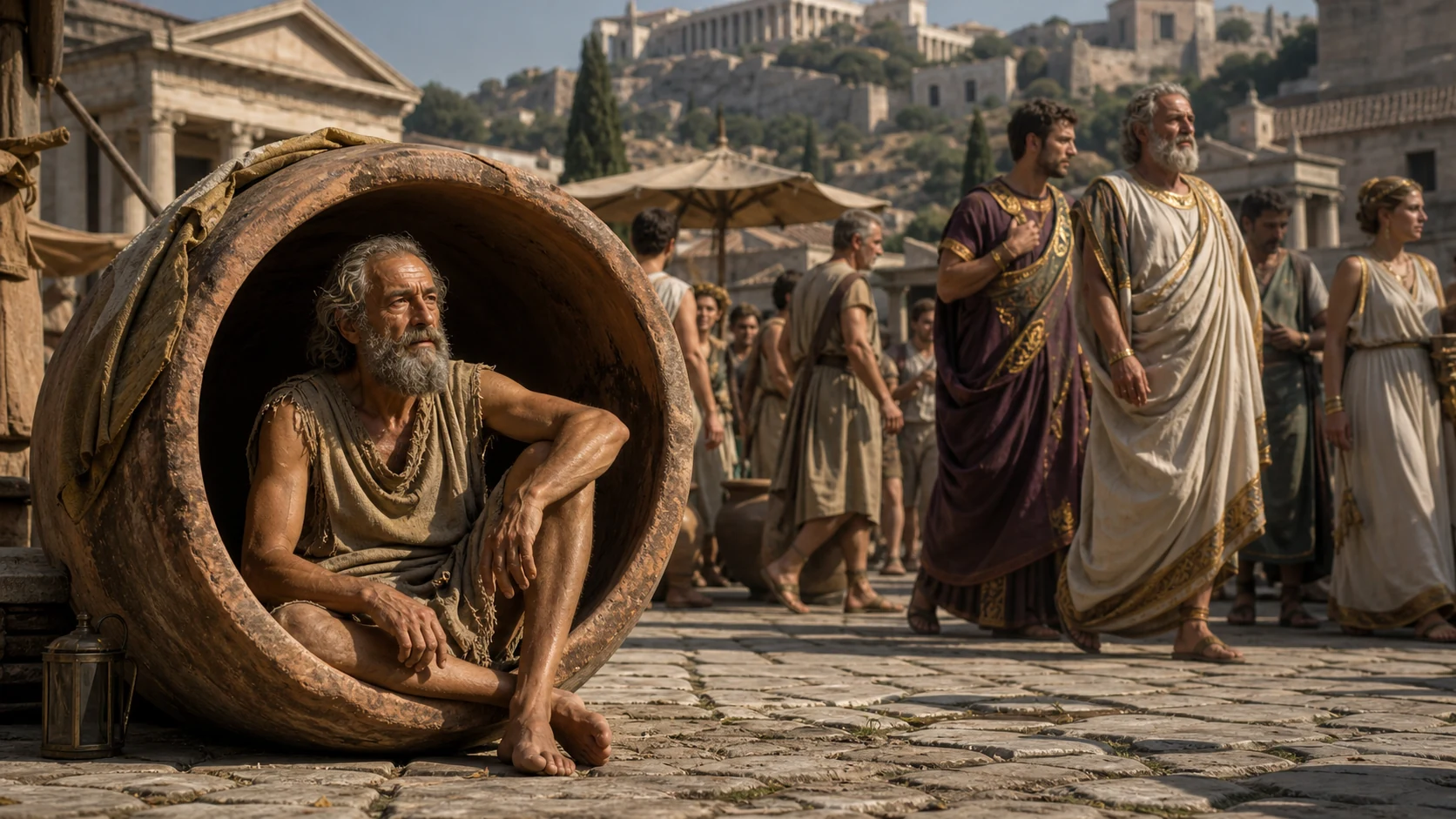
Aristotle had no patience for invisible realms. He wanted to look at things - actually look at them, classify them, dissect them, measure them. He catalogued hundreds of animal species. He wrote the first systematic works on logic, biology, physics, ethics, and drama. He is history's most enthusiastic noticer of the physical world.

So his palm sweeps downward and outward - toward the earth, toward the observable, toward the real things you can stub your toe on. His other hand carries the Nicomachean Ethics, a book not about the heavens but about how actual human beings should actually live their actual lives. Where Plato looks up for answers, Aristotle kneels down.

Aristotle spent twenty years in Plato's school, and his reward was arriving at the exact opposite conclusion.

How Raphael knew what to paint

Raphael was not a philosopher. He was the son of a court painter from a small Italian town, and his education was mostly visual. But he was working in Rome during the Renaissance, when the rediscovery of ancient Greek texts was reshaping everything - politics, religion, science, art. The arguments between Plato and Aristotle were being furiously relitigated in every intellectual salon in Italy.

Raphael's genius was to make the argument visual. He probably had help - scholars believe the humanist scholar Tommaso Inghirami advised him on the figures - but the choice of the gestures, the composition, the elegant simplicity of two hands going in opposite directions: that was a painter's solution to a philosopher's problem.

And he modeled Plato's face on Leonardo da Vinci, who was then the most famous man in Italy. It was a compliment and a categorization: Leonardo, with his obsessive interest in hidden patterns and cosmic order, belonged in the idealist camp.

Raphael solved in two hand gestures what philosophers had argued over for two thousand years.

The two hands as a philosophy course

The gestures work as a complete map of Western philosophy's central divide.

1

01. Plato's index finger points skyward

Indicates the realm of Forms - eternal, perfect, non-physical. This is where, for Plato, truth actually lives. The gesture also echoes early Christian iconography of divine pointing, possibly intentional in a painting commissioned for the Pope's private library.

2

02. Plato's book: the Timaeus

His dialogue about cosmology and the divine creation of the universe. A book about things above us, in every sense.

3

03. Aristotle's palm sweeps downward

Indicates the physical world - the earth, observable nature, human experience. Truth is found by looking at real things.

4

04. Aristotle's book: the Nicomachean Ethics

His masterwork on human virtue and how to live well in the real world - grounded, practical, earthly.

Why this argument never ended

The Plato-Aristotle split is not just art history trivia. It is arguably the original fault line of Western thought, and almost every major intellectual battle since has been fought along the same divide.

Medieval Christian theology was largely Platonic - God exists in a perfect realm above, the physical world is fallen and secondary. When Aristotle's full works were rediscovered in the 12th century, the Church had a crisis: here was a brilliant pagan insisting that reality was entirely physical. Thomas Aquinas spent his life trying to reconcile the two men whose painted versions would later stare out from Raphael's wall.

The Scientific Revolution was, in a sense, Aristotle winning: observation, experiment, the physical world as the ultimate source of truth. And yet Plato's ghost kept returning in mathematics, physics, and the eerie fact that abstract equations keep describing the real world with uncanny precision.

Things hidden in plain sight

Raphael painted himself in
In the lower right corner, a young man looks directly out at the viewer. That's Raphael, placing himself among history's greatest minds.
Heraclitus sits alone, brooding
The gloomy figure leaning on a marble block was added late, and his face is modeled on Michelangelo, who was painting the Sistine Chapel just down the hall.
No one in the painting attended the same school
Raphael collapsed philosophers from wildly different centuries and locations into one imaginary afternoon.
The building is impossible
The grand architecture was influenced by Bramante's plans for St. Peter's Basilica. Raphael painted a future building to house ancient thinkers.

Wait, isn't it just a decorative pose?

Myth

Some viewers assume the gestures are simply artistic convention - a generic sign of wisdom or speech.
Because the painting is so visually rich, it is easy to assume the central gesture is compositional rather than conceptual.

Reality

The gestures of Plato and Aristotle are not decoration. They are the painting's thesis statement.

The gestures of Plato and Aristotle are not decoration. They are the painting's thesis statement.

The argument in the world today

Mathematics: invented or discovered?
When abstract equations perfectly describe physical reality, the Platonic interpretation is hard to resist.
Cognitive science and AI
Innate knowledge versus knowledge from experience echoes the Plato-Aristotle divide in modern arguments about minds and machine learning.
Medical research
Every argument between pure theory and clinical evidence echoes the two men in the painting.

Two gestures that built the Western mind

The School of Athens is a painting about a debate, and the debate is still live. Every time a scientist insists on evidence over theory, every time a mathematician trusts a beautiful equation, and every time a theologian argues for a reality beyond the physical, Aristotle and Plato are still pointing.

The painting hangs in the pope's private library, meaning the leader of the Catholic Church has worked for five centuries under a painting of two pre-Christian philosophers arguing about whether God's realm is real.

Worth noting

The argument that never lands

Plato points up. Aristotle points down. And if you stand in front of that fresco long enough, you might notice something strange: both of them are walking toward you. Raphael managed to make a 2,500-year-old debate feel like it is still in progress because it is. Two men, two directions, one argument: where does reality actually live?

Quick answers

Common questions

Why does Plato look like Leonardo da Vinci?

Raphael modeled Plato's face on Leonardo da Vinci as a tribute to a mind associated with hidden patterns and cosmic order.

What is the Platonic realm of Forms?

It is Plato's idea that perfect, eternal, non-physical originals exist beyond the physical things we see.

Did Aristotle completely reject Plato?

Not completely. Aristotle kept reason, universals, and divine hierarchy, but rejected a separate realm of Forms.