Philosophy & Thinkers

Why Didn't Socrates Write Any Books?

The man who shaped Western philosophy left behind zero pages of his own writing. Socrates treated writing as a suspicious technology: useful for recording words, but bad at producing understanding.

Quick answer

Socrates believed real knowledge came from live questioning, not silent reading. A text cannot notice your confusion, challenge your assumption, or change its explanation for the person in front of it. The irony is that we know this argument because Plato wrote it down.
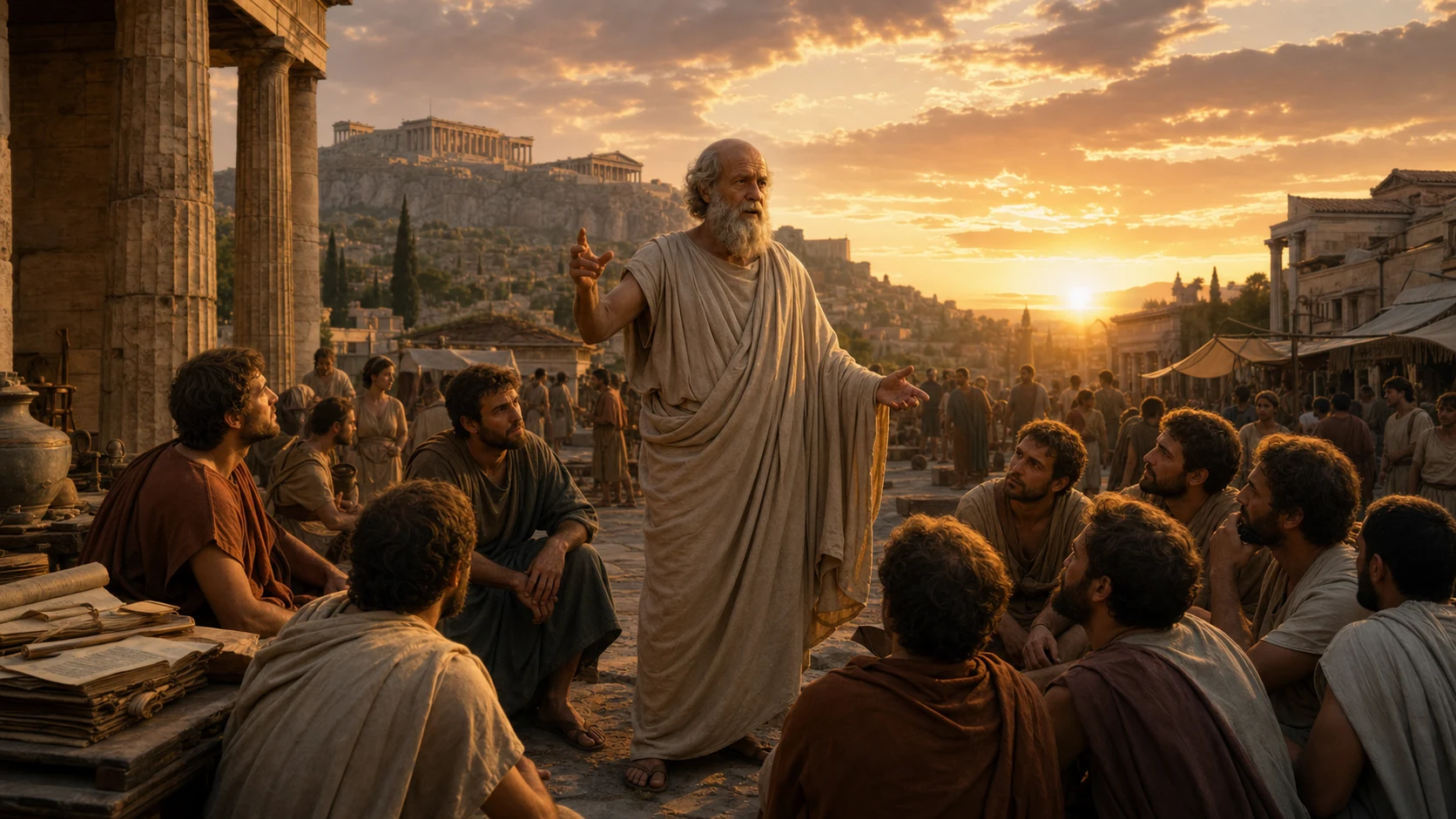
Why Didn't Socrates Write Any Books? hero image

The hook

He left no confirmed writings of his own.

The hidden mechanism

His method depended on conversation that could adapt in real time.

The twist

The anti-writing argument survived only because a student wrote it.

Common mistake

He was not illiterate; the refusal was philosophical.

Why Writing Felt Like a Trap

In Plato's Phaedrus, Socrates argues that writing gives the appearance of wisdom without the living work of thinking. A scroll can repeat an answer, but it cannot defend it, clarify it, or expose where the reader has misunderstood.

That mattered because Socrates was not trying to transfer information. He was trying to produce intellectual friction. A written text tells every reader the same thing, even when each reader needs a different challenge.

Why Conversation Was the Point

Socrates spent his days in public conversation, asking generals, poets, craftsmen, and politicians to define ideas they claimed to understand. The follow-up questions were the real engine. They forced people to notice contradictions inside their own answers.

For him, knowledge was not a package handed from teacher to student. It was something a mind discovered under pressure.

How Socrates Actually Taught

The Socratic method still has his name because it turns confusion into a tool.

1

Ask a simple question

What is justice? What is courage? What makes a person good? The question sounded easy enough to answer confidently.

2

Follow the answer until it breaks

Socrates accepted the first definition, then asked small follow-up questions until the answer contradicted itself.

3

Make the discovery belong to the student

He compared himself to a midwife: he did not put ideas into people, he helped them deliver what their own thinking could produce.

The Real Reason: Knowledge Cannot Simply Be Transferred

Socrates thought understanding had to be earned. A book can inform, but it cannot transform the reader through challenge, embarrassment, and correction.

That is why the refusal to write was not laziness. It was part of the philosophy itself.

The Common Misunderstanding

Myth

Socrates did not write because writing was unavailable or he was illiterate.

It is an easy explanation because it makes the story simpler than it really was.

Reality

Writing was established in Athens. Socrates rejected it because he thought it was the wrong tool for wisdom.

The real explanation is more interesting because it shows the system, pressure, and tradeoffs behind the event.

Why It Mattered

Immediate effect
His silence forced students to preserve and interpret him.
Long-term effect
Plato's written dialogues became the foundation of Western philosophy.
Modern echo
Every seminar, law-school cold call, and Socratic therapy question carries the same premise.
Best way to remember it
Socrates did not fail to write. He refused to write because he believed wisdom had to be earned in conversation.

Worth noting

Key Takeaway

Socrates did not fail to write. He refused to write because he believed wisdom had to be earned in conversation.

Quick answers

Common questions

How do we know what Socrates believed?

Mostly through Plato and Xenophon, which is why historians still debate where Socrates ends and his students begin.

What is the Socratic method?

A disciplined chain of questions that exposes contradictions and helps someone reach understanding through their own reasoning.