Everyday Science

Why Does a Whistle Work?

A tiny chamber of air, engineered to scream on command. Blow into a plain metal tube and you get nothing but the sound of breath. Blow into a whistle, shaped almost identically, and you get a piercing shriek loud enough to stop traffic. The difference between silence and that shriek comes down to a small internal trick most people have never actually looked closely at. The answer involves turbulent air, a vibrating chamber, and the same basic physics that makes flutes and bottles hum when you blow across them.

Quick answer

A whistle works by forcing air through a narrow opening against a sharp edge, which creates turbulence that causes air inside an internal chamber to vibrate rapidly at a specific frequency, producing a clear, sustained tone. Many whistles contain a small ball, called a pea, whose chaotic bouncing motion modulates the airflow to create the distinctive warbling trill of a traditional referee's whistle.
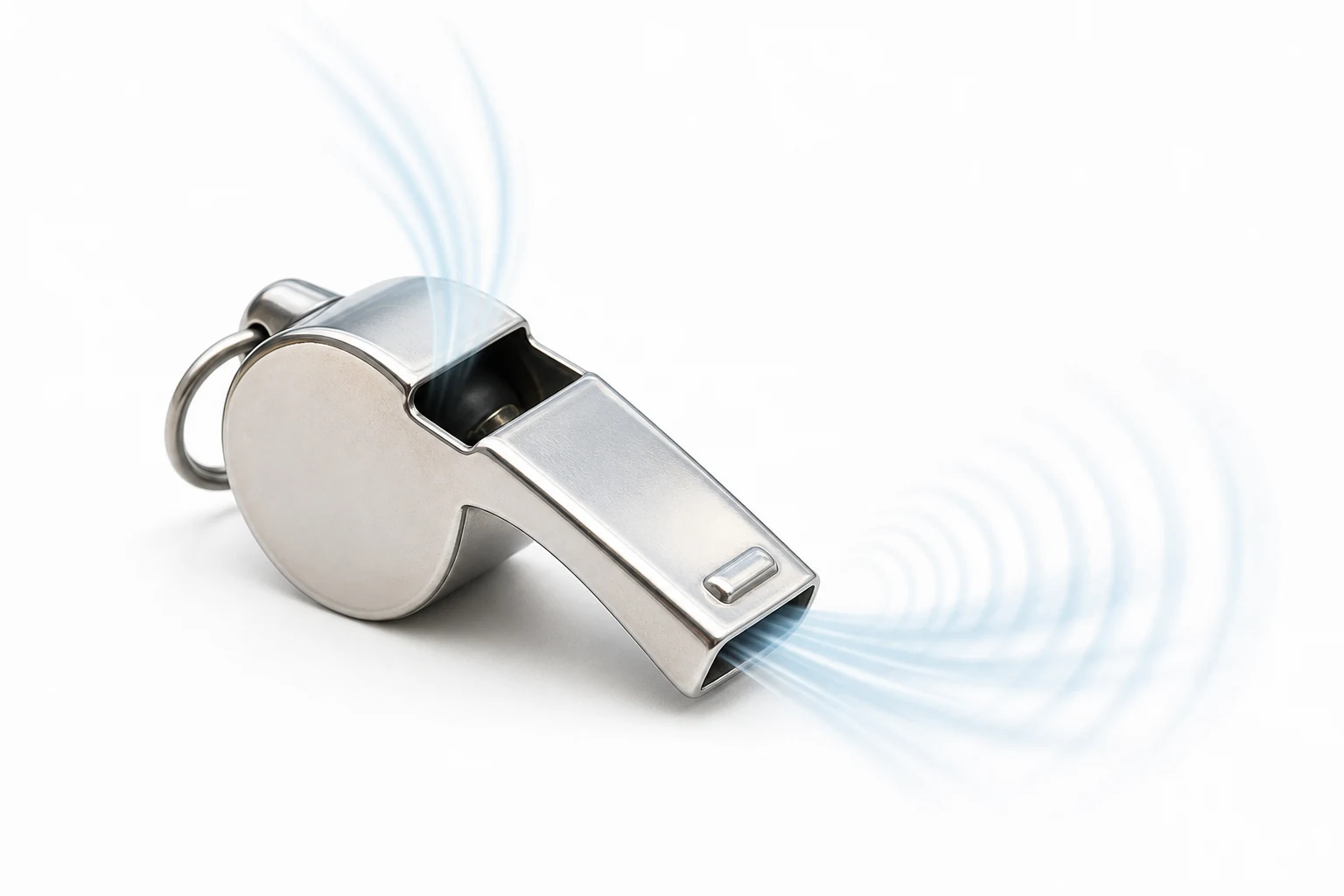
Why Does a Whistle Work? hero image

The mystery

The answer involves turbulent air, a vibrating chamber, and the same basic physics that makes flutes and bottles hum when you blow across them.

The short answer

A whistle works by forcing air through a narrow opening against a sharp edge, which creates turbulence that causes air inside an internal chamber to vibrate rapidly at a specific frequency, producing a clear, sustained tone.

The twist

Many whistles contain a small ball, called a pea, whose chaotic bouncing motion modulates the airflow to create the distinctive warbling trill of a traditional referee's whistle.

Common mistake

Some assume a whistle simply makes the natural sound of blowing air louder.

How moving air becomes a piercing tone

A whistle's design carefully channels ordinary breath into a tightly controlled, repeating vibration.

Air hits a sharp edge and becomes turbulent

As air is forced through a narrow slot, it strikes a sharp edge inside the whistle, called a labium, which disrupts the smooth airflow into rapid, repeating turbulence.

This turbulence is the raw material the whistle shapes into sound.

A whistle does not produce sound from breath alone; it produces it from breath deliberately thrown off balance.

The chamber amplifies one specific frequency

The turbulent air sets the air inside the whistle's internal chamber vibrating, and the chamber's size and shape determine which specific frequency resonates most strongly.

This resonance amplifies one dominant pitch while damping out the rest, producing a clear, focused tone rather than a noisy hiss.

Inside every whistle is a tiny room built specifically to agree loudly with one particular note.

Chamber size determines the pitch

Smaller chambers vibrate at higher frequencies, producing higher-pitched whistles, while larger chambers produce lower, deeper tones.

This is the same basic principle that makes small flutes sound higher than large tubas.

A whistle's pitch is decided the moment its chamber is shaped, long before anyone ever blows into it.

From breath to sound, step by step

A short sequence converts a simple exhale into a sustained tone.

1

01. Air is forced through a narrow opening

Breath enters the whistle under pressure through a tight slot.

2

02. Airflow strikes a sharp edge

This disrupts smooth airflow, generating turbulence inside the chamber.

3

03. The internal chamber resonates

Turbulent air excites the chamber's air at its natural resonant frequency.

4

04. A sustained tone radiates outward

The amplified vibration produces the clear, audible whistle sound.

Why whistles are part of a much larger family

Whistles belong to a broad category of instruments called edge tone or air-reed instruments, which also includes flutes, recorders, and even the sound made by blowing across the top of a glass bottle.

In every case, the underlying physics is the same: turbulent air interacting with a resonant chamber to amplify one specific frequency.

Surprising whistle facts

The human mouth is itself a whistle
Whistling with your lips and tongue uses the exact same edge-tone and resonance principles as a manufactured whistle.
Some whistles are inaudible to humans on purpose
Dog whistles are tuned to ultrasonic frequencies above the range of human hearing but within a dog's hearing range.
Police whistles were chosen for cutting through noise
Their high-pitched, piercing tone was specifically selected to stand out clearly amid loud street and crowd noise.

Isn't a whistle just amplifying the sound of your breath?

Myth

Some assume a whistle simply makes the natural sound of blowing air louder.

Since breath is the obvious input, it feels intuitive to assume the output is simply a louder version of that same sound.

Reality

A whistle does not amplify breath sounds at all; it generates an entirely new tone through turbulence and resonance, unrelated to the sound of breathing itself.

A whistle does not amplify breath sounds at all; it generates an entirely new tone through turbulence and resonance, unrelated to the sound of breathing itself.

Where this principle appears in instruments

Recorders and flutes
These instruments use a nearly identical edge-tone mechanism, with pitch controlled by finger holes changing the resonant air column.
Bottle blowing
Blowing across a bottle's opening creates the same turbulence-and-resonance effect, with pitch determined by the bottle's air volume.

Why this small mechanism matters

The physics of whistles underlies an enormous range of musical instruments and practical safety devices used worldwide.

Understanding edge-tone resonance has informed the design of everything from concert flutes to emergency safety whistles.

Worth noting

A small chamber with a big voice

A whistle takes something as ordinary as breath and, through nothing more than careful shape and turbulence, turns it into one of the most attention-grabbing sounds humans have ever engineered. No one has ever ignored a whistle, and the physics inside it was built specifically to make sure of that.

Quick answers

Common questions

Why do some whistles trill instead of holding a steady note?

A small internal pea bounces chaotically in the airflow, rapidly interrupting the tone to create the warbling trill.

Does blowing harder make a whistle louder or just higher?

Mostly louder - the pitch is determined primarily by chamber size, though extreme airflow changes can shift it slightly.

Everyday Science

Related questions

They are tuned to ultrasonic frequencies above the upper limit of human hearing, but audible to dogs.

The man behind the modern referee's whistle

Joseph Hudson

A 19th-century English toolmaker who invented the pea whistle, widely adopted by police and sports officials for its piercing, attention-grabbing trill.

Related questions

Why does blowing across a bottle make a sound?

It triggers the same edge-tone and resonance effect found inside a whistle's internal chamber.

Where this principle appears in instruments

Recorders and flutes

These instruments use a nearly identical edge-tone mechanism, with pitch controlled by finger holes changing the resonant air column.

Where this principle appears in instruments

Bottle blowing

Blowing across a bottle's opening creates the same turbulence-and-resonance effect, with pitch determined by the bottle's air volume.

Isn't a whistle just amplifying the sound of your breath?

A whistle does not amplify breath sounds at all; it generates an entirely new tone through turbulence and resonance, unrelated to the sound of breathing itself.

A whistle does not amplify breath sounds at all; it generates an entirely new tone through turbulence and resonance, unrelated to the sound of breathing itself.