Everyday Science

Why Does a Lightning Rod Work?

A simple metal spike that quietly volunteers to take a hundred million volts so your house doesn't have to. During a violent thunderstorm, a tall building survives direct lightning strikes again and again, completely unharmed, while a thin metal rod on its roof absorbs the full force instead. It looks almost like sacrifice. In a sense, that is exactly the arrangement Benjamin Franklin designed. The answer involves electrical charge, the path of least resistance, and a kite experiment that has been wildly exaggerated by history.

Quick answer

A lightning rod works by providing a path of low electrical resistance from the top of a structure down to the ground, encouraging lightning to strike the rod rather than the building, and then safely conducting that massive electrical charge harmlessly into the earth. A lightning rod does not actually prevent lightning from striking nearby; it simply makes itself the most attractive, lowest-resistance target so the strike goes there instead of somewhere more dangerous.
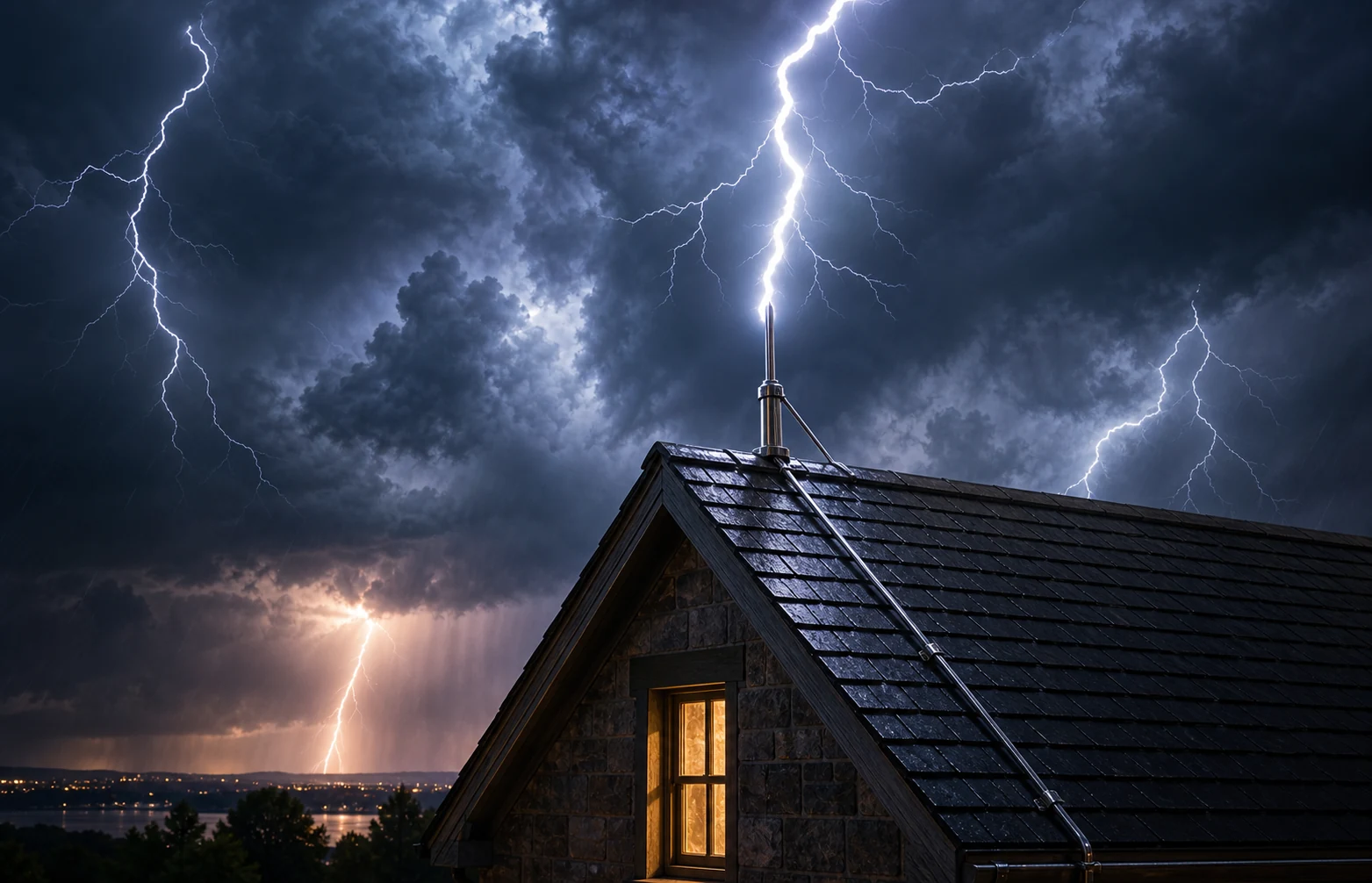
Why Does a Lightning Rod Work? hero image

The mystery

The answer involves electrical charge, the path of least resistance, and a kite experiment that has been wildly exaggerated by history.

The short answer

A lightning rod works by providing a path of low electrical resistance from the top of a structure down to the ground, encouraging lightning to strike the rod rather than the building, and then safely conducting that massive electrical charge harmlessly into the earth.

The twist

A lightning rod does not actually prevent lightning from striking nearby; it simply makes itself the most attractive, lowest-resistance target so the strike goes there instead of somewhere more dangerous.

Common mistake

A common misconception is that a lightning rod stops lightning from striking nearby altogether.

Giving lightning the easiest possible path

A lightning rod's effectiveness comes down to controlling exactly where a strike happens and where its enormous electrical energy goes afterward.

Lightning seeks the path of least resistance

As a thunderstorm builds, electrical charge accumulates between clouds and the ground, eventually discharging through whatever path offers the least electrical resistance.

Tall, pointed metal objects, like a lightning rod, are excellent conductors and naturally become attractive targets for that discharge.

Lightning is not picky about beauty or importance; it is only interested in finding the easiest way down.

A grounding wire carries the charge safely away

Once lightning strikes the rod, a thick conductive cable channels the enormous electrical current down the side of the building and into a grounding system buried in the earth.

This controlled path prevents the current from traveling destructively through the building's structure, wiring, or occupants.

A lightning rod's real job only begins after the strike, safely escorting all that energy straight into the ground.

Pointed shapes concentrate electrical field strength

Sharp, pointed conductors concentrate electrical field strength more intensely than flat or rounded surfaces, making them especially effective at either attracting a strike or, in some designs, helping to gradually discharge a buildup of charge before a strike even occurs.

This is why lightning rods are traditionally built as narrow, pointed spikes.

A lightning rod's pointed tip is not decorative; it is precisely engineered to be irresistible to incoming electrical charge.

From storm cloud to safely grounded charge

A short sequence explains how a strike is captured and safely redirected.

1

01. Electrical charge builds during a storm

Differences in electrical charge accumulate between storm clouds and the ground below.

2

02. The rod offers the lowest-resistance path

Its height and conductive material make it an attractive target for a developing lightning strike.

3

03. Lightning strikes the rod instead of the structure

The discharge follows the rod rather than less conductive parts of the building.

4

04. A grounding cable safely channels the current away

The enormous electrical charge travels harmlessly into the earth instead of through the building.

Why this simple idea took so long to arrive

Before Benjamin Franklin's experiments in the 1750s, lightning strikes on tall structures like church steeples were a major and poorly understood source of fires and destruction.

Franklin's insight, that a grounded conductive rod could safely intercept and redirect lightning's electrical charge, was a genuinely transformative piece of practical science, well before electricity itself was fully understood.

Surprising lightning rod facts

Franklin's kite experiment is often misremembered
Contrary to popular legend, Franklin was not struck by lightning during his famous kite experiment, which demonstrated the electrical nature of lightning rather than directly testing a rod.
Modern buildings often use multiple rods and a full cage system
Tall modern structures typically employ a network of rods and conductors, called a Faraday cage system, for comprehensive protection.

Doesn't a lightning rod prevent lightning from striking the area at all?

Myth

A common misconception is that a lightning rod stops lightning from striking nearby altogether.

Because protected buildings appear unharmed during storms, it is easy to assume the rod is somehow repelling lightning entirely.

Reality

A lightning rod does not prevent lightning strikes in the area; it simply ensures that any strike is directed safely through the rod instead of through the building itself.

A lightning rod does not prevent lightning strikes in the area; it simply ensures that any strike is directed safely through the rod instead of through the building itself.

Where similar grounding principles apply

Airplane lightning protection
Aircraft are designed with conductive skins that allow lightning current to travel around the exterior and exit safely without harming passengers.
Electrical grounding in homes
Household electrical systems use grounding wires for a related safety purpose, directing excess or stray current safely into the earth.

Why lightning protection still matters

Lightning rods remain a critical safety feature for tall buildings, towers, and other structures vulnerable to direct strikes.

Modern lightning protection systems, building directly on Franklin's original design, prevent significant fire damage and save lives every year.

Worth noting

A small spike with an enormous responsibility

A lightning rod's entire purpose is to deliberately attract one of nature's most violent forces, then calmly usher it harmlessly into the ground. Few inventions have so cheerfully volunteered to be struck by lightning on purpose, over and over again.

Quick answers

Common questions

Can a lightning rod be struck multiple times?

Yes, a properly installed lightning rod can safely handle repeated strikes over its lifetime.

Do all tall buildings have lightning rods?

Most modern tall buildings include lightning protection systems, though designs vary based on local building codes and structure type.

Everyday Science

Related questions

Height increases the likelihood that the rod, rather than a lower part of the structure, becomes the path lightning follows.

The man who tamed lightning

Benjamin Franklin

An American scientist and statesman who, in the 1750s, demonstrated lightning's electrical nature and invented the lightning rod.

Related questions

Is it true Benjamin Franklin was struck by lightning during his kite experiment?

No, this is a popular myth; Franklin's experiment demonstrated lightning's electrical nature without him being directly struck.

Where similar grounding principles apply

Airplane lightning protection

Aircraft are designed with conductive skins that allow lightning current to travel around the exterior and exit safely without harming passengers.

Where similar grounding principles apply

Electrical grounding in homes

Household electrical systems use grounding wires for a related safety purpose, directing excess or stray current safely into the earth.

Doesn't a lightning rod prevent lightning from striking the area at all?

A lightning rod does not prevent lightning strikes in the area; it simply ensures that any strike is directed safely through the rod instead of through the building itself.

A lightning rod does not prevent lightning strikes in the area; it simply ensures that any strike is directed safely through the rod instead of through the building itself.