Everyday Science

Why Do Rubber Bands Stretch?

A material that seems to break every rule about how solid things should behave. Pull a rubber band to three times its resting length and release it - it snaps back to exactly where it started, apparently undamaged. Most solid materials that deform significantly do not return to their original shape. Rubber does this reliably, repeatedly, and for reasons that have nothing to do with the material being unusually springy in any familiar sense. The answer involves tangled polymer chains, entropy, and the counterintuitive thermodynamics of elastic materials.

Quick answer

Rubber bands stretch because natural rubber is composed of very long polymer chains that are normally tangled and coiled. Stretching uncoils and aligns these chains, while the thermodynamic drive to return to maximum entropy, maximum tangling, creates the restoring force that snaps the rubber back. A stretched rubber band is thermodynamically unusual: it actually gets warmer when stretched and colder when suddenly released - the opposite of what most materials do - because the restoring force is entropic rather than energetic.
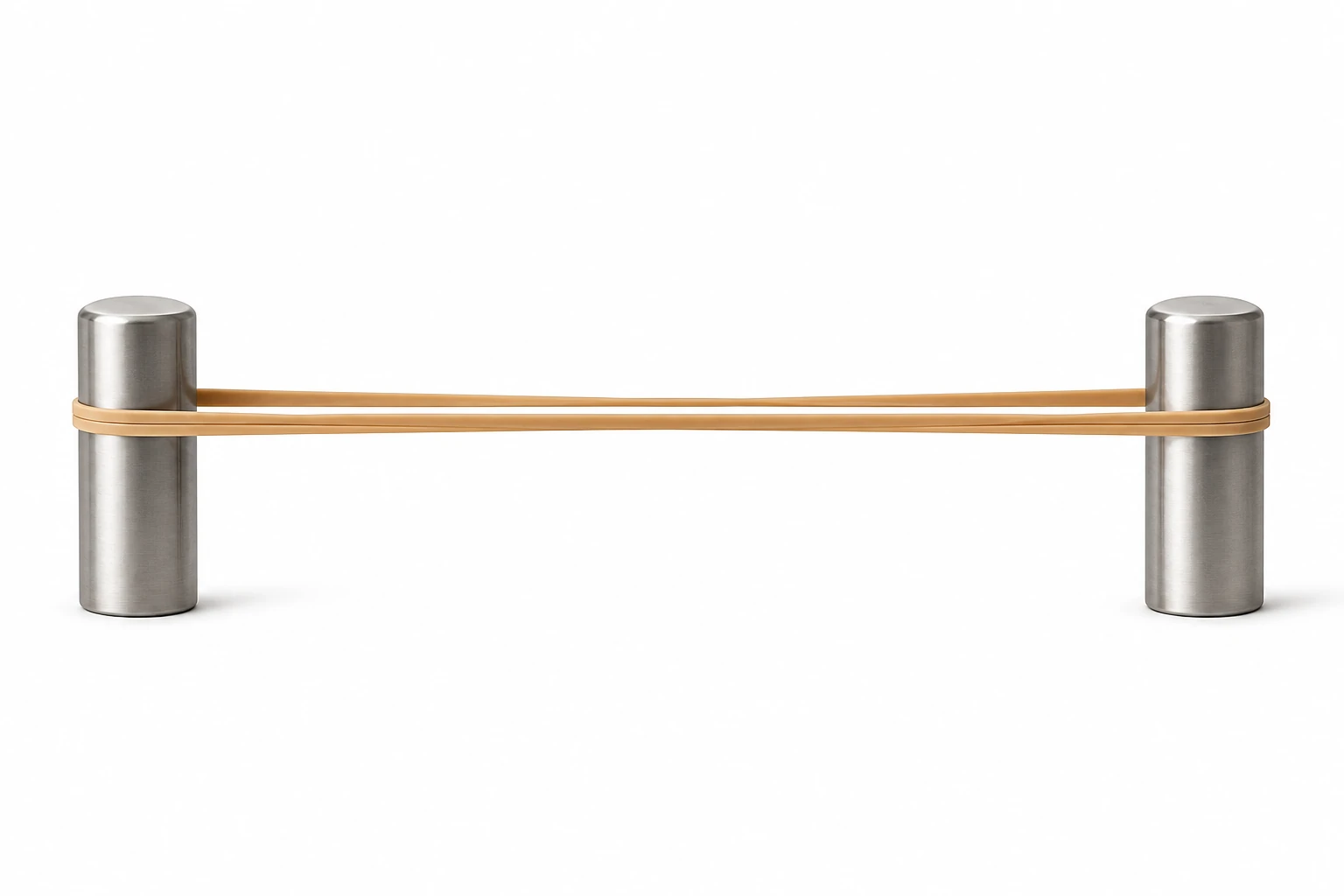
Why Do Rubber Bands Stretch? hero image

The mystery

The answer involves tangled polymer chains, entropy, and the counterintuitive thermodynamics of elastic materials.

The short answer

Rubber bands stretch because natural rubber is composed of very long polymer chains that are normally tangled and coiled. Stretching uncoils and aligns these chains, while the thermodynamic drive to return to maximum entropy, maximum tangling, creates the restoring force that snaps the rubber back.

The twist

A stretched rubber band is thermodynamically unusual: it actually gets warmer when stretched and colder when suddenly released - the opposite of what most materials do - because the restoring force is entropic rather than energetic.

Common mistake

Rubber is often described as springy, implying its elastic behavior is similar to metal springs.

Stretched rubber is fighting entropy, and losing

Rubber's elasticity is driven by thermodynamics, not mechanics, which makes it fundamentally different from spring steel or other elastic materials.

Natural rubber is a tangle of very long polymer chains

Natural rubber consists of polyisoprene chains - long flexible molecular chains that coil and tangle with each other randomly in the unstretched state.

This random coiling represents a high-entropy state, since the molecules can be arranged in many different configurations.

Unstretched rubber is a molecular mess, and in thermodynamics, mess is exactly where materials want to be.

Stretching aligns the chains, reducing entropy

Pulling on rubber straightens and aligns the polymer chains, reducing the number of possible configurations they can be in.

This low-entropy, highly ordered state is thermodynamically unfavorable - the molecules have a statistical drive to return to the high-entropy tangled state.

Stretched rubber is thermodynamically uncomfortable, and everything uncomfortable wants to return to comfort.

The restoring force is entropy, not elasticity in the usual sense

In metals, the restoring force in elastic deformation comes from electromagnetic repulsion between displaced atoms. In rubber, it comes primarily from entropy.

This is why rubber and metal respond differently to temperature: heating rubber makes it contract (more entropy available), while heating metal makes it expand.

Rubber snaps back not because of atomic repulsion, but because disorder is statistically irresistible.

From stretch to snap back

A short sequence explains the molecular journey of a stretched rubber band.

1

01. Rubber at rest: chains randomly tangled

Maximum entropy configuration - high disorder.

2

02. Stretching aligns and extends polymer chains

Entropy decreases as chains are forced into ordered configurations.

3

03. Thermodynamic drive toward higher entropy creates restoring force

The statistical tendency toward disorder acts as the elastic restoring force.

4

04. Release allows chains to retangle

Chains return to random configurations and the band returns to original length.

The heat of stretching rubber

When rubber is stretched rapidly, it becomes measurably warmer, because decreasing entropy releases thermal energy. When it contracts, it cools.

This is the opposite of what happens when you stretch most materials, which cool on stretching and warm on contraction - a distinction that was historically used to identify rubber as thermodynamically unusual long before polymer science existed to explain why.

Surprising rubber elasticity facts

Hot rubber bands are less elastic
At higher temperatures, the thermodynamic drive toward entropy already has access to more configurations, reducing the restoring force and making rubber stretch more easily.
Vulcanization made rubber useful
Natural rubber without vulcanization becomes sticky in heat and brittle in cold; Charles Goodyear's discovery of vulcanization, adding sulfur crosslinks, gave rubber consistent elastic properties across temperatures.
Silicone rubber works by a different but related mechanism
Silicone elastomers achieve elasticity through similar entropic polymer chain physics, but using silicon-oxygen backbone chains instead of carbon-based ones.

Is rubber springy like a metal spring?

Myth

Rubber is often described as springy, implying its elastic behavior is similar to metal springs.

Both materials return to their original shape after deformation, making them look mechanically identical at the macroscopic level.

Reality

Metal spring elasticity is energetic, driven by atomic displacement forces; rubber elasticity is entropic, driven by thermodynamics. They produce similar macroscopic behavior through completely different mechanisms.

Metal spring elasticity is energetic, driven by atomic displacement forces; rubber elasticity is entropic, driven by thermodynamics. They produce similar macroscopic behavior through completely different mechanisms.

Where entropic elasticity matters

Biological tissues
Tendons, skin, and artery walls all use biological elastomers that rely on entropic elasticity similar to rubber.
Seals and gaskets
Rubber O-rings and gaskets exploit the same polymer chain thermodynamics to maintain seals under compression.

Why this unusual physics matters

Understanding rubber as an entropic material rather than a mechanical spring has significant implications for designing rubber components that must perform across temperature ranges.

It explains why rubber seals behave differently in cold weather - one of the contributing factors in the Space Shuttle Challenger disaster.

Worth noting

A material running on entropy

A rubber band stretches and snaps back not because it is mechanically springy, but because its molecules have a thermodynamic preference for chaos over order - which turns out to be a remarkably effective design principle. Few everyday objects are as thermodynamically motivated as a rubber band that just wants to be messy again.

Quick answers

Common questions

Why does a rubber band launch farther when warm?

Warm rubber has lower elastic restoring force for a given stretch, storing more potential energy at maximum stretch that is then released on launching.

Everyday Science

Related questions

Oxidation attacks the polymer chains, breaking them and eliminating the long-chain structure that enables stretching.

The man who made rubber useful

Charles Goodyear

An American inventor who discovered the vulcanization process in 1839, enabling rubber to maintain elastic properties across a wide temperature range.

Where entropic elasticity matters

Biological tissues

Tendons, skin, and artery walls all use biological elastomers that rely on entropic elasticity similar to rubber.

Where entropic elasticity matters

Seals and gaskets

Rubber O-rings and gaskets exploit the same polymer chain thermodynamics to maintain seals under compression.

Is rubber springy like a metal spring?

Metal spring elasticity is energetic, driven by atomic displacement forces; rubber elasticity is entropic, driven by thermodynamics. They produce similar macroscopic behavior through completely different mechanisms.

Metal spring elasticity is energetic, driven by atomic displacement forces; rubber elasticity is entropic, driven by thermodynamics. They produce similar macroscopic behavior through completely different mechanisms.