Everyday Science

Why Does Graphite Conduct Electricity?

The same carbon that writes on paper also carries electrical current - and for a surprisingly elegant reason. Carbon is the basis of all life, the core of every pencil, and under most circumstances, a perfectly reasonable electrical insulator. But graphite, which is simply carbon arranged in a specific way, conducts electricity with ease. Change the arrangement, and diamond, also pure carbon, is one of the best insulators known to exist. The material is the same. Only the geometry differs. The answer involves delocalized electrons, quantum chemistry, and a molecular structure that accidentally creates one of the most interesting electronic properties of any common material.

Quick answer

Graphite conducts electricity because each carbon atom in its layered structure forms only three of its four possible bonds with neighboring atoms, leaving one electron per atom free to move throughout the entire layer in a delocalized electron system that can carry electrical current. Graphite conducts electricity much more easily along its layers than across them - the conductivity is dramatically anisotropic, making it directionally selective in a way few everyday materials are.
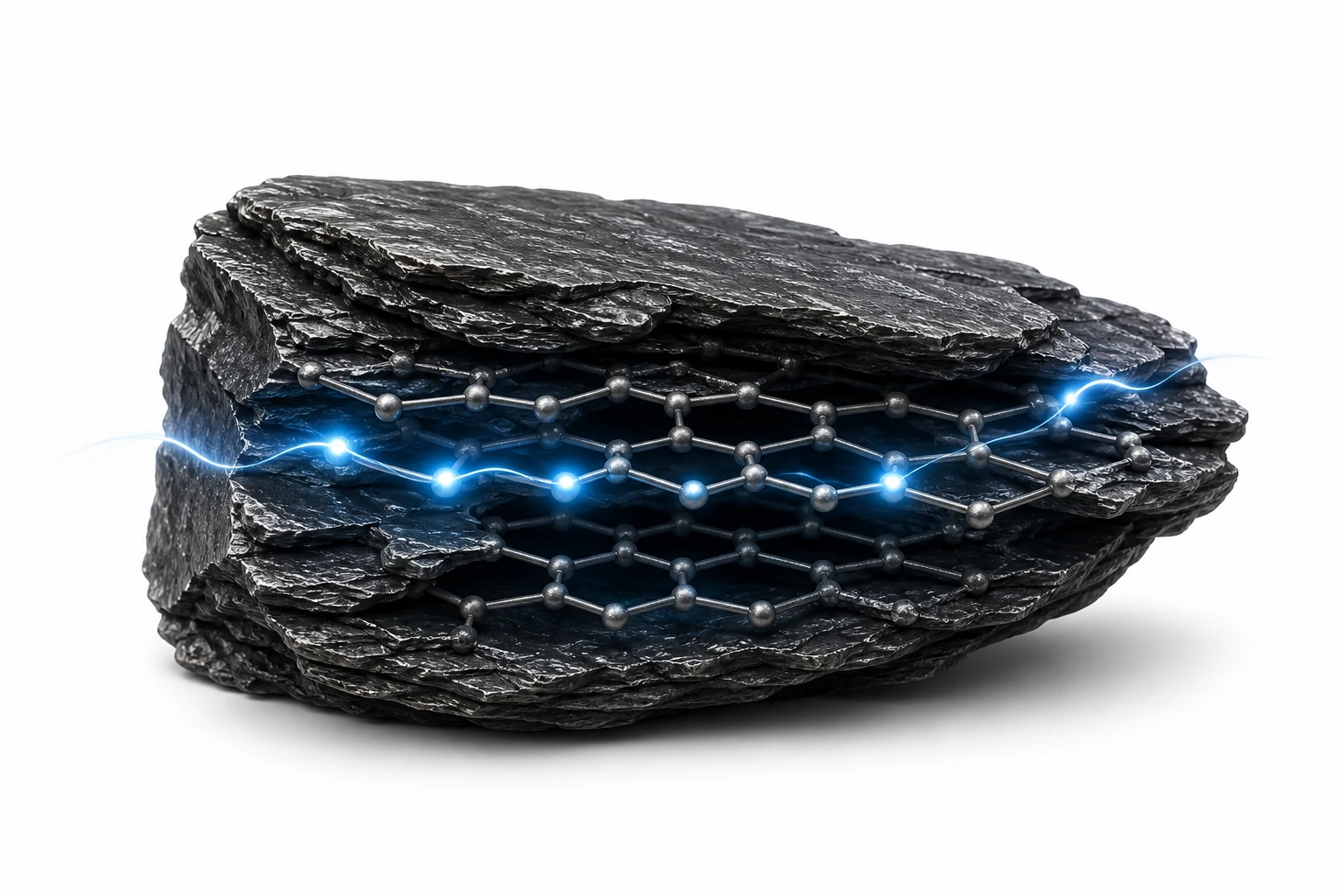
Why Does Graphite Conduct Electricity? hero image

The mystery

The answer involves delocalized electrons, quantum chemistry, and a molecular structure that accidentally creates one of the most interesting electronic properties of any common material.

The short answer

Graphite conducts electricity because each carbon atom in its layered structure forms only three of its four possible bonds with neighboring atoms, leaving one electron per atom free to move throughout the entire layer in a delocalized electron system that can carry electrical current.

The twist

Graphite conducts electricity much more easily along its layers than across them - the conductivity is dramatically anisotropic, making it directionally selective in a way few everyday materials are.

Common mistake

Many people assume electrical conduction in graphite requires highly pure or specialized graphite.

One electron per atom that has nowhere specific to be

Graphite's electrical conductivity comes directly from an excess electron that each atom contributes to a collective, mobile cloud.

Carbon atoms in graphite leave one bond unused

Each carbon atom can form four chemical bonds. In graphite's hexagonal layers, each atom forms three bonds with neighboring atoms, using three of its four outer electrons.

The fourth electron is not bonded and exists instead as part of a delocalized electron system spread across the entire layer, similar to the free electrons in metals.

Every carbon atom in graphite contributes one electron to a collective cloud of charge carriers that belong to the layer as a whole rather than any individual atom.

Delocalized electrons move freely under an applied voltage

When a voltage is applied across a graphite surface, these loosely bound electrons move in response, constituting an electrical current.

This is exactly the mechanism that makes metals conduct - graphite simply achieves the same effect through a different molecular architecture.

Graphite is a non-metal that conducts electricity by borrowing one of the fundamental tricks of metallic bonding.

Conductivity is dramatically directional

Electrons move freely within each carbon layer but cannot easily cross the weak interlayer gaps between graphite sheets.

This makes graphite conduct electricity roughly 10,000 times better parallel to its layers than perpendicular to them - a property called anisotropic conductivity, used deliberately in some electronic applications.

Graphite conducts electricity enthusiastically in one direction and reluctantly in the other - a distinction most materials do not make.

From carbon atom to electrical conductor

A short sequence links graphite's atomic structure to its conductive behavior.

1

01. Each carbon atom bonds to three neighbors

Three of four outer electrons form sigma bonds within the hexagonal layer.

2

02. The fourth electron joins a delocalized pi system

These electrons are shared across the entire layer.

3

03. Applied voltage drives these electrons through the layer

Mobile electrons constitute an electrical current.

4

04. Weak interlayer forces prevent cross-layer conduction

Conductivity is high along layers and low between them.

Why diamond, the same element, is a perfect insulator

In diamond, each carbon atom forms all four bonds with neighboring atoms, leaving no free electrons at all. Every electron is locked into a specific bond, with no mobile charge carriers to conduct electricity.

Diamond is therefore one of the best electrical insulators known, while graphite is a reasonable conductor - from the exact same element, purely because of atomic arrangement.

Surprising graphite conductivity facts

Graphene is an extraordinary conductor
A single layer of graphite, graphene, conducts electricity faster than almost any other known material at room temperature.
Graphite electrodes are used in industrial processes
Graphite is used as electrodes in electric arc furnaces and electrolysis cells because of its conductivity and heat resistance.
Pencil marks can complete basic electrical circuits
A thick pencil mark on paper is conductive enough to be used in simple hobbyist electronics experiments.

Doesn't graphite need to be very pure to conduct?

Myth

Many people assume electrical conduction in graphite requires highly pure or specialized graphite.

Electrical conductivity feels like a property that should require high-specification materials.

Reality

Common pencil graphite conducts electricity reasonably well, though high-purity graphite is used in industrial applications where consistent conductivity is critical.

Common pencil graphite conducts electricity reasonably well, though high-purity graphite is used in industrial applications where consistent conductivity is critical.

Where graphite's conductive properties are used

Battery electrodes
Graphite anodes are used in lithium-ion batteries, exploiting both the conductivity and the layered structure's ability to intercalate lithium ions.
Carbon brushes in motors
Graphite's conductivity combined with its lubricating properties make it ideal for the sliding electrical contacts in electric motors.

Why this matters beyond chemistry class

Graphite's unusual electronic properties are directly exploited in battery technology, industrial electrodes, and the production of graphene for advanced electronics.

Understanding graphite's conductivity underlies the entire field of carbon-based electronics, one of the most active areas of materials research.

Worth noting

The same element, two completely different identities

Graphite and diamond are built from identical atoms arranged differently, and that arrangement alone decides whether the result conducts electricity brilliantly or refuses to conduct it at all. Carbon is both the dullest conductor and the best insulator, depending entirely on how it decides to arrange itself.

Quick answers

Common questions

Can you use a pencil to fix an electrical circuit?

In emergencies, a thick pencil mark can provide enough conductivity to complete simple low-current circuits, though resistance is high.

Everyday Science

Related questions

Diamond's completely bonded carbon structure makes it the hardest natural material, with all electrons locked into bonds rather than free to move.

The scientists who isolated graphene

Andre Geim and Konstantin Novoselov

The physicists who isolated graphene from graphite using sticky tape in 2004 and won the Nobel Prize in Physics in 2010.

Where graphite's conductive properties are used

Battery electrodes

Graphite anodes are used in lithium-ion batteries, exploiting both the conductivity and the layered structure's ability to intercalate lithium ions.

Where graphite's conductive properties are used

Carbon brushes in motors

Graphite's conductivity combined with its lubricating properties make it ideal for the sliding electrical contacts in electric motors.

Doesn't graphite need to be very pure to conduct?

Common pencil graphite conducts electricity reasonably well, though high-purity graphite is used in industrial applications where consistent conductivity is critical.

Common pencil graphite conducts electricity reasonably well, though high-purity graphite is used in industrial applications where consistent conductivity is critical.