History & Engineering

Why Did Roman Buildings Last for Thousands of Years?

Modern concrete crumbles in decades. Roman concrete only gets stronger with age. The Pantheon in Rome has been in continuous use for nearly two thousand years. Its unreinforced concrete dome is still the largest of its kind on Earth. The concrete under many modern highways will begin to fail within fifty years. Something is wrong with that comparison. Roman concrete does not just resist deterioration. Under the right conditions, it actively repairs itself.

Quick answer

Roman buildings lasted because of pozzolanic concrete chemistry, arches and vaults that distribute weight, overbuilding, and the lucky preservation of structures that were buried, reused, or maintained. Volcanic ash and seawater can form minerals inside cracks, strengthening Roman concrete over centuries.
Why Did Roman Buildings Last for Thousands of Years? hero image

The mystery

Roman concrete does not just resist deterioration. Under the right conditions, it actively repairs itself.

The short answer

Roman buildings lasted because of pozzolanic concrete chemistry, arches and vaults that distribute weight, overbuilding, and the lucky preservation of structures that were buried, reused, or maintained.

The twist

Volcanic ash and seawater can form minerals inside cracks, strengthening Roman concrete over centuries.

Common mistake

People imagine a lost ancient recipe that modern science cannot recover.

The concrete that improves with age

Modern Portland cement is versatile but fragile. Roman opus caementicium was a different material with different chemistry.

The volcano under Rome's buildings

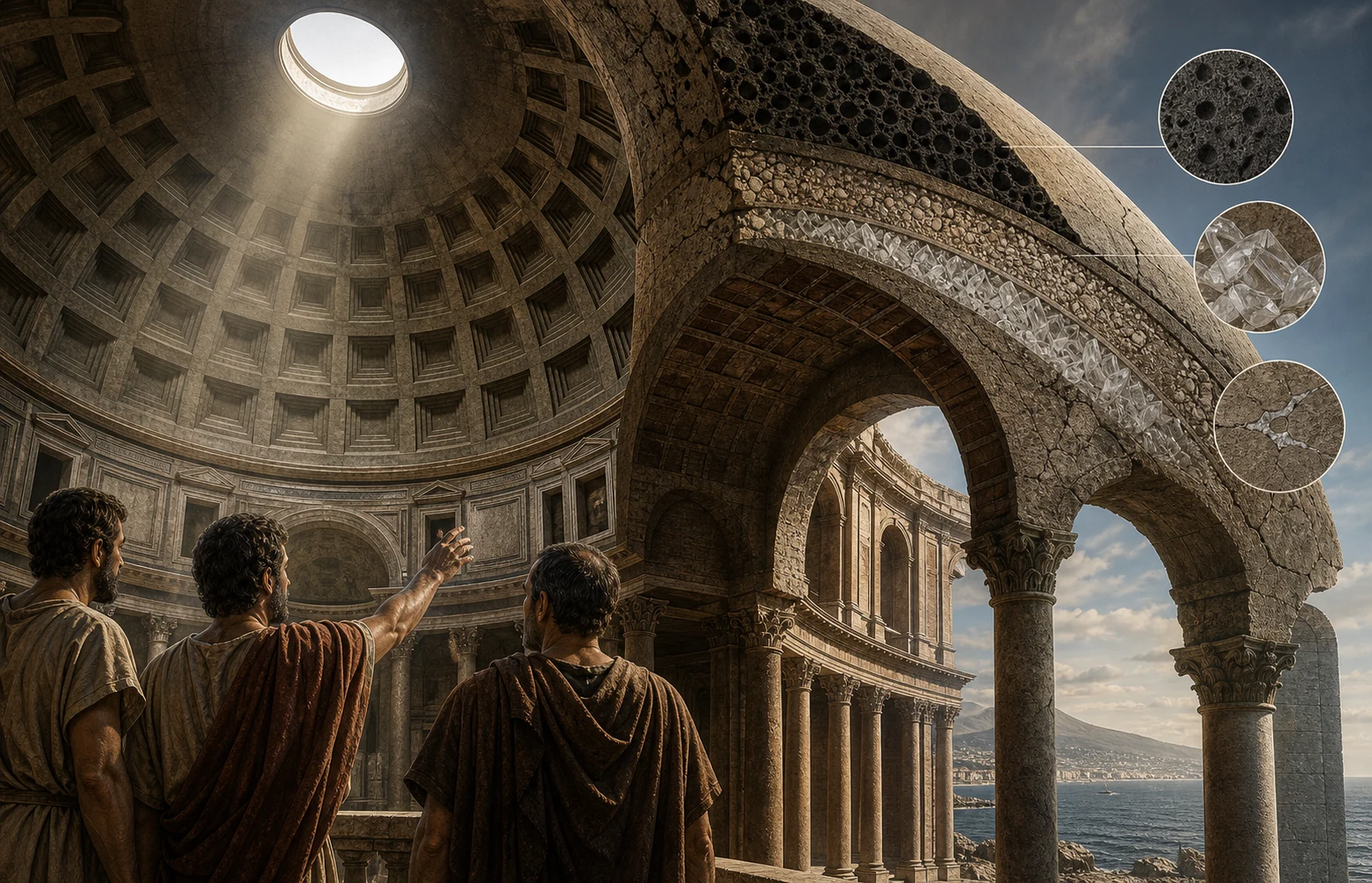
Roman concrete used pozzolana, volcanic ash from around the Bay of Naples. Mixed with lime and seawater, it created a material ancient writers already considered remarkable.

Modern analysis shows that seawater can react with the ash to form tobermorite crystals that fill cracks and strengthen the material.

The secret ingredient in Rome's immortal concrete was a nearby volcano - and two thousand years of patient seawater.

The arch: distributing the impossible load

An arch converts downward weight into compression along a curve. Stone and concrete are excellent under compression.

The Colosseum survives in part because it is a machine for distributing weight across arches, even after losing much of its original stone.

The Colosseum has been robbed of two-thirds of its stone and still stands.

The philosophy of overbuilding

Modern engineers optimize. Romans overbuilt because they lacked modern structural calculation tools. The Pantheon's dome is far thicker than a modern minimum design would require.

That excess is part of why it is still standing.

The Romans built so much stronger than necessary that we have spent two thousand years wondering how they did it.

Why Roman concrete beats modern concrete

The difference is chemistry plus structural form.

1

01. Modern concrete corrodes around steel

Water and carbon dioxide attack steel reinforcement, which expands and widens cracks.

2

02. Roman concrete grows helpful minerals

Pozzolanic chemistry can create tobermorite that fills cracks rather than expanding them.

3

03. Burial and reuse preserve buildings

The Pantheon's conversion to a church meant maintenance, and maintenance meant survival.

4

04. Survival bias matters

We mostly see the elite durable fraction of Roman building, not ordinary buildings that vanished.

What Rome knew that we forgot

Vitruvius wrote the recipe down. The problem was not complete loss of knowledge but incentives and materials.

Portland cement won because it could be made quickly and almost anywhere. Roman-style concrete requires particular volcanic ingredients and time.

The Roman engineering that still astonishes

The Pantheon dome is still unrepeated
Its unreinforced concrete dome remains the largest in the world.
Roman roads lasted through route choice
Many alignments remain useful because Romans chose durable, logical paths.
Romans poured concrete underwater
Harbors like Caesarea Maritima used concrete that seawater helped cure.

Didn't Romans have lost secret knowledge?

Myth

People imagine a lost ancient recipe that modern science cannot recover.

The contrast between ancient durability and modern decay makes a lost secret feel satisfying.

Reality

The ingredients were described. The larger issue is that modern economics rewards speed and repeatability over 2,000-year durability.

The ingredients were described. The larger issue is that modern economics rewards speed and repeatability over 2,000-year durability.

Bringing Roman concrete back

Modern seawater concrete research
Researchers have analyzed Roman harbor concrete to develop longer-lasting modern mixes.
The Pantheon as structural lesson
Its dome uses lighter aggregate higher up and heavier aggregate near the base.

Infrastructure that outlives empires

Roman concrete matters because modern infrastructure is expensive, aging, and often designed around budget cycles rather than centuries.

The Romans built infrastructure for an empire they expected to last forever. We build for maintenance schedules.

Worth noting

The two-thousand-year building

The Pantheon's oculus still moves a circle of light across concrete that has outlived the empire that poured it. The Romans built things that were still getting stronger long after Rome itself had fallen.

Quick answers

Common questions

Could we build a new Pantheon today?

Yes technically, but the economics, labor, and material choices would be very different.

Was Roman engineering the best in the ancient world?

Rome was unmatched in large-scale civil infrastructure in the West, though other civilizations produced rival achievements.