History & Games

Why Are Chess Pieces Named After Medieval Roles?

Chess was not invented in medieval Europe. But somewhere along the way, it picked up a whole new cast of characters. The chess set in front of you is a creative retelling. The original board had no queens. Bishops were elephants. Rooks were chariots. Pawns were infantry in an ancient Indian army. By the time chess reached English, it had been translated into a portrait of medieval European society. The pieces you know reveal feudal power, religious authority, gender politics, and one of the most dramatic rule changes in game history.

Quick answer

Chess pieces are named after medieval roles because the game was adapted to fit European feudal society as it moved from India through Persia and the Islamic world into Europe. The queen was originally the weakest major piece. In the 15th century she became the most powerful, possibly under the influence of Queen Isabella I.
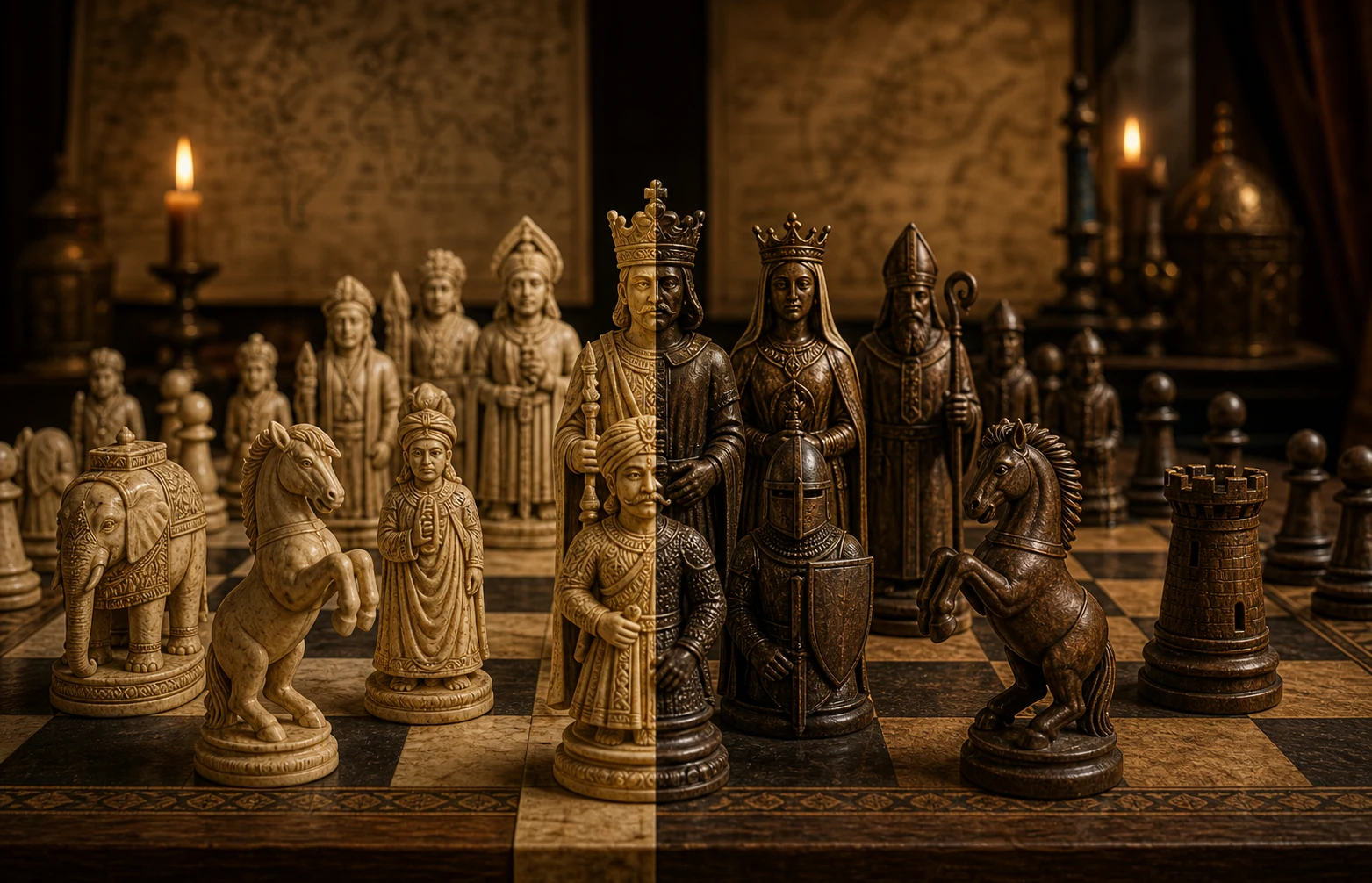
Why Are Chess Pieces Named After Medieval Roles? hero image

The mystery

The pieces you know reveal feudal power, religious authority, gender politics, and one of the most dramatic rule changes in game history.

The short answer

Chess pieces are named after medieval roles because the game was adapted to fit European feudal society as it moved from India through Persia and the Islamic world into Europe.

The twist

The queen was originally the weakest major piece. In the 15th century she became the most powerful, possibly under the influence of Queen Isabella I.

Common mistake

Most people assume chess has been essentially unchanged for thousands of years.

The journey of a game across 1,500 years

Chess began as chaturanga, Sanskrit for four divisions of the military: infantry, cavalry, elephants, and chariots.

The Indian original: war on a board

Chaturanga was a miniature battlefield. The chariot became the rook, the horse became the knight, the elephant became the bishop in much of Europe, and infantry became pawns.

The king was central from the beginning because losing command meant losing the army.

Every rule that makes chess what it is was invented by someone simulating an ancient Indian army on a square board.

Persia rewrites the cast

In Persia, the game became chatrang. The terms shah and shah mat produced the English check and checkmate.

The king's counselor became the farzin or vizier, still weak compared with the modern queen.

The word checkmate is Persian, still echoing in every game played today.

Europe renames everything

European players reinterpreted unfamiliar pieces through their own society. The chariot became a castle tower, the elephant became a bishop, and the vizier became a queen.

The knight stayed recognizable because a horse is a horse almost everywhere.

The bishop was an elephant. Europeans looked at the carving and saw a church hat.

How each piece changed

The modern board is a record of translation across cultures.

1

01. Pawn: infantry

The pawn remained the foot soldier, slow, numerous, expendable, and capable of promotion.

2

02. Knight: cavalry

The horse's L-shaped move survived the entire journey with little change.

3

03. Rook: chariot to castle

The original chariot kept its straight-line power but changed its visual identity.

4

04. Queen: weak advisor to supreme power

The vizier became the queen, then acquired full board mobility in late medieval Europe.

Why medieval society saw itself in the game

Medieval Europe was obsessed with hierarchy. Chess gave it a perfect mirror: king, queen, clergy, warriors, castles, and common soldiers.

Writers even used chess as moral allegory, explaining social duties through the pieces on the board.

The game has hidden history

Chess was used for divination
Some medieval Islamic courts interpreted chess positions as omens.
The Lewis Chessmen were buried for centuries
The famous walrus-ivory pieces were found in a Scottish sand dune in 1831.
The bishop still has other names
In Russian it remains an elephant; in French it is a fool; in German a runner.

Wasn't chess always the game we know?

Myth

Most people assume chess has been essentially unchanged for thousands of years.

The game feels ancient and authoritative, which hides how much it changed.

Reality

The queen's movement, pawn rules, castling, en passant, and standardized tournament rules all developed over time.

The queen's movement, pawn rules, castling, en passant, and standardized tournament rules all developed over time.

Chess pieces in unexpected places

Corporate language
Gambit, endgame, checkmate, and pawn sacrifice still shape business language.
The queen in culture
The chess queen remains one of culture's clearest symbols of constrained but overwhelming power.

A mirror for every civilization it touched

India saw a battlefield. Persia saw a royal court. The Islamic world abstracted the pieces. Europe saw feudal hierarchy.

The chess queen may be the most dramatic rebalancing of game mechanics in tabletop history.

Worth noting

The board that holds 1,500 years of history

Every chess set is an archaeology of empire, translation, and borrowed imagination. Every chess set is an accidental archaeology of 1,500 years of empire, translation, and borrowed imagination.

Quick answers

Common questions

Why is the strongest piece called a queen?

The queen became the king's most mobile agent while the king remained too precious to risk.

Do other countries name pieces differently?

Yes. Many languages preserve different layers of the game's history.