Thought Experiments

What Happens If the Sun Disappears?

Earth would keep going in a straight line for eight minutes before anyone even noticed. If the sun vanished this instant — not exploded, not dimmed, simply ceased to exist — nobody on Earth would know for a full eight minutes. Sunlight already on its way here would keep arriving on schedule, oblivious to the fact that its source no longer exists. It's a thought experiment, obviously. But working through it seriously reveals just how strange the relationship between Earth and its sun really is. The story runs from an eight-minute delay to a frozen ocean to a planet drifting off into permanent darkness.

Quick answer

If the sun disappeared, Earth would continue receiving its light and warmth for about 8 minutes, then plunge into darkness, drift off in a straight line rather than orbiting, and gradually freeze over. Gravity and light both travel at the same speed limit, so Earth wouldn't even begin flying off its orbital path until that same eight-minute delay had passed.
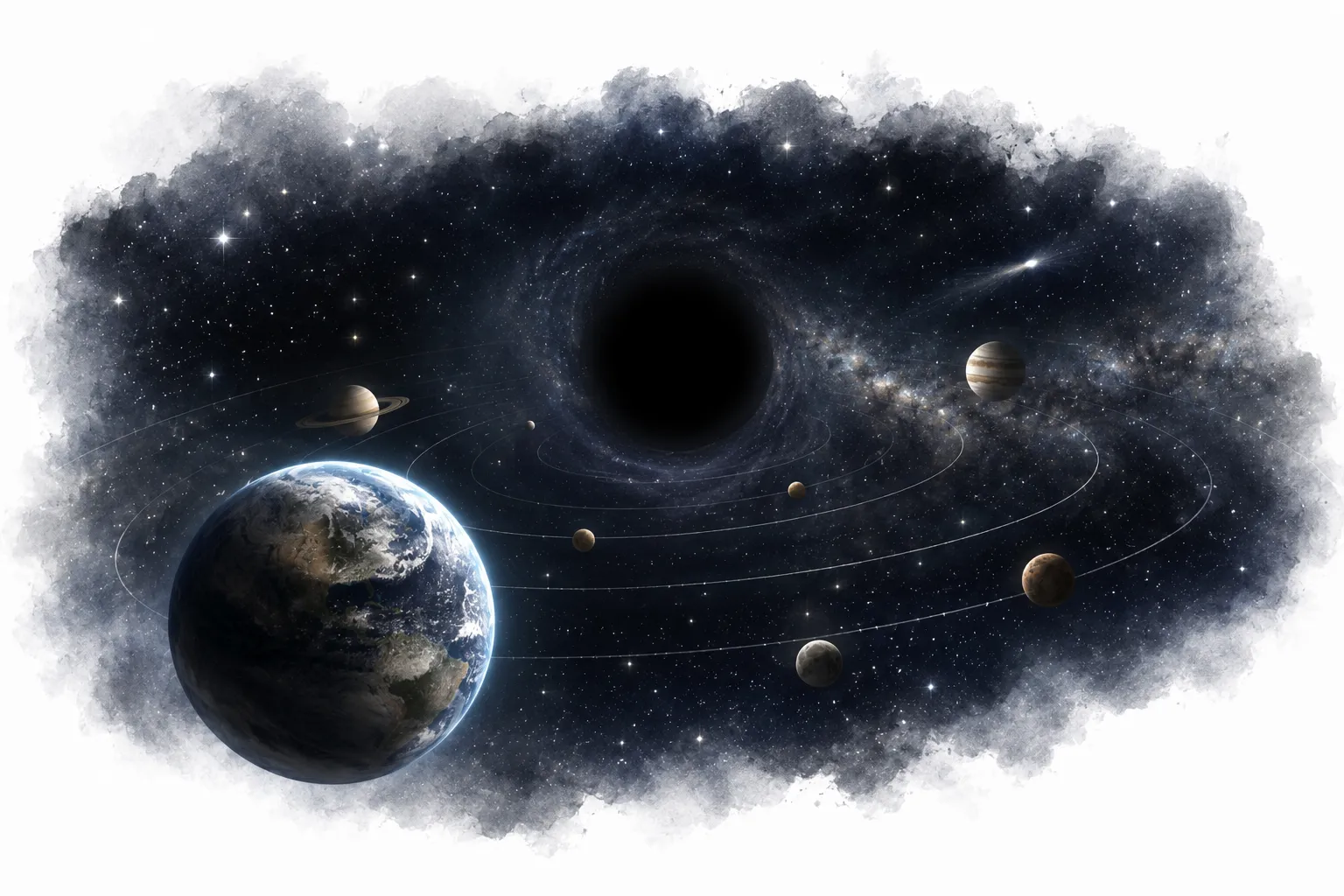
What Happens If the Sun Disappears? hero image

The mystery

The story runs from an eight-minute delay to a frozen ocean to a planet drifting off into permanent darkness.

The short answer

If the sun disappeared, Earth would continue receiving its light and warmth for about 8 minutes, then plunge into darkness, drift off in a straight line rather than orbiting, and gradually freeze over.

The twist

Gravity and light both travel at the same speed limit, so Earth wouldn't even begin flying off its orbital path until that same eight-minute delay had passed.

Common mistake

A common assumption is that Earth would plunge into a deep freeze almost immediately once sunlight stopped.

Eight minutes of blissful ignorance

Earth sits about 93 million miles from the sun, and light — even at its staggering speed — takes time to cross that distance. That delay turns out to matter enormously in this scenario.

The eight-minute lag

Sunlight takes roughly 8 minutes and 20 seconds to travel from the sun to Earth. If the sun vanished right now, the light already en route would keep arriving on the usual schedule until that window closed.

According to general relativity, gravitational effects also propagate at the speed of light, meaning Earth would continue orbiting an empty point in space for those same eight minutes, entirely unaware anything had changed.

For eight full minutes, Earth would keep circling a sun that no longer exists, purely out of gravitational habit.

The drift begins

Once that delay passes, Earth would stop curving around its old orbit and instead fly off in a straight line, obeying Newton's first law of motion, since nothing would remain to pull it into a curve.

Without the sun's gravity, Earth, along with every other planet, would drift outward into deep space, eventually becoming what astronomers call a rogue planet — untethered, unlit, and alone.

Without the sun's gravity holding the leash, Earth wouldn't fall into darkness — it would simply wander off.

The slow, cold ending

Surface temperatures wouldn't crash instantly; Earth's atmosphere and oceans hold heat, so the initial cooling would be gradual, dropping below freezing within roughly a week for most land surfaces.

Over following months and years, oceans would freeze from the surface down, though geothermal heat from Earth's interior would keep the deep sea liquid and, remarkably, still capable of supporting some heat-independent life for far longer than the surface world above it.

The last living things on a sunless Earth wouldn't be on the surface at all — they'd be in the dark, warm places that never needed sunlight to begin with.

The order in which everything would actually unfold

It wouldn't happen all at once. Different systems would fail on very different timelines.

1

01. Light and gravity vanish together, eight minutes late

Both effects propagate at light speed, so Earth experiences a brief, identical delay before losing sunlight and gravitational pull simultaneously.

2

02. Temperatures fall gradually, not instantly

Earth's atmosphere and oceans act as heat reservoirs, meaning the planet would cool over days and weeks rather than freezing immediately.

3

03. Photosynthesis collapses before temperature does

Plant life dependent on sunlight would begin dying within days, collapsing food chains well before the deeper freeze fully set in, making starvation a faster threat than cold for surface-dwelling life.

Why this scenario is scientifically impossible, but still useful

The sun cannot simply vanish — the laws of physics don't allow matter to disappear without a trace, and even a hypothetical sudden collapse wouldn't happen instantaneously.

Despite being physically impossible, the thought experiment remains valuable because it isolates exactly how dependent Earth is on the sun for both its warmth and its orbital stability, in a way abstract explanations alone don't capture.

Surprising facts about Earth's dependence on the sun

Deep-sea ecosystems could largely survive
Communities near hydrothermal vents rely on chemical energy rather than sunlight, meaning some of Earth's most alien ecosystems could persist long after surface life collapsed.
The moon would go dark too, almost instantly for us
Since moonlight is just reflected sunlight, the moon would stop shining within about the same eight-minute window, having no light left of its own to reflect.

Would Earth freeze over within hours or days of losing the sun?

Myth

A common assumption is that Earth would plunge into a deep freeze almost immediately once sunlight stopped.

Because the loss of sunlight itself would be instant and total, it's intuitive to assume temperature would follow just as quickly, without accounting for how much stored heat the planet actually holds.

Reality

Earth's atmosphere and oceans store enormous amounts of heat, meaning surface freezing would take roughly a week, and the deep ocean could remain liquid for a much longer stretch.

Earth's atmosphere and oceans store enormous amounts of heat, meaning surface freezing would take roughly a week, and the deep ocean could remain liquid for a much longer stretch.

Where this kind of thought experiment gets used

Physics and astronomy education
Instructors frequently use the 'sun disappears' scenario to teach students about the finite speed of light and gravity in an intuitive, memorable way.
Science fiction and speculative writing
Writers exploring rogue planets or solar catastrophe scenarios often draw on the same physics to ground otherwise fantastical premises in real scientific principles.

Why this hypothetical clarifies real astronomy

Working through this scenario carefully makes abstract concepts like the finite speed of light and gravitational propagation concrete and memorable, in a way equations alone often fail to do.

This kind of scenario has become a staple teaching tool precisely because it forces a step-by-step reasoning process that mirrors how physicists actually think through orbital mechanics and relativity.

Worth noting

A planet that doesn't notice right away

The sun-disappearing thought experiment is really a lesson in delay: how something as fundamental as gravity and light still takes time to travel, and how much of what we see is already old news by the time it arrives. Even the end of the world, it turns out, would have to wait in line behind the speed of light.

Quick answers

Common questions

Would we see the sun disappear or just go dark?

We'd see the sun's disk vanish abruptly after the eight-minute delay, rather than fading gradually, since the light reaching us until that moment would have left the sun before it disappeared.

Thought Experiments

Related questions

Without significant intervention, most surface-dependent food chains would collapse within weeks to months, though some humans could theoretically survive longer using stored resources and geothermal or nuclear energy.

The physicist who explained gravity's finite speed

Albert Einstein

Through his theory of general relativity, Einstein established that gravitational influence, like light, cannot propagate instantaneously but travels at a fixed, finite speed.

Where this kind of thought experiment gets used

Physics and astronomy education

Instructors frequently use the 'sun disappears' scenario to teach students about the finite speed of light and gravity in an intuitive, memorable way.

Where this kind of thought experiment gets used

Science fiction and speculative writing

Writers exploring rogue planets or solar catastrophe scenarios often draw on the same physics to ground otherwise fantastical premises in real scientific principles.

Would Earth freeze over within hours or days of losing the sun?

Earth's atmosphere and oceans store enormous amounts of heat, meaning surface freezing would take roughly a week, and the deep ocean could remain liquid for a much longer stretch.

Earth's atmosphere and oceans store enormous amounts of heat, meaning surface freezing would take roughly a week, and the deep ocean could remain liquid for a much longer stretch.