Physics

Is Antimatter Real?

Yes — and hospitals use it, physicists manufacture it, and the universe is oddly short on it. Antimatter sounds like something a screenwriter invented to justify a spaceship engine. It has the vague menace of a word borrowed from science fiction, which makes its actual, mundane reality somewhat disorienting. Antimatter is real, has been detected since 1932, gets manufactured in laboratories on purpose, and is quietly involved in a medical scan that millions of people undergo every year. The story includes a Caltech physicist, a scan you may have had done at a hospital, and one of the biggest unsolved mysteries in physics.

Quick answer

Antimatter is real. It consists of particles that mirror ordinary matter but carry opposite electric charge, and it has been observed, measured, and even manufactured since the 1930s. The strange part isn't that antimatter exists — it's that there's almost none of it left in the universe, even though physics predicts the Big Bang should have created equal amounts of both.
Is Antimatter Real? hero image

The mystery

The story includes a Caltech physicist, a scan you may have had done at a hospital, and one of the biggest unsolved mysteries in physics.

The short answer

Antimatter is real. It consists of particles that mirror ordinary matter but carry opposite electric charge, and it has been observed, measured, and even manufactured since the 1930s.

The twist

The strange part isn't that antimatter exists — it's that there's almost none of it left in the universe, even though physics predicts the Big Bang should have created equal amounts of both.

Common mistake

Popular fiction often treats antimatter as an imminent, near-limitless energy or weapons source.

The mirror image of ordinary matter

Every particle of ordinary matter, it turns out, has an antimatter counterpart — same mass, opposite charge, like a reflection that happens to be electrically inverted.

A prediction before a discovery

In 1928, physicist Paul Dirac was working through equations describing electrons when his math kept insisting on the existence of a particle identical to the electron but positively charged. Dirac didn't invent antimatter; his equations simply refused to make sense without it.

Four years later, physicist Carl Anderson spotted exactly this particle in cosmic ray experiments and named it the positron, confirming Dirac's unsettling math had been right all along.

Antimatter was discovered because a physicist's equations refused to lie, even when the answer sounded absurd.

It's already in hospitals

Positron Emission Tomography, better known as a PET scan, works by injecting a patient with a substance that emits positrons — antimatter particles — inside their own body.

When those positrons collide with ordinary electrons in nearby tissue, they annihilate each other and release detectable energy, which doctors use to build detailed images of organs and tumors.

Antimatter isn't confined to laboratories. It's occasionally injected directly into human patients, on purpose, for their own good.

The universe's missing half

According to the physics of the Big Bang, matter and antimatter should have been created in equal amounts, and should have annihilated each other completely, leaving nothing behind — no stars, no planets, no anyone to wonder about it.

Yet here we are, made entirely of ordinary matter, with barely a trace of natural antimatter anywhere in the observable universe. Why matter won that fight is one of physics' most stubborn open questions.

By the numbers, the universe shouldn't exist at all — and nobody has fully explained why it does anyway.

How antimatter behaves when it meets ordinary matter

The interaction between matter and antimatter is dramatic, precise, and entirely governed by a few consistent rules.

1

01. A particle meets its opposite

When a matter particle, like an electron, encounters its antimatter counterpart, a positron, the two are drawn together by their opposite charges.

2

02. Mutual annihilation occurs

On contact, both particles are converted entirely into energy, following Einstein's famous equation, releasing gamma-ray photons in the process.

3

03. The energy is released, not stored

Unlike a chemical reaction, nothing physical is left behind — the mass of both particles is completely transformed into pure energy, which is why antimatter is often described, only slightly dramatically, as the most efficient fuel theoretically possible.

Why we can't just stockpile it

Antimatter is staggeringly expensive and difficult to produce and store, since it destroys itself the instant it touches ordinary matter — including the walls of any container built from normal atoms.

Physicists get around this using magnetic traps that suspend antimatter particles in a vacuum, never letting them touch a physical surface, but even the best traps can only hold tiny amounts for limited periods.

Surprising antimatter facts

It's the most expensive substance ever made
Producing antimatter in particle accelerators is so resource-intensive that estimates have placed its cost at trillions of dollars per gram.
A tiny amount naturally forms during lightning storms
High-energy processes inside thunderstorms can briefly produce small amounts of positrons, meaning trace antimatter occasionally forms naturally in Earth's atmosphere.

Could antimatter be used as a weapon or fuel source soon?

Myth

Popular fiction often treats antimatter as an imminent, near-limitless energy or weapons source.

Because antimatter's theoretical energy potential really is enormous, science fiction has run with the idea, glossing over the practical difficulty of ever producing usable quantities.

Reality

Current production methods yield such minuscule amounts, at such enormous cost and energy input, that antimatter remains far from practical as fuel or weaponry with existing technology.

Current production methods yield such minuscule amounts, at such enormous cost and energy input, that antimatter remains far from practical as fuel or weaponry with existing technology.

Where antimatter shows up in real research

Medical imaging
PET scans remain the most widespread practical application of antimatter, used daily in hospitals worldwide to detect cancer and monitor organ function.
Fundamental physics research
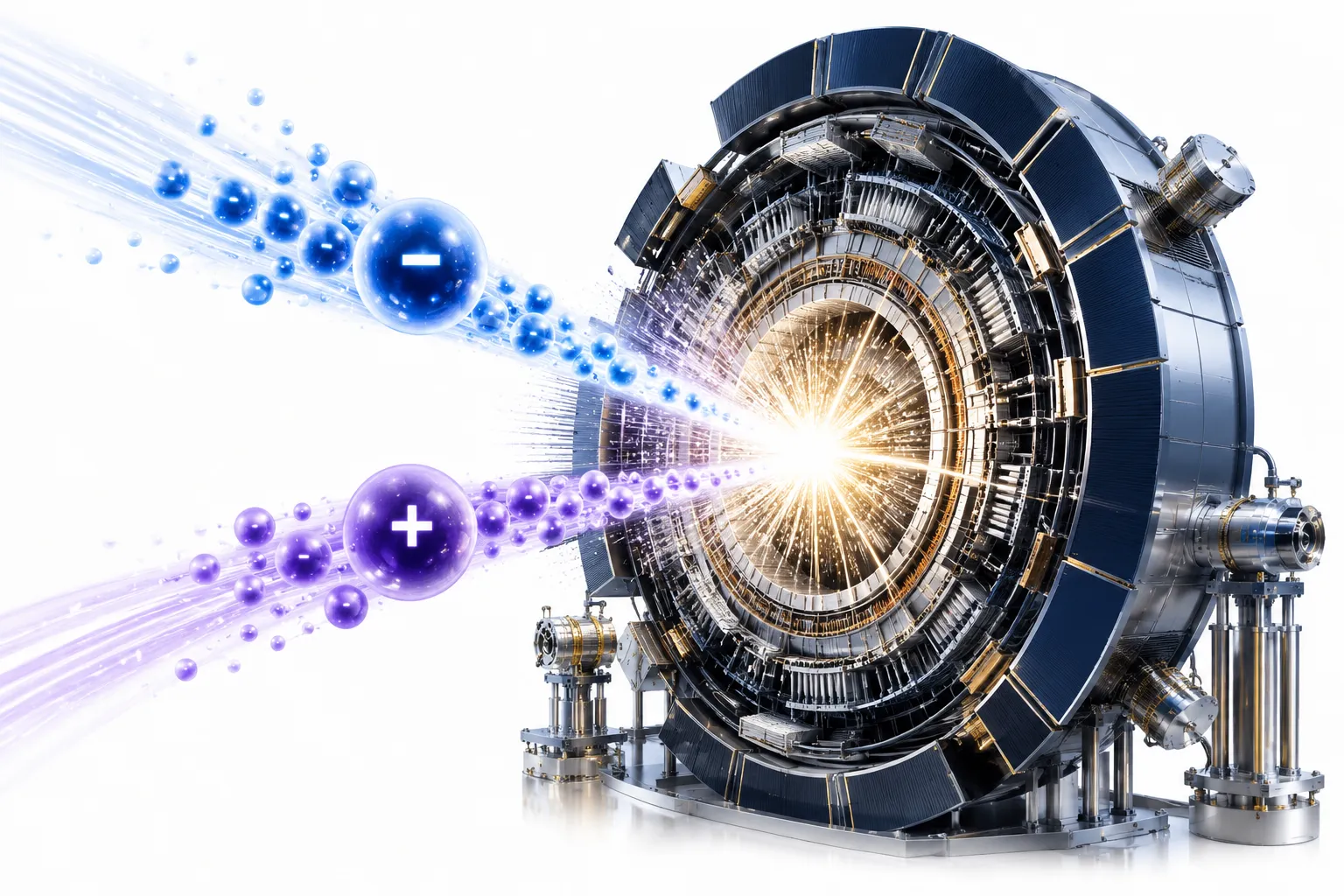
Facilities like CERN produce and trap antimatter specifically to study why the universe ended up with so much more matter than antimatter.

Why the matter-antimatter imbalance matters

Understanding why the universe favors matter over antimatter could reveal entirely new physics beyond the current Standard Model, potentially reshaping our understanding of the universe's earliest moments.

This question has driven decades of research and multi-billion-dollar experiments, since resolving it could fill in one of the largest remaining gaps in fundamental physics.

Worth noting

A mirror the universe mostly discarded

Antimatter is real, measurable, and even medically useful, but its scarcity across the universe remains one of physics' most persistent and fascinating puzzles. We are, in a sense, made of the leftovers from a cosmic tie that matter narrowly won.

Quick answers

Common questions

Has antimatter ever been used to harm anyone?

No — the amounts humans have ever produced are far too small and short-lived to pose any realistic danger outside tightly controlled laboratory conditions.

Physics

Related questions

They would annihilate completely, converting their entire combined mass into an enormous release of energy, far exceeding chemical or even nuclear reactions of the same mass.

The physicist whose equations demanded antimatter

Paul Dirac

A British theoretical physicist who, while working to reconcile quantum mechanics with relativity, arrived at equations that mathematically required the existence of a positively charged electron counterpart.

Where antimatter shows up in real research

Medical imaging

PET scans remain the most widespread practical application of antimatter, used daily in hospitals worldwide to detect cancer and monitor organ function.

Where antimatter shows up in real research

Fundamental physics research

Facilities like CERN produce and trap antimatter specifically to study why the universe ended up with so much more matter than antimatter.

Could antimatter be used as a weapon or fuel source soon?

Current production methods yield such minuscule amounts, at such enormous cost and energy input, that antimatter remains far from practical as fuel or weaponry with existing technology.

Current production methods yield such minuscule amounts, at such enormous cost and energy input, that antimatter remains far from practical as fuel or weaponry with existing technology.