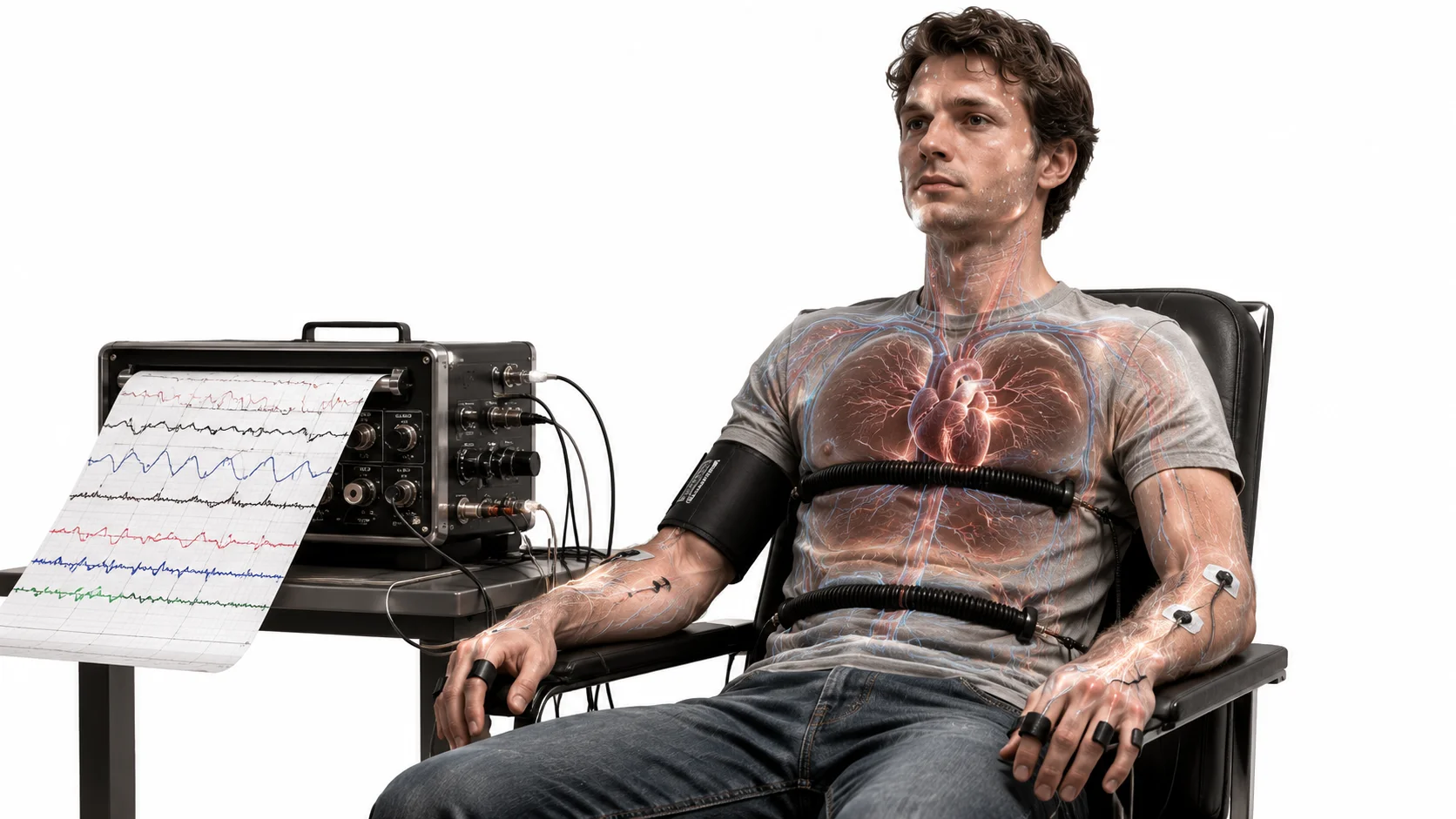
Visual answer
What a Polygraph Actually Measures
Four separate body signals are recorded simultaneously during a polygraph examination.
Breathing rate
Elastic bands placed around the chest and abdomen measure how quickly and deeply the person is breathing. Stress commonly causes breathing to become shallower or faster.
Heart rate and blood pressure
A blood pressure cuff monitors cardiovascular activity. Stress typically raises heart rate and blood pressure, sometimes sharply in response to specific questions.
Skin conductivity
Small sensors on the fingertips measure galvanic skin response, how much the skin conducts electricity. Sweating increases conductivity. Even tiny, invisible amounts of sweat are detectable.
Movement and muscle activity
Modern polygraphs may also include a seat pad or additional sensors that detect physical movement. Examiners watch for deliberate attempts to manipulate results through physical activity.
Introduction
A Lie Detector Does Not Actually Detect Lies. It Detects Stress.
Picture a nervous person sitting in a plain room. Bands are wrapped around their chest. A cuff squeezes their arm. Small sensors are clipped to their fingers. A machine quietly records every breath, every spike in heart rate, every bead of sweat.
But here is the problem. The machine has no way of knowing why any of those things are happening. It cannot read your mind. It cannot hear your thoughts. It only knows that your body is reacting.
So why do police forces, intelligence agencies, and employers around the world still use it? That is the question worth understanding.
What Is It?
What Is a Lie Detector?
A lie detector is almost always a polygraph. The word polygraph comes from Greek roots meaning many writings, because the device records multiple body signals at once onto a moving chart.
It is not a mind-reading machine. It has no way of accessing thoughts, intentions, or memories. It is a physiological recording tool, essentially a sophisticated stress monitor, that is then interpreted by a human examiner.
The interpretation is the critical step. The machine produces data. A trained examiner decides what that data means. That human element introduces both skill and subjectivity into the process.
How It Works
How Does a Lie Detector Test Work Step by Step?
Before the test begins, the examiner attaches sensors to the body. Elastic bands go around the chest and abdomen to track breathing. A blood pressure cuff goes on the arm. Small metal plates or clips attach to the fingertips to measure skin conductivity.
The examiner then asks a structured series of questions. These typically include neutral questions with obvious true answers, control questions that are mildly stressful but unrelated to the main issue, and relevant questions directly about the topic under investigation.
The key comparison is between how the person reacts to control questions versus relevant questions. If relevant questions produce consistently stronger physiological reactions than control questions, the examiner may interpret this as a sign of possible deception.
Importantly, no single reaction makes someone appear deceptive. The examiner looks at patterns across multiple signals and multiple questions before drawing any conclusions.
What It Measures
What Does a Polygraph Actually Measure?
Breathing rate
Elastic bands around the chest and abdomen record how fast and deeply you breathe. Stress often causes breathing to become faster, shallower, or irregular.
Heart rate
A cardiovascular monitor tracks heartbeats per minute. An elevated or suddenly changing heart rate in response to a specific question is considered a potential stress indicator.
Blood pressure
A cuff monitors blood pressure throughout the test. Stress activates the sympathetic nervous system which tends to raise blood pressure, sometimes sharply.
Skin conductivity
Sensors on the fingertips measure galvanic skin response. Stress triggers sweat glands even when no visible sweat appears. Moisture on the skin increases its ability to conduct electricity and the sensors detect this immediately.
Why Lying Triggers Stress
Why Can Lying Change the Body?
When most people lie, especially in high-stakes situations, the brain registers a threat. Not a physical threat, but a social and psychological one: the fear of being caught.
That fear activates the same stress system the body uses for genuine danger. Adrenaline is released. The heart beats faster. Breathing changes. Sweat glands activate. These are automatic reactions that happen largely outside conscious control.
This is the assumption that the polygraph rests on: lying produces stress, and stress produces measurable physical changes. The assumption is not unreasonable. Research does support a connection between deception and physiological arousal in many people.
The problem is that the connection is not exclusive to lying. The exact same stress response can be triggered by fear of being wrongly accused, anxiety about being in the room, memories of past trauma, or simply the pressure of being watched and judged.
Myth vs Reality
Does a Lie Detector Actually Detect Lies?
What people assume
The machine reads your body and knows when you are lying. A strong reaction means deception. A calm reaction means honesty.
What actually happens
The machine records physiological arousal. A strong reaction means the body is stressed. The examiner then interprets whether that stress pattern resembles deception.
The central weakness
A calm liar may produce little reaction and appear truthful. A frightened but honest person may produce strong reactions and appear deceptive. The machine cannot distinguish between these two scenarios.
What this means
The polygraph is a stress detector, not a lie detector. Its accuracy depends on the assumption that deception is the primary cause of physiological arousal in a given person during a given test.
Accuracy
How Accurate Is a Lie Detector Test?
Accuracy claims for polygraph testing vary widely depending on the study, the method used, the examiner's training, and the conditions of the test. There is no single agreed-upon accuracy figure.
In controlled laboratory settings with cooperative subjects and clear scenarios, some studies report accuracy rates above chance. In real-world conditions, where people are genuinely scared, where examiners vary in skill, and where the questions are more ambiguous, performance is harder to measure.
What researchers broadly agree on is that the polygraph is not 100 percent accurate, that it can produce both false positives and false negatives at a meaningful rate, and that it should not be treated as definitive proof of anything by itself.
The American Psychological Association has noted that the research on polygraph accuracy is limited and that claims of very high accuracy are not well supported by the available evidence.
When It Gets It Wrong
Can a Lie Detector Test Be Wrong?
False positive: truthful person appears deceptive
Causes include anxiety, fear of being wrongly accused, post-traumatic stress, a naturally nervous personality, an intimidating setting, or a prior negative association with the topic being discussed.
False negative: deceptive person appears truthful
Causes include a calm or controlled personality, practiced or habitual lying that no longer triggers strong stress responses, deliberate physical or mental countermeasures, or simply low emotional reactivity.
Examiner error
Because the final interpretation is made by a human, errors in question design, inconsistent scoring, or confirmation bias can also contribute to incorrect results.
Test conditions
Fatigue, medication, illness, or unusual psychological states on the day of the test can all affect physiological baselines and skew results in either direction.
Failing While Truthful
Can You Fail a Lie Detector Test While Telling the Truth?
Yes. This is not a rare edge case. It is a documented and acknowledged limitation of polygraph testing.
The body's stress response does not require deception to activate. If you are frightened of being wrongly accused, if the room feels threatening, if the questions touch on something personally painful, or if you are simply a person who reacts strongly to high-pressure situations, your physiological signals may look indistinguishable from those of someone who is lying.
This is why polygraph results, even when they suggest deception, should never be treated as absolute proof. A failed polygraph means the body showed a stress pattern that an examiner interpreted as possible deception. It does not mean the person lied.
Can You Beat It?
Can Someone Beat or Fool a Lie Detector?
This is one of the most searched questions about polygraph testing, and the answer is genuinely complicated.
Some researchers and former examinees have claimed that physical or mental countermeasures can disrupt polygraph results. These include things like deliberately altering breathing patterns, controlling mental focus, or trying to produce false reactions during control questions to mask reactions during relevant ones.
Examiners are trained specifically to look for countermeasure attempts and some polygraph setups include sensors designed to detect deliberate physical manipulation.
There is no guaranteed method for beating a polygraph that has been validated through rigorous research. Some people may pass tests they should fail, and some may fail tests they should pass, but this is largely unpredictable and attempting to game the test introduces its own risks.
In Court
Are Lie Detector Results Used in Court?
In many court systems, polygraph results are treated with significant caution or excluded entirely as evidence. The core reason is that their reliability is disputed and not sufficiently established to meet the standards required for scientific evidence in legal proceedings.
In the United States, federal courts generally exclude polygraph evidence. Some states allow it under specific conditions, typically when both parties agree to its use. Military courts have their own rules. The situation varies considerably by jurisdiction.
Internationally, rules differ even more widely. Some countries prohibit polygraph evidence entirely. Others allow it in limited circumstances. A very small number of legal systems give it more weight.
Even where polygraph results are technically admissible, they are rarely treated as conclusive proof. They tend to be considered alongside other evidence rather than as a standalone determination of guilt or innocence.
Police Use
Do Police Use Lie Detector Tests?
Police and investigators in many countries do use polygraph examinations, but typically as an investigative tool rather than as final proof of anything.
A polygraph may be used to help narrow down suspects, to guide the direction of questioning, or to assess whether a witness's account is consistent with a physiological stress pattern. It functions more like a lead-generation tool than a verdict.
A failed polygraph does not automatically prove guilt, and a passed polygraph does not automatically prove innocence. Investigators who use polygraphs responsibly treat the results as one data point among many, not as a definitive answer.
There have been notable cases where people who passed polygraphs were later found guilty, and cases where people who failed polygraphs were ultimately proven innocent. These cases illustrate exactly why the results require careful handling.
Apps and Online Tools
Are Lie Detector Apps or Online Lie Detectors Real?
No. Smartphone apps and browser-based lie detector tools cannot work like a real polygraph and should be treated as entertainment rather than truth detection.
A valid polygraph test requires calibrated physical sensors attached to the body, a controlled testing environment, a structured and validated question protocol, and a trained examiner who interprets results in context.
Apps that claim to detect lies through voice analysis, finger-on-screen contact, or camera-based readings have none of these components. They lack the sensors, the methodology, and the scientific validation needed to produce meaningful results.
They can be amusing as party tricks but treating their output as genuine information about whether someone is lying would be a serious mistake.
Why It's Controversial
Why Lie Detectors Remain Controversial
The entire polygraph rests on a single foundational assumption: that lying produces a detectably distinct stress pattern in the body. That assumption is not completely wrong, but it is far from airtight.
Stress does not belong only to liars. Innocent people panic. Honest people feel shame when asked about embarrassing topics. Trauma survivors react strongly to questions about difficult subjects. People with anxiety disorders may spike on every question.
Guilty people, meanwhile, are not always stressed. Some experienced deceivers feel no particular anxiety about lying. Some people genuinely believe their own distorted version of events and produce no stress reaction at all.
The machine is measuring something real. The controversy is about what that something actually means. When the stakes are high, like criminal cases, employment screening, or security clearances, getting this wrong has serious consequences for real people. That is why the polygraph, despite decades of use, remains a subject of genuine scientific and ethical debate.
Final Takeaway
The Real Way to Understand a Lie Detector
A lie detector is better understood as a stress-response machine. It records how your body reacts under pressure and during questioning. It can reveal physiological patterns that an experienced examiner associates with deception.
It cannot read the mind. It cannot access memories. It cannot prove that someone is telling the truth or lying. It measures the body, and the body responds to many things besides dishonesty.
Used carefully, by trained professionals, as one tool among many, a polygraph can be a useful investigative aid. Treated as a definitive truth machine, it becomes something much more dangerous: a device that can punish the innocent for being human and let the guilty walk free for being calm.
Quick answers
Common questions
How accurate is a lie detector test? +
There is no single agreed-upon accuracy figure. Studies vary widely depending on the method, examiner, and conditions. Polygraphs can perform better than random chance in controlled settings, but they are not reliable enough to be treated as definitive proof. False positives and false negatives both occur at meaningful rates.
Can a lie detector test be false? +
Yes. Both false positives and false negatives are documented. A truthful person can appear deceptive due to anxiety, fear, or trauma. A deceptive person can appear truthful if they are calm, practiced, or emotionally low-reactive. The test reflects physiological arousal, not truth or deception directly.
Can you fail a lie detector test and still be telling the truth? +
Yes. The body's stress response does not require lying to activate. Fear of being wrongly accused, anxiety about the setting, or emotional reactions to sensitive questions can all produce the same physical signals as deception. A failed polygraph means the body showed a stress pattern, not that the person lied.
Is there any way to beat a lie detector test? +
Some people claim that physical or mental techniques can disrupt results, but no method has been proven reliable through rigorous research. Examiners are trained to detect countermeasure attempts and some polygraph setups include sensors specifically designed to identify them. There is no guaranteed way to manipulate the outcome.
Can lie detector results be used in court? +
In many jurisdictions, polygraph results are restricted or excluded as evidence because their reliability is disputed. In the United States, federal courts generally do not admit them. Some states allow them under specific conditions. Rules vary significantly by country, jurisdiction, and court type.
Do lie detector tests actually work? +
They work as stress monitors. Whether they work as lie detectors depends on the assumption that deception is the primary cause of physiological arousal during a specific test, and that assumption does not always hold. They can provide useful investigative information but they cannot reliably prove guilt or innocence.
Is a polygraph the same as a lie detector? +
Yes, in common usage they refer to the same thing. A polygraph is the technical name for the device that records multiple physiological signals simultaneously. Lie detector is the popular name, though it is somewhat misleading since the machine does not detect lies directly.
Are lie detector apps real? +
No. Smartphone apps and online tools that claim to detect lies cannot replicate a real polygraph. They lack calibrated sensors, controlled testing conditions, validated questioning protocols, and trained examiners. They should be treated as entertainment only.
Can anxiety affect a lie detector test? +
Yes, significantly. Anxiety produces many of the same physiological signals that examiners associate with deception, including elevated heart rate, changes in breathing, and increased skin conductivity. A person with high general anxiety may show strong reactions throughout the test regardless of whether they are lying.
Do police use lie detector tests? +
Many police forces and investigative agencies use polygraph examinations as one investigative tool among many. They are typically used to guide questioning or assess consistency rather than as final proof. A failed polygraph does not prove guilt and a passed polygraph does not prove innocence.